
A chance exchange of words recently with a friend of mine gave me an interesting glimpse into the suspicion that the word “spirituality” brings into the minds of a few people. My friend asked me views on whether commercial success has made him arrogant and dismissive of “lesser” people. My response was that his character has remained the same even 20 years back and his success has not really changed him. I however added that while this is positive in one sense, this may also be viewed as negative since there has not been much visible growth (from a mental attitude perspective) in the long time span of 20 years. Since my friend knew my Adhyatmic orientation, he immediately shut the conversation and when I met him later, he told that he is very happy with the joys (or Moh-Maya) of the material world and would not like to explore any deeper dimension involved in spiritual growth. He was unwilling to engage in any further conversation of the topic and I also respected his state of mind and left this at that.
My assessment is that this friend possibly visualizes life in a binary perspective as below:
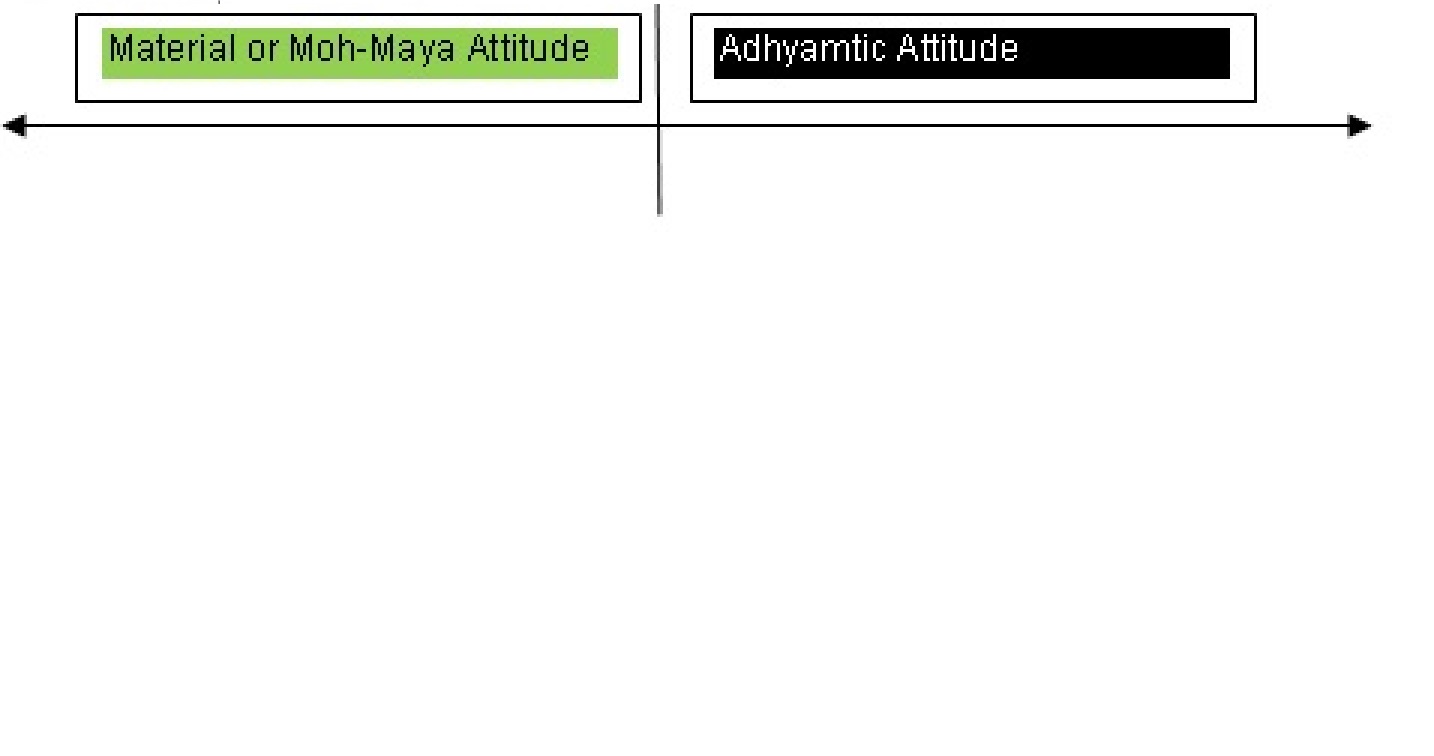
The panicky and strong reaction to a mere suggestion that further depth can be added to live life in the material world using Adhyatmic lens was not considered seriously. In fact, the decision to fully stop further conversation left me with the view that probably my good friend felt that bringing Adhyatmic lens into life will bring down the “material” quotient of his life which he was not willing to forgo at this point of time. If my assessment is true, I wonder where this thought process come from. What is our education system or surrounding environment doing that is making at least some people (if not many) to wear these binary spectacles that perceives Adhyatma as “other-worldly”. I can understand that this misconception may be possible in other countries but India being a land where Adhyatmic Gyan is being conveyed for thousands of years in various forms and multiple formats, this binary vision was never the message conveyed by the great saints and Gyanis of India. The danger of this mindset is obvious – whatever book gets classified as “Hinduism” or “Dharma” or “Vedic Vision”, many people will end up not studying these books their whole lives thinking that these books are possibly relevant only post conclusion of an active working life. This is however contrary to the ancient world view where knowledge from the scriptures were transmitted at a young age to enable to person to live the chaos of life in an informed manner. While few people took up Sanyasa, many Indians for hundreds of years were getting married and lived a happy married life as well as had successful work engagements before they took up a more comprehensive “give-up” attitude in the latter part of their lives. Adhyatma lens is an all encompassing perspective that is relevant for kids, young adults, middle age as well as old age. In fact, it was the intelligent Arjuna was who professing the “give-up” attitude in the Gita and Sri Krishna pushed him to fight the war by conveying the Adhyatma lens to him – despite this, the word Adhyatma seems to scare a few Indians quite literally!!!
It is not my skill or knowledge to comment on the reasons for why the educated Indians have or are becoming binary in their perspective to life. But this narrow vision appears to be rampant. When debates happen about national heroes, you either have people who hate Nehru (for example) or love Nehru. Each side picks up convenient arguments to describe the reasons why they hate or love Nehru and stick with these views during arguments. Similarly, the national discourse on Gandhi, capitalism vs Socialism, globalization vs localization, etc are throwing outcomes that seem to support one side strongly or the other. This confusion is passed on to the readers who equally develop these binary perspectives to life.
When I watch the characterization of Duryodhana or Shakuni on TV, they are shown as negative while Pandavas are shown as nice guys. When one reads the actual scriptures, one easily comes across multiple shades that are not reflected in the characterization. For example, when the Pandavas were undergoing their Vanvaas, Duryodhana apparently ruled the kingdom very well and the people in the kingdom were very satisfied with the king. Ravana similarly is shown as a villain though he is equally a great Shiv Bhakt and people even today recite the famous stuti of Shiva by Ravana viz Shiva Tandava Stotram. The ability to place all the activities of people on a Dharmic scale and thereby separate the positives from the negatives to thereby praise the positives while rejecting the negatives is the need of the day. This appears to have been lost altogether in modern Bharat.
Coming back to the difficulty faced by my good friend, how does one convey the need to inculcate Adhyatma perspective to life without making them feel that they are being forced to give-up the pursuits of their liking? My limited novice mind feels that for starters it may be good to convey a pictorial view to all Indians that may look as below (I am sure there are better approaches)

With the above, it becomes clearer that we may pursue the desire that appeals to us but we pursue these goals with a high intensity of Adhyatma. If such an action is indeed undertaken, the possibility of success is definitely higher than pursuing the goal without the Adhyatmic perspective.
This then begs the question – what is this Adhyatmic perspective or lens that we need to wear as we pursue our goals? Most Indian scriptures refer to Shad-Sampatti (meaning six attributes) that may be described as below. I have of course used the writings of Swami Ranganathananda on Vivekachudamani to express the following:
- Sama or calmness – The resting of the mind steadfastly into the goal of one’s choice after having detached oneself from the other divergences by continually observing the gaps in divergences is called Sama. One of therefore clear about one’s own goal if one is established in the state of Sama. Whatever alternative is thrown up, howsoever alluring this may be, one continues to remain calm in pursuit of his or her own goal.
- Dama or self-control – Turning our sense organs away from physical pursuits that take one away from the stated goal and keeping them focused on the pursuits of our stated goal is Dama. While Sama is therefore self-control with respect to one’s own mind, Dama is self-control with respect to one’s own sense organs.
- Uparati or self-withdrawal – This consists of the mind-function ceasing to be affected by external pursuits other than one’s own goal. Uparati is an indrawn state of mind where external objects cease to exert their influence on us.
To give a more practical example, if someone is interested in becoming the all India Badminton champion, Sama is a state where one is absolutely clear that this goal is indeed the only goal worth pursuing, Dama refers to ability of our body sense organs not to be excited by allurements other than success in badminton (like great food, movies, video games, etc) while Uparati refers to a state where one can easily withdraw from pursuit of other vocations (like ability to get up early in the morning even though sleeping for a longer time may be alluring at such time). All these three therefore ensure continuing focus on the objective of one’s life viz success in badminton.
4. Titiksha or forebearance or patience – The bearing of all afflictions without caring to redress them, being free (at the same time) from anxiety or lament on their score is Titiksha. More recently, the Milkha Singh movie showed the character continuing to participate in the 400m race despite leg severely injured on account of an attack by the opponent. Physical challenges must not be allowed to be used as an excuse to keep away from pursuit of one’s goal and this means that one must have the ability to bear pain for a longer time in pursuit of one’s interest. Heroic spirit is indeed necessary to persevere and this is Titiksha.
5. Sraddha or faith – Acceptance by firm judgement as true of what the scriptures and the Guru instruct is called as Sraddha. All of us have certain role models or teachers or even books that we may refer to in pursuit of our goals. Often, it so happens that contrary ideas are conveyed by the society where the teacher may be maligned or the ideas of our favourite book may be rubbished and this may make us lose confidence not only in our teacher but even our goal. One must therefore exercise a lot of discrimination or intelligence before one selects a teacher or a role model or a book but once this is chosen, one must remain fully committed to the teacher despite contrary ideas emanating from the society. This faith will be put to test many times but one must continue to repose faith and persevere in their teachings. This unflinching faith in both the goal as well as the medium to reach the goal is an obvious essential pre-requisite for success.
6. Samadhana or self-settledness – Not the mere indulgence of thought (in curiosity) but the constant concentration of the intellect (or the affirming faculty) on our ultimate goal is what is called as Samadhana. To quote the example given earlier, if one wants to achieve success in Badminton, one needs to think about Badminton, read about Badminton, write about Badminton, meet people who play Badminton, etc and be comfortable with pursuit of the goal of one’s choice in a state of self-settledness.
After reading the above, it is quite possible that someone may respond – so what is the big deal about the above? This is nothing else but elementary common sense and does one have to read about the so-called great Indian scriptures to know what is already known to us? This response misses the following two obvious points:
- We need constant reiteration of these principles in our day to day lives and most of the cases of lack of success arises primarily because these principles are not followed to the fullest. Constant reading of the scriptures therefore acts as a constant reminder of these principles and we can therefore swerve back into our area of focus with renewed vigour and inspiration. Mahabharata and Ramayana are nothing else but case studies of success (and failure) in the past and constant reading of these case studies can keep us focused.
- The confusion arising from binary thinking wherein we are today understanding Adhyatma as pursuit of Moksha only instead of understanding that these principles can be applied to our day to day goals also will get clarified. It will become clear that these principles are as relevant to our immediate goals as they are for pursuit of Jivanmukta status. In fact, Adhyatma perspective of life is not for weaklings but heroes only and will actually make us strong and committed and engaged with our lives instead of “give-up” attitude. Misconception involved in understanding Adhyatma as a “give-up” attitude will get cleared immediately and we can end up being heroes instead of living zero lives.
Of course, Adhyatma is a lot more than just “Shad-Sampatti”. Also, without presence of a Guru or Adhyatma oriented parents around, someone reading an Adhyatma scripture may try to implement the message meant for a person in a circumstance different from the reality relevant to this individual and thereby make errors of assessment that may end up being counter-productive (just like Arjuna was confused but while he had a Sri Krishna around, others may not be as lucky). Having said that, only if one engages in scriptural reading will such problems be relevant and in any case, this cannot be an excuse to not engage in scriptural reading at all and thereby keep away from acquiring an Adhyatmic lens.
A small and a simple change of perspective by bringing Adhyatma into our lives can thereby be expected to bring considerable depth into our lives. Richer lives can thus lead to a richer stock of experience that will benefit the individual as well as the society around such an individual. Finally, the rich knowledge traditions of India will continue to not just remain relevant but thrive and expand the knowledge and thereby continue to enrich the country as well as the world till eternity.
Om Tat Sat
 Adhyatma Writings