
संध्या वन्दनम् comes under नित्य कर्म. Detailed commentaries exist on the topic in संस्कृत. The following has been put together based on lectures on the topic available on Youtube – these were given by Swamiji Paramarthananda in English and Sri Shanmukha Saamaveda Sarma in Telugu. Those who are curious about this कर्म, would like to know more and those who are performing but are not aware of the meaning may read on. I must add that the lectures are far richer than what is being put in the blog here – that is the limitation of written text as well as my own limitation.
Who can do सन्ध्या?
Those who go through उपनयन संस्कार must do without fail. And those who do must perform the Karma by knowing its अर्थ. Even those who do not go through the उपनयन संस्कार must perform सन्ध्या as taught to them by their own गुरु. But for those who have neither gone through an उपनयन संस्कार or have access to a गुरु must some कार्य aligned to धर्म during the सन्ध्या times (viz three times of the day). Simply put, anyone doing भावना on the सूर्य and praying to the सूर्य with an understanding that सूर्य is akin to परमात्मा is doing सन्ध्या वन्दनम् – and therefore, all people aligned to वेद (whether undergone उपनयन संस्कार, received instructions from a गुरु or otherwise) must perform संध्या वन्दनम्.
For those who have gone through उपनयन संस्कार, सन्ध्या is performed differently as aligned to different वेद (ऋग्वेद, यजुर्वेद, etc) – while most of the कर्म is common, there are a few differences here and there. Further, from the day one goes through उपनयन संस्कार till the last day one lives, one must perform संध्या वन्दनम्. And why so? The benefit of performing this कर्म is not for one’s personal benefit only but also of the fellow people, country as well as environment. शास्त्र refers to four categories of people and these categories are referred to as वर्ण. A famous श्लोक is given below:
जन्मना जायते शूद्र: कर्मणा द्विज उच्यते | वेदपाठेन विप्रस्यात् ब्राह्मणो ब्रह्म वेदनात् ||
शूद्र means प्राकृत पुरुष:, one living according on one’s own nature and instinct. Life is not governed by any discipline for such a one – an unrefined life (स्वच्छन्दचारी – meaning life is run by whatever comes to the mind instinctively). Such a person is not a संस्कृत पुरुष. कर्म, on the other hand, refers to disciplined action, a cultured action. Life of a शूद्र is governed by राग and द्वेष. A द्विज, on the other hand is governed by विधि and निषेध. Such a one does कार्य or अकार्य as mandated by the शास्त्र. Being a द्विज is however not enough since even though one may follow the शास्त्र, one may not know the meaning or intent behind actions being undertaken by oneself. Eventually, such actions will not stand the test of time since they are not done with conviction. Actions with knowledge is that done by a विप्र – such a one’s disciplined actions become assimilated into one’s persona since these actions have become part of one’s own character. However, while कर्म by a विप्र are commendable, such a discipline however can become a shackle, a golden bond that keeps us glued to कर्म only rather than going beyond it. One who goes beyond कर्म is a ब्राह्मण. One is a ब्राह्मण by knowing the ultimate reality which is beyond धर्म & अधर्म. Our life is fulfilled when one reaches this state (note here that no where is there a reference to which family one in born into).
उपनयन begins when one reaches the state of द्विज and कर्म prescribed during उपनयन are continued even one reaches the stage of a विप्र. The stages of द्विज and विप्र differ from the state of a शूद्र to the extent that in the state of शूद्र, there is no prescription for taking on to any discipline while the stages of द्विज and विप्र mean one of taking on to the life of discipline. Formal ceremony is उपनयन where one is moved from first mother to second mother viz the वेद and in this state, the गुरु or आचार्य become the father. उपनयन संस्कार is akin to a purification ceremony before one takes on to the study of the वेद. The श्लोक that is relevant here is quoted below:
मातुर् अग्रेSधि जननम् द्वितीयम् मौञ्जि बन्धनात् | तत्रास्य माता गायत्री पिता तु आचार्य उच्यते ||
Our physical mother is our own first mother. Second birth happens during one’s उपनयन. And for this second birth, गायत्री becomes our mother while the गुरु or आचार्य becomes the father.
वेद prescribes a lifestyle involving three important factors. First, develop certain attitudes (भावना) (towards creation, parents, teachers, elders, etc). Second, develop values and virtues (गुण) to be followed (as per योगसूत्र, for example which points to cultivation of यम & नियम). Third is to engage with certain actions (कर्म) that must be performed regularly. There are five types of कर्म – नित्य (compulsory regular activity daily or monthly, once in four months, etc), नैमित्तिक (compulsory but conditional or occassional, e.g., during eclipses, etc), काम्य (actions to fulfill desires), निषिद्ध (prohibited actions) and प्रायश्चित्त कर्म (actions of atonement seeking forgiveness for committing a wrong actions – these are also seen as compensatory actions).
Our focus here is कर्म viz संध्यावन्दन कर्म. संध्यावन्दन is a नित्यकर्म. It varies from one’s वर्ण and वेद. What is taken up here in this write-up is one that relates to यजुर्वेद. What is the benefit of doing this कर्म?संध्यावन्दन कर्म are done only for अध्यात्म upliftment – they are not काम्यकर्म and therefore there is no benefit of a लौकिक kind for performance of this कर्म. It should be done with a निष्काम mindset. One will develop discipline, purity of mind, concentration of mind, expansion of mind, grace of the भगवान् – these are the benefits of the अध्यात्म kind. Having said that, as by-products of performing the संध्यावन्दन, one also attains a long life, health & prosperity and purity. One must however note that the ultimate purpose of संध्यावन्दन is मोक्ष.
Meaning of the word संध्यावन्दन
वन्दनम् means उपासना which also means meditation or discipline. संध्या derived from the word संधि which means junction or union. So संध्या refers to union-time – union between night and early morning/ forenoon, union between morning and afternoon and afternoon moving to night – dawn, noon and dusk. One may therefore see this time as the time of appointment with the भगवान् (junction time between a भक्त and भगवान्). This is also expressed as a junction time of जीवात्मा with परमात्मा. Three times a day, we are not supposed to do any other job and maintain any other relationship but only one viz the relationship with the भगवान् – no office, social or family work must be done at that time and instead, one must work with ईश्वर alone at that time. Do therefore something aligned to धर्म at these times. Chant श्लोक, visit temple or read some शास्त्र at this time.
संध्या is derived from the root द्यै ध्याने which means सम्यक् ध्यायति यस्मिन् काले स: काल: सन्ध्या – time for doing ध्यान –what does one achieve by doing ध्यान at this time? One attains संध्या देवी who is none else than परमात्मा. The following श्लोक gives a definition of संध्या as below:
उपास्ते संधिवेलायाम् निशाया दिवसस्य च तामेव संध्याम् तस्मात् प्रवदन्तु मनीषिण:
Any उपासना at the संधि काल viz the meeting point between night-time and day-time – such an उपासना कर्म is understood as संध्या कर्म. There is another श्लोक:
वाग्यतो गायत्री जप एव संध्या या संध्या सैव गायत्री
That मंत्र that is uttered by keeping निग्रह (or control) over one’s वाक्, such a मंत्र is referred to as संध्या.
Simply put, this means that गायत्री जप is not to be sung like a song that one enjoys and sings with gay abandon – instead, one controls all urges of singing to ensure that one does गायत्री जप in a controlled manner. And such an orientation qualifies the जप to be uttered during संध्या काल and such a जप is referred to as संध्या. Another श्लोक conveys this more clearly:
संध्या नाम अर्क बिम्ब अभिव्यक्ता आदित्य शब्दवाच्या: परब्रह्म रूपा चित् शक्ति: गायत्री प्रतिपाद्याः
What is getting व्यक्त from the solar disc and referred to as आदित्य is actually चैतन्य of परब्रह्म and such a चैतन्य is known as गायत्री.
It should become evident from this line that सूर्यबिम्ब is merely an आलम्बना (support) and the power that powers the सूर्य (viz परब्रह्म चैतन्य) is the गायत्री who we are trying to seek via this कर्म. We do not therefore worship सूर्य but सूर्य is seen as an आलम्बना to access something deeper viz गायत्री.
One point may be useful to make here. There is a difference between a नित्यकर्म like a पूजा and उपासना. A पूजा is primarily क्रिया-oriented (meaning focus is on doing specific कर्म as stated in the शास्त्र); however, an उपासना is भावना-oriented meaning the आलम्बना of सूर्य is taken and one does भावना that the परब्रह्म is innately present within सूर्य – and this requires भावना (or imagination) – this distinction between a पूजा क्रिया and उपासना कर्म must be clearly understood. संध्या वन्दनम् is an उपासना कर्म (and therefore more important कर्म to be performed than a पूजा).
This काल is described as a special काल by the वेद. There is a मंत्र in the वेद which says that just as a lover is extremely excited being around the partner, सूर्य too is most excited at the संध्या काल. This काल is also referred to as उषा काल as well as सर्व मङ्गल काल.
संध्या is also explained as the ईश्वर तेजस् (परम् ज्योति) present within the सूर्यमंडल. Doing उपासना using सूर्य as an आलम्बना is वन्दनम्. सम्यक् ध्यानम् इति संध्या – meaning that which is realized via ध्यान is संध्या. संध्या refers to भगवान् worshipped in feminine form. ब्रह्म with माया is ईश्वर is संध्या देवी. In this context, there is a श्लोक that may be quoted here:
या सन्ध्या सा जगत्सूति: मायातीता तु निष्कला | ऐश्वरी केवला शक्ति: तत्व त्रय समुद़्भव ||
This संध्या is the Lord or creator of the Universe. She is the controller unconditioned by माया. She is निष्कल – pure undivided ब्रह्म. She is ईश्वर स्वरूपिणी – she is in the form of शक्तिरूप. She is the source of गुणत्रय (viz सत्व, रजस् and तमस्).
What is the प्रमाण (or source or proof) of this ज्ञान on संध्या वन्दनम्?
Her उपासना (or पूजा) is advocated in both श्रुति and स्मृति – it is a श्रौतकर्म. And the मंत्र given in the श्रुति is – उद्यन्तम् अस्तम् यन्तम् आदित्यं अभिध्यायन् सकलम् भद्रम् अश्नुते
One must do ध्यान on the rising and the setting सूर्य and one who does this obtains all rounded auspiciousness (indicating धर्म, अर्थ, काम and मोक्ष).
Another मंत्र in the श्रुति is: अहरहः सन्ध्याम् उपासीत
One should do उपासना of संध्या daily.
In the स्मृति too, there are प्रमाण – one of the श्लोक is given here: संध्या त्रयं तु कर्तव्यम् द्विजेन आत्मविदा सदा
Every द्विज must perform संध्या three times daily
There is another श्लोक: यावत् ब्रहोपदेशस्तु तावत् संध्याधिकम् नहि | ततो मध्यान्न संध्यादि सर्वं कर्म समाचरे ||
Until उपनयन is undertaken, संध्या कर्म is not necessary but after उपनयन is completed, one must perform this कर्म three times.
When can संध्या वन्दनम् not be done?
One may encounter situations when one is unable to do the संध्या कर्म. These may be when the place where the person is staying may be going through a serious crisis, one is unwell, one is doing another significant क्रिया (like a यज्ञ) or if one is going through the one-year period following death in the family. And even if at such times, one may ask one’s family – father, brother, child, etc., or anyone close to perform संध्या on one’s own behalf to ensure that continuity of doing संध्या is not broken.
As for timings, referring to शास्त्रs, Sri Saamaveda Sarma Garu states that प्रात: संध्या done from 6am to 645am can be called as उत्तम संध्या, from 645 to 736am can be called as मध्यम संध्या and from 736am to 824am is called as अधम संध्या. As for मध्यान्न संध्या, the timing range has been specified as 10:48am to 1:12pm. If one is unable to undertake मध्यान्न संध्या for any reason at these timings, one may undertake मध्यान्न संध्या immediately after प्रात: संध्या – in effect, two संध्याs can be done successively and this is regarded as valid. Finally, सायं संध्या timing can be between 6pm to 736pm. If one is unable to complete the सायं संध्या by 712pm, one may take this up to 824pm by which time the कर्म should be completed. I have sourced the following table from the Internet which may be helpful guide know the exact timing for performance of the कर्म
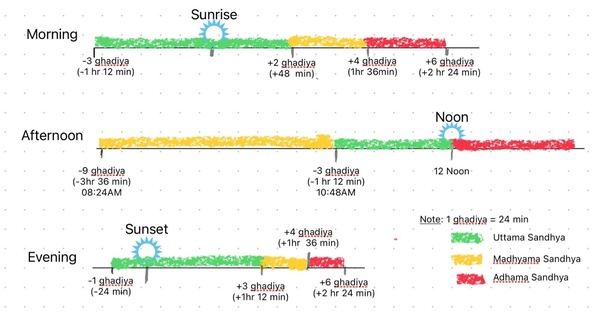
How do we do Her उपासना? And where do we do Her उपासना?
संध्यादेवी is worshipped as located in सवितृ (or सूर्य) मंडल – the solar orb or disc. On this disc, we invoke संध्यादेवी. It is संध्या worship on the सूर्य. Since Her उपासना is undertaken three times a day, each time, she is seen in three aspects.
| नाम | समय | अवस्था | वर्ण | स्वरूप | गुण | वाहन | कर्म | रूप |
| गायत्री | Dawn | कुमारी | लोहित (Red) | आनन्द | राजसी | हंस वाहन | सृष्टि कर्त्री | ब्रह्मा रूप |
| सावित्री | Noon | युवती | श्वेत (white) | सत् | तामसी | वृश वाहन | लय कर्त्री | रुद्र रूप |
| सरस्वती | Dusk | वृद्ध | श्यामला (Dark) | चित् | सात्विकी | तार्क्ष्य वाहन (गरूड) | स्थिति कर्त्री | विष्णु रूप |
With the above background, we can summarise with four key points:
- संध्या वन्दनम् कर्म must be performed three times in the day. This कर्म is an उपासना where the person performing कर्म takes सूर्य as an आलम्बना (support) and does भावना that the परब्रह्म or ईश्वर is innately present within सूर्य.
- Those who undergo उपनयन संस्कार are referred to as द्विज and they have to necessarily perform this कर्म till the last day of their life (since this is a promise made by them in front of अग्नि)
- Those others who do not undergo the संस्कार must also perform some धर्म कार्य three times a day (like chanting विष्णु सहस्रनाम , आदित्य हृदय, etc or visiting a temple or just thinking about ईश्वर).
- The benefit of performing this कर्म is not just for oneself but also one’s family, nation and environment.
In the next section, we will take up the study (or analysis) of the उपासना कर्म of the संध्या वन्दनम्.


Good write up on Sandhya
LikeLike