
उपनिषद् series
Commentary on the दशोपनिषद् will be given here. This series will begin with ईशोपनिषत् and end with बृहदारण्यक. Intent is to eventually take up study of ब्रह्मसूत्र (which as one knows, must only be taken after a proper study of the उपनिषद्s). Key points about this series are summarized below:
- Commentary here may be taken as study notes made by a novice. This may therefore be seen by those who would want to have an introductory reference to these texts.
- Style adopted is to provide the मंत्र from the उपनिषद् first followed by a word-to-word meaning provided along with the textual translation and lastly, a commentary has been provided to understand the मंत्र clearly.
- Reference is made to the authors named to put the commentary together: स्वामि गंभीरानंद, स्वामि चिन्मयानंद and स्वामि कृष्णानंद।
- As always, words like “God”, “gods”, “Supreme Being”, “Worship”, “Prayer”, “Thee”, “Thy”, “Subtle Body”, “Gross Body”, etc., have been avoided and the original संस्कृत words (or simpler language) has been used within the commentary to ensure that the readers connect with the ideas more easily. To elaborate on this, we often find that in many of the existing translations, both the words “पूजा” and “उपासना” are translated as “worship”, the words “ध्यान” and “उपासना” are translated as “meditation”, etc. We believe that each of the words in our texts has a certain मर्यादा and translating these often causes the reader the lose the real meaning behind use of these words. Even the translation of the word “देवता” as ‘god’ does a huge dis-service to the depth of the word in the relevant context – attempt has therefore been made to ensure that while the translation is in English, the technical terms are being retained in original संस्कृत so that possibility of connecting with a distorted meaning is minimized.
- Overall, the intent is to help साधकs to have a quick reference point to the उपनिषद्s – following this, they can refer to the more detailed commentaries for a much more detailed understanding of the मंत्रs.
Hope this effort is beneficial to all – ॐ तत् सत्
ईशोपनिषत्
part of
वाजनसेय संहिता of शुक्ल यजुर्वेद
ॐ पूर्णमदः पूर्णमिदं पूर्णात् पूर्णमुदच्यते । पूर्णस्य पूर्णमादाय पूर्णमेवावशिष्यते ॥
ॐ शान्तिः शान्तिः शान्तिः ॥
| ॐ पूर्णम् – Whole, completeness, अदः – that, पूर्णम् इदम्– this, पूर्णात् – from पूर्णम्, पूर्णम्, उदच्यते – becomes manifest, पूर्णस्य – from पूर्णम्, पूर्णम्, आदाय – is negated, पूर्णम्, एव – alone, अवशिष्यते – remains, ॐ शान्तिः – calm, serenity, peace, शान्तिः, शान्तिः, | That is Whole, this is Whole, from the Whole, Whole becomes manifest, from the Whole, when the Whole is negated, what remains is again the Whole. |
व्याख्या: This is a शांति मंत्र before taking up the उपनिषद्. What does पूर्णम् mean? पूर्णम् refers to that which is not bound by any limit – it is infinite. The परमात्मा is the infinite. The Universe has come from पूर्णम्. Let us take space. Space is everywhere in the Universe. There is no place in the universe where space does not exist. And if we take away space from space or add space to space, space continues to exist in its पूर्णस्थिति only (there can be no addition or reduction to space). And given that space is just a सूक्ष्म (subtle) manifestation of परमात्मा within the Universe, we can comprehend the idea of परमात्मा from the above मंत्र.
Thisमंत्र is from the बृहदारण्यक उपनिषद् and forms the मंगलाचरण for this ईशावास्य उपनिषद्. All वेद have four divisions – संहिता, ब्राह्मण, आरण्यक and उपनिषद्. ईशावास्य उपनिषद् is placed in the 40th chapter, शुक्ल यजुर्वेद at the end of the संहिता and therefore, referred to as मंत्रोपनिषद (however, if an उपनिषद् is placed after the ब्राह्मण, it is called as ब्रह्मोपनिषद)।
The terms अदः and इदम् have often occurred in कठोपनिषद् also. अदः means the cause from which the effect comes. इदम् means that which is manifest and here it means जगत् viz the world. The विषय (objects) of the इन्द्रिय are spoken of as इदम्. That which is beyond the इन्द्रिय s is अदः. As the cause is, so is the effect. The effect exists within the cause in an अव्यक्त (unmanifested) form. In the seed, the tree is not seen, but it is in an अव्यक्त स्थिति. And since the cause, viz the परमात्मा is infinite, the Universe that has come from this cause is also infinite, even though it appears to be perceivable to the senses. The उपनिषद् will convey this later. Last, आदि शंकर adds here that the purpose of this मंत्र (and this उपनिषद्) is to remove the natural ignorance about the self (as being a person born in a certain family, free from defects and capable of achieving everything via कर्म) – and produce knowledge of the oneness of the Self, which is a means of uprooting दु:ख, मोह, etc., relevant for mundane existence.
॥ अथ ईशोपनिषत् ॥
ॐ ईशा वास्यमिदꣳ सर्वं यत्किञ्च जगत्यां जगत् । तेन त्यक्तेन भुञ्जीथा मा गृधः कस्यस्विद्धनम् ॥ १॥
| ईशावास्यम् – indwelling or clothing of भगवान्., इदम् – this, सर्वं – everything/ all, यत् किम् च – whatever, जगत्यां – in the जगत् or universe, जगत् – the (moving) universe, तेन – by (परमात्मा), त्यक्तेन – by giving up, by abandoning, by that which is left, भुञ्जीथा – (you) may enjoy, मा – do not, गृधः – covet/ seek, कस्य स्विद् – whose, anybody’s, धनम् – wealth | All this, whatsoever moves in this जगत्, including the जगत् which is itself moving, is indwelt or pervaded or enveloped or clothed by परमात्मा. Give up that जगत्, (and) enjoy. Do not covet anyone’s wealth. |
व्याख्या: The उपनिषद् begins with the word, ईशावास्यम्, and hence carries that name.
Three aspects are conveyed in this मंत्र – 1) सत्ता of परमात्मा, 2) स्वरूप of जगत् and 3) कर्तव्य of जीव. How so? Let us elaborate.
- ईशावास्यम् may be seen as ईशा+आवास्यम or ईशा+वास्यम with the former meaning “that which envelops जगत्” while the latter means “fit for ईश्वर to reside in or stay-in”. We have stated earlier that इदम् means जगत् viz the world. All “this” (seen or unseen, gross or subtle, effect or cause, sentient or insentient) is covered by or enveloped with ईश्वर. ईश्वर is the आत्मा of all beings, and, as such, rules all. ईश्वर is the one who is the Supreme Ruler and, as the indwelling being within all, is Supreme आत्मा of all. ईश्वर thus exists as the सत्ता (power, authority, existence principle).
- “All this” refers to जगत् that can be seen and experienced and परमात्मा is the आत्मा of the entire जगत् that is moving. “Whatever is moving” is a reference to apparent द्वंद्व (duality), the effect of अज्ञान, which is characterized by ideas such as कर्तृत्व (doer-ship), भोगत्व (enjoyer-ship), etc (since this involves separation of objects from the परमात्मा that are to be worked upon, enjoyed, etc., while nothing can be separated from परमात्मा). ईश्वर exists in all – it exists in the insentient where तमस् is greatly predominant, it exists in the sentient where it possesses both सत्ता & चैतन्य while only a little आनन्द is present in them – there is a predominance of रजस् and तमस् in both man and animals (although तमस् may be a little less in a man as against animals). For a man, when रजस् and तमस् are destroyed, सत् rises up and only then, आनन्द is experienced, for सत् is आनन्द.
- Contemplate on the परमात्मा and abandon all the bundle of modifications known by नाम, रूप and कर्म – that is the message here. Thus, when the call for “abandon wealth” is made, “wealth” here is not limited to money, but includes all desirable possessions, wealth of any kind which gives us joy and pleasure. Whatever is given by ईश्वर may be enjoyed – noting that we have a right to enjoying the objects granted to us but ownership of all objects rests with ईश्वर only (and not with any of us). Why so? ईश्वर is the inner essence in all objects but is not in contact with the objects. And at the level of परम सत्ता, there is परम आनन्द. Therefore, to the extent the परम सत्ता is activated with us, proportional is the existence of आनन्द within us. Therefore, when one does त्याग of the objects, one is enhancing the quantum of परम सत्ता within – which enhances the सत्व आनन्द of the kind that is enjoyed by ऋषि’s or भक्त’s. One may also understand the message here that when one attains to the ईश्वर स्थिति, all of ईश्वर’s property, viz the जगत् will automatically be earned by default – so, giving up limited wealth and moving towards ईश्वर is the obvious route that one must take.
कुर्वन्नेवेह कर्माणि जिजीविषेच्छतꣳ समाः । एवं त्वयि नान्यथेतोऽस्ति न कर्म लिप्यते नरे ॥ २॥
| कुर्वन् – performing, एव – alone, इह – here (in this world), कर्माणि – work, deeds, actions, जिजीविषेत् – should desire to live, शतꣳ – a hundred, समाः – years, एवं – thus, त्वयि – while you are, न – not, अन्यथा – otherwise, इत: – than this, अस्ति – is, न – not, कर्म – deed/ action, लिप्यते – is attached, नरे – in the man | Performing work in this जगत्, one should desire to live for a hundred years. This alone is right, for there is no other right path. कर्म (action) never clings to a person following this path. |
व्याख्या: Thisमंत्र is conveying the कर्म सिद्धांत. What is our कर्म? Our कर्म is to act for ईश्वर as its agent and not to act for our own self as an individual, a personality. If we should dwell on, meditate upon, and run towards ईश्वर and towards ईश्वर alone, we must do our कर्म also as an offering to ईश्वर. Says आदि शंकर – if one desires to live for a hundred years and identifies oneself as having a human personality, one may do so by performing कर्म is that aligned to the शस्त्र – if one does so, one is living the life of शस्त्र (as against pursing कर्म that is prompted by one’s own अहंकार); and therefore, one does not acquire कर्म (that binds us) by living such a long life. कर्म liberates you when you base all your actions in ईश्वर. So, dedicate them to ईश्वर. And कर्म un-associated with individuality and associated with ईश्वर is liberating कर्म. कर्म associated with one’s individual personality and un-associated with ईश्वर is binding कर्म.
आदि शंकर adds that this मंत्र may not be seen as a contradiction to the earlier मंत्र which pushes one to त्याग – there are two paths established by the वेद – one asks for doing कर्म while the other talks about त्याग – and one may therefore ask – which one is true? Both are – as we will see the details being elaborated in the later मंत्रs. The first two मंत्र are referred to as the मूल मंत्र of the entire उपनिषद् and the succeeding मंत्र are an exposition of the wisdom conveyed already in the first two मंत्रs.
असुर्या नाम ते लोका अन्धेन तमसाऽऽवृताः । ताꣳस्ते प्रेत्याभिगच्छन्ति ये के चात्महनो जनाः ॥ ३॥
| असुर्या – असुर, नाम – really, ते – those, लोका – लोक or people, अन्धेन तमसा – by blinding darkness or तमस्. आवृता – covered, ताꣳ – to those, ते – they, प्रेत्य – after death, अभिगच्छन्ति – go to, ये के च – whosoever, आत्म हन: – killers of the आत्मा, जनाः – people | असुरी are those लोक and enveloped in blinding darkness to which all those people, who kill their own आत्मा go, departing from here. |
व्याख्या: Who is exactly as असुर? One meaning assigned is that it is a place where there is no light – and darkness can be of two kinds – one is physical caused by elements of प्रकृति while the other is आध्यात्मिक (which relates to absence of ज्ञान of one’s own आत्मा). To live a life without ईश्वर चेतना is to live a life of darkness. श्रीकृष्ण also conveys about असुर लोक as below:
या निशा सर्वभूतानां तस्यां जागर्तिसंयमी। यस्यां जाग्रति भूतानि सा निशापश्यतो मुनेः ॥२.६९॥
In that (तस्याम्) which (या) is night (निशा) for all beings (सर्वभूतानाम्), the one who is wise, who has mastery over oneself (संयमी), is awake (जागर्ति). That (सा), in which (यस्याम्) beings (भूतानि) are awake (जाग्रति), is night (निशा) for the wise (मुनेः) one who sees (पश्यतः).
Thus, the ordinary people filled with अज्ञान are referred to as killers of आत्मा who live in darkness. Why so? Owing to अज्ञान, the knowledge of the real nature of आत्मा remains concealed from such persons. The experience of आत्मा as free from decay and death that comes as a result of realization existence of आत्मा remains concealed from such persons – and this state is similar to the चेतना of persons who have already died. And because of the very fault of slaying the आत्मा, they are subject to birth & death.
So long as we are unaware of the आत्मा and are present far from ईश्वर, we will remain in darkness, for we are then under the force of the power of the इंद्रिय and the mind forgets the आत्मा. For, to be under the sway of the इंद्रिय is the same as forgetting the आत्मा. So long as the mind is supported by the इंद्रिय, only the objective world alone appears as real. The आत्मा cannot rest peacefully in any limited time or space; and this is an unalterable fact and a psychological truth. When the mind loves an object, it does not consider it to be different from the आत्मा and considers the object as part of itself. The object being identified with the आत्मा, when this loved object is lost, there is a feeling of having lost a part of one’s very आत्मा. One feels as though a limb of the body is cut off because one feels, I am the object, and what happens to the object happens to myself. To thus live in a world of wrong identification is to live in the world of objects, or the असुर लोक. To live in the world of objects is the characteristic of संसार. And this is our present condition. To consider objects as outside us is to bind ourselves to them and we exert ourselves to pull them towards ourselves. This is संसार. How can objects be identified with the आत्मा? This can never be. This is why we live in असुर लोक, the world of darkness. We think we are in the bright daylight of the sun. But this daylight is but a kind of spiritual darkness.
अनेजदेकं मनसो जवीयो नैनद्देवा आप्नुवन्पूर्वमर्षत् । तद्धावतोऽन्यानत्येति तिष्ठत्तस्मिन्नपो मातरिश्वा दधाति ॥ ४॥
तदेजति तन्नैजति तद्दूरे तद्वन्तिके । तदन्तरस्य सर्वस्य तदुसर्वस्यास्य बाह्यतः ॥ ५॥
| अनेजत् – unmoving, एकं – one, मनस: – than the mind, जवीयो – swifter, न – not एनत् – this, देवा – देवता, आप्नुवन् – reached, पूर्वम् – before, अर्षत् – ran, तत् – it, धावत: – running, अन्यान् – others, अत्येति – overtakes, तिष्ठत् – staying, तस्मिन् – in it, अप: – activities, मातरिश्वा – wind, दधाति – supports or allots | The आत्मा is the motionless one, swifter than the mind. The देवता (इंद्रिय or हिरण्यगर्भ) could not overtake. It runs before them. Sitting. It goes faster than those who run after it. By It, air supports the activities of all living beings. |
| तत् – IT, एजति – moves, तत् – IT, न एजति – not moves, तत् – IT, दूरे – far, तत् – IT, अन्तिके – near, तत् – IT, अन्त: – inside, अस्य – of this, सर्वस्य – all, तत् – IT, उ – verily, सर्वस्य – all, अस्य – of this, बाह्यतः – outside | The आत्मा moves and It moves not; it is far and It is near, It is within all this and It is also outside of all this. |
व्याख्या: Meaning of आत्मा is being conveyed here using seemingly contradictory expressions. आत्मा is expressed as being motionless; while stating immediately that it moves faster than the mind. Let us take space again – it is everywhere. But if we take a pot in front of us, we may use the expression “pot space” and say that “pot space is in the pot” – but is space really inside the pot? Or is there no space inside the pot? Essentially, if one looks at आत्मा as unconditioned (infinite, निर्गुण state, etc), in that state, it is un-moving. However, when आत्मा takes a specific state as being a mind, then it takes up the role of a conditioned entity – and a conditioned entity will think in terms of the self-imposed limitations. Therefore, in an unconditioned state, आत्मा is not moving (just as space cannot move since it is everywhere), however in a conditioned state, we will say that आत्मा moves faster than the mind (since whenever mind thinks of something and goes to such a space, आत्मा is already present at such a place). One may remember the story of गणेश and कार्तिकेय where when asked to travel the word, गणेश just circles around शिव & उमा while कार्तिकेय flies away on a peacock across the universe – but wherever कार्तिकेय used to go in the Universe, गणेश was already present at such a location. This story is conveying that when बुद्धि circles around or identifies with आत्मा, it acquires the characteristics or traits of the आत्मा – and thus is present everywhere.
At a पिंडण्ड level (meaning within the body or microcosm), देवता refers to इंद्रिय which may be taken to include the mind too. इंद्रिय within the body engage with the object for experience but when they reach the object, चैतन्य is already present within the object too thereby facilitating अनुभव (experience). This is so because आत्मा pervades all. While देवs are running to reach their destination, the आत्मा sitting and without motion or any effort, reaches there, for आत्मा is already there. At the ब्रह्माण्ड level too (macrocosm), हिरण्यगर्भ is the creator, the सृष्टिकर्ता, the महत् तत्व (or the Ego principle) which is the foundation which keeps everything in its place and does all work in the पिंडण्ड as well as in the ब्रह्माण्ड. महत् तत्व is like the Central Government working in the Local Government. If the former is weak, the latter also is weak. A strong Central Government is the cause behind a strong Local Government. The महत् तत्व stands apart in majestic aloofness. It does not speak and appears to do nothing and yet It is responsible for doer-ship in all. All this is the great Inner Controller’s grand work. Never forget this— ईश्वर’s सत्ता or Existence and क्रिया (or action) are one. In the case of man, existence and action are two different things. Based on existence and action of ईश्वर alone, everything in creation exists and works: for, such is ईश्वर.
ईश्वर is the innermost existence, the wonder of wonders. ईश्वर acts and is at the same time actionless. ईश्वर moves and yet moves not. ईश्वर is inside and outside. One may ask – does सूर्य give light or spread its rays or is it that wherever सूर्य is present, light is always present and sunrays keep spreading out – सूर्य is not doing anything but in its presence, everything happens. All these contradictions are reconciled in ईश्वर. All that is good and all that is bad, ugly and beautiful, everything looks resplendent in ईश्वर. In ईश्वर, there is nothing contradictory and there is no argument or quarrel. Everything is beautiful. Nothing dies; everything is eternal. It is near and It is at the same time far also. All contradictory factors, let us repeat, lie in unison in ईश्वर. It is a synthesis of all thesis and anti-thesis. It is within and outside and everywhere. Who can understand this! Unless all contradictions are merged into unison no one can know it. It moves and moves not. From the empirical point of view, it is said that It moves and It does not move. In the transcendental sense, none of these verbs that It is inside, It is outside, It is near and far away, can apply to that ईश्वर.
यस्तुसर्वाणि भूतान्यात्मन्येवानुपश्यति । सर्वभूतेषुचात्मानं ततोन विजुगुप्सते॥ ६॥
| य: – who, तु – however, सर्वाणि – all, भूतानि – beings, आत्मनि – within the आत्मा, एव – alone, अनुपश्यति – constantly sees, सर्वभूतेषु – in all beings, च – and, आत्मानं – आत्मा, तत: – then, न – not, विजुगुप्सते – shrinks/ feels hatred | He who constantly sees everywhere all existence in the आत्मा and the आत्मा in all beings and forms, thereafter, feels no hatred for anything. |
व्याख्या: One who seeks to attain मुक्ति sees all beings, from the unmanifested ending with the immobile aspects of the Universe as existing within the आत्मा – such a person does not see anything as different from the आत्मा. Says श्रीकृष्ण in the श्रीमद्भगवद्गीता as below echoing the same expression as this उपनिषद्:
विद्याविनयसम्पन्ने ब्राह्मणे गवि हस्तिनि । शुनिचैव श्वपाके च पण्डिताः समदर्शिनः ॥५.१८॥
Wise people (पण्डिताः) are indeed (एव) those who see the same (ब्रह्म) (समदर्शिनः) in a ब्राह्मण who is endowed with विद्या & विनय (विद्याविनयसम्पन्ने), in a cow (गवि), in an elephant (हस्तिनि), in a dog (शुनि) and (च) (even) in a dog-eater (श्वपाके).
Says आदि शंकर about the vision of a ज्ञानी – “Just as I, the आत्मा of the body, which is an aggregate of causes and effects, am the witness of all perceptions, and as such, I am the source of its consciousness, am pure and attribute-less, similarly, in that very aspect of mine, am I the आत्मा of all, beginning from the Unmanifested and ending with the immobile, – one who realizes the unconditioned आत्मा in all beings thus, by virtue of that दृष्टि, feels no hatred towards anyone.
यस्मिन्सर्वाणि भूतान्यात्मैवाभूद्विजानतः । तत्र को मोहः कः शोक एकत्वमनुपश्यतः ॥ ७॥
| यस्मिन् – in whom, सर्वाणि – all, भूतानि – beings, आत्मा, एव – alone, अभूत् – have become, विजानतः – knowing, तत्र – these, क: – what, मोहः – delusion, कः – what, शोक – sorrow, एकत्वम् – oneness, अनुपश्यतः – while constantly seeing | When, to the knower, all beings have become one in his own आत्मा, how shall such a knower feel deluded thereafter? What grief can there be to such a one who sees oneness everywhere? |
व्याख्या: Says आदि शंकर – Sorrow and delusion come to the ignorant man who does not perceive the seed of काम and कर्म (meaning one who is not aware of the outcome of one’s engagements in the world – whether arising on account of काम or any other ego-triggered कर्म), but not who operates in the mode of अनुपश्यतः एकत्वम्, i.e., the one who realizes the absolute oneness of the आत्मा, which is like that of space. This मंत्र indicates what the आत्मा that was spoken of in the previous मंत्र, really is, in Its own स्वरूप.
स पर्यगाच्छुक्रमकायमव्रण-मस्नाविरꣳ शुद्धमपापविद्धम् ।
कविर्मनीषी परिभूः स्वयम्भू-र्याथातथ्यतोऽर्थान् व्यदधाच्छाश्वतीभ्यः समाभ्यः ॥ ८॥
| स: – that person, पर्यगात् – all-pervading, शुक्रम् – bright, अकायम् – bodiless, अव्रणम् – without wound, scatheless, अस्नाविरꣳ – without muscles, शुद्धम् – pure, अपाप विद्धम् – un-pierced by पाप (कर्म), कवि: – wise, मनीषी – omniscient, परिभूः – transcendent, स्वयम्भू: – self-existing, यथा-तथ्यत: – respectively, अर्थान् – functions, duties, goals, व्यदधात् – allotted, शाश्वतीभ्यः – eternal, समाभ्यः – for years to come (means प्रजापति here) | That one (that आत्मा) is all-pervading, bright, bodiless, without wounds, without muscles, pure, unpierced by पाप, wise, omniscient, transcendent and self-existing. It (आत्मा) alone allotted their respective duties to the various eternal years (प्रजापतिs or creators). |
व्याख्या: By use of words that आत्मा is शुक्रम् (bright), उपनिषद् is stating that आत्मा is चैतन्य (consciousness). By use of words that आत्मा is अकायम् (bodiless), उपनिषद् is stating that आत्मा does not have a सूक्ष्म शरीर. By use of words that आत्मा is अव्रणम् (without wound, scatheless) and अस्नाविरꣳ (without muscles), उपनिषद् is stating that आत्मा does not have a स्थूल शरीर. And by use of the word शुद्धम् (pure), it is stated that आत्मा does not have a कारण शरीर. कवि: indicates that the आत्मा is a द्रष्टा, the seer of Truth (सत्) – आत्मा is the only one that sees. मनीषी means ruler of the mind, आत्मा is one who exists above all (and thus transcendent); further, such an existence is not a dependent existence since it is a स्वयम्भू: (self-existent). Last, आत्मा is the one who has allotted duties in a proper way (as per their individual कर्म or संस्कार) to the various प्रजापतिs or creators of the Universe.
अन्धं तम: प्रविशन्ति येsविद्यामुपासते | ततो भूय इव ते तमो य उ विद्यायाꣳ रता: ॥ ९॥
अन्यदेवाहुर्विद्ययाऽन्यदाहुरविद्यया । इति शुश्रुम धीराणां ये नस्तद्विचचक्षिरे ॥ १०॥
विद्यां चाविद्यां च यस्तद्वेदोभयꣳ सह । अविद्यया मृत्युं तीर्त्वा विद्ययाऽमृतमश्नुते ॥ ११॥
| अन्धं – blinding, तमः – darkness, प्रविशन्ति – enters, ये – who, अविद्याम् – अविद्या, उपासते – doing उपासना, तत: – than that, भूय – greater, इव – as though, ते – they, तमो – darkness, य – who, उ – surely/ verily, विद्यायाꣳ – in विद्या, रताः – devoted, engaged in | They who do उपासना in अविद्या alone enter into blinding darkness, and they who do उपासना in विद्या surely fall, as though, into a greater darkness. |
| अन्यत् – different, एव – definitely, आहु: – (they) say, विद्यया – by विद्या, अन्यत् – different, आहु: – (they) say, अविद्यया – by अविद्या, इति – thus, शुश्रुम – (we) have heard, धीराणां – of the wise, ये – who, न: – to us, तत् – that, विचचक्षिरे – explained | One thing, they say is that by विद्या, a really different result (is achieved) and by अविद्या, another different result (is achieved), thus, we have heard from the wise who explained that to us |
| विद्यां, च, अविद्यां, च, य: – who, तत् – that, वेद – known, उभयꣳ – both, सह – together, अविद्यया – by अविद्या, मृत्युं – death, तीर्त्वा – crossing, विद्यया – by विद्या, अमृतम् – eternality, अश्नुते – enjoys/ obtains | One who knows at the same time both विद्या and अविद्या, overcomes death by अविद्या and obtains eternality by विद्या |
व्याख्या: These मंत्रs are slightly difficult and will require some explanation and attention of the reader.
Having conveyed on what आत्मा (or ईश्वर) stands for in the previous two मंत्र, the उपनिषद् provides brings up an interesting question – what lifestyle must one take on to to attain (or regain connect with) the आत्मा state of existence? In the वेद (the संहिता part), two lifestyles are expressed – lifestyle of अविद्या and lifestyle of विद्या. साधकs are encouraged in a few मंत्र to undertake lifestyle of अविद्या with the benefit conveyed as attaining to a particular लोक (गंधर्व लोक, पितृ लोक, इंद्र लोक, etc). At other places, lifestyle of विद्या is encouraged (ध्यान on देवता and various उपासनाs – on सूर्य, चंद्र, वायु, etc) – with the benefit of attaining the स्थिति of such a particular देवता if ध्यान is undertaken appropriately. Which one will enable a साधक to attain the आत्मा स्थिति? Note that आत्मा स्थिति is a ज्ञान स्थिति (and not a लोक of a certain kind, say स्वर्ग).
This मंत्र is making an interesting point – it is not a choice to be made. One who only takes on to कर्म will certainly obtain darkness as an outcome – since this is being done without any ज्ञान and performed mechanically as conveyed in the शस्त्र. And therefore, the outcome of कर्म will not lead to ज्ञान and keep one glued to संसार. But what about the path of विद्या? Here, one does study of the देवता and undertakes ध्यान of such a देवता as instructed by the शस्त्र – why should this then also be expressed as a path of darkness?
Here is where one needs to understand three types of विद्या (knowledge) – 1) प्रातिभासिक, 2) व्यावहारिक and 3) पारमार्थिक. प्रातिभासिक means illusory knowledge where there is a perception of an object before us (like in a dream) though there is nothing really, since it is illusory. Such knowledge arises or get projected from वासना present within us and gets extinguished when one wakes up. व्यावहारिक refers to such a knowledge used by the इंद्रिय and मनस् to survive in the world – so we perceive objects, living or non-living and engage with them in such a way that it enables us to live a normal life and undertake transactions. For example, all people today use a mobile phone for making calls/ sending money, etc – it does not mean most of the people who use the mobile really know how a mobile works but they have adequate awareness of how a mobile works to use it to meet their needs – such a knowledge of objects in the world (as well as knowledge of people) may thus be seen as useful and adequate for survival but stops significantly short of real knowledge of the world and its objects. The third kind of knowledge is पारमार्थिक which refers to knowledge of the world as it. When one sees a tree, one recognizes its name & form (wood, trunk, leaves, flowers, etc) but one does not know the tree for what it is – a combination of पुरुष and मूल प्रकृति that has transformed to take a certain name & form by modifying त्रिगुण in a specific way. No जीव can recognize a tree or any other object or person as its base level as a combination of मूल प्रकृति and पुरुष with its numerous transformations to take the present shape of a tree in this time – such a knowledge at a root level is referred to as पारमार्थिक and only a highest योगी may gain access to such a knowledge.
Why is the above detail important? The highest ज्ञान is of the पारमार्थिक kind – one will have access to आत्मा only when one develops दृष्टि of the पारमार्थिक kind – but this requires साधना that combines both types of उपासना – of अविद्या and of विद्या COLLECTIVELY. अविद्या alone will create a binding कर्म but pursuit of विद्या alone and ignoring कर्म will merely add information onto the mind (bringing knowledge of the व्यावहारिक kind but not knowledge of Truth). ईश्वर or आत्मा operates at the पारमार्थिक level – it is referred to as सत्य when existing at the transcendental level but ऋत when operating in the universe. A साधक will need to engage with ऋत since he is part of the world and undertake कर्म mandated by the वेद (नित्य कर्म like अग्निहोत्र, संध्या वंदनम्, etc) but such कर्म must be done with the knowledge that आत्मा is the universe सत्य (as conveyed under मंत्र ८ viz that आत्मा is मनीषी, परिभूः, स्वयम्भू:, etc). Doing कर्म alone without विद्या is as useless as doing no कर्म at all (based on विद्या obtained about आत्मा being bodiless, non-moving, etc). The purpose of विद्या is not व्यवहार (like using a mobile to play games) but to eventually attain to the आत्मा status directly – as per अद्वैत, the end goal is to be become one with ईश्वर – and doing निष्काम कर्म (doing all कर्म in the name of भगवान् or offering all फल of कर्म to भगवान्) combines pursuit of both अविद्या and विद्या collectively taking one to मोक्ष – that is the purpose of the collection of three मंत्र given here.
Note: The word उपासना is often translated as “worship” or “prayer” in some commentaries. For a beginner साधक, this often causes confusion since “worship” or “prayer” innately conveys the idea of a द्वंद्व (duality) between the साधक and the object of उपासना. However, उपासना actually involves developing a connect with the object in a manner that one eventually sees no difference between both. Thus, उपासना of सूर्य involves a साधक to understand that since सूर्य represents ज्योति, आत्मा within also represents ज्योति, सूर्य rises & sets, our body similarly wakes up and goes to sleep (and thus detaches from चैतन्य within), सूर्य gives light, आत्मा gives चैतन्य, etc. Therefore, उपासना of सूर्य makes the उपासक realize the non-difference in terms of qualities of सूर्य with that of आत्मा within and this non-difference will eventually lead to developing alignment of qualities of सूर्य within oneself fully – and this alignment is a significant step one has to develop before being able to practice ज्ञान योग. In this translation therefore, the word उपासना will be retained in its original essence and confusing translation as “prayer” or “worship” will be avoided.
अन्धं तमः प्रविशन्ति येऽसम्भूतिमुपासते । ततो भूय इव ते तमो य उ सम्भूत्याꣳ रताः ॥ १२॥
अन्यदेवाहुः सम्भवादन्यदाहुरसम्भवात् । इति शुश्रुम धीराणां ये नस्तद्विचचक्षिरे ॥ १३॥
सम्भूतिं च विनाशं च यस्तद्वेदोभयꣳ सह । विनाशेन मृत्युं तीर्त्वा सम्भूत्याऽमृतमश्नुते ॥ १४॥
| अन्धं – blinding, तमः – darkness, प्रविशन्ति – enters, falls into, ये – who, असम्भूतिम् – unmanifest, उपासते – doing उपासना of, तत: – than that, भूय – greater, इव – as though, ते – they, तम: – darkness, य – who, उ – verily, surely, सम्भूत्याꣳ – in the manifested, रताः – immersed, devoted | They fall into blinding darkness who do उपासना of the Unmanifest (मूल-प्रकृति); but those who immerse themselves to the manifested (हिरण्यगर्भ) enter into greater darkness. |
| अन्यत् – different, एव – definitely, आहुः – (they) say, सम्भवात् – from the manifest, अन्यत् – different, एव – definitely, आहुः – (they) say, असम्भवात् – from the unmanifest, इति – thus, शुश्रुम – (we) have heard, धीराणां – of the wise, ये – who, न: – to us, तत् – that, विचचक्षिरे – explained | One type of result, they say is surely obtained from the उपासना of the unmanifest and another type of result they say, is obtained from the उपासना of the unmanifest; thus have we heard from the wise who have explained that to us. |
| सम्भूतिं – Manifested, च – and, विनाशं – destruction (हिरण्यगर्भ), च – and, य: तत् – that, वेद, उभयꣳ – both, सह – together, विनाशेन – by destruction (हिरण्यगर्भ), मृत्युं – death, तीर्त्वा – crossing, असम्भूत्या – unmanifested, अमृतम् – eternality, अश्नुते – enjoys/ obtains | He who does उपासना of the सम्भूतिं and असम्भूतिं together, overcomes death through सम्भूतिं and eternality through the उपासना of the असम्भूतिं |
व्याख्या: Multiple long explanations are given in the various texts – this is technical and various schools have given slightly varying ways to convey the meaning of these मंत्रs. Attempt is made to convey the idea in a simple way below.
These मंत्र instruct us that we should do उपासना of combination of सम्भूतिं and असम्भूतिं. उपासना of सम्भूतिं & असम्भूतिं given in the above three मंत्र is likened to उपासना of विद्या & अविद्या in the earlier three मंत्र. सम्भूतिं & असम्भूतिं apply at a ब्रह्माण्ड level while the same are expressed as विद्या & अविद्या at the पिंडण्ड level. असम्भूतिं is not perceivable to the इंद्रिय – it is also called as अव्यक्त (unmanifest) as against सम्भूतिं (also called as व्यक्त viz “manifest”) which is perceivable to the इंद्रिय. सम्भूतिं means “being born” or “being manifest” and is to be understood as the effect while असम्भूतिं is understood as the cause – असम्भूतिं causes the birth of the first born, the हिरण्यगर्भ. How does one understand this? The शास्त्रs state that the entire manifested universe has arisen out of अव्यक्त (also referred to as मूल प्रकृति). While the following diagram may not be taken as a literal expression, this has been given below to convey the flow of projection (not creation) of the universe as per वेद and how and where both अव्यक्त (viz मूल प्रकृति) and व्यक्त (viz हिरण्यगर्भ) come into the flow of such a projection.
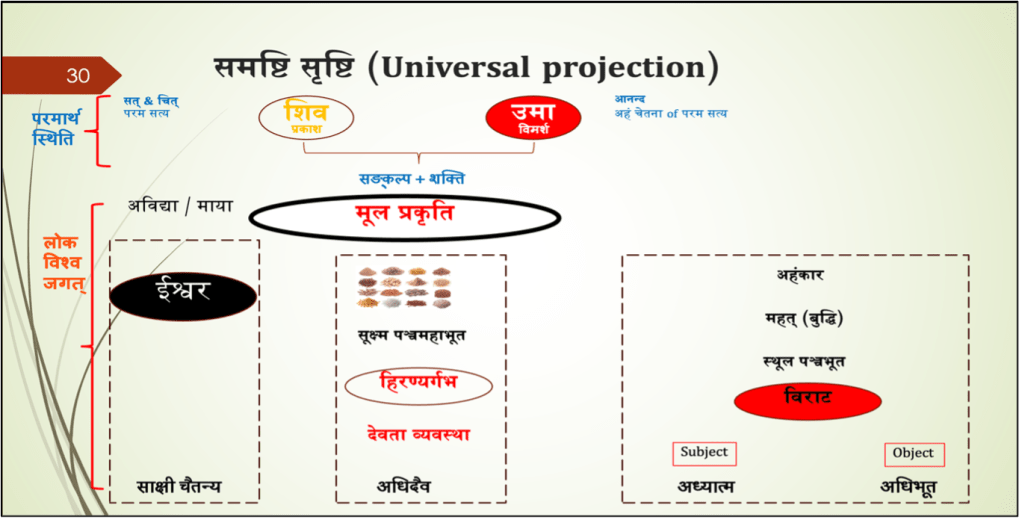
If परमात्मा is taken as (शिव and उमा) abiding in सत्, चित् and आनन्द स्थिति, beginning of सृष्टि (projection) involves bringing out मूल प्रकृति to use it to project the Universe (as कृष्ण says in the श्रीमद्भगवद्गीता – “I place My seed in प्रकृति and the world comes about”). At the stage of मूल प्रकृति, the त्रिगुण are in सम अवस्था (equilibrium) and universe remains unmanifested. Following this, शस्त्र then refers to formation of हिरण्यगर्भ (translated as golden egg) when परमात्मा together with मूल प्रकृति take the shape of हिरण्यगर्भ which is the state where the सङ्कल्प (intent to project the universe) is added to all संस्कार (or वासना) of all the जीव and this forms the basis for projection of the physical universe (without a specific plan, how else can universe take a certain form or shape?). हिरण्यगर्भ thus becomes seen as the first principle of the व्यक्त (or manifested) universe. And just as कारण शरीर is the cause principle at the पिंडांड level (since all वासनाs are hidden within it) and it enables formation of सूक्ष्म शरीर (subtle body), हिरण्यगर्भ is the equivalent of सूक्ष्म शरीर at the universal level.
Why is the above background relevant? वेद has prescribed उपासना on the अव्यक्त as well as उपासना on the व्यक्त. ऋषि मनु gives five characteristics for अव्यक्त or मूल प्रकृति – (1) Complete darkness, (2) Unknowable, (3) of the form of तमस्, (4) indescribable and (5) similar to deep sleep. उपासना on the अव्यक्त therefore leads one to प्रकृति लय – प्रकृति लय (लय means re-absorption) is the state of this manifested world merging in मूल प्रकृति. प्रकृति लय is like the state of deep sleep (note that the condition of the body and mind that come out of deep sleep is just as it was before going to sleep). This उपासना therefore means annihilation of all material wants and the consequent absence of rebirth into संसार in order to exhaust the existing वासना.
Why does the मंत्र state that if this उपासना is done alone, it will lead to darkness? Note that when सृष्टि (projection) happens, Universe comes out from प्रकृति लय स्थिति in exactly the same condition as it was before it entered into लय(absorption). We start all over again where we left off before the प्रकृति लय just as we wake up every morning after getting up from experience of deep sleep. So, उपासना on this fails to bestow final मुक्ति. Even though this उपासना is cosmic in character, it is only उपासना, and the object for उपासना in which अव्यक्तis taken as an object, i.e., you consider that you are different and the अव्यक्तis different and you are doing उपासना on the “other”. However, the cosmos is not really different from the परमात्मा. Therefore, while प्रकृति लय is the essential benefit that one gets from doing उपासना of अव्यक्त, one needs to go beyond the प्रकृति लय mode to परमात्मा which will not happen is उपासना of अव्यक्त is undertaken alone.
What about उपासना of the व्यक्त (or हिरण्यगर्भ or the manifested universe)? Knowledge of the structure of the projection is the manifest (or the व्यक्त). हिरण्यगर्भ may been seen as the initial state of potency from where the big bang happens.Those who meditate on सम्भूतिं (or व्यक्त or हिरण्यगर्भ) are those who do उपासना on the cosmos, that the entire projected universe is a single unit and that प्रकृति is NOT separate from चैतन्य or परमात्मा. Given that हिरण्यगर्भ contains within itself the entire potency of projection of the universe, उपासना of हिरण्यगर्भ will mean becoming one with that potency (that contains all desires existing as वासना within oneself).
What does उपासना of हिरण्यगर्भ will also lead one to darkness? In the उपासना on the व्यक्त or हिरण्यगर्भ, the साधक does साधना with the idea that the परमात्मा is different from the world, So, the उपासक performs उपासना for the desired result and here, there is the desire to enjoy the fruits of one’s good deeds. And since action must give its result, this result becomes transmigration (or to get enmeshed in the cycle of birth & death).
Thus, doing उपासना of अव्यक्त separately keeps one glued to जीव-hood while उपासना of हिरण्यगर्भ keeps one glued to संसार – both done individually will not take on to मुक्ति. We must know that आत्मा स्थिति is non-different from the universe as well as प्रकृति – all need to be seen as a composite single whole. Given the above, if one needs to attain one’s innate स्थिति of आत्मा, one will need to combine उपासना of अव्यक्त with उपासना of हिरण्यगर्भ. Removal of the individuality and the universe through विद्या – अविद्या उपासनाin the पिंडण्ड, and the removal of the differentiation between the परमात्मा and the Universe in the ब्रह्माण्ड, both lead to the same result, graduated liberation (क्रम मुक्ति) and both give freedom from death. However, both these types of उपासना are extremely hard and can be practised only by very advanced साधकs.
To enumerate once again: there are two kinds of practices needed to achieve मुक्ति. One is to escape getting caught by कर्म by combining it with ज्ञान. The other is to free oneself from काम through वैराग्य and विवेक Both these practices of training the mind helps to firmly fix oneself in the परमात्मा. Both in the पिंडण्ड and ब्रह्मांड, there are two ways of completely detaching the mind. Detach it by removing the काम for विषय by विद्या-अविद्या उपासना (verses 9-11). Detach the mind from the world of विषय and fix it in the परमात्मा (verses 12-14).
हिरण्मयेन पात्रेण सत्यस्यापिहितं मुखम् । तत्त्वं पूषन्नपावृणु सत्यधर्माय दृष्टये ॥ १५॥
पूषन्नेकर्षे यम सूर्य प्राजापत्य व्यूह रश्मीन् समूह तेजः । यत्ते रूपं कल्याणतमं तत्ते पश्यामि योऽसावसौ पुरुषः सोऽहमस्मि ॥ १६॥
वायुरनिलममृतमथेदं भस्मान्तꣳ शरीरम् । ॐ क्रतो स्मर कृतꣳ स्मर क्रतो स्मर कृतꣳ स्मर ॥ १७॥
अग्ने नय सुपथा राये अस्मान् विश्वानि देव वयुनानि विद्वान् । युयोध्यस्मज्जुहुराणमेनो भूयिष्ठां ते नमौक्तिं विधेम ॥ १८॥
| हिरण्मयेन – golden, पात्रेण – by the vessel (which acts like a lid), सत्यस्य – of truth, अपिहितं – covered, मुखम् – face, तत् – that, त्वम् – you, पूषन् – O Sun, अपावृणु – do open, सत्य-धर्माय – the practitioner of Truth, दृष्टये – for beholding | The face of Truth is covered by a golden lid, remove, O सूर्य, that (covering) for me, the practitioner of Truth, so that I may behold it. |
| पूषन् – O पूषन्, एकर्षे – O! Sole Seer, यम, सूर्य, प्राजापत्य – O Son of प्रजापति, व्यूह – disperse, रश्मीन् – rays, समूह – gather up, तेजः – light, यत् – what, ते – your, रूपं – form, कल्याणतमम् – most auspicious, तत् – that, ते – your, पश्यामि – (I) see, य: – who, असौ – this, असौ – this, पुरुष, स: – He, अहम् – I, अस्मि – Am | O पूषन् (सूर्य, Nourisher), O Sole Seer, O Controller of All, सूर्य, son of प्रजापति, disperse Your rays and gather up Your light… I behold, Your glorious form.. the पुरुष within You, He am I |
| वायु: – air (प्राण), अनिलम् – to the air (Universal), अमृतम् – immortal, अथ – now, इदं – this, भस्मान्तꣳ – reduced to ashes, शरीरम् – body, ॐ, क्रतो – O my Mind! स्मर – (you) remember, कृतꣳ – what you did, स्मर, क्रतो, स्मर, कृतꣳ, स्मर | Let my प्राण merge into the all-pervading air (and) now let this body be burnt (by fire) to ashes. ॐ! O my mind! Remember, remember what you did! Oh remember, remember what you did! |
| अग्ने – O अग्नि!, नय – lead, सुपथा – by a good path, राये – wealth, अस्मान् – us, विश्वानि – all, देव, वयुनानि – ways, विद्वान् – knower, युयोधि – remove, अस्मत् – from us, जुहुराणम् – crookedly attracting, एन: – पाप, भूयिष्ठां – best, ते – to you, नम-उक्तिं – salutations., विधेम – offer | O अग्नि! Let us lead on to ‘wealth” by a good path, as You know best, O देव! All the many ways. Remove the crooked attraction of पाप from us. We offer You our best salutations. |
Last four मंत्र are a स्तुति of सूर्य, मनस् and अग्नि. Since Vedic times, सूर्य is seen as the expression of परमात्मा. Just as आत्मा powers the physical body, the same principle is seen as powering the physical सूर्य. Thus, both आत्मा and परमात्मा are established in सत्य. Just as working of the Universe (including the working of the physical सूर्य) is aligned to ऋत, a साधक lives a lifestyle that is aligned to धर्म – both ऋत and धर्म are expressions of सत्य in the manifested universe. सूर्य is therefore being asked to remove the cover of the हिरण्य पात्र (golden lid). हिरण्य पात्र refers to the objects in front of us which glitter like gold – we only see our projection in those objects. “Withdraw these projected rays that illumine the objects and thereby make me realize सत्य, the Truth. What I look to be the world of objects is but an illusion due to मोह, remove this wrong notion that the world is outside me – then I can see the Truth” – this is the message conveyed to सूर्य. And the glorious message further conveyed here is – the पुरुष within You that gives You Your form is the same पुरुष that is within me too – we are one.
As one moves towards मुक्ति, the body consciousness drops away – अग्नि is being asked to burn up the body while प्राण (viz part of सूक्ष्म शरीर) merges in the all-pervading वायु. मनस् is being asked to remember all कर्म undertaken till now – these कर्म will not follow one since these belong to the व्यक्त प्रपञ्च while मुक्ति is a स्थिति beyond शरीर and मनस्. And only if मनस् remembers all the chasing of objects it had undertaken life after life, reflects on such कर्म and evaluates it well, साधक will then get wisdom to go beyond मनस्.
Then comes the prayer to अग्नि (the Fire Principle): “O, अग्नि, take me (who am on my deathbed) through the correct path. You are the all-knowing देवता. Forgive me all my पाप. Not only forgive, but also burn up and destroy all my पाप. Do but that which is for my good. नमस्कार to You again and again. Burn up all my पाप committed unknowingly and in my अज्ञान, in my perverseness.” By these स्तुति, theजीव asks to be led by the सूर्य to ईश्वर, the Absolute.
॥ इति ईशोपनिषत् ॥

