
Inspired by the talks of Sri Sri Sri Samaveda Shanmuka Sharma & Swami Nityananda as well as writings of Sri Rajiv Malhotra, Swami Krishnananda and Swami Ranganathananda (and many others)
This article is a long and a serious journey for the readers. People steeped in the world-view acquired from the modern education of our country may find the article challenging; for other Indians untainted by the modern education, this should be a breeze. One more point – I am a layman with limited abilities and any infantile expressions given below are mine only and wrongful or inadequate expression of the ideas must be blamed on me only. Being neither a historian nor a philosopher in the modern academic sense, my qualification to write this piece may be deemed suspect but the love for ancient Indian thought has made be brave enough to attempt this piece.
What is this write-up all about? This write-up attemps to define the fundamental contribution of ancient India to the world of thought which is Adhyatmic seeking. My personal view is that there is indeed a fundamental core of Indian thought that has not been appropriately conveyed to modern Indians. Lot of terms used today – scientific, religious, Hinduism, Sprituality, etc are words that are being used with a confused meaning in our day to day lives and this article is an initial attempt to address this problem. Modern day debates about contributions of ancient India have become battlegrounds and one does come across a feeling of inadequacy in the arguments given by both sides – this blog attempts to provide a direction for creating a new narrative that may contribute to reduce the noise while offerring an alternative view to enrich our lives.
Let me start with something that should be known to most Indians.
Around a 1000 years back, for about a Century, the Parsi community was persecuted in Iran, the nation of their birth. After many decades spent in hiding, they realized that they had to leave Iran permanently. The only country they could think where they felt they would be safe is India. So they came to India after going through an arduous journey by sea. Here they sought permission to settle from the local ruler, Jadi Rana. He asked for an account of their traditions and laid down four pre-conditions before agreeing to grant them sanctuary:
a. They should use only the local language,
b. the women should adopt the local dress,
c. they must put down their weapons and vow never to use them and, finally,
d. their marriage ceremonies should be conducted only in the evening
In the Parsis’ own account of their traditions (to comfort the Indian king), they emphasized the features that accorded with Dharma traditions of India, for instance, reverence for the sun and the moon, fire and water, and the cow. Oral tradition relates that Jadi Rana felt apprehensive about granting sanctuary to people of such warrior-like appearance, but his priests convinced the king that they would be ‘like sugar in a full cup of milk, adding sweetness but not causing it to overflow. The rest they say is history.
Why did I start with the above story? There are two ways to look at the above story – most Indians today will cite this example as an illustration of the magnanimity of the Indians to accommodate people of diverse traditions from other parts of the world. They will similarly cite examples of how India offered shelter to the Jews or more recently, Tibetans. The other aspect of the event is however not discussed much. Why were conditions imposed on them? Was it right for Indians to impose conditions? Why did the Parsis emphasize certain aspects of their traditions (like reverence to the cow) to make themselves appealing to the Indians? Why did the Parsis accept the conditions imposed on them? If this event had happened today, some of our modern Indians will bring about words like minority rights, freedom of expression & religious practice, etc. and may not have allowed the imposition of such conditions as was done around 800 years back. So did Indians really show magnanimity by imposing conditions on the Parsis? Let us park this event aside temporarily and turn to the subject at hand.
Getting the crap out of the way
Why modern Indians feel a sense of pride about their own country is an interesting question with the answers displaying a wide range of reasons. But before we get into analysis of the causes of pride about India, let us attempt to agree on what causes the feeling of pride in an individual. Firstly, pride is a good thing since it gives a feeling of high to such an individual and connects him strongly with the object of pride. We can agree that as long as pride does not lead to vanity or arrogance, it is fine for all individuals to develop a sense of pride in their identity, their profession and above all, themselves. Clearly, one feels pride if one possesses something which others do not possess or a very small size of population possesses such an object or has such an achievement. For example, one feels no pride in having hands and legs that work since at least 80-85% population of the world has hands and legs that work. One does not feel a sense of pride in our ability to breathe since all of the people on this planet are living because they are able to breathe. Pride is such for possessing something special – richest man may be proud of his wealth, a Brahmana may be proud of his ability to chant a large corpus of Vedas clearly, someone may be proud about their looks, parents of a child may be proud that their child has topped an exam, etc. In all cases, the person develops pride since they possessed or may have acquired something unique or something that is usually hard to obtain. If we keep this in mind and then give the following as examples given by people for them being proud about India, how should we analyse the reasons for their pride?
I am proud that India is a democracy
Well!! There are many other democratic countries in the world. So why should this give us pride?
I am proud that India has grand monuments like the Taj Mahal.
Well!! There are numerous other countries in the world each having some monument or the other – the Statue of Liberty, the Eiffel Tower, the Sydney Opera, the Pyramids, etc. Each such country will thus be proud of the monument that such a country possesses. So why should this give us pride?
I am proud that India has the Himalayas.
Firstly, India is not the only country to have Himalayas; China, Nepal, Bhutan, Pakistan, etc are also countries that have a part of the Himalayas. Equally, why should presence of a geographical landscape give us a sense of pride? Most, if not all, countries of the world are owners of a certain unique landscape given by nature that gives them a sense of pride – Europeans have Alps, USA has the Grand Canyon, etc. So why should Himalayas give us a sense of pride?
I am proud of Indian food.
Yawwwnnnn – an Indonesian is proud of their food traditions, an Arab is proud of their own food traditions, Americans are fond of how they have taken the food traditions of the world and made them American (Pizza, Burger, etc). Clearly, the pride of Indians in their own food traditions is not unique. One may stretch and say that the Indian food is unique but so is the food eaten by people from other traditions.
I am proud that India has a long running and ancient civilization.
This may be an interesting answer but the idea of civilization is generally opaque. Once again, even China has a long and ancient civilization. Egypt had an ancient civilization, the Greeks had one, Middle East also has experienced a long civilization. In fact, all parts of the world have been populated by people for at least the last 3000 years – why should this give us a sense of pride? Some modern-educated Indian may add – our civilization has the best history of pluralism. Pluralism is a fancy word but the meaning is not really discussed. Even if we keep aside the disputes with non-Indian traditions, there have been numerous disputes within Indian traditions themselves; Vedic people fighting with Jains, Jains with Buddhists, Buddhists with Vedic people, Shaivas with Vaishnavas and vice versa. Also, should we really have pluralism for its pluralism’s sake? If an evolved Aatma like Adi Shankara engaged in numerous debates with people from other traditions and defeated them, was he not plural? Pluralism is another word used by the most Indians without having any clue of what this word really means or entails. Further, no one has really made any effort to understand why Indian society had become plural unlike many other societies in the world.
To conclude the above part, what instils a sense of pride among many Indians does not really merit serious consideration since every part of the world has been given something in equal measure by nature or people in other parts of the world have also used their ingenuity or intellect to create fascinating aspects that are a pride of human endeavour for the whole world.
Seekers vs Believers
Let me come to an interesting perspective before I get into the real matter. Who are seekers and who are believers? I regard people who are wise or keen to acquire wisdom as “seekers”. Seekers have a questioning attitude to life, they are eternally curious and are not satisfied with the answers that their education or society has given them. They keep asking questions, reading books, living life by taking resort to multiple experiences and learn through all these activities. Such a learning attitude differentiates them from “believers”. The questioning attitude of “Believers” stops after a period of time. Beliefs could be of various types – wealth maximization, prescriptions of a certain scripture, possess power at any cost, being charitable, etc. Some beliefs may sound noble with others may not but the key aspect is that the beliefs are nothing else but a fixated world view. There is no seeking done by believers and their orientation to explore beyond their beliefs is limited or not present at all. They “believe” in the truth of their chosen ideology and will not listen to any other perspective. So if one takes the Shaivaite-Vaishnavite in-fighting in medieval India, essentially one side sees Shiva as the ultimate and the other sees Vishnu as the ultimate. Both “believed” strongly and therefore became blind to the existence of the word Shiva within Vishnu-Sahasranama or the word Vishnu in Shiva-Sahasranama. Since their questioning attitude stopped, they are unable to see that both the deities represented the same ultimate property or truth-principle. Instead, they indulged in meaningless violence with one another that continues in some measure even in modern India.
Let us turn to the seekers now. Today, it is commonly recognized today that scientists may be termed as seekers since they explore the world and adopt a questioning attitude. This questioning and inquisitive attitude in fact created modernity and the phenomenal achievements of science and technology are supposed to be a measure of success of the scientific seekers. However, in my personal opinion, to say that scientists are the only seekers is only partly true. There are actually two types of seekers and I will name them as “Big-Bang seekers” (NASTIKA) and “Adhyatmic seekers” (ASTIKA). Essentially, the Big-Bang seekers understand the world to be an accident, a random event and by keen observation and insight are making efforts to discover the source of the Universe; a recent quest for “God-Particle” may be deemed as an effort in this direction. On the other hand, India’s contribution to the world is the presence of Adhyatmic seekers who again adopt a questioning attitude and introspect on the human condition all their life to reach the ultimate truth of the way of the Universe. Adhyatmic seekers, while possessing the same attitude of the Big-Bang seekers, however understand the world to have emanated from a single principle which is in a state of Sat-Chit-Ananda or living consciousness. Their goal of life is to eventually experience the universality of the world’s most fundamental particle that actually lies within themselves. In the jargon of the world today, the Big-Bang seekers are identified as scientists while Adhyatmic-seekers are identified as “believers”. The unfortunate classification that clubs Adhyatmic seekers with the believers and not identified separately as a distinct world view is indeed a tragedy of modern India (or the world).
So how do both the seekers pursue their stated world-views? What makes the seeker “scientific”? The answer is obvious – seekers of both types have developed a string of variables or laws using which they attempt to undertake their explorations. Let us understand this with an example – how does one understand the balance sheet of a company? Anyone with a basic knowledge of accounting will be aware of various ratios that have been defined to understand a balance sheet – Debt/ Equity Ratio, Net Asset Value, Earning growth Year on Year, Assets/ Liabilities, market-share etc. Every accountant will use the same variables to understand the balance sheet. Without a set of common variables, it is impossible to analyse the balance sheet of a company and understand its health. The scientists have similar variables – Newton’s Laws may be given as one variable, mathematical formulae may be identified as another variable, etc. Using these multiple variables defined as basic laws together with other fundamental mathematical formulae, the scientists perform experiments and thus arrive at the conclusions. Such experiments done with an open mind lead the scientists to further insight and discoveries are made as a result of this attitude. While I am sure everyone will be with me till this part, the key question is – what variables do Adhyatmic seekers have? This also brings me finally to the core question at hand – the source of my pride for India.
Is there a core idea of India?
When I say that love India or Bharat or Ajanabha or Hindustan, ancient Indian knowledge systems, Dharma world view, incredible achievements of our history, what am I really saying? We tend to wrongly use these disparate words together in a casual way. As I have stated earlier in this blog, when one cuts away the crap of achievements of India listed by lay persons as items to be proud about, one eventually comes to a more fundamental question – is there an idea of our country? What is unique about Bharat that made us what we are? This is a serious question. My argument is that my pride about our country is that this is the only place in the world (together with efforts of some others outside India like the Taoists of China, the Sufis, the Zen Masters, etc) which has diligently encouraged and allowed the pursuit of Adhyatmic seeking. This is a unique contribution and this seeking has continued for thousands of years again and again and again by its inhabitants. This seeking has not stopped even today and continues to engage people who are aligned to the world view of Adhyatmic seeking. A view that the world is nothing else but a singular living consciousness which is the core particle of the universe (Brahmanda) which is also the core particle within us (the Pindanda) bringing about the famous equation Brahmanda = Pindanda.
One may ask the question – what sort of variables did the Adhyatmic seekers have or use to explore the universe as well as their individual selves? Key ones are given below (there are a few others also):
1. 24 or 25 Samkhya categories (Prakriti, five Karmendriyas (hands, legs, genitals, excretion, five Gyanendriyas (eyes ears, nose, tongue and skin), 5 Bhutas or elements (air, water, space, fire and earth), 5 Tanmatras (Sound or Shabda), Touch or Sparsha, Form or Rupa, Taste or Rasa, Smell or Gandha), Manas or Mind, Chitta or Memory, Buddhi or Intellect and Aatma).
2. Karma Siddhanta (Agama, Sanchita and Prarabdha)
3. Reincarnation
4. Guru-Shishya Parampara
5. Panchikarana process (how the Samkhya categories mix with Gunas to create the universe and life)
6. Triguna – Sattwa, Rajas and Tamas
7. Purusha – Prakriti (or Jivatma-Paramatma) distinction together with the concept of Panchakosha.
8. Three types of proofs or Pramana – Pratyaksha Pramana (one that can be directly seen or experienced, Anumana or inference and Agama (trust in a known source like an experienced Guru or scriptures)
9. Dharma
10. Concept of Devata (foolishly translated as God)
11. Concept of four stages of life – Brahmacharya, Grihasta, Vanaprastha and Sanyasa
12. Four Purushathas – Dharma, Artha, Kama and Moksha
13. Distinction between Sruti and Smriti
14. Concept of Ekam Sat (one reality from which we emanate, live within it all the time) and Vasudaiva Kutumbakam following from this.
The above variables form the core – the centre, of the Indian world view. Take any text of India and the entire literature is an inter-play of these 14 variables. Do note that I am not saying that the core of Indian thought is Advaita, Dwaita, Charvaka, or that the core of Indian achievements are Mathematics, architecture, etc. The core is these variables and an inter-play of these variables with one another generated outcomes like poetry, philosophy, arts, medicine, etc. The latter represent the fruits and while more fruits kept on getting generated from time to time, the core remained intact. All the so-called religions like Buddhism, Jainism, Hinduism, etc came out of this core only. If we take just one variable – Panchikarana process, one will observe that this variable forms the background in Manusmriti, in the Puranas, in Natyasastra, in Ayurveda, in Shilpa Sastra, music as well as in Jyotisha-Sastra. Even the so-called “lower” subjects like governance, societal harmony, poetry, literature, etc., have been elucidated using the above variables. What Indian society strived to do over thousands of years is to weave a society, its daily life, norms of social behaviour, etc., around these variables only. What the Adhyatmic seekers or ASTIKAs have done is to use these variables to formulate a world view and in the process understand themselves. There is intense seeking in processes like meditation but equally there is intense seeking for a Grihasta on a day to day basis using the variables given above. Reams and reams of Indian literature including Sri Ramayana and Srimad Bhagavat Katha or Charaka Samhita (medical science) or Vastu-Sastra (architecture) are indeed outcomes of this intense seeking – these are not story books or foolish superstitious imaginations of less-evolved “believers”. The “ism” may change but the core remained intact. One may argue that other civilizations also had the principle of re-incarnation – this is true but they lacked the other variables and therefore could not generate the number of thought traditions that India had generated. The core must be seen as a combination and not split individually – this combination had helped in retaining the Indian-ness over generations.
My love for India is thus around these variables of thought and the inter-play between them. Just like a spark of fire has the same property as a large fire within a Yagna-kunda, each and every separate discipline (like medical science or Yoga or Philosophy) is like an individual spark that is not different from other knowledge systems. What is the connection between all these disciplines – it is nothing other than the 14 variables described above!!! Is this not fascinating? This also means that the ASTIKAS can actually even undertake reverse engineering and if they are well-versed in one discipline, they can work hard by using their seeking intellect to restore another lost discipline – this is because at the core, all disciplines emanate from the same core or source or reality. The variables may be likened to elements within a periodic table highlighted within a basic textbook of Chemistry – combine these elements in different ratios and various new compounds (or knowledge disciplines) can come about.
There is another way to reiterate the importance of the core. Our own body temperature remains constant in the midst of external temperature fluctuations and if at all it fluctuates due to some reason, it restores the balance automatically. Similarly, when we work or get angry or excited, our composition of blood is disturbed but our body has an inbuilt mechanism that restores its psychological equilibrium. This inbuilt mechanism within the body which maintains a constant state of organic equilibrium is called homeostasis. This mechanism not only enabled human beings to survive but also acquire mastery over the environment and living conditions. The core similarly may be deemed as the homeostasis quality of Indian thought – it is this core that made us one of the most successful and evolved societies in the past. Maintaining the core keeps us Indian; take the core away and our continued presence or identity as uniqueness is gone forever even though we may be called as Indians outside or may continue to possess brown skin.
Tragedy of modern-educated Indians
Our good friends – our modern Indian educated people must be simmering in anger by now. Poor guys – they have been taught that India is a melting pot of multiple influences. They have been taught that India took mathematics and temple making from the Greeks, alchemy from the Chinese, horses from Arabs, etc. They have been taught that India is great because it took everything from the world and made it its own. Off late, we have heard people using new jargon like “Open Source Software” to describe India. What modern Indians are missing when we are using this jargon is the obvious – What is the core operating system of India? All applications and software (like the borrowings from Greeks, Chinese, etc.) were loaded onto an operating system. What is this operating system – this is nothing else but the 14 variables of thought indicated above. Without an operating system, can any software run at all? Take the operating system away from the day to day life; the death of operating system means the death of all software layered over it which also means the death of all applications built on this operating system. Tragedy of modern India is that Indians grow up and live their entire life without even being aware of the 14 variables described above. What people do not realize is that India’s adoption of modernity has been over the dead body of our core operating system; these multiple variables that have collectively sustained our lives for thousands of years have exited from our day to day life – what we see in India even among the so-called Hindus is mere repetition of certain behavioural mannerisms of yesteryears (like going to a temple or wearing a Teeka mechanically not as seekers but as believers). But these mannerisms will also go away over time once the connection with the core are severed (as is already happening).
Let me illustrate a simple example to explain my point. If one takes the beautiful statue of Nataraja, it is possible that we may have learnt to sculpt from the Greeks or smelting from the Chinese, etc but what is expressed in the form of the statue, the hand movements, etc. are uniquely Indian – no one can say that the idea being conveyed by Shiva or the beautiful symbolism expressed as Narayana is Egyptian or Arab or Persian, etc – this is the core that I am indeed referring to that defines my idea of India. The temple building may have been learnt from other civilizations but the idea or design of the temple is uniquely Indian – can anyone deny this? Sri Vidyaranya is famed as the Guru of Hakka and Bukka who started the great Indian Vijayanagara Kingdom which had incredible achievements to its credit. The same Vidyaranya wrote the great book Panchadasi which essentially elucidates on the Sat-Chit-Ananda aspect of the universe by using the 14 variables. When these variables come together in the world view of day to day lives of people, one saw how a great Vijayanagara civilization was born which ruled a large part of India for more than 250 years. While no one is thus denying the positive contribution of external influences on India, the argument is that there is a core idea of India that remained protected (till of course the advent of modern age where the ideas of the NASTIKAS have gained significant prominence and changed the whole world including India).
I will give another simple analogy – suppose we have a mango seed that we place within the earth in our backyard. Over the next few days/ weeks/ months/ years, if we diligently and lovingly pour water, manure, fertilizers, provide exposure to sunlight, protect from wild-animals, etc., how will the mango tree grow? The answer is obvious – the seed will eventually grow into a beautiful and large mango-tree. We cannot expect the various influences in the form of water, manure, etc., to convert the tree into an apple or a banyan tree. My point is that the various influences over Indian society over the many thousands of years were indeed a tapestry and multi-layered influences over a common base or platform of the 14 variables indicated above. Without the presence of a base or a core, if the Indian civilization had fully changed after each invasion, it would have been called as Greek civilization when Greeks invaded it, the Persian civilization when Persians invaded it, the Mughal civilization when the Turks invaded it, etc. However, this did not happen and unlike the experience of some other countries – India remained India despite taking influences of the world. The argument is that the Indian civilization till the advent of British indeed behaved in a certain way that made it distinct and different from other civilizations. That distinction made it unique – Arabs turned Persia into an Islamic country while the Arabs/ Turks merely ruled India but India remained what it was (till of course the British made us the confused Indians of today!!) Why? The mango seed had certain innate characteristics and when I therefore say that I want this “India” to be protected/ respected/ lived, etc., I am actually seeking to explore the possibility to accepting the so-called modernity without surrender of the idea that is the core of India.
Our so-called “educated” and “never read any scripture” Indian may be tempted to raise an “intelligent” question. They may put forth a point that presence of a truth called Sat-Chit-Ananda may also be termed as a belief. Why should this be termed as seeking since there is no proof of the presence of truth in the form of Sat-Chit-Ananda? The answer is obvious – firstly, we can levy a counter-charge that the Big-Bang view may also be deemed as a belief since there is no rational basis to really state that the world has evolved from matter accidentally (all around us, we have examples of life or non-life coming out of a living being and not life coming out of synthetic compounds or an in any accidental manner). Second, any boy student of Vedanta is aware of the end goal of Vedanta together with numerous steps that one needs to take in a rational manner by adopting a critical attitude with an open mind to realize the truth behind it all. While a belief system may say that there is heaven or hell after death, there is no way one can prove this except to believe this blindly but Vedanta however states that one can cognize Universality “right here right now”; this then becomes a realizable goal that one can sincerely endeavour to work towards and achieve it. With our living tradition of Gurus who have achieved realization not just thousands of years back but even in recent times (Ramakrishna Paramahamsa or Ramana Maharishi), this claim can thus not be taken as a belief but a seeking goal for all open-minded & genuine aspirants. Similar seekers can be found in other traditions like the Sufis or Taoists or Tibetans – these then becoming seeking traditions and must not be mixed up with belief traditions.
Lastly, there is confusion where the word technology is mixed up with science. If science can be taken as an attitude or a process or a behavioural trait using which we observe the world, technology may be deemed as an outcome of human endeavour using his or her sense organs together with mind to use the world for his or her benefit. Technology has always been there – shipbuilding, manufacture of metals, architecture, mathematics, etc have always been there for thousands of years. No doubt the technology of the last 200 years has indeed outclassed the technology of the earlier centuries but this difference is difference of scale and ingenuity but still remains within the realm of technology. Science and scientific temper equally have been therefore for thousands of years. To say that building of pyramids or the Ashoka Pillar are not work of science like a mobile phone today may be deemed as today is indeed an infantile argument and does not deserve any sympathy.
WHY ASTIKA AND NASTIKA
I have thus far used the above words without explaining why I have used these words. The use of these words is an idea given by Sri Rajiv Malhotra in his book – the Indra’s Net. Most modern Indians will associate the word NASTIKA as non-believer in GOD and ASTIKA as believer in GOD. This is again a tragedy of perspective in modern India. Any boy student of traditional Indian knowledge systems will know that an ASTIKA is one who has Shraddha or faith in Indian scriptures. And what Indian scriptures we are referring to? We are referring to the scriptures which focus their entire attention and give out all their views using the 14 categories given above – this means we again return to the source of my pride about India – the 14 variables. These variables were understood across the country and were used even by the Vedantists, Samkhyans, the Bauddhas and the Jainas. Though there may be variation in how each of these terms was defined by each distinct tradition, that difference is a matter of detail but one cannot deny that these categories formed the basis for discussion and engagement across the country. “Na Asti” also means “Not Exists” meaning that “Consciousness does not exist” while “Asti” means “It Exists”. Thus, Astika traditions believe in the presence of a living consciousness that is all permeating and represents the fundamental truth or state of this entire universe from where this diversity that we see all around us has emerged, exists and will eventually merge into. I have to admit here that the definition of who constitutes an ASTIKA and a NASTIKA did vary over thousands of years. A book on Darshana Shastras by Madhavacharya in the 14th Century classified Indians aligned with the Vedic scriptures as ASTIKAS while others like Bauddhas and Jainas as NASTIKAS. Rajiv has however rightly included people aligned with all Dharma traditions as ASTIKAS given that they are also aligned to the 14 core variables indicated above. By having Shraddha to these variables (like scientists have Shraddha over Newton’s laws), fundamental and phenomenal discoveries were made by ancient Indians. By implication therefore, seekers having world views formulated without the use of these core categories have been termed as NASTIKAS. Both ASTIKAS and NASTIKAS are seekers at heart and both deserve respect. One is not greater than the other since both have the same orientation to understand the world and live life as per this world view.
Confusing ASTIKAS with believers is indeed the biggest tragedy of modern India and sincere efforts must be made to correct this wrong. Some leftist intellectuals will term this process as Saffronization but this objection is rather naïve or un-informed if undertaken in a genuine manner or mischievous if done to resist the classification of communist ideology as NASTIKA (which it really is). Since I am according equal respect to a NASTIKA view as a genuine and serious world view with many honest seekers within this domain, there is no need for one to deride or look down upon each other. These just represent different world views and we can accept this idea as such without accompanying anger or derision over the other.
FIGURATIVE REPRESENTATION OF TWO WORLD VIEWS

I may have indeed drawn up something which is beyond my expertise or ability to comprehend the way of the world. What is given above are the two world views – the root view of this perspective is indicated at the bottom of each tree and the outcomes in the form of fruits and leaves that the world has received from each of these seekers is given around these trees.
No doubt the above is too bold and too simplistic and the world view is too complex to be put into two binary perspectives. My humble view is however that the current divide between science and religion, which is a western world view needs a counter-point and the above is an initial attempt to define this. I am sure there are many intelligent people who will come out with better approaches to define the divide. The above picture has the following interesting aspects:
a. There is indeed a root world view that most if not all people hold. They may express this or they may not express this but most of the people hold one view or another which shapes all other thoughts that they carry within themselves.
b. Stress on a certain world view indeed generates outcomes and the above figure attempts to illustrate the nature of fruits and leaves that the world has received from both these world-views.
c. The believers do not really have a strong world view. They merely pick and choose what suits their personal agenda and usually sit on the branches of both the trees to eat and digest the leaves that appeal to their personal agenda.
d. Believers are thus neither ASTIKAS or NASTIKAS but a confused lot who sit on the fence on most occasions since they have never really attempted to sincerely find out what world view they really hold on to as a general rule. It is believers who have been causing havoc over history for thousands of years and will continue to do so. There is thus a great need for ASTIKAS to guard against not just NASTIKAS but even believers; the latter can be more difficult to handle and will and have been making attempts to bury or demonize the ASTIKAS for generations.
e. Quantum Science is probably the first attempt that attempts to bring ASTIKAS and NASTIKAS together – this is however still a Work in Progress.
f. Genuine seekers at both ends of the spectrum are really like each other and can and must collaborate with one another to enhance their effectiveness.
g. Seekers must engage with believers and debate openly with them to push them also into a seeking mode. In today’s world, Richard Dawkins may be cited as a NASTIKA who has written books pushing believers to change their perspectives. However Richard is too much “in-the-face” and loud and thus created a violent flutter within his surroundings. I will rather use the example of our own native Adi Shankara. When Shankara was confronted by people who were Devi worshippers and indulged in human sacrifices, Shankara converted them by showing them the real meaning of words like Bali (which is sacrifice of human ego) and other aspect of Devi worship. At the end of this conversion, nothing changed externally for the Devi worshippers – they remained with Devi traditions, their dressing remained the same, their language remained the same but their devotion to Devi was truer and deeper than the blind and violent beliefs carried earlier by them. This is real conversion which retains the self-respect of the converted while making them Adhyatmic also in the process.
h. A larger majority in most societies will remain believers owing to various reasons – inability to think, lack of proper seeking environment, poor education quality, lack of role models, etc.
Let us return to the event of the Parsis. How would each strand of society have reacted to the Parsis if they seek asylum today?

You would have realized that I am partial to the ASTIKAS but India has shown this face to Tibetans, Jews and Parsis and thus can rightfully claim success in this regard. Other societies do not have such stories though one must agree that US and UK (if I can call them NASTIKA societies) have shown reasonable success in integrating outsiders in the past century though challenges keep cropping from time to time on this aspect.
Another way to look at the Parsi issue
Some readers who have reached thus far must have got uncomfortable with a new binary that I have indicated. ASTIKA – NASTIKA perspectives sound very close to other existing binaries like Good – Evil, Positive – Negative, God – Satan, etc. It is usually “believers” who have developed such binary categories of “Us” and “them” and even the NASTIKAS have adopted the silly binary categories like the believers as Scientific – Religious, Spiritual – Ritualistic, Educated – Illiterate, etc. As we all know, these binaries have not been helpful in understanding the world or in decision making. Modern society has come up with a third category – “grey area” to specify the unknown but such a category is also useless in giving us some more inputs to decision making.
Taking cue from the 17th Chapter of the GITA, an ASTIKA may put down a table as given below to facilitate decision making to address situations when a group of people seek asylum from our country:
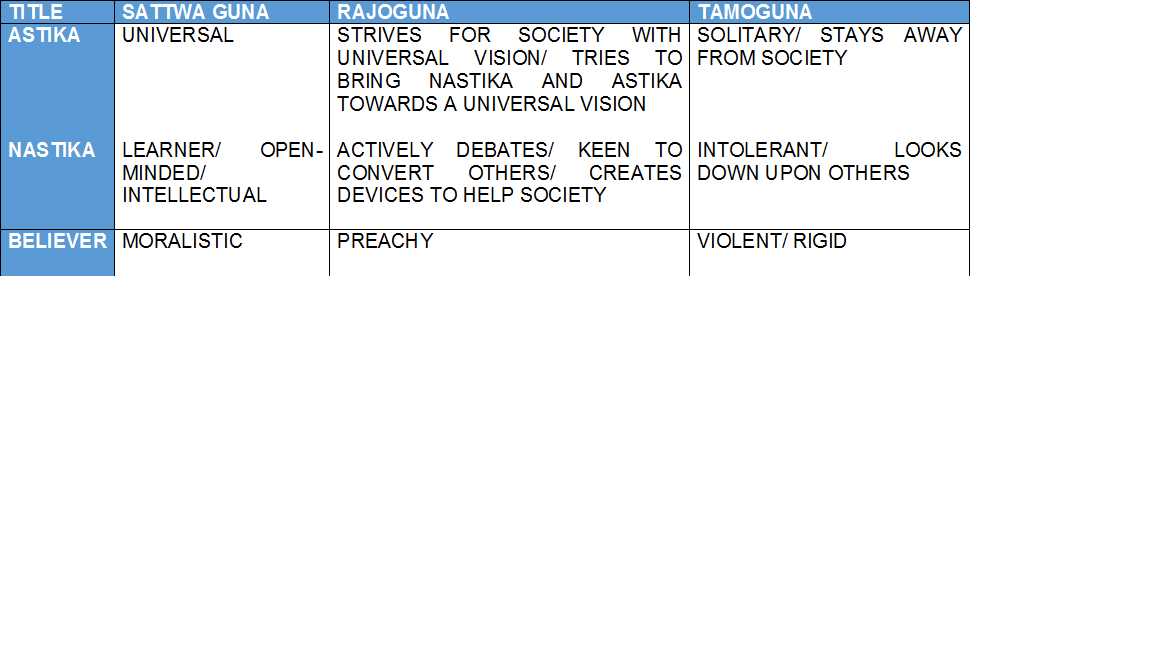
The above is a rough one and not to be taken literally since I am not really as ASTIKA expert. Be that as it may, it must be evident that this thinking approach brings out more options to facilitate a decision making. Clearly, if the asylum-seeker comes to an ASTIKA country but belongs to a civilization or group that has a TAMOGUNA background significantly, asylum must not be granted despite all good intentions in the mind of the ASTIKA. Equally, one needs to be careful about granting asylum to all types of believers though one can be liberal with the believer who exhibits Sattwa Guna in his or her orientation. With the above table, we move away from binary categories of decision making like exhibiting universal goodness to all asylum seekers foolishly only to regret later.
A key question confronting modern world is how to organize a society. How do we choose our neighbours; whom do we marry, who can be our friends, etc., do come up as questions to most of us from time to time. A typical NASTIKA view will be that we must indeed have complete freedom in choosing our neighbours/ spouses but this view will equally not be comfortable to create divisions in society in terms of their chosen identity. NASTIKA view is that the world-view of an individual is in the personal mind-space but the society must not make these divisions in terms of having different neighbourhoods for different personal inclinations. Singapore comes up as a good example where housing societies built by the government had a mandatory clause whereby each housing society was meant to house people from all races/ ethnicities rather than create ghettos. This indeed sounds noble and sensible from a NASTIKA view but Singapore equally bans certain religious practices within these societies like bursting crackers or religious processions or allowing display of religious symbols to keep a semblance of external uniformity. What becomes obvious is that external uniformity is a requirement of a NASTIKA world view but not of as ASTIKA world view which revels in diversity within unity and unity within diversity.
Without getting into further detail, I will end this section by stating that ASTIKA world view can offer much more diverse templates that may be relevant and useful for decision making both in individual as well as societal lives. Today’s world run on NASTIKA world view has led to certain benefits but has also created many challenges which seem insurmountable and a dose of ASTIKA thought process will add a lot of value to make the world a more engaging place.
Adhyatmic seeking is spiritual or religious?
A new nonsense has come about in human society over the last decade when it has become fashionable for the educated elite to say – “I am not religious, I am spiritual”. Clearly, since the elite are stating this, it means that “religious” is regarded as something lower and “spiritual” as something higher. What is the meaning of Spiritual? Spiritual means that which relates to the spirit and a dictionary meaning of Spirit is that it refers to the non-physical part of a person which is the seat of emotions and character; the soul. If one looks at Indian traditions, the mind and Buddhi may be the loose equivalents of the word Spirit or Soul. Aatma however is beyond the mind and Buddhi and Adhyatmic seeking therefore cannot relate to the spirit and is thus not spiritual. The typical dictionary definition of religion refers to a “belief in, or the worship of, a god or gods” or the “service and worship of God or the supernatural”. Adhyatmic seeking cannot be deemed as a religion by this definition since it does not refer to a supernatural GOD but the Paramatma principle that is already present within us and give us energy and ability to engage with the world. Paramatma is thus not supernatural but the most natural aspect of life within us. Use of non-Indian words to describe Adhyatmic seeking can bring about un-necessary confusion and must therefore be avoided as much as possible.
In a practical sense, our educated elite use spiritual to mean that they do not believe in undertaking rituals or physical demonstration of their connection with the God (like wearing a Teeka or going to a temple/ church, etc) but respect the connection within themselves. Spiritual is thus used more in a negative way of rejection of the external rituals. This is again an infantile view. Both external and internal go together and cannot be separated from one another. For example, if is confronted by an attacker, an emotion of self-defence or fear arises within and physical action of either running away or taking up a weapon to engage with the attacker happens. When one has heard a joke, joy is experienced within and laughter or smile get expressed outside. This is a natural way of thinking and one does not have to suppress one or another in our day to day conduct. Physical rituals like going to a temple or doing morning Puja in front of the deity are also external expressions of the internal Adhyatmic action of communication with the Divine. I agree that there are people who only display the external mannerisms but there is no internal connection – this is indeed sad. Equally however, if one suppresses the external expressions to demonstrate that they indeed have an internal connection with the Divine is equally silly. I will give an analogy to explain this better. Readers may be aware that when the mind is at unrest, the breathing pattern become irregular. The Yogic breathing thus reverses this whereby it makes the Yogi undertake breathing in a rhythmic pattern which in turn has a calming effect on the mind. Similarly, if external rituals were prescribed like daily Puja before sunrise or chanting on special days like Ekadashi, the expected effect if done sincerely over a period of time is that the mind can slowly and surely learn to regulate itself and thereby develop the connection with the Paramatma principle within.
Let us therefore judge Adhyatmic seeking on its own terms and its own standards rather than use alien words to confuse its adherents. Adhyatmic seeking is a world view that states that the world has emanated from a fundamental living principle and the scriptures devoted to Adhyatmic seeking share the experiences of people who have been successful in the past to connect or plug themselves with this fundamental principle. The series of living practices – both external and internal have been prescribed in the scriptures of the Dharma traditions to enable its adherents to achieve the same connection or Samadhi state as was achieved by Ramana Maharashi or Ramakrishna Paramahamsa or Paramacharya or many others before them.
One more allegation levelled against Adhyatmic seekers are that they are world-negating or people who were wanting to become Saints. Such seeking is thus relevant only after one becomes old or those who are not interested in participating in the activities of the world. No view can be more uninformed than this. The picture given earlier clearly shows numerous disciplines or achievements of the Adhyatmic seekers from ancient India (medicine, architecture, etc) – this is thus as world embracing as one can imagine but it embraces the world on its own terms. Another distinction – “materialism” vis a vis “spiritualism” is again used time and again these days but this distinction is alien to an Adhyatmic seeker who remains devoted to Adhyatma whether he or she is in a battlefield or running a business or doing meditation.
Way Ahead
This has been a long write-up. It is time for me to summarize and propose an approach for the way ahead.
a. Much of Indian history has been written by the people with NASTIKA mind-set. Names of such historians include Ramachandra Guha, Romila Thapar, Karen Armstrong, Wendy Doniger or Kosambi who are self-professed atheists or Marxists. While their good intent is not being doubted, their failing has been their inability to understand India using ASTIKA categories. Even ASTIKA historians have not used the ASTIKA variables to understand India and its traditions.
b. One reason for Adhyatma categories not coming out is the excessive focus of Indologists on topics like those given below and not looking at these aspects using the Indian categories of thought:
i. Social aspects like Sati, Untouchability, Caste system, etc.
ii. Physical attainments were described based on archaeological findings (story of how Ashoka pillars were spotted and how Brahmi script was interpreted is indeed fascinating).
iii. Religious ideas of India (a new word Hinduism came about and over a period of time, became a distinct religion in itself separate from Buddhism, Jainism, etc).
iv. How India got various aspect of technology from outside – temple architecture from the Greeks, mathematics from Greeks/ Sumerians, Samosa from Persians, Coffee from Arabs, Tea from British, Cauliflower & Tomato from ….etc.
c. Using the Western lens, Indians were made to believe that they have no sense of history. Reality is that Indians had a strong sense of self-identity and history but the “look-back” was more to protect the core rather than figure out how cauliflower or coffee came to India. The narrative of the Upanishads, Puranas, the Bhasyas of Adi Shankara & Ramanuja, the framework for internal debates between Vedic-seers or with Buddhists/ Jainas, the Tyagaraja Kirtanas as well as utterings of Ramana Maharishi – over the thousands of years, the method adopted by each of them struck to the core.
d. Adi Shankara would have been shocked that the Vedas and the Upanishad words are being used not to enhance knowledge about living consciousness but about whether our ancestors were nomads or lived in plains – this is stupidity multiplied by stupidity but surprisingly, most modern Indians do not find this obsession with unnecessary aspects of their history odd at all. This obsession to look at Rig-Veda to figure out the age of our civilization or to identify the influences to our civilization as a big and unfortunate tragedy of modern India.
e. To make matters worse, modern Indians absorbed the Western way of looking at things which led us to stupidly get into useless debates by making counter-claims of historicity of Ramayana and Mahabharata or ancient Indian discoveries or scientific achievements in the Western language or manner. Even lives of saints ended up being seen with NASTIKA eyes than ASTIKA categories. The “social” aspects ended up attaining greater prominence unfortunately, Indians themselves moved away from being really “Indian” in the way Indians thought and lived till around 200 years back. The “core” not just shifted from the main-stream narrative, it ended up moving away from our lives and thus creating a mind-space where modern Indians merely wait for the next discovery of a concept or technology from the West (Capitalism, Marxism, Secularism, Behavioural Economics, Internet, “god-knows-what next” etc).
f. Thanks to the dominant NASTIKA view, even a child in India looks at the rituals or the Karma Kanda aspect of the Vedas as a chore or a waste. This has come about mainly because of a view that Upanishads are seen as a revolt against the rituals. This is ridiculous. Each and every Upanishad is aligned to the four Vedas and disillusionment with the Karma-Kanda does not explain why each Upanishad is aligned with the Vedas themselves and seeks to elaborate the hidden meaning of the Vedas themselves. Upanishads are therefore not a new creation but merely a deeper Gyana way of seeing the Vedas themselves. But both Karma & Gyana together are essential and Dharma tradition does not pit one against the other at a general level but gives equal importance to both collectively with emphasis of one over the other at appropriate stages of life. Krishna said that for a Gyani, the Vedas are as useful as the water in a well within a flooded area – the key point is that Vedas are redundant for a Gyani but till we are in the mode of duality or in a lower state, both Karma and Gyana are necessary. Without Karma, no Gyana is possible.
A direction for the way ahead may be given as below:
a. The core idea of India is that of a civilization of Adhyatmic seekers. Current categories Indian world view as Hinduism, Buddhism, Jainism, Sikhism, etc., have confused our society completely. We must junk use of words like Pantheism, Monotheism, Monism, Secularism, etc. to understand Indian thought. Attempt must be made to rewrite Indian thought using the ASTIKA categories.
b. Just like Confucious is for all Chinese (irrespective of their individual sects), the world view of the ASTIKAS can be taken up by people from all traditions within India (and not just people currently categorized as Hindus). People from non-Hindu traditions have also had Adhyatmic seekers in their past (Zen masters in Japan, Sufis in Islam, Christian mystics, etc). However, these other civilizations could not possibly sustain this type of seeking for a longer period since the elaborate language or variables developed in the ASTIKAS as an end to end framework were not developed by them and thus has kept Adhyatmic seeking peripheral to these societies. Adoption of ASTIKA language & variables will sustain the Adhyatmic way of life while at the same time enable each subsect to retain respect for their individual rituals and practices.
c. Equally, I would like to emphasize that the ASTIKA and NASTIKA world views are not to be taken as antagonistic. Both are genuine seekers and this seeking aspect must actually bring them closer and encourage in undertaking friendly competition with one another. Equally, both must guard against the RAJOGUNA and TAMOGUNA tribe within them (though there is more danger to ASTIKAS from the NASTIKAS than vice versa). Exhibiting of a free-for-all liking for all seekers is foolish and has indeed created many problems for thousands of years.
d. ASTIKAS must preserve their categories zealously. No one must be allowed to pick & choose these categories selectively and reject a few others – this will amend the operating system and cannot be allowed for a person to be called as an ASTIKA. If such pick & choose is allowed, individual components will get digested by the NASTIKAS (as is happening all around us). As one can see already, the NASTIKAS and the Believers have already taken many ASTIKA achievements like Yoga from the ASTIKAS and digested these by removing references to concepts like Samadhi or union with the ultimate truth. One may argue that even ASTIKAS have borrowed by the NASTIKAS. Borrowing must be regarded as fine in my opinion as long as there is attribution to the source. If there is no attribution, it will amount to stealing which is what we are seeing today. Ayurveda mined for information diligently and converted into herbal medicine is another example of a NASTIKA digestion of an ASTIKA idea. While sharing is fine, when the source from where the data has been mined is obliterated, this needs to be referred to as stealing and nothing less.
e. ASTIKA must develop new literature relevant for modern India. ASTIKAS must develop new economic theories, new corporate business models, new standards for personal conduct, society organization, legal structures, etc. If this is not done, attachment to ASTIKA world view based on literature written thousands of years back will seem emotional than substantial. For this, they must preserve their thought categories and not get digested in the NASTIKA world view (which has already happened to a large extent). To do this, using ASTIKA categories and case studies from the Puranas/ Itihasas/ Poetic literature like the Kalidasa and Bhasa, one needs to merely inculcate four values – Shaucham or Cleanliness, Perfection in work (YOGAHA KARMASU KAUSHALAM as stated in the 2nd Chapter of the Gita), Empathy for another (VASUDAIVA KUTUMBAKAM) and good understanding of Dharma. I am sure that instilling of these four values using ASTIKA categories will recreate a massive Banyan tree filled with wonderful leaves in the form of a new modern literature.
To conclude, it will be a big loss to the world civilization if Adhyatmic seeking is abandoned from India. Indian civilization will be dead and the benefit that the world may receive from this alternative world view will remain lost forever. Modern India is primarily constructed with NASTIKA principles and much of discontent in modern India is because no suitable distinction has been made between the NASTIKA and ASTIKA world view. This has exacerbated confusion significantly leading to conflict and in-fighting. Today’s India is a mess primarily because this confusion is playing out openly in all places and we have been unable to accept either NASTIKA view properly and also abandoned the ASTIKA world view significantly. If things continue as they are today, India will live life of a digested society where both believers and the NASTIKAS will eat up all the leaves of the beautiful tree grown by the ASTIKAS over millennia and this beautiful tree will eventually die. The world will thus merely be filled with NASTIKA world view and believers together with Adhyatmic seekers, if any left at all, will merely be leading lives of the “other”. Let us hope and pray that this sad situation does not come about and all of us strive to bring back the glory of India into the world and offer a strong alternative to the world society which will make the world and lively and exciting place.
Om Tat Sat
 Adhyatma Writings
Thanks for such a wonderful, insightful knowledge.
LikeLike