
The blog provides a translation of the Tattwabodha that is ascribed to Adi Shankaracharya. What is provided below is a basic translation of each and every line in the text followed by a basic commentary to enable readers to appreciate the intent behind every line of the book. I have used the translation provided by Swami Tejomayanandaji on the text issued by the Chinmaya Mission. Any errors is use of words in the commentary is mine and mine only. I hope all of you enjoy this wonderful text.
1. What are the four-fold qualifications (साधनाचटुष्टयम्)? The capacity to discriminate b/w permanent & impermanent (नित्यानित्यवस्तुविवेक), dispassion towards enjoying the fruits of one’s action here or hereafter, six-fold wealth like शम & so on and constant yearning to become free (मुमुक्षत्वं).
(UV – Each of the ४ criteria will be elaborated in subsequent श्लोक)
2. What is meant by discrimination b/w the permanent & impermanent (नित्यानित्यवस्तुविवेक)? The Reality alike is eternal; everything else is ephemeral. This conviction alone is the discrimination b/w the permanent & the impermanent.
(UV – this simple idea is fascinating since it rests on a view that what lasts forever is the only aspect that is Real. What is born will also die and what is capable of destruction cannot thus be considered Real (it is relatively real but not absolute). An investigating mind is meant to observe the world & every phenomena to spot the Real & discard the unreal – what lasts longer should attract as against those that do not last. When ancient Indian view dismisses the world as माया/ मिथ्या, what is actually states is that the visible universe is relatively real but not an absolute truth since it is not eternal).
3. What is dispassion (विराग)? The absence of the desire for enjoyments (of fruits of one’s actions) in this world and in स्वर्ग.
(UV – this is interpreted usually that ancient Indian view is world negating. Far from it. The purpose of quest for HIGHEST REALITY should be clear – negatives are given in this Shloka. One is not pursuing this to achieve some super natural powers or to impress people around you or to get a chance to be with अप्सर in स्वर्ग. Such desires must be absent while pursuing this study. Then why must be pursue this study at all can be an obvious Q. This will be answered later – I will merely state now that this pursuit is to get back to our original nature; to shed the “compound” persona and recover the pure “element” aspect of ourselves.
If one wants to pursue HIGHEST REALITY, one cannot do it while pursuing enjoyment. Focus is being stressed upon here. If focus is necessary for low intellect pursuits like CA/ Engineering/ Medical 😀, can it not be much more so for pursuing the highest goal of all? Does it mean that Shankara does not want people to enjoy life? Far from it – enjoy pursuing HIGHEST REALITY IS ALL THAT HE IS STATING or enjoy drinking/ eating if pursuit of HIGHEST REALITY does not appeal to you – that is all)
4. What is the inner wealth starting with शम (शमादि साधन संपत्ति)? These are शम, दम, उपरति, तितिक्षा, श्रद्धा & समाधानम्.
(UV – these six are also referred to as षट् संपत्ति – people can be deemed wealthy if they possess these six forms of wealth. Details to be elaborated next).
5. What is शम? It is control or mastery over the mind.
(UV – most of the time, we are in the control of our mind rather than we controlling our mind – hold the thought that we and the mind are one 😄. Getting swayed by thoughts and inability to control their flow means that our mind is not in our control. Through साधन, this can be subdued.).
6. What is दम (Dama)? It is the control of external sense organs such as eyes and so on.
(UV – one may lose control over the mind yet may retain control over senses like one may get angry but refrain from use of harsh words/ hands. Control over senses should aid control of mind and vice versa. Training of senses is to perfect their usage for our goals rather than let them loose is दम).
7. What is उपरति? It is the strict observance of one’s own धर्म (स्वधर्म अनुष्ठानम् इव).
(UV – Tough to comment upon since this point needs serious thinking. धर्म denotes “that which holds together the different aspects and qualities of an object into a whole”. Loose translations like duty/ righteousness/ morality, etc are used but real meaning would be “that which makes a thing or being what it is”. धर्म of Sun is to give heat & light while that of a tree is to provide fruits/ flowers. What is our own धर्म (or our own calling that is aligned with one’s own personal disposition) is the key Q here that needs to be introspected upon by every person individually. A person having a trait of उपरति must have the sense to spot when he/ she strays from स्वधर्म to quickly do course correction to return to his personal Dharma. To waste time in pursuits that are not true to one’s own core calling must be avoided – moot point being made here).
8. What is तितिक्षा? It is the endurance of heat & cold, pleasure & pain.
(UV – Easy one – People get disturbed when confronted with extreme situations and allow their minds to get affected in such situations positively or negatively. A certain kind of relaxed demeanour when experiencing both extremes is critical for a साधक. One more point – the concept of need to remain steady while enduring pain can be appreciated easily but enduring pleasure may seem odd and usually ignored. Getting carried away with pleasure is also a noose that binds since the experience of sensual happiness will reside in memory making the person to seek a repeat of such experience and thereby getting diverted from his ultimate goal).
9. What is the nature of श्रद्धा? Full alignment in the words of the Guru & the Vedas is श्रद्धा.
(UV – blind trust is repugnant as a trait to the so-called rational/ educated mind. A little insight will however blow away this infantile view. We are aware that the learning curve of a child is max in the first few years when he/she blindly trusts the mother. As ego rises in such a child, trust reduces and learning slows. We trusted our teachers in school, we trusted the view that modern science has all answers even though modern science is as close to solving the puzzle of life as we were 5000 years back. We trust Wiki/ media even though… Trust is thus normal IN INITIAL STAGES and does not make us less rational. Over time, as we outgrow our parents & teachers, we evolve enough to set aside their views as we become capable of independent thinking using their taught principles. “वेद are a repository of highest ज्ञान” – one has to have विश्वास in this proposition. Then, as Krishna says in the Gita, once a person becomes evolved, वेद are as useful as water in a well to a person during a flood – meaning that he outgrows the वेद).
10. What is समाधानम्? It is the single-pointedness of the mind.
(UV – this should be a no-brainer. Focus/ concentration, etc are the mark of a sharp mind and it is much more essential to a person pursuing the highest wisdom. Dhruva’s example is given by Shastras as an epitome of concentration. The Hindi word relevant here may be एकाग्रता).
11. What is मुमुक्षत्वं? “Let me attain freedom/ access to highest truth”. This intense desire is मुमुक्षत्वं.
(UV – whatever vocation we pursue, whether it is a game or study or profession or family care or a medal in Olympics, we are expected to pursue these intensely if we desire success. Same passion is thus expected even for one who pursues the highest Truth – this has to be a BURNING wish. Whatever one reads, whatever one talks, whatever friend one makes – all these actions must reflect this burning to seek the highest Truth visibly; not for others but for oneself. For one to whom this pursuit to gain the highest Truth is of a flickering variety, success is difficult).
12. This is the four-fold classification. Thereafter, they become fit for the enquiry into the Truth.
(UV – Whosoever says pursuit of आध्यात्म is only about blind faith is obviously not familiar with works of greats like आदि शंकर / नागार्जुना/ अभिनवगुप्त/ वराहमिहीर. An interim recap of 4-fold criteria (साधना चटुष्टयम्):
1. नित्य अनित्य वस्तु विवेक – discriminating बुद्धि
2. विराग – dispassion or objectivity
3. षट् संपत्ति – शम, दम, उपरति, तितिक्षा, श्रद्धा & समाधानम्
4. मुमुक्षत्वं – strong desire to learn).
13. What is enquiry into the Truth (तत्वविवेक:)? It is the firm conviction that आत्मा alone is real and all, other than That, is unreal.
(UV – तत्व means attribute/ property. Q raised is “What is the attribute or property of the Highest Truth?”. Answer – “Any enquiry or study that arrives at आत्मा as the highest Truth is the right enquiry since only आत्मा has the attribute of being eternal. How do we make sense of this?
Well!!!! All enquiries usually have a starting point, a working hypothesis, from where enquiry needs to begin. “World emanated from non-living matter” – this is the proposition of modern science and experiments are being done taking this proposition as true (though unproven). Nothing wrong here since further experiments will either prove the hypothesis right or we change the hypothesis based on further evidence that comes our way. A similar hypothesis is the starting point for वेदान्त that आत्मा alone is Real (of course this is given as an end goal). आत्मा may thus be taken as Variable X, an unknown to be taken as Real (meaning eternal) and all other than आत्मा is unreal. What is this आत्मा or X? Def. of आत्मा follows).
14. What is आत्मा? That which is other than gross (स्थूल), subtle (सूक्ष्म) & causal (कारण) body, beyond the five sheaths, the witness of the three states of consciousness (waking, dream & deep sleep) and of the nature of “Sat-Chit-Ananda” (Existence – Conscious – Blissful) is the आत्मा.
(UV – The आत्मा definition given here is both +ve & -ve. Detailed meaning of each of the individual terms follows. The word Soul and आत्मा must not be used inter-changeably).
15. What is स्थूल शरीर? That which is made up of five great elements that have undergone the process of पंचीकरण, सत्कर्मजन्यम् (born as a result of सत्कर्म), भोगसाधनम् (the bearer of experiences of joy & sorrow, etc) and षड् विकारवत् (subject to six modifications) is the gross body.
(UV – Five elements in our body – आकाश (space), वायु, अग्नि (heat), आप (liquidity) & पृथ्वी (solidity). These five come about via a process called as पंचीकरण (will be elaborated later). Six modifications are – अस्ति (conception/ existence), जायते (is born), वर्धते (grows), विपरिणमते (matures), अपक्षीयते (decays) & विनश्यति (dies). स्थूल शरीर is merely a platform to bear life experiences just like a space suit is worn to move in space and shed once you are home. logically, स्थूल शरीर cannot be Real since it is born and what is born does not exist before thus making it unreal).
16. सूक्ष्म शरीर किम्? That viz composed of five great elements not undergone grossification, born of good actions of the past, the bearer for the experience of joy, sorrow etc., constituted of 17 items namely, ५ ज्ञान इंद्रियाँ senses, ५ कर्म इंद्रियाँ, five Pranas (प्राण, व्यान, अपान, समान & उदान), the मन and बुद्धि.
(UV – सूक्ष्म means subtle which cannot be perceived by senses. Five elements in pre-gross state are called as तन्मात्र viz शब्द, रूप, रस, स्पर्श & गंध. Capacity to perceive is not in the external organ but something subtle beyond them just like even a blind man has a physical eye but cannot still see. Why सूक्ष्म शरीर is not आत्मा will be elaborated).
VEDIC PHYSICS BEGINS 😄
17. The ज्ञान इंद्रियाँ are ears, skin, eyes, tongue and nose. The associated देवता are ears – आकाश, Skin – वायु, Eyes – सूर्य, Tongue – वरुण and Nose – अश्विनी कुमार. The field of experience (विषय) of the ज्ञान इंद्रियाँ are शब्द for that ear, स्पर्श for the ear, रूप for the eyes, रस or cognition of taste for the tongue and गंध or cognition of smell for the nose.
(UV – In Hindu thought, everything is seen from the perspective of a triad – Subject or experiencer, Object or what is experienced and Connecting link b/w the two known by the term देवता. Why is a “subject” able to experience an “object”? If both are fully unconnected with one another, subject should not be able to experience the object? So what connects the two to one another? As per Vedanta, it can only happen if there is a connecting link between the two and this link is known as देवता).
18. The कर्म इंद्रियाँ are mouth, hands, legs, excretion & genital organs. The associated देवता are: mouth – अग्नि, hands – इंद्र, legs – विष्णु, excretion – यम and genitals – प्रजापति. Function of mouth is to speak, hands to grasp things, legs locomotion, excretion elimination of waste and genitals being procreation.
(UV – देवता is an interesting concept to dwell on. It is a conscious entity that makes connection possible with the world. They thus reside outside as well as inside. It is not us who use देवता for enjoying the world but it is the देवता who are enjoying themselves through the media of our body. One may say that our individual world view of Reality is actually an inverted upside down view).
19. What is कारण शरीर (causal body)? That which is अनिर्वाच्य (inexplicable), अनादि (beginning-less), अविद्यारूपम् (full of Avidya or ignorance), the sole cause of स्थूल & सूक्ष्म शरीर, ignorant of one’s own true nature, free from duality/ formless is कारण शरीर.
(UV – There is some aspect within us that keeps us view ourselves as limited. Though our real nature is unlimited, as per वेदान्त, a principle called as अविद्या (or माया or प्रकृति) covers our real vision from ourselves. Key point to note here is that our gross/ subtle body emanates from the raw material or ingredients provided by अविद्या – clearly hinting that our instruments (senses, mind, intellect, etc) are “evolutes” and thus intrinsically incapable of being used to realize our true selves. But this is all we have – is it not? 😄).
20. What are the three states (अवस्था त्रयं)? They are the waking, dream and deep sleep states.
(UV – All of us are familiar with these three states – is it not? Study of our life by digging into our state of being in all these three states is a very critical aspect of study of Vedanta. While it is normal to study our being in waking state only, given that a third of our life at least is spent in other two states, Vedanta assigns a lot of importance to learning about other two states also to define ourselves fundamentally. In the West, it is usually stated that study of dreams only began in early 20th Century with Sigmund Freud).
21. What is the जाग्रत् अवस्था? That state of experience in which the sense objects like sound are perceived through the sense organs like ears, etc in the waking state. The आत्मा, identifying with the स्थूल शरीर is called “Vishwa” in this state.
(UV – Note the language used here – “आत्मा identifies with स्थूल शरीर “. आत्मा is not स्थूल शरीर but believes this to be its identity in waking state.)
22. What is the सेवप्ना अवस्था? The world that is projected while in sleep from the impressions born of what was seen or heard in the waking state is called the dream state. The Self, identifying with the subtle body, is called Taijasa in this state.
23. Then what is the सुषुप्त्यवस्था? That state about which one states that “I did not know anything, I enjoyed good sleep”, is the deep sleep state. The आत्मा, identifying with the deep sleep state, is called प्राज्ञ in this state.
(UV – Ancient Indians were puzzled by this state – post deep sleep, both मन & शरीर get energy & feel good. So what energy source powers these two to make them so effective post deep sleep? What makes a dead mind wake up post deep sleep – clearly once a mind is dead to itself, it cannot wake up on its own? So who wakes it up? This thinking led man into ध्यान (meditation) where mind is subdued/ made latent so as to eliminate its nature of keeping us limited and establish contact directly with the primal energy source viz the आत्मा.)
FIVE कोश (Sheaths)
24. What are the पंच कोश? They are अन्नमय, प्राणमय, मनोमय, विज्ञानमय & आनंदमय.
(UV – कोश means covering – the layers over our आत्मा. Why this is important? Because आदि शंकर will define 5 aspects we mis-identify with as “I” daily. Then these are argued out as “not us” and eliminated; what is then left is आत्मा – our true identity).
25. What is अन्नमय? That which is born of the essence of food, grows by the essence of food and merged into the earth, which is also the nature of food is called अन्नमय कोश or also स्थल शरीर.
(UV – अन्न is translated as food and मय as modification – physical body is thus food modified. From a reading of the above, food meaning may be widened to mean matter from which our body is composed of. Our body is nothing other than Samosa, Cabbage, Palak, water or flesh of other beings mixed up and modified; nothing else 😄. How can then one say that my “I” is this physical body?)
26. What is प्राणमय? The five Pranas like Prana, etc and five कर्मेन्द्रिय like speech, etc form the प्राणमय.
(UV – this sheath is more subtle than the earlier one. Prana means life force. Five Pranas refer to five physiological functions of the body. प्राण – Breathing, अपान – Evacuation/ rejection of waste from the body, व्यान – blood circulation, उदान – all reactions/ reverse processes like shedding tears, burping, sneezing & vomitting – it is उदान that supplies the power to subtle body to leave the gross body at death and समान – digestion/ assimilation. Though these are more subtle, “I” cannot be these).
27. What is मनोमय कोश? The mind and the five senses form the mental कोश.
(UV – mind is a seat of emotions like anger, love, compassion, jealousy, etc. Mind perceives objects through senses but equally if mind is not connected to senses, mind will not receive stimuli. Mind is constituted of thoughts in a state of flux – “should I? Should I not?” are the kind of thoughts a mind generates based on stimuli. Vedanta makes an interesting distinction between the mind (viz likened to a “doubting Thomas” and intellect which is really the seat of decision making (this comes next). Such a changing mind cannot thus be आत्मा which is unchanging and eternal).
28. What is विज्ञानमय? The Buddhi and the five organs of perception together constitute the विज्ञानमय.
(UV – this is subtler than the previous three. It controls the other three. While thoughts in flux is the mind, thoughts in a state of decision making is Buddhi. It is the seat where values are established – what we value, we run after, cherish and pursue. From this foundation, rest of the body is directed and is thus the driver of the body. The concept of self identity – I am tall, I am hungry, I am a doer, I love food, etc actually is based in the Buddhi. This again cannot be the आत्मा since even values of life, though relatively more stable, keep changing and is thus unstable and unsure of itself).
JOY COMES FROM ONE-NESS (VERY IMP)
29. What is आनंदमय? Established in अविद्या, which is of the form of कारणशरीर, of impure nature, united with thoughts like Priya, etc is विज्ञानमय. These are the five sheaths.
(UV – कारणशरीर is seen as a core zone within us from where trigger for life (with an idea of limited-ness) emerges & which directs sheaths like बुद्धि, मन, etc to perform their actions. Just like perception of objects goes away (though they exist) at night, perception of lower adjuncts like mind, senses, etc goes away during deep sleep. Joy is thus enjoyed in deep sleep state owing to experience of one-ness (in the absence of lower adjuncts). आत्मा whose innate nature is bliss is able to shine fully in this state thereby giving the experience of joy. However, owing to presence of Avidya, this state is not permanent and when one wakes up, only a taste of joy (having slept well) remains while immediately lapsing into the world of duality (with attendant unhappiness). Similarly, there is joy experienced when thinking of a dear object/ being (viz a longing for one-ness of the person with the dear one). The intensity increases when one actually gains the object (मोद) and joy is maximum when one becomes one with the object (प्रमोद). However, this feeling of bliss when experiencing one-ness is not permanent. The आनंदमय sheath is the zone which really enables a person to experience joy during experiences of one-ness. However, even this zone is taken as a sheath and does not represent the core of our being since the experiences of joy are not permanent).
30. Just as bangles, ear-rings, house, etc known as “mine” are all other than “me”, so too the five sheaths are known by oneself as my body, my मन, my बुद्धि, etc and therefore not the आत्मा.
(UV – this is a simple analogy though very very very powerful when one internalises this fully. With this Shloka, आदि शंकर has sealed the discussion to conclude all that we are not – the candidates who thus staked their claim for being identified as “us” have been eliminated. The obvious Q that now comes is – if “I” am not all of these, then what am I or Who am I?).
31. Then what is the आत्मा? It is of the nature of सत् (existence), चित् (consciousness) and आनंद (bliss).
(UV – a “thing” can be explained in terms of तटस्थ लक्षण meaning by relating it to some other aspect of the world – witness to thoughts, cause of the world, etc where the “world” and “thoughts” are the ideas which आत्मा is indicated. Alternatively, an idea may be conveyed in terms of स्वरूप लक्षण like “eternal”, “infinite”, etc where we have no relation with any other object or thing. The definition given here is of the type of स्वरूप लक्षण. Each of these three words will be elaborated further and are central to getting a sense of what आत्मा stands for).
32. What is सत् (existence)? That which remains unchanged in the three periods of time (past, present or future) is सत् (existence).
(UV – we took examples earlier on this. Gold exists irrespective of change in ornamentation or mud remains whether you make a pot or a statue of clay. “I” remains the same whether I take the form of a kid or teenager or adult or old man – it always remains an an eternal witness to everything. At the highest states of साधना, a योगी is successful in being able to stop identifying with changing aspects within his persona like मन, बुद्धि, etc and realizes that he is the eternal आत्मा – at this state, he exclaims with a hair raising cry of joy – अहम् ब्रह्मास्मि since he realizes that he is indeed eternal or सनातन. Once a person knows that he is eternal, how can there be any place for fear?).
33. What is चित् (consciousness)? It is of the nature of absolute knowledge (ज्ञान स्वरूप).
(UV – चित् is the Self-shining ever-shining ज्ञान principle. ज्ञान of world is gained by thoughts in the मन. Without ME, no thoughts can happen in the मन. It is only “I” who can detect the presence as well as absence of thoughts and while thoughts come and go, I remain unchanging & ever-shining. Can a mind viz just a cumulation of information from outside and which is itself illumined by the आत्मा ever know the आत्मा? Can a pen know it’s user or a toy its maker? आत्मा is thus the “subject” or CONSCIOUS “knower” Itself (not an unconscious particle 😄). It is NOT an object like a science theory or a tree that can be learnt about by reading a book or seen with senses – since it is the knower Itself, an ultimate state of ज्ञान is to just know itself – that is all. How can a knower know itself? When It realizes that it is itself the “knower” (subject), the “known” (object) and ज्ञान (knowing principle), it achieves a state of singularity where it sees itself everywhere – this is the state archived by Mystics like रामकृष्ण परमहंस / रमण महर्षि. आत्मा is thus a state of ज्ञान that it is the सनातन knower – the only pursuit of सनातन धर्म through acts like कर्म/ भजन/ स्वाध्याय/ योग thus is a journey to know oneself – परमात्मा, देवता, स्वर्ग, नर्क, vegetarianism, no booze, etc – these were experienced by past seers as essential props as steps to climb for the lower मन to reach the final state of being when one exclaims अयं आत्मा ब्रह्मा).
34. What is आनंद? It is of the nature of of सुख स्वरूप – happiness is its nature.
(UV – core pursuit of life is happiness. Ever wondered why? Why do we gravitate towards happiness NATURALLY? It is so obvious to all that it seems beyond questioning. Why question the obvious? I love my house, I love my friends, etc but I love myself the most. I love others for my sake and I love myself unconditionally. Why I thus gravitate towards happiness naturally is because it must be my true nature. Just like people are comfortable in their own home, people are in a steady state in happiness. There is sorrow in limited-ness or finitude and while happiness is never a burden to me. Sorrow is a burden meaning therefore that sorrow cannot be my true nature. Thereby, bliss or joy is the true nature of आत्मा.)
35. Thus one should know oneself as having the nature of सत्त्, चित् & आनंद.
(Rediscovering these three aspects within ourselves thus becomes the goal and purpose of life – there is nothing else except this).
THE UNIVERSE
36. Now we shall explain the evolution of 24 तत्व (causative factors).
(We now move from individual to causative aspects of the Universe. सनातन धर्म makes a startling claim viz ब्रह्मांड=पिंडांड meaning that the same aspects that make up the individual also make up the universe. Lao Tze also says that one can know the universe without leaving the door of our house).
37. Depending on ब्रह्म ( ब्रह्म आश्रय), माया exists which is of the nature of three qualities of सत्व, रज: & तम:
(UV – three गुण are very very very core to सनातन धर्म. ब्रह्म stands for “big” and the bigness of ब्रह्म has no limits. Now what is the cause of the world? If we say ब्रह्म is the cause, we are creating a problem since we have already stated earlier that Truth is real only if it is eternal and ब्रह्म as eternal is essentially changeless and if as a cause and CHANGES into an effect, then ब्रह्म becomes unreal. So how did world come about? This is where वेदान्त brings out the concept of माया which also came from ब्रह्म itself, सांख्य calls this प्रकृति, Shaivism calls this आदि शक्ति, etc. माया is referred to as a She, who endowed with three गुण uses two powers – आवरण शक्ति (veiling power) to cover the Truth of ब्रह्म and विक्षेप शक्ति (projecting power) to project the world of names & forms. ब्रह्म + माया = ईश्वर also referred to as ब्रह्मा as the Projector of the world.
As per वेदान्त, ब्रह्म is static and formless while activity comes about on account of माया. In Kashmir Shaivism, ब्रह्म & माया are not seen as two separate entities but essentially two aspects of the same One. Just like sun and sunlight cannot be separated, शिव & शक्ति cannot be separated. सत्व गुण is characterised by ज्ञान, रजोगुण is characterised by activity and तमोगुण is likened to inertia. Entire creation has come about as per Divine Will using the त्रिगुण.
There is one more thing unique to वेदान्त – two causes are necessary for creation of the universe – material cause or उपादान कारण as well as efficient cause viz निमित्त कारण. To make a pot, potter is the निमित्त कारण and mud is the उपादान कारण. However, Hinduism says that the same ईश्वर is both the कारण meaning that Universe has been created from the body of ईश्वर itself – no separate material has been used.
38. From माया, आकाश is born, from आकाश, वायु:, from वायु, तेज़: meaning fire, from तेज़, आप: meaning water and from आप comes पृथ्वी meaning earth.
(UV – no analysis is required and this has to be taken as is. In physics, we talk of three states of matter – solid, liquid and gas. As per Vedic physics, these have been given as five states of matter – space, air, heat, liquid and solid. Note that पृथ्वी does not mean physical earth here but means solid and आप: does not mean water but to be taken as liquid property. Note that in the order of creation, the first creation is more subtle than the next one and solid at the end is the most gross in its nature. Space has the quality of sound and can therefore carry sound as sound waves. From space came air which has qualities of sound and touch and it can therefore be heard and felt. Fire comes next and it has qualities of sound, touch and form. Water or liquidity comes next and it has properties of sound, touch, form and taste. Lastly, it is solidity which has the qualities of sound, touch, form, taste and smell. Another critical point – the original element is present in all subsequent creations. ईश्वर is present in all including माया, ईश्वर & माया are present in space, ईश्वर, माया & space are present in air, etc. Therefore, one should realize that ईश्वर is present in the entire creation and can be found in stones, air, other forms of life, etc.
39. Among these five great elements, out of the सात्विक aspect of आकाश came the organ of hearing viz the ear. From the सात्विक of वायु came the organ of touch viz the skin. From the सात्विक aspect of fire, the organ of sight, the eye evolved. From the सात्विक aspect of water, the organ of taste, the tongue evolved. From the सात्विक aspect of earth, the organ of smell, the nose evolved.
(UV – note that सत्व is the ज्ञान aspect of माया and therefore the organs Buck evolved from this aspect enable us o gain ज्ञान – eyes to see, tongue to taste, etc. Without these organs, one can never get awareness of the ways of the universe)
40. From the total सात्विक aspect of all these five elements, the inner instrument of मन, बुद्धि, अहंकर्ता & चित्त meaning memory evolved. The मन is of the nature of indecision, the बुद्धि is of the nature of decision, the अहंकर्ता is of the nature of notion of doership
and memory is of the nature of thinking and recollection. The देवता of मन is the चंद्रमा, of बुद्धि – ब्रह्मा, of अहंकर्ता – रुद्र & चित्त – वासुदेव.
(UV – thus far, we have listed organs of knowledge and all these have come out of सात्विक aspect of माया).
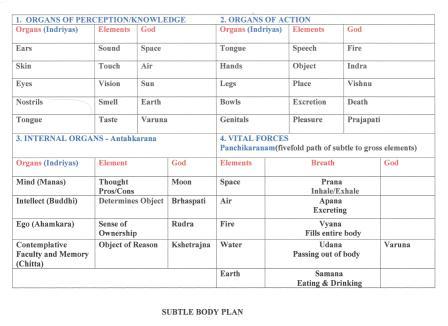
41. Among the five elements (पंच भूत) from the राजस aspect of आकाश, the organ of speech is formed. From the राजस aspect of वायु, the organ of grasping – the hands are formed. From the राजस aspect of अग्नि, the organ of locomotion, the legs are formed. From the राजस aspect of water, the organ of procreation (उपस्थेन्द्रियम्) is formed. From the राजस aspect of पृथ्वी, the organ of excretion , anus (गुदेन्द्रियम्) is formed. From the total राजस aspect of पंच भूत, the पंच प्राण (व्यान, अपान, etc) are formed.
पण्चीकरणम्
42. From the तामस aspect of these पंच भूत, the grossified five elements are formed. If it is asked how this पण्चीकरणम् takes place, it is as follows:
1) the तामस aspect of each of the पंच भूत divides into two equal parts.
2) one half of each remains intact.
3) the other half of each gets divided into four equal parts.
4) then to the intact half of one element, 1/8th portion of each of the other elements gets joined.
5) then पण्चीकरणम् is complete.
6) from each of these grossified, the gross body is formed.
(UV – the तामस is characterised by inertia. That which cannot know itself or illumine another is inert. That which cannot activate itself is inert. Interesting point is that each of the gross element has some property of another (1/8th as given above). The vegetable we eat has starch, protein, chemical viz the earth, water content, it’s own heat, air and occupies space. Even water in the sea has a form, taste, colour and smell and occupies space. Our own body also has all these aspects and when the subtle body leaves the gross body, all elements of our body go back to their original source (air to air, water to water, etc). The death ceremonies in Hinduism carry this idea and hence we burn the body (fire), ashes are immersed in water, etc. A pictorial view should make this clearer.

A sensible question that may be raised now is the connection between the elements referred to by Adi Shankara and the elements of our periodic table. Unfortunately, I am not personally aware of whether such work has indeed been attempted by anyone and if it has, I am not aware of such work. Since I am neither a physicist nor an Adhyamta experienced person, I am not qualified to even attempt to make the connection. However, even a lay understanding needs to settle somewhere – probable hypothesis where I would like to leave it pending further investigation is as below.
The elements described by the Upanishads probably represent the states that have been formed prior to birth of elements of the periodic table like Hydrogen, Carbon, etc. One may add that Upanishads refer to spiritual elements while periodic table refers to elements relating to the “matter” domain. I will leave it at that for now.
43. Thus there is identity between the microcosm (पिण्डांड) and macrocosm (ब्रह्माण्ड).
(UV – this is a very critical statement to be dwelt on. Just like a human body has all these components described above, even the universal body of ईश्वर has all these components. All humans have all these components, all forms of life have all these components and the collective universal also has all these components. Thus, our individual mind is part of total universal mind, our individual intellect is part of universal intellect, etc. )
जीव & ईश्वर
44. The reflection of ब्रह्म which identifies itself with the gross body is known as जीव. The जीव by nature takes ईश्वर to be different from himself or herself. The आत्मा conditioned by अविद्या is called जीव and when conditioned by माया is called as ईश्वर. So long as the notion exists that जीव & ईश्वर are different, which arises on account of difference in the conditionings, remains, till then, there is no redemption from संसार which is of the form of repeated birth and death. Due to that reason, the notion that जीव is different from
ईश्वर should not be accepted.
(UV – this is indeed a bold statement and can stun lay people. No other tradition anywhere in the world including other Indian schools like द्वैत or विसिष्ट अद्वैत make this bold assertion. We individuals are the जीव and feel limited owing to the influence of अविद्या; however, as far as ईश्वर is concerned, माया is in HIS control – that is the real difference. The success of religious endeavours is when one gets the experience of ईश्वर within oneself – this is the claim of अद्वैत propounded by आदि शंकर in line with the declaration of the उपनिषद्.)
तत्वमसि
45. But the जीव is endowed with अहंकार (I-ness) and therefore his ज्ञान is limited whereas ईश्वर is without अहंकार and is therefore omniscient. Then how can there be identity as stated in the महावाक्य – तत्वमसि (You Are That) between these two who are possessed of contrary characteristics.
(UV – it is an obvious Q. How can one say that ईश्वर & जीव are one and the same when evidently there is a difference between both the states of experience? The answer follows. तत्वमसि is one of the four महावाक्य – आदि शंकर picked one most significant and profound line from each वेद संहित and तत्वमसि is picked from the सामवेद).
46. If there exists such a doubt, it is not so. The literal meaning of the word त्वम् is the one identified with the gross and subtle bodies. The implied meaning of the word त्वम् is pure चैतन्यम् (consciousness) which is free from all its conditionings and which is appreciated in the state of समाधि. So also the literal meaning (वाच्यार्थ) of the word तत् is ईश्वर having omniscience and the implied meaning (लक्ष्यार्थ₹ of the word तत् is pure चैतन्यम् (consciousness) which is free from all its conditionings. Thus, there is no contradiction regarding the identity between the जीव & ईश्वर from the standpoint of चैतन्यम् (consciousness).
MAN OF REALISATION (जीवन्मुक्त)
47. Thus by the words of वेदान्त and teachings of the सत्गुरु, those in whom the vision of the Truth (ब्रह्मबुद्धि) in all beings, are liberated (जीवन्मुक्ता:) while living.
(UV – Advaita has some unique claims. One can achieve liberation right here right now. One need not wait to die and then go to some place called heaven. Liberation is a state and not a place at a certain location.).
48. Then who is a जीवन्मुक्ता? Just as one has a firm belief – “I am the body”, “I am a man”, “I am a Brahmin”, “I am a Sudra”, in the same way, one who, by his immediate knowledge b(अपरोक्ष ज्ञान) has firmly ascertained – “I am not the body”, “I am not a man”, “I am not a Brahmin”, “I am not a Sudra” but “I am unattached” and of the nature of सत् चित् आनंद, the effulgent (प्रकाशरूप), the indweller of all (सर्वान्तर्यामी) and the formless awareness (चिदाकाशरूप अस्मि), is a जीवन्मुक्ता.
(UV – this is self-evident. What can be a more clear definition of universal brotherhood than that coming out of these lines. Each of the words used in this Shloka are deep and one can spend hours explaining each concept. These are however relevant when one is meditating since one must keep this vision of oneself and then meditate. प्रत्यक्ष ज्ञान is direct ज्ञान of objects obtained via the senses. परोक्ष ज्ञान is indirect ज्ञान obtained from others via reading or hearing others. It is not available to senses and is not available near the person. अपरोक्ष ज्ञान is also immediate ज्ञान that is neither direst or indirect and it is not of an object that is neither far nor near. We all know “I am”, no senses or hearing from others are not required since such ज्ञान is immediately available to us. The ब्रह्मबुद्धि must also come to us as a form of अपरोक्ष ज्ञान.
49. By अपरोक्ष ज्ञान that I am ब्रह्म alone, one becomes free from the bondage of all कर्म (actions).
(UV – this brings us to the last but very important concept of Hinduism, कर्म without which any of the Indic tradition can never be understood. कर्म means action and the proposition is that all actions done from the perspective of limited “I” generate a deposit in the form of कर्म An action with the intent of benefiting another generates a deposit of good कर्म (पुण्य) while that done with an intent to harm another generates a bad कर्म (पाप) These will keep accumulating in our कर्म Bank. However, any action done as a duty that is indifferent to the outcome and done in a manner that any person in a similar situation will perform a similar action is an actionless action – Chapter 3 and 4 of the Gita dwell at length on the nature of action. Till this कर्म bank is zeroised, one is born again and again to work towards zeroising the Bank. Till this is zeroised, कर्म – whether good or bad is considered a bondage and needs to be got rid of).
50. If it is asked, how many kinds of कर्म are there, (the reply is) there are three kinds of कर्म – आगामि, सण्चित & प्रारब्धेन.
51. The results of actions, good or bad performed by the body of the realized or enlightened आत्मा after the dawn of ज्ञान is known as आगामि.
(UV – animal actions do not generate कर्म since all their actions are done instinctively without a sense of doership unlike that of a human being that are done as doers who exercise choice. Wise man however does not undertake actions with a sense of doership and even though they may be visibly engaged in actions, such actions are आगामि since they do not generate पुण्य or पाप consequences.)
52. The results of actions performed in all the precious births which are in a seed form and giving rise to endless crores of births (in future) are called as सण्चित कर्म.
(UV – all humans are born with an accumulated bank of कर्म known as सण्चित. Some part of this is used up in this life while most of it will be carried forward together with those that are being accumulated in the current life).
53. Having given birth to this body, the actions which give result in this very world in the form of happiness or misery and which can be destroyed only by enjoying or suffering them is called प्रारब्ध कर्म.
(UV – this one is most experienced by us. All our current life experiences are generated by the प्रारब्ध कर्म. If we therefore hit a windfall without working for it, it is a पुण्य that has got used while a sudden unplanned misery means a पाप has been used up. A योगी sees such events differently – if a windfall or a positive experience comes about, Yogi is worried that some पुण्य has been used up and is happy when a misery strikes him since a पाप has been used up or liquidated).
How does one exhaust सण्चित कर्म? (since once this is used up or liquidated, the scope of future births is done away with).
54. सण्चित कर्म is destroyed by the firm knowledge (निश्चयात्मक ज्ञानेन), “I am ब्रह्म alone”.
(UV – once a Yogi identifies himself with the universal consciousness and stops identifying with the limited idea of oneself, the entire capital of actions becomes null and void. It is compared in Yoga literature to roasted seeds since once the seeds are roasted, no more plants or trees can come out of it. Another analogy used is that of space in a pot that has been living with the belief that it is unique and different. Once the pot is broken, the space inside merges with the universal space outside).
55. The आगामि कर्म is also destroyed by knowledge and a wise man is not affected by it – as a lotus leaf is not affected by water on it.
(UV – unlike other leaves which become wet when kept in water, lotus leaf does not become wet even though water goes over it – it remains detached. Similarly, a wise man may perform various actions but they do not generate results because He has no sense of doership for these actions).
56. Further, to those who praise, serve and worship a ज्ञानी, go the results of the good actions done by the wise man. To those who criticise, hate or cause pain to the ज्ञानी go the results of all unpraiseworthy and sinful actions done by the wise.
(UV – with this, one can appreciate why India has had this tradition to serve Sadhus and Sanyasis since by merely serving such people, the benefit passes on to such people. Of course, people may take advantage of such a situation; nevertheless who can say who is wise and who is not 😄. With the ebbing of Hinduism in India, we can of course see such actions to stop altogether. Let us see what shape our country takes for its future).
57. Thus, the आत्मवित् (knower of the Self), having crossed Samsara attains Supreme Bliss here itself. The Sruti (meaning the Vedas) affirm this – the आत्मवित् goes beyond all sorrow. Let the wise man cast off his body in Kashi or in the house of a dog eater, (it is immaterial because) at the time of gaining knowledge itself, he is liberated, being freed from the results of all his actions. So asset the Smritis too.
इति तत्वबोध प्रकरणम् समाप्तम्
 Adhyatma Writings