
VN: True UB without bhakti there is always a chance of a tapasvi and gyani becoming a victim of ahankar .🙏🏻
PK: Hmmm… I am again confused. What is the definition of bhakthi? I have only read the word shraddha in the shlokas which I interpret to mean devoted focus (which is required to attain any knowledge) .., almost like single minded passion – can you define bhakthi for me? It seems to be that the interprets are adding that word.., in conjunction with Karm and gyan … I also remember the word yagya which I take to mean the attitude of gratitude to suffuse through all one’s activities – which seems like an awesome concept! I thought some folks interpreted bhakthimarg as a separate oath although I have not seen that yet either! Thoughts? Is (tapasya, skill in action) and gyan (acquiring knowledge) coupled with a Focus (desire) to learn the eternal truth ( param ) for its own sake without ego etc not yoga? a new word kaivalya was used in the last para which sounds like the same thing?
UB: He who is absorbed in Me and with श्रद्धा seeks Me – this last verse is the Bhakti element. This element will find expansion in Chapter 12. कैवल्य, निर्वाण, Unity Consciousness, Moksha, etc all mean the same thing.
VB: I liked the fact that what we do does not go to a waste. Getting born into a family that encourages the journey is helpful. Gives some meaning and importance to what we do in this life. Obviously, I need to believe in rebirth. Which though I have no real proof of, I have to believe in as part of the larger framework of our religion. I have a mathematical question. If a person is reborn as a another human, or gets out of the cycle or is born again as some other life form
UB: Is the Q over?
VB: Is the number of such life forms constant I.e. number of souls constant. And I know u touched upon briefly earlier, where does heaven and hell appear in this cycle?
UB: These are tough questions to answer. My own sense is that there are varying opinions on this point. Besides, they say that Truth or Reality is very complex for human mind to understand. More later once I reach home 😀
PA: PK very very good questions and thoughts 👏🏻👍👍
UB: As per Puranas, there are 14 Lokas and our physical Earth is one of them where all life forms have a certain sensual way of life. But there are other Lokas – like प्रेत, यक्ष, गंधर्व, देव, etc where life ecosystem is different. The सूक्ष्मता component of each loka is different. Overall, there is mention of 85 Lakh forms into which one can experience life. Now, between two life forms, we have this experience of heaven or hell – now heaven is a Loka above Earth and Hell is one below Earth and in the pecking order, Earth is the 7th from top in the सूक्ष्मता order.
UB: Now to your Q – are the number of life forms fixed, there are varying answers. As per योग or सांख्य schools, there are innumerable आत्मा which live alongside परम्. However, Advaita states that there is only One and they state that liberation is a state where the river merges into Ocean. So we as the river become one with the ocean or we become the ocean. But in the interim, the ONE takes many life forms to live out our Vasanas. Even as of now, we may be simultaneously living out multiple life forms. That is all I have as even I am not clear on many details given in these texts.
UB: VB – Life within us has 3 parts. आत्मा + सूक्ष्म शरीर + स्थूल शरीर
आत्मा – Reality which is present everywhere and at all times and present in all
सूक्ष्म शरीर = अहंकार + मन + बुद्धि
स्थूल शरीर = प्राण + Physical aspects of the body that merge into Earth post death.
सूक्ष्म शरीर is a “Unit” for experiencing life. Post death, सूक्ष्म शरीर continues to exist and move on to gain newer experiences. It is this that is equivalent of the word “soul” and it is this that continues to live in either of the 14 Lokas till it realizes that the purpose for which it came into being has been realized.
Liberation means that अहंकार drops away and thus मन + बुद्धि cease to have any meaning to live life as a limited Unit of experience. Thus they merge into आत्मा. Essentially, we in our limited lower forms cease to exist but we exist as the आत्मा as a river in an ocean.
This may sound depressing but there are more glamourised descriptions in Puranas which use the language that one who gains Mukti stays forever in वैकुण्ठ with Narayana रूप or in कैलाश with a शिव रूप. But dig deeper and it becomes obvious that वैकुण्ठ/ कैलाश are not physical places like Earth but represent state of being. Now that I will revealed my own confusion, I will shut up. 😀😀😀
PA: It’s so wonderfully put by you UB 👏🏻👏🏻 Ahankar drops away and the limited form of existence ceases to be … So wonderfully said
PA: This is a interesting concept of we may be simultaneously living out multiple form!! This has been talked about in science fiction too – paralllel reality – amazing!! That’s where the linear concept of time does not exist. Any more details would be great as this is so fascinating
UB: Parvindar – In his commentary on योग पतंजलि, विवेकानन्द has referred to Yogis simultaneously creating multiple bodies to exhaust their Karma stock more quickly so that they can drain themselves more quickly and merge with the One. In the life of आदि शंकराचार्य, in his debate with मंडन मिश्र, शंकराचार्य is said to have left his body and entered the body of a dead king, learnt about conjugal life using King’s body and returned back armed with this knowledge to defeat his opponent. But above all, the text of योग वसिष्ठ is the most unusual text where there are events of multiple lives lived in a parallel time scale by the same person – story of Lila or Shukra in YV are available on Google and these put most modern Science fiction movies like Inception to shame 😀. Any normal person should make an attempt to read YV at least once in their lifetime. Fascinating text very different and unique among all Indian texts….
PA: Waoo ! I was just thinking about the movie inception! However is it possible that we normal people are also living parallel lives?
UB: No idea really – it seems theoretically feasible. After all, what are we other than Vasana filled Jivas. To fulfill the Vasanas, we take जन्म. Since Vasanas drive what we do, it definitely seems possible that many bodies can be generated just like multiple robots can be manufactured to support factory activities. So it does seem conceivable but….😀
PA: Thanks 🙏🏻 UB. Our school prayer which can now be understood with a different perspective;
ॐ असतो मा सद्गमय ।
तमसो मा ज्योतिर्गमय ।
मृत्योर्मा अमृतं गमय ।
ॐ शान्तिः शान्तिः शान्तिः ॥
Om Asato Maa Sad-Gamaya |
Tamaso Maa Jyotir-Gamaya |
Mrtyor-Maa Amrtam Gamaya |
Om Shaantih Shaantih Shaantih ||
Meaning:
1: Om, (O Lord) Keep me not in the Unreality (of the bondage of the Phenomenal World), but lead me towards the Reality (of the Eternal Self),
2: (O Lord) Keep me not in the Darkness (of Ignorance), but lead me towards the Light (of Spiritual Knowledge),
3: (O Lord) Keep me not in the (Fear of) Death (due to the bondage of the Mortal World), but lead me towards the Immortality (gained by the Knowledge of the Immortal Self beyond Death),
4: Om, (May there be) Peace, Peace, Peace (at the the three levels – Adidaivika, Adibhautika and Adhyatmika).
UB: Indeed – many meanings are only becoming known now 👍😀. The 8th Chapter begins with a Q by Arjuna seeking the meaning of three levels – Adhibhautika, etc.
VN: 🙏🏻brought back old memories
PA: Yes UB been busy will Diwali celebrations. Until now I have not been able to put down a summary for the chapter 6. Looks like this will happen sometime next week from my side. Sorry for that 🙏 Let us see how our dear PK thinks about it. Perhaps she has put up something. UB I have another book from S Radhakrishnan on the BG which I was reading and found it quite nice 👍
UB: 👍👍 No problem – no need to do summary – I was just joking. I have not read the Sarvapalli version but I am sure it must be interesting
PK: Thank you – I am in the midst of re- reading chapter 6 ( up to 6-24 with summary done) – and I would like to continue . I will try to work on it today if I get some down time- it’s a research day for me today before I head to Chicago tomorrow and this summary qualifies me thinks🙏🙏🙏
UB: BTW, summary of CH 5 has not been done too. http://www.swami-krishnananda.org/bgita/bgita_18.html. Swami Krishnananda’s summary of first 6 chapters will be a useful reference
PK: I know – chapter 6 seemed harder so I thought I would start with that !
UB: 👍👍
PK: It’s difficult but fun-, thank you again for this ! I am learning a lot 😃
PA: Wao PK that’s so great that you have already done half of the summary 👏🏻👏🏻🙏🏻🙏🏻👍
PK: I finished my summary 😃… GITA Chapter 6 summary
When one performs Karm without attachments to results (karmphal) he is considered not just a sanyasi but also a Yogi. A sanyasi who has abdicated the routine life including performing any karm (worthwhile actions is my interpretation) may be considered a sanyasi by the world but not a karmyogi. It is essential to give up Sankalp (defined here as mindset of want or desire) to be a karmyogi which goes beyond external appearances of an attitude of giving up actions/participation in worldly activities. (6-1 and 6-2)
I liked this part where the ability to be a karmyogi did not necessarily require an abdication from worldly life. The word सङ्कल्पः was interesting though- I though t it meant strength of mind to stick to a decision and have never heard this word in this context until this shloka. It was used with different meanings in 6-3 and 6-4 which was confusing. J Bottom-line though seems to be the goal of giving up sankalp and maintaining शम.
To achieve ध्यानयोग dhyanyog ( i.e. meditation), the path is through karmyog , but for one who is already at dhyanyog, maintaining शम ( total renunciation) is the way. At that point one is neither attached to sense objects or karm and is beyond sankalp ( 6-3 and 6-4)
I am wrapping my head around this and am not sure I get this at all. Sounds to me that at some point total abdication are recommended 9(contrary to shlokas above ) but I am presuming we are all far away from this stage so we shall proceed onwards.
6-5 and 6-6 : Important and worth memorizing in my opinion “ 6-5 Uddhared atmanatmanam, Naatmaanam avasadayet, Aatmaiva hy Atmano bandhur Atmaiva ripur atmanah “; Let a man raise himself by his own efforts. Let him not degrade himself. Because a person’s best friend or worst enemy is none other than his own self.
This verse reminds me of Rabbi Hillel’s questions “ IF I am not for myself, who is for me ? When I am for myself , what am I ? If not now, when? It reminds me that every thinking individual faces this constant struggle for a balance between self (self-interest?) and service to others.
Descriptions of a Yogi and (expansion of concept of samaadarshan) as one who is tranquil and contented in himself , unaffected by physical/mental attributes ( heat /cold, happy/sad, praise/blame), physical objects and treats everyone the same( vasudhaiva kutumbukam) {6-7, 6-8, 6-9}
Description of physical and mental attributes as well as goal required for Dhyanyog ( meditation): One needs to be alone, in a quiet location, relaxed in both body and mind and unattached to worldly possessions and mental cravings and focus on Param. The seat should be comfortable and clean . One should focus ( ekagram) one’s mind and practice. The meditators body should be still, spine erect and looking straight ahead ( 6-10.6-11 ,6-12, 6-13 ). The tranquil mind should focus, think and be centered on ME alone (paramnirvan) {6-14,6-15}.
I was intrigued by the inclusion of Brahmachari in 6-14 . “ One’s commitment to the life of a ब्रह्मचारि (ब्रह्मचारिव्रते), – if that is true then what happens to us ? Needs more clarity and for now a little aspect to ignore in my 2 centsJ
Emphasis on moderation: One should be moderate in all daily activities like eating, sleeping ( neither too little nor too much), moderate in effort expended for one ‘s duties (युक्तचेष्टस्य कर्मसु), ) in order to be happy.( 6-16, 6-17)
I like this “way of the middle”- Reminded me of Lincoln’s quote ” It has been my experience that folks who have no vices have very few virtues”. The “work hard and party hard” ethos is inevitable in modern life and probably results as an average in moderation. This happens to me fairly frequently but is probably counterproductive if done constantly ) J . विवेक buddhi seems to be the key to me (more than moderation).
The goal we are striving for “ the mind mastered by practice of yoga, abides in atman, seeing oneself (आत्मानम्) by oneself (आत्मना) alone (एव), one rejoices (तुष्यति) in oneself (आत्मनि).( 6-20)
With the help of the mind to control the senses and buddhi ( more subtle than mind) held by firm resolution , one should restrain from desire and withdraw from external distractions and focus on param or atman . Goal is to be constantly aligning the mind and buddhi inwards towards the atman rather than outwards towards senses and external distractions. This will happen slowly (शनै शनै). When the mind wanders ( chanchal) as it surely will, we should get it back to focusing on atman ( 6-24,6-25 and 6-26).
Developing a प्रशांत चेतस्, (tranquil mind) by avoiding distractions from external world one attains उत्तमम् सुखम् from the experience of ब्रह्म स्पर्श (Touch of the Divine), ( 6-27 and 6-28)
For me, this is easier said than done- yet here the (शनै शनै) philosophy gives me hope- two steps forward and one step back.
One who sees ME everywhere , sees ME as existing in everything (सर्वभूत आत्मा) , is never lost (6-29, 6-30, 6-31)
I like this view of samadrashan- we are all parts of the same cosmic unity; I also think this is hard and requires immense will and effort.
I agree with David Foster Wallace’s take on this ( one of my favorite)
“ Being conscious and aware enough to choose what you pay attention to and to choose how you construct meaning from experience. The really important kind of freedom involves attention and awareness and discipline, and being able truly to care about other people and to sacrifice for them over and over in myriad petty, unsexy ways every day. That is real freedom. That is being educated, and understanding how to think. The alternative is unconsciousness, the default setting, the rat race, the constant gnawing sense of having had, and lost, some infinite thing.
O अर्जुन, that योगी is considered the best who judges what is सुखम् & दु:खम् in all beings by the same standard as he would apply to himself ( 6-32)
I really like the concept described in this shloka; similar to Socrates ” Do not do to others what angers you if done to you by others.”
The mind is difficult to restrain ( as it is chanchal) but can be done with diligent ( निरंतर), mindful , vigilant and passionate practice (अभ्यास) and letting go of attachments to physical and emotional worldly objects/emotions recognizing their imperfect nature वैराग्य ( detachment/dispassion. Striving for yog/ param with a mind under control (वश्य आत्मना) using right means is the advice given by Lord Krishna. (6-35, 6-36)
I thought this was a good description
What is the fate of one who may have faith/conviction but who fails to achieve the desired outcome through lack of diligence or distraction? Does he get ruined? Please enlighten me and remove my doubts ((संशय)) ( 6-37, 6-38, 6-39)
There is no loss for anyone in either this life or in the after-life for anyone engaged in this worthy goal of dharm/ब्रह्म (ब्रह्मणःपथि), /union with ME does not meet with a deplorable end. ( 6-41)
I like this concept of no loss of effort as we go through this journey. All knowledge that is accrued/ modifications of thought and actions that ensue can only be positive- I take this to be a सनातन सत्य. We may fall off the wagon periodically owing to distraction/ responsibilities . We should then get back to it ( abhyas and viaragya principles) and be a वश्य आत्मना i.e. bring the mind under our control using the attributes of our natural inclinations/strengths/knowledge .This is the part which becomes our individual journeys based on our Svabhav.
The knowledge acquired in a previous birth will be carried over as a natural disposition ( connection with an intellect (बुद्धि संयोगं) . The power of his Abhyas done previously he will propel forward either from curiosity or against his will and achieve the ultimate goal. ( 6-43, 6;44)
I am still unsure about the reincarnation aspect but the basic premise about natural inclinations/interest I totally accept ( the nature vs nurture concept).
A yogi is superior to a tapasvi ( doing prayers/austerities/renunciations) , men performing karm ( detached actions/hard work) or a gyani ( on path of acquiring knowledge) therefore Krishna urges Arjuna to become a yogi ( योगी भव).( 6-46)
Krishna says that among the yogis, the one who is dedicated to ME and seeks ME with shraddha, I consider him to be the best. (6-47)
End of Dhyanyog
Key concepts/take-away
- Importance of giving up Sankalp ( defined here as mindset of want or desire) to become a karmyogi
- The path to Dhyanyog is through Karmyog
- Uddhared atmanatmanam, Naatmaanam avasadayet, Aatmaiva hy Atmano bandhur Atmaiva ripur atmanah “ (6-5) – our thoughts and our actions create our reality.
- Expansion of attitude of smadarshan
- Dhyanyog details including emphasis on moderation
- Developing a प्रशांत चेतस्, ( tranquil mind)
- Align the mind and buddhi शनै शनै using abhyas and vairagya to attain the ब्रह्म स्पर्श and vision of सर्वभूत आत्मा)
- योगी भव ( beyond tapasvi, performing karm or gyani)
VG: Thanks PK , nice summary.
VN: Wow PK 🙏🏻summary 👌🏻
UB: First things first, enjoyed your summary. You have emphasized on all key points. Few comments:
1) Never heard of David Foster & Rabi Hillel. Good to know some new names. Did Rabi also provide answers to the questions raised? DF lines were good.
2) Behind all our actions is a thought. While we have many thoughts, it is one of them that becomes दृढ; once our mind firms up to this thought viz the संकल्प, we act in line with this thought. So the meaning of संकल्प as per you and the verse is the same – not sure what you found unclear. Let me know.
3) You mentioned difficulty in connecting with the idea of total abdication. Essentially, at earlier stages, the idea of giving up is experienced; giving up food, giving up काम, etc for doing meditation. However, once we evolve, this idea of giving up goes away once food no longer appeals to us since one does not give up that which is unappealing anyway.
4) Intrigued by ब्रह्मचारी word – one meaning of the word is to be a celibate but not the only one. The word has two parts – ब्रह्म + चर meaning one who walks the path of ब्रह्म. Given that ब्रह्म will look at all parts of his creation with equal eye, one who is a ब्रह्मचारी also acts like ब्रह्म (detached or maybe attached equally to all). In this state, one thus does what one is meant to do at a certain point of time rather than getting digressed owing to prejudices, likes or dislikes.
5) Your mathematical approach to moderation was very funny viz average of work hard and play hard is also an average. Hahahahahaha. Definitely this was not the intent of श्रीकृष्ण.
6) I understand the discomfort with पुनर्जन्म. This is however the most fitting explanation to many Qs. One may say – just because the explanation fits does not mean it is true. That is a fair point but I have decided to take the best answer available now as true till I get a better answer.
Once again, enjoyed your summary.
PK: Thanks UB 🙏🙏🙏 If sankalp is firming of intention why do they emphasize giving up sankalp? I thought sankalp towards attaining the eternal truth is good and desirable ..,that is my confusion. Check out David foster Wallace’ s 3095 commencement speech called “this is water” .., you should be able to google it ..,interesting especially when you know his life story .., he was considered one of Ametica’s most talented and promising young writers before his untimely death in 2008 by suicide. 2005 commencement speech
UB: Understand the point of the confusion – see Swami Krishnananda’s commentary on the word Samkalpa which will probably address the issue. A Sannyasin has another quality: he does not will that something has to be done. He has no volition in any particular direction. He does not decide that something should be ‘like this’, and he does not decide that it should not be ‘like this’. Such a decision, such a determination, such a wish does not arise in his mind. He has no sankalpa.Sankalpa means a kind of desire-filled determination of the will. As a Sannyasin does not have any desire, he cannot have a determination in respect of doing something and avoiding something else. The Sannyasin, having withdrawn his self from contact with sense objects, cannot have a desire to decide matters in favour of certain things or against certain other things. Na hy asaṁnyastasaṁkalpo yogī bhavati kaścana: A person who isasaṁnyasta-saṅkalpa—that is, a person who has not freed himself from this desire-filled willing in terms of achievements in the world—such a person who has not attained this freedom cannot become a yogi.
PK: 🙏🙏🙏… that makes sense -,will check out commentary of sankalp
UB: Enjoyed the 10 page speech – be aware of your default setting and then choose the setting wisely. He mentioned about over-intellectualizing as well as suicide in his speech and he did eventually commit suicide 3 years later. Wonder what happened? Will read more. Thanks again for sending this….
VN: This explanation was very helpful for me too. What I personally feel is doing anything with sankalp is having expectations which can become the cause of your miseries. I also believe in not thinking too much about the future but going with the flow. Over a period of time as we move towards “param” the pain of taking decisions diminishes and what is right will be done. Not very good with words but this is what I understand🙂
PA: What a wonderful summary laxmi PK . Thanks for sharing that with us 👍👏👍👍 🙏🏻
HB: Nice summary, PK . Liked the explanation given by UB.
UB: PK – this man David Foster seems like a very brilliant man but extremely messed up in personal life
PA: Great thoughts VN thanks for sharing 🙏👍
PK: You are correct UB – brilliant but a severe depressive on medications .. many of which did not work for him. Apparently that he would go off when he was creative … they say he was off medications when he shot himself – his writings are brilliant though – incisive , thoughtful , occasionally very blunt to the point of rude/ vulgar but always honest – would have been very interesting to see him mature as a writer and person but that is not to be 🙏
PK: VN : agree with PA – very interesting thoughts – probably occurs more as we enter midlife/ old age . I have to confess that I feel that the attitude of sankalp is quite useful in achieving success at least when one is young -( kids, youth etc) ; letting go of sankalp advice requires a level of maturity but agree with you that it probably useful to go with the flow as one matures / ages/ hopefully becomes slightly wiser about the vagaries of life and limitations of control. Wallace IMO was an example of brilliance in a setting of mental illness – his mind and buddhi were harder to control I guess for him than for us usual folks yet he could create 🙏. I have also been intrigued by his paragraph in that lecture on how no one is really an atheist – we all worship something -either consciously or unconsciously and the important thing is to be aware constantly like you said.
UB: Yes – everyone worships one Devata or another using the Gita language 😀 As stated earlier, we will discuss the description of God from Chapter 7 onwards – so it is a new turn from what we have been discussing thus far
HB: Sounds good. I have completed upto 4.22 today😇
UB: 👍
VB: Great going
HB: It a a very big chapter. I can say with conviction that I am thoroughly confused. And I almost thought that chapter was over at 4.22 till I read PK’s summary. Looks like there is more to go…. Felt like Arjuna. But I am not giving up😂
PK: 😂😂.., I agree HA! Lots of info to process
HB: 😄😄
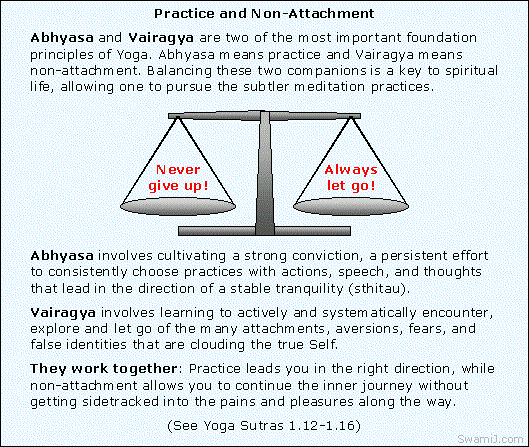
PA: I just love the picture that you have posted of balancing vairagya and abhyasa !!
Never give up and always let go ! What a wonderful way to remember the importance of two basics forces that we encounter every day and balancing the two at each moment. If one suddenly interprets non attachment to non action we know the left side of the balance is empty as we are lazy and tamsik . Similarly the other way around too much effort / not giving up leads us to clinginess and stubbornness which leads to anger. Just knowing this subtle difference is already going to help us putting back on the middle of we sway to one side too much. Another perspective 😊
PK: Perfectly put PA 🙏🙏 Loved the practical way you have described it 👌
 Adhyatma Writings