
तपः स्वाध्यायेश्वरप्रणिधानानि क्रियायोग: ।।१।।
तपः – austerity, स्वाध्याय – self-study, ईश्वर प्रणिधान – submission to ईश्वर, क्रियायोग:
तप, स्वाध्याय & ईश्वर प्रणिधान are (together referred to as) क्रियायोग
In समाधि पाद, पतंजलि dwelt on समाधि and वृत्ति. In साधना पाद, He will dwell deeper into the functioning of the चित्त. अभ्यास & वैराग्य were conveyed as the way to be adopted by a योगी in the समाधि पाद – these two are however doable only for an advanced योगी whose mind has predominance of सत्व. However, सामान्य जन (or a beginner योगी) have an outgoing mind that is under the influence of रजस् & तमस्. For such persons, before one attempts to subdue the वृत्ति, one must take up चित्त शुद्धि (purification of चित्त). चित्त शुद्धि can be attained by what this सूत्र refers to as क्रियायोग (श्रीमदभगवद्गीता uses the words कर्मयोग) that is a more action-oriented method. क्रियायोग is comprised of three means – तप, स्वाध्याय & ईश्वर प्रणिधान.
तप means इंद्रिय निग्रह – controlling the quantity, quality and regularity of one’s food intake as well as quality of what one reads and talks about. In other words, activities of the senses are being made more & more सात्विक. Says व्यास – no तप, then no योग. Deeply ingrained संस्कार cannot be removed without self-discipline. विज्ञानभिक्षु adds that this process must be gradual that will not disrupt the clarity of mind and weaken the body. Even आदिशंकर adds here that if one practices तप that disturbs the mind, it defeats the entire purpose of योग to still the mind. रामानन्द सरस्वती considers तप to include ब्रह्मचर्य, गुरु सेवा, सत्य-वाक्, keeping मौनम्, doing धर्म, tolerance of extremes (तितिक्षा) and controlled intake of food.
व्यास defines स्वाध्याय as जप viz repetitive chanting of मंत्र such as ॐ and study of शास्त्र. From स्वाध्याय, an aspiring योगी gains ज्ञान and inspiration. व्यास defines ईश्वर प्रणिधान as dedication of all actions to ईश्वर and renunciation of the longing of all fruits that may accrue from one’s action. विज्ञानभिक्षु notes that submission to ईश्वर in the समाधि पाद required योगी to focus on ईश्वर as an object of ध्यान (viz concentration on His name and its meaning). क्रिया़योग is more action-oriented. Thus, total inward ध्यान is for advanced योगी while action-centered practices is for minds which are still outward inclined. Most commentaries quote Gita extensively to convey the meaning of ईश्वर प्रणिधान. विज्ञानभिक्षु notes that क्रियायोग incorporates कर्मयोग by using तप, ज्ञानयोग by using स्वाध्याय and भक्तियोग by using ईश्वर प्रणिधान as essential actions to be done by outward-focussed minds.
समाधिभावनार्थ: क्लेशतनूकरणार्थश्च ।।२।।
समाधि – meditative absorption, भावना – bringing about, अर्थ: – for the purpose of, क्लेश – afflictions, तनू – weak, करण – making, अर्थ: – for the purpose of, च – and
(क्रियायोग) is for bringing about समाधि and for weakening of the क्लेश (afflictions).
Just as we learnt five kinds of वृत्ति in the समाधि पाद, five kinds of क्लेश are referred to in साधना पाद – what is क्लेश? Root cause of वृत्ति (or movement of mind) are the क्लेश (afflictions) present in us. And while वृत्ति can be क्लिष्ट or अक्लिष्ट (harmful or beneficial), क्लेश obstructs from having a clear vision thus influencing वृत्ति. Stronger क्लेश leads to our mind moving about in harmful ways while weaker क्लेश means our वृत्ति will move in beneficial ways. आदिशंकर says that it is क्लेश that obstructs us from seeing the difference between प्रकृति & पुरुष even though we may appreciate this theoretically. क्रियायोग weakens the रजस् & तमस् tendencies to manifest within us and with क्लेश weakened, सत्व is enhanced which in turn enhances our विवेक culminating in developing ability to know difference between प्रकृति & पुरुष. Five क्लेश are listed in the next सूत्र.
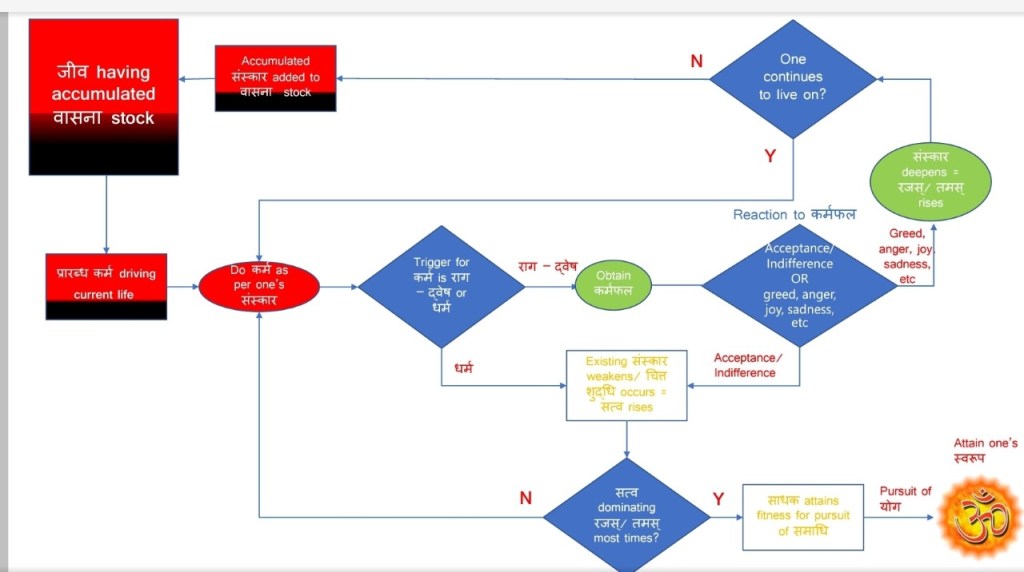
A quick recap of our current state of life may be useful here. We are a जीव (since our पुरुष state eludes us). Over crores of lives, we have accumulated a lot of वासना stock. Out of this stock, some संस्कार gets released into our current life and this stock is our प्रारब्ध कर्म for this life. Our habitual conduct of this life is driven by the stock of संस्कार of this life. कर्म of previous lives gives us फल for this life (house that we are born into, wealth, education, etc) as well as influences फल that we attain during the course of our life. Our संस्कार propels us to do कर्म (conceived as goals of life) which then gives us a certain type of कर्मफल. This कर्मफल in turn generates a reaction – attachment, aversion, anger, fear, joy, etc. Such reactions in turn deepen our pre-exisiting stock of संस्कार. This in turn propels us to do more कर्म, which again gives us कर्मफल that in turns deepens our pre-existing संस्कार and thus we keep on depositing additional load of संस्कार into our वासना bank. As long as वासना stock exists, we keep doing कर्म after कर्म which in turn means we have to be born again and again to experience कर्मफल that we have not yet experienced in our previous lives – this is inevitable.
So is there a way out? We do not have control over our प्रारब्ध since this is an outcome of earlier कर्म done. कर्मफल we get from our कर्म in this life is deeply influenced by our past कर्म and thus what we get may be much more or much less than the कर्म put in now. We do not have control over our mental predisposition, our संस्कार, since these orientations are habits ingrained by us from our previous lives. And habits are difficult to change. So what do we have control over?
We have control over how we react to the कर्मफल that we attain. So whether the कर्मफल is tuned to our expectations or not, cultivating an indifference is an option just as a gain or loss of Rs 500 for a person having a corpus of Rs 10000 crores does not generate any reaction. कर्मफल keeps happening by doing कर्म as per one’s प्रारब्ध – if emotion of joy or disgust is our reaction, संस्कार deepens but if one is indifferent or accepting of any outcome for a कर्म done well, one does not add to संस्कार stock.
Do we have control over our own कर्म? In a sense, one may say “No” here since we are all bound by our own habits (meaning our संस्कार). We are not free from our own good and bad habits. However, शास्त्र prescribes कर्म that may or may not be aligned to our संस्कार (say नित्यपूजा, दानकर्म, सत्यम् वद, etc). So when one follows rules as per शास्त्र, one is not following one’s own संस्कार but that of a ऋषि. And when does कर्म as per शास्त्र, then one is not doing one’s OWN कर्म and if fact may be going against our own संस्कार. Such कर्म then becomes धर्म and this has two benefits – 1) acts of धर्म do not add to संस्कार stock and 2) existing stock of संस्कार comes down – this is because when one is doing धर्म, emotional anticipation to the फल goes away and one accepts whatever फल we get as a प्रसाद of ईश्वर.
By क्रियायोग, the संस्कार stock depletes, our habitual conduct weakens, रजस् & तमस् tendencies (क्लेश) also weaken as a result, सत्व rises which facilitates clarity of thought that reduce distractions, make our mind calmer and thus cultivate अभ्यास & वैराग्य which is necessary for समाधि. One needs to add here that as संस्कार stock depletes, need to do more कर्म comes down, need to experience certain कर्मफल also comes down and need to lead multiple lives also comes down.
Vasana Karma Dharma Cycle Flowchart
HB: Are u saying acceptance or indifference leads to chit shuddhi ?
UV: मा फलेषु कदाचन – this is how I have understood it.
HB: Acceptance come from faith but indifference … very interesting
PA: I think indifference means not being numb to what is happening or to the karmphal but not be overly joyful and overly sad then things Turn sometimes as per our expectations / desires and sometimes not
UV: That is correct – indifference is more related to how one experiences कर्मफल. If the reaction is ecstacy or depression, then it cannot be seen as indifference. Just as a person desperate to become CEO of a company remains unmoved even when he or she gets large bonus or praise from colleagues, such is the kind of indifference to life experiences is what we are referring to here. A sort of detachment with any material, emotional attainments – good or bad
अविद्यास्मितारागद्वेषाभिनिवेशा: क्लेशा: ।।३।।
अविद्या – ignorance, अस्मिता – ego, राग – attachment or longing, द्वेष – aversion, अभिनिवेशा: – clinging to life क्लेश: – afflictions
The impediments (to समाधि) are अविद्या (ignorance), अस्मिता (ego), राग (attachment or longing), द्वेष (aversion), अभिनिवेशा: (clinging to life)
These five are expressed as universal root causes that affect all minds. Every other emotion or state of mind springs from these five only. One may thus understand क्लेश operating as primary drivers that make all minds move in a certain manner. The day all क्लेश are eliminated, mind also forgets the need to cognize anything at all. Mind, as we have said, signifies movement or वृति. And the mind moves towards प्रमाण, विकल्प, निद्रा, etc only because these five क्लेश are present in all minds at all times.
Sheer simplicity of listing these five as primal root causes for all human actions is fascinating. From अभिनिवेशा comes all कर्म done by us for survival – need for security, chasing and hoarding wealth, health obsessions, fears (from loss of security), etc. From राग comes all कर्म that propel us towards what we love, ambitions, desires, lust, seeking of fame and राग also takes us to greed, frustrations (if needs not met), etc. द्वेष inculcates dislikes, feelings of hatred, avoiding of certain experiences, pursuit of obsessive enmities, etc. Ego deepens our identity as an individual separate from others and creates barriers in connecting with others at all times. Finally, अविद्या keeps the knowledge of our true identity as पुरुष hidden from us. What else is there for any human life other than multitude of actions springing from these primal root causes that engage our minds? Details on what each क्लेश stands for will follow in later सूत्र
PA: Indulging in for example Rag Dwesh False Ego and clinging to life further enhances our Avidya from which these Kleshes enhances further. The cycle of karamphal continues Sanskar deepened and the „joy“ ride continues 😀
अविद्या क्षेत्रम् उत्तरेषां प्रसुप्ततनुविच्छिन्नोदाराणाम् ।। ४।।
अविद्या – ignorance, क्षेत्रम् – field, उत्तरेषां – of the others, प्रसुप्त – dormant, तनु – weak, विच्छिन्न – interrupted, intermittent, उदाराणाम् – activated, manifest
अविद्या is the breeding ground of the other क्लेश, whether they are in a dormant, weak, intermittent or fully activated state.
अविद्या is the foundation of other क्लेश; what exactly is अविद्या will be conveyed in the next सूत्र. Says आदिशंकर – just as a piece of land is the substratum for bushes, creepers, grass, etc., अविद्या supports other क्लेश. Interesting point made here is that all the क्लेश are not manifest all the time – some are dormant for some time or even for one or two lives before they reactivate when certain situations or contexts emerge and thus serve as triggers. Then what has been प्रसुप्त (dormant) will become उदार (fully activated). At other times, these क्लेश will be विच्छिन्न or intermittent meaning they come and go. व्यास says that when aversion for something is present, attachment becomes latent at such a time and vice versa.
व्यास uses a rare sense of humour to state that just because चैत्र is attracted to one particular woman at one point of time does not mean he is disinterested in other women; it is just that he is interested in one particular woman at this point of time – same goes for how क्लेश also operates 😂. व्यास says that when one consciously cultivates a state of mind that is opposite to क्लेश, they become weak. Thus व्यास says that right knowledge dispels अविद्या, discrimination between पुरुष & प्रकृति dispels अस्मिता, detachment dispels both राग & द्वेष and realization of eternality of the आत्मा dispels क्लेश of clinging to life. More details will follow.
अनित्याशुचिदु:खानात्मसु नित्यशुचिसुखात्मख्यातिरविद्या ।। ५।।
अनित्य – temporal, non-eternal, अशुचि – impure, दु:ख – painful, अनात्मसु – that which is not आत्म, नित्य – eternal, शुचि – pure, सुख – joyful, आत्म – self, ख्याति: – notion, perception, अविद्या – ignorance
अविद्या is the notion that takes the आत्मा, which is joyful, pure and eternal to be the अनात्मा (non-self) which is painful, unclean and temporary.
What is called as माया at the cosmic level is अविद्या at an individual level. अविद्या has its seat in बुद्धि (intellect). अविद्या means not only absence of ज्ञान, but also erroneous ज्ञान. A man trapped in अविद्या does not know what is real and thinks that the appearances are real. An individual identifies himself with empirical self, equating his existence with the physical body. Under the influence of अविद्या, he dissociates himself from the Ultimate Reality. When the man acquires ज्ञान, the duality of the प्रकृति and पुरुष disappears. He realizes that the जीव is really one with पुरुष . This realization of the पुरुष puts an end to the अविद्या. वेदान्त texts refer to two aspects of अविद्या – आवरण शक्ति & विक्षेप शक्ति. The former refers to covering aspect and latter refers to projection aspect. Owing to presence of अविद्या, the true reality of our identity as पुरुष is covered up and instead, what gets projected to us (and thereby seen by us) is that of a separate person cut off from others as well as the universe. Thus, outward orientation comes from विक्षेप शक्ति.
Let us now turn to पतंजलि who uses the word अशुचि (impure/ unclean) for the body. The ascetic traditions use strong language to describe the body as a receptacle of mucus, bones, pus, sweat, urine, etc. While true, it is difficult to hear this language for many of us though the intent may be to startle us to take on to योग with more fervour. आयुर्वेद defines body as a complex combination of substances that need to be kept in appropriate balance; कामशास्त्र sees body as a means for intense sensual enjoyment in skillfully manipulated circumstances, तंत्र considers body as a manifestation of चित्शक्ति while भक्ति traditions see body as a temple that can be used in service of ईश्वर. All these may not be seen as mutually exclusive and are conveying the idea that our body is not our identity in different ways. Ascetic traditions describe our body as an abode of अशुचि adding that our real identity viz that of आत्मा is शुचि (clean, pure). Yearning for आत्मा thus becomes a quest to shed अशुचि and regain our शुचि state of being.
अनात्मा thus means having an idea of ourselves as having a distinct काया, मनस्, बुद्धि, स्मृति and अहंकार separate from everyone else – this separation makes us a जीव or अनात्मा. So what is आत्मा? Words used are नित्य, सुख and शुचि. There is something नित्य or eternal about us. Most of us live life as if we will live forever. Even a 95 year old person is animated about who will win the next local elections 😂. The fact that death, even though natural to अनात्मा, makes us uneasy is because it somehow militates against our innate idea of eternality of our being. And सुख mentioned here is not the temporal joy (e.g., good food, material gains) but bliss or joy that is again the most natural identity of our being. The fact that everyone chases सुख most naturally is because our real state of being is आनन्द. Just as a spring comes back to its state after releasing pressure on it, all beings also seek शुचि, नित्यता & आनन्द as our most legitimate pursuits.
यथा दृष्टि, तथा दर्शन (how one sees, thus one experiences). But because of presence of अविद्या, we end up suffering from a दृष्टि-दोष and thus while our need for pursuit of शुचि, सुख & नित्यता is innate, our दोष makes us seek these in a wrong direction. When we see ourselves as young kids, we chase toys, as young adults, we chase other young adults and as old persons, we seek joys from our children and grandchildren. As we impose an artificial identity on ourselves, we seek experiences that are tuned with our self-imposed identity. And thus as अनात्मा, we seek शुचि, सुख & नित्यता from external objects (e.g., शुचि from having bath or cleaning house alone, नित्यता by researching for drugs to attain immortality and आनन्द by seeking material gains). But when we develop a दृष्टि that our identity is that of पुरुष, we then orient ourselves to have दर्शन of ईश्वर and the temporal states of our body, mind, etc cease to have a hold on the nature of expecriences that we seek.
दृग्दर्शनशक्त्योरेकात्मतेवास्मिता ।।६।।
दृक् – subjective power of seeing, the seer, दर्शन – instrumental power of seeing, sight, शक्त्यो – of the powers, एक – one, आत्मता – nature, इव – as if, अस्मिता – ego
Ego or अस्मिता is (to consider) the nature of the seer and the nature of instrumental power of seeing to be the same thing
अस्मिता used by पतंजलि is a technical word and is the same as अहंकार found in सांख्य. As per सांख्य, अस्मिता is a specific aspect of अविद्या that “specifically” identifies the अनात्मा viz बुद्धि with पुरुष. रामानन्द describes अस्मिता as the knot in the heart that ties these two distinct entities together. So who is the seer? It is the पुरुष. But what does a जीव see with or experience life with? It is the बद्धि. Says व्यास – not perceiving the पुरुष to be distinct from बुद्धि in nature, form and awareness, one makes a mistake of considering the बुद्धि to be अात्मा as a result of illusion. The difference between the two is that आत्मा is unchanging while बुद्धि is ever-changing. As a result of this mis-identification, one identifies oneself with various stages of बुद्धि – as small, as big, as a learned person, as awake, as peaceful, etc.
विज्ञानभिक्षु brings out the difference between अविद्या & अस्मिता especially since they seem similar. अविद्या initially involves a not-yet-specific notion of I-ness, a sense of आत्मा as being something undefined other than पुरुष; a partial identification of पुरुष with बुद्धि while अस्मिता involves a more developed or complete (mis)identity between पुरुष & बुद्धि. A crude example given is identifying oneself with one’s spouse & kids is अविद्या while actually feeling their happiness & distress is अस्मिता. Thus, अस्मिता may be seen as consciousness refracting outward away from its source and being falsely identified with its प्राकृतिक embedded-ness.
A personal (controversial) take. The family example given above may stress a few people here 😂. Question may arise – “Are we not supposed to be responsible for/ connect and share joys with our family?”. A साधक must never forget the big picture. Our family that has come together is not much different from a group of travellers who have come together in a train यात्रा or a cricket team formed to play and win a match. Some unknown ऋणानुबन्धम् of the past has brought disparate people and bound them into a family to perform roles of wife, husband, child, etc. And just as disparate members of a sports team too have to align fully with one another while in the game to win the watch, every member of the family also has to take responsibility for each other to win. But what does winning in a family mean?
Key aim of a साधक is to reduce संस्कार load. All members of a family carry their own संस्कार load. Doing धर्म by following विवाह वचन taken during सप्तपदी reduces the संस्कार load. Family life is thus a chance to watch our कर्म and reaction to कर्मफल to check if our राग-द्वेष rises or falls. And even if one member takes on to धर्म, others too may be encouraged to take on to धर्म thus enabling all to reduce their संस्कार load and journey towards पुरुष. Focussing on काम alone (parties, holidays, gifts, etc) as the sole basis of family life will merely enhance अस्मिता (ours and those of others).
Deepening of family ego may make us a menace to society and identifying oneself always with family may enhance possessiveness thereby constricting freedom of the entire family to pursue their own चित्तशुद्धि. Rise of fear, insecurities, etc worrying about loss of fellowship will leave us with making family life miserable instead of a celebration. But a family that is able to reduce their संस्कार load remains as joyous as group of वारकरी who (may not know each other but) come together singing विट्ठल – विट्ठल enjoying their association and attain विट्ठल at their end of their journey at पंढरपुर. But if the family experience merely enhances fear, insecurity, anxiety, attachment, etc., we can sing जनम जनम का साथ है kind of songs and continue such experiences in our future lives also. 😂😂
PA: 👍👍anything that we are aware of or can point out specifically is not Purush ( aatma). However this projection aspect of maya is so powerful that when these different upadhis are being played out during our life journey or many life journey we just latch on to the specific role or actor that is currently played out and are very attached to it.
Now this experience in form of rag – dwesh has been already stored in dormant or active form and all of a sudden when these situations arise again one starts experiencing happiness or pain. The tendency is always to enhance happiness and reduce pain and further strengthening the Sanskar load. This further strengthens the asmita ( false ego ).
Our real nature is aatma which is pure sat chit ananda. Since it wants to experience it self instead of using our buddhi to move towards this state we use it to experience this in the external objects and everything is external objects including the thoughts that are arising in my mind. As the nature of the praktriti is changing and temporary so we also experience series of thought or states. It’s like this wide white screen on which experiences come and go. The only reason they come and go is it’s the nature of Parkriti which is projected by Purush. If we don’t hold on to these experience them we have a clean pure screen again. However we hold on to the good and bad experiences and we want to repeat it or repel it again. So now the screen is a bit muddy as residues are left on this screen from past experiences. Next time the experience comes we interpret it from this residue information and already judge it. The residue gets even more stronger ( Sanskar ). The idea is to clean this screen by experiencing the events it as it is and let it go.
सुखानुशयी राग: ।।७।।
सुख – happiness, अनुशयी – consequence, राग: – attachment or longing
Attachment stems from (experiences of) happiness
राग is the third क्लेश and व्यास says that hankering, desire or craving for pleasure by one who remembers past experiences of pleasure is राग. Key ingredient in this process is memory as it is recollection that makes one hanker to repeat the experience in present or future or attain the means of repeating the experience and it is this dwelling on past experiences that constitutes राग. वाचस्पति adds that just as अविद्या is the root cause of अस्मिता, अस्मिता is the root cause of राग.
Commentators make the point that when a new means of pleasure is perceived, it is memory that perceives that this new means of experience of pleasure is same or similar to what was produced in the past and will produce similar or same pleasure in present or future also. Thus, memory precedes राग. हरिहरानन्द adds that even if memory is not consciously activated, the latent संस्कार cause the mind and senses to be unconsciously drawn towards objects that have produced pleasure in the past. Hence, one might find oneself partial to something for no particular conscious reason and this is the effect of past संस्कार. And हरिहरानन्द adds that when राग descends into greed, the sense of right and wrong, morality becomes neglected.
PA: Would be correct to identity the state of happiness as just sensory / fleeting pleasures ? Or to be precise the experience of these pleasures / happiness is basically a part of the prakriti ? I think this is where all the concept of devas come in which are enjoying of being fulfilled as the desires arising thorough contact with prakriti and the experiencer is the underlying devas.
UV: That’s right – this is a subtle one. How does one end distinguish bliss of Aatma with happiness on attainment of fame or a cup of coffee? Are all three not same or are they different? The difference is said that the former is innate and eternal while the latter two are dependent on something external. Let us imagine that a mountain of honey is available within us for access at all time. Unfortunately, our अविद्या has blocked access to this honey mountain. And we then seek access to honey by courting external objects. Now, you may seek butter-milk, I may seek Samosa and a third person may seek fame, music, etc. And when each one gets access to the external object, a small spoon of honey that is already present within us is released into our system and we experience a temporary sense of bliss.
UV: If the honey is outside, all three will experience same amount of joy if they access the same object. That does not happen since their own make-up is different. So where did they get this spoon of honey from when they ate a Samosa, Kheer, etc? The bliss exists within us only but our external orientation driven by our राग makes us work to seek access to this honey outside of us. So one day, a seeker says enough is enough. I am tired of this spoonful honey being released to me. My राग is making me keep on chasing the external objects and before I know, the spoon of honey gets exhausted. He turns back into himself and attempts to focus on breaking down the barrier of अविद्या within. And one day, when he succeeds, the wall breaks and he immediately drowns in the अमृत that is already present within. He then becomes अमृतपुत्र – the child of bliss or eternality. He has attained पुरुष.
UV: Maybe we can say that external sources of happiness is not available on a continuous basis, it keeps changing with time and age and it requires a lot of effort to gain it and keep it. But what is always with you need no effort and is available with you all the time. All this “theory” is sooo good to hear though I have no clue what this means in a real sense 😊
PA: Yes and also with repeated let’s say bhog of the same experiences the pleasure also decreases. The even new ever fresh part that we actually are we want to experience that through experiences outside limited by the framework of time and space hence we keep looking outside because of Avidya created by the the projecting and covering aspect of maya.
दुःखानुशयी द्वेष: ।।८।।
दुःख – pain, अनुशयी – the consequence, द्वेष: – aversion
Aversion stems from (experiences) of pain
व्यास explains that feeling of resistance anger, frustration and resentment towards pain and its causes by one who remembers past experiences is द्वेष. द्वेष is thus the flip side of राग. When we resist or resent something or are angry or frustrated over something, it is because of a remembrance that this thing caused us pain in the past.
PA: This is the Difficult part to forget incidents in the past which had unpleasant experiences involving hurt and trauma and especially when one honestly feels one may have been treated unfairly and for no fault of oneself. The Spiritual lesson here say clearly to not be further be sad and ruminate over these experience as one would start the negative cycle again and will enforce the Sanskar and again lays the seeds for further auch experiences in the future life and lives. It’s like to have that really big heart to say yes this happened but it’s not the person it’s only the mind body complex which made the person act in this way and forgive and move on.
HB: The philosophy of Nonviolence says separate the person from behavior. Don’t attribute the blame on individual but on behavior. All spiritual non-violent believed that behaviors are learnt operant so can be corrected. It is easier to ignore or give benefit of doubt or forgive if one firmly believes this philosophy..,it’s not easy though
UV: PA – you have rightly raised a key issue here. Is forgiving the other person an answer here? First, we need to assume that our feelings of anger, etc may have been triggered by own misgivings and it is not always the other person who may have been responsible for our bad experience. Second, is forgiving such an easy option since while we have forgive at a conscious or sub-conscious level, we may nurse anger at a Vasana level that is difficult to erase. In MBH, 35 years after the way, Yudhistira goes to स्वर्ग and gets upset to see his brothers in नरक while Kauravas were in स्वर्ग and cries out aloud as to why the “bad guys” are in heaven? Meaning the labelling of “bad guys” was not erased from his mind. If this is soo difficult to Yudhistira, how much more difficult will it be for us?
- We need to internalize first that whatever bad may have happened to us is an outcome of my own कर्म – yes, the other did it but our suffering was our own error. This will make us examine our own current conduct deeply.
- Next, अधर्म must not be forgiven. Did अर्जुन not want to forgive while श्रीकृष्ण slapped him and asked him to fight? Pacifism is not the solution in all situations but while we must attempt to correct the other, our action is not to correct the person but correct the संस्कार of the person. This way, our corrective is not personal. But I agree this is difficult
- Unless an ant becomes an elephant, it will not forget its “ant-insults” 😊. Unless we really evolve, while we may forgive one person, some other person will do the same act and we will nurse anger towards another person. The problem, we must note, is within and not outside. It is our own संस्कार or कर्म that attracts misery to ourselves. So by relentless pursuit of धर्म, we must strive to evolve. Only then can we realize that it is not an incident or person that is at fault us, it is us and us only. And once we become an elephant, once we gain ज्ञान, only then can our द्वेष be really eliminated at the root. And this is a long haul solution that cannot happen in a jiffy.
Another way to look at “I am forgiving” approach is that while may get rid of द्वेष क्लेश, we may end up deepening the अस्मिता क्लेश since we are saying “I” am forgiving. So our overall क्लेश score remains where it was 😀😀
PA: Yes true !! So true ! Either way it’s tricky .. because again we will act as of I am the doer and this also enhances the false ego ( asmita) one just somehow take sharan of Bhagwan. “Klesh ka Naash Karo”. I have a problem trying to understand how to Differentiating a behavior that is on path of dharma or adharma. Is it not their visions is clouded by ego greed and arrogance (for example taking example of kauravas) so many attempts for peace failed and then with no option the war was the only option. Is it our duty to correct somebody’s say Sanskar quote ? It’s very difficult.
UV: “Is it our duty to correct someone else’s संस्कार?” In one sense, one may say that it is not for us to correct someone else – it is that of ईश्वर. But then what are people in the Army, Police and Courts doing? Or closer home, what do parents do when a child misbehaves? The parents may admonish or even hit the child but the scolding is not personal since the parents will kiss the child immediately once he or she cries and apologises. And the scolding is not personal since we regard the child as “ours” (meaning not separate from our own selves). So we may extend this logic – our धर्म is not to correct someone else’s संस्कार but our धर्म is to do our own धर्म which often may involve correcting the other.
But the “other” may be corrected as “ours” (like the child above). If we attempt to correct another person as the “other”, ego comes in our way but if we attempt to correct as “ours”, then even our approach to correct the “other” does not become personal. Besides, one must not forget that self-preservation is our highest धर्म and if someone is trying to harm us, if we remain passive or non-violent, we are allowing ईश्वर within us to be harmed and this is not acceptable. So if someone is attacking us physically or even mentally, we must give back since we value the ईश्वर within – but the giving back is to “our” in the other person and not the “other”. I know this is theory and may not seem practical but if we read the lives of Saints, one does see this happening in practice and we can then connect with the theory in a better manner.
HB: Nonviolence is not passive in fact the most powerful nonviolent response is constructive and positive. In story of Gajanan maharaj …he was beaten up by Patil bandhus … he held his ground. They whipped him with Sugarcane. He didn’t utter a single word. Finally when they were tired … and sat down, maharaj picked up the thrashed sugar cane sticks, squeezed them to extract the sugarcane juice and gave it to the Patil bandhus. I thinks only saints can really be nonviolent in their thoughts, words and deeds.
UV: Agree HB – here, we are trying to define what is अहिंसा vs हिंसा. Whatever reaction we may have outside (violent or otherwise), what is the mind-space that one must be in? If I see my attacker as the “other”, any action I do may be हिंसा while if I see the other as a part of me, it is not violence whether I am hitting him or otherwise. Else, we will struggle to connect with why Krishna wanted Arjuna to fight the war while extolling अहिंसा. Why were the Sikh Gurus fighting the Mughals? Why should Rama kill Ravana?, etc. Both seem contradictory and this is therefore a tough one to comprehend
HB: I think the issue of fairness and justice cannot be neglected. Each of this example clearly have reasons where justice was compromised. Dharmayudha is the last solution when all attempts of peace talks fails. We are biologically programmed to be sensitive to fairness issues. It’s not learnt. Even babies and primates are known to be touchy about these issues. Nonviolence is just one of the means … preferably the first choice
स्वरसवाही विदुषोsपि तथारूढोsभिनिवेशः ।।९।।
स्व – own, रस – potency, juice, वाही – carrying, विदुष: – the possessor of wisdom, अपि – even, तथा – also, रूढ: – pervaded, grown, established, अभिनिवेशः – clinging to life.
(the tendency of) clinging to life affects even the wise; it is an inherent tendency.
Commentators have ascribed the role of memory to this क्लेश too viz fear of death or clinging to life. All people – whether learned or otherwise have this fear. वाचस्पति notes that this fear is present even in an infant who may not have heard about imminence of death from reliable persons (parents, teachers, etc) or from books. Despite this, if infants or even a newly born worm displays a fear of death, योग commentators state that all creatures have latent recollections of previous deaths as a संस्कार embedded in the चित्त. This past experience subconsciously cause creatures to avoid death. And even among wise who are aware of the inevitability of death and have read the शास्त्र many times, they too fear death especially since this क्लेश is the stronger संस्कार than others (as per विज्ञानभिक्षु).
Significance of क्लेश needs to be appreciated before we proceed further. It must not therefore be understood casually as just another concept. We live lives based on fundamental assumptions about ourselves. The most key assumption about ourselves is “I am a मनुष्य”. No one has to remind us of this truism and we “naturally” act our entire lives as per this idea. Below this idea, we take on other “natural” roles from time to time. Among family, we “naturally” take the role of wife, mother, grandfather, uncle, etc. In the office, we “naturally” take on the role of CEO, Clerk, etc. Challenge obviously happens when one set of behaviour which is natural in one setting (say workplace) is taken to another setting (say among friends) and what is “natural” becomes “unnatural” and creates discord/ confusion.
क्लेश may thus be seen as our default natural setting. And hence by default, we keep on accumulating संस्कार, doing कर्म, etc and living life after life. Clearly, what is “natural” is not true just as what is “natural” in workplace is not “natural” in a playground. ध्यान is difficult for us since our “natural” setting is dictated by these क्लेश which then becomes an obstruction for doing ध्यान. Our current “natural” setting is based on a very limited idea of ourselves while our true setting is that of सत्-चित्-आनन्द स्वरूप (albeit in a मनुष्य रूप). Hence, any आध्यात्म text questions our fundamental assumptions about ourselves as a first step. Then it tells us to do साधना over an extended period of time so that we cultivate new habits that are more attuned to our “natural and true” setting. Over time, we attain fitness for ध्यान and attainment of समाधि becomes a “most natural and true” outcome or end-state. Need to therefore remind ourselves of क्लेश as obstructions is a key idea of the योग school.
ते प्रतिपसवहेया: सूक्ष्मा: ।।१०।।
ते – these (five क्लेश), प्रतिपसव – return to original state, हेया: – are eliminated, सूक्ष्मा – subtle
These क्लेश are subtle; they are destroyed when (the चित्त) dissolves back to its original matrix.
Says आदिशंकर here – no fire is needed for something that has already been burnt nor grinding mortar for what has already been grounded. The चित्त having fulfilled its objectives has become redundant. क्लेश are the seeds which keep the चित्त running but when these seeds become burnt up through the process of समाधि, चित्त too dissolves into प्रकृति. हरिहरानन्द highlights a nuance here – difference between the burnt seed state of the क्लेश and their total dissolution along with the चित्त into प्रकृति corresponds to the difference between संप्रज्ञात & असंप्रज्ञात समाधि. In the former state, चित्त is still active and even the enlightened – wisdom संस्कार “I am not the body” is a वृत्ति though we may call it an अक्लिष्ट वृत्ति (beneficial वृत्ति). With the death of the body of the योगी who has attained असंप्रज्ञात समाधि, the चित्त is no longer capable of capturing the awareness of the पुरुष and of again producing a misidentification, rebirth and संसारिक existence.
 Adhyatma Writings