
People who chant ललिता सहस्रनाम will be familiar with the following श्लोक:
पराशक्ति परानिष्ठा प्रज्ञानघन रूपिणी । माध्वीपानालसा मत्ता मातृका वर्णरूपिणी ।।
What does मातृका mean? We may have often heard that संस्कृत अक्षर are themselves expression of the Divine and संस्कृत is therefore referred to as देवता भाषा. It is often said by elders that even going through संस्कृत वर्णमाला is akin to doing देवता पूजा. Why so? I have come across a book by Jaideva Singh on शिव सूत्र that provides an explanation of the commentary by Kshemaraja, a disciple of the famous Abhinavagupta, on the text. The commentary is based on various तंत्र and आगम textual traditions apart from personal experience of the various आध्यात्म masters. I am sharing the below as an extract from the larger commentary on शिवसूत्र that gives an insight into the mystical aspects of संस्कृत वर्णमाला contained within the text. Also, readers familiar with अद्वैत दर्शन of वेदान्त may find the अद्वैत as conceived by Kashmir Shaivism tradition interesting and a glimpse of this may also be found here. Of course, what is conveyed below is a basic overview (and bookish) and people will need to read the original texts or approach a Guru to gain a deeper insight on both the संस्कृत वर्णमाला and Kashmir Shaivism. And to understand वर्णमाला better, a basic overview of the core idea of the शिव सूत्र is essential – the blog therefore starts with this and then takes up the वर्णमाला.
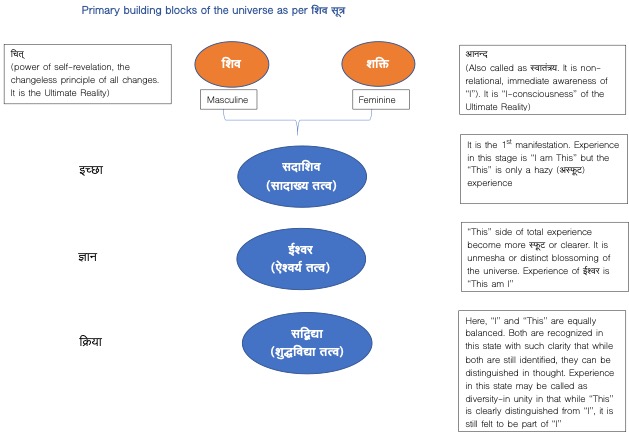
A conscious being (चेतना) is one who thinks, who is absolutely free in pursuit of any ज्ञान and क्रिया. चैतन्य is the state of one who has चेतना. The highest शिव alone has that absolute freedom. शिव (also referred to as आत्मा) is प्रकाश which means light – not in the ordinary sense of physical light but one in whose presence, one can detect light (or darkness too). Hence, whenever there is any appearance, there is प्रकाश or presence of चैतन्य. Nothing can have its own being without प्रकाश. There is a line in Spandakarika which says: “The आत्मा is the whole of reality, because all existents derive their existence from the आत्मा, and because in the process of knowing, the known gets identified with the आत्मा”. How does one know चेतना? It is not possible to know चेतना by means of प्रमाण (proof) since the means of प्रमाण are themselves dependent for their proof on self-luminious चेतना and चेतना being ever luminous, it is impossible for anything whatever to veil it, as it is ever luminously present.
But the Ultimate Reality is not just प्रकाश – it is विमर्श too. विमर्श is शक्ति, the स्वभाव or शिव. It is, so to speak, the mirror in which शिव realizes His own grandeur, power and beauty. विमर्श is the कर्तृत्व शक्ति of शिव, the power of doership. विमर्श is explained as non-relational immediate awareness of “I”. If Ultimate Reality is merely प्रकाश and not विमर्श, it will be inert and powerless. It is this ”I-consciousness” of the Ultimate Reality that is responsible for सृष्टि, स्थिति and लय of the universe. Creativity is thus the essence of Divinity. चित् is consciousness of Itself as चिद्रूपिणी शक्ति which is referred to as विमर्श. Other names used for विमर्श are पराशक्ति, स्वातंत्रय, ऐश्वर्य, कर्तृत्व, स्फुरत्त, सार, हृदय or स्पन्द. To conclude, the Ultimate Reality is not only Universal Consciousness but also Supreme spiritual energy or power and this all-inclusive Universal Consciousness, the शिव, is referred to as अनुत्तरा (Highest Reality or Absolute) which is both transcendental and immanent. शिव तत्व is thus the initial creative movement of शिव while शक्ति तत्व is the energy of शिव who polarizes चेतना into अहम् (I) and इदम् (This) viz subject and object. शक्ति is the creative aspect of शिव and His “I-consciousness, His intentness to create. In शक्ति तत्व, the आनन्द aspect of the Supreme is predominant (just as the joy of an artist who pours creativity into a canvas – the painting is an outer expression of आनन्द already contained within the painter).
In सदाशिव, इच्छा or Will aspect is predominant which affirms the “This” side of the Universal Experience. The Ideal Universe is experienced as an indistinct something in the depth of consciousness. The सदाशिव तत्व is the first manifestation or आभास where both the subject and object are consciousness. Consciousness in this aspect becomes perceptible to Itself; hence a subject and an object. Experience of सदाशिव is “I am This”.
ईश्वर तत्व is the stage of Divine Experience where इदम् or the “This” side of total experience becomes a little more defined and at this stage, ज्ञान is predominant. Experience of ईश्वर is “This am I”.
Experience in this stage is known as परापरा दश and represents the intermediate stage between परा (higher) and अपरा (lower). At this stage, क्रिया शक्ति is predominant and “I” and “This” are recognized in this state with equal clarity and while both are identified, they can be clearly distinguished in thought. Diversity-in-unity is the right expression at this state since while the “This” side is clearly distinguished from “I”, it is still felt to be part of the “I” or आत्मा. All experience is ideal (in the form of an idea) till this state and is called perfect or pure order i.e. a manifestation in which the स्वरूप of the Divine is not yet veiled or hidden.
Descent
A limitation is made to appear by शिव in His own being due to His power of महामाया – this महामाया is simply a form of Self-veiling brought about by His power of absolute freedom or स्वातंत्रय. This self-veiling is His technique for the play of life in varied, multiple forms. Readers may be familiar with शिव being described as a पञ्चमुखी with each मुख describing one of the five functions of शिव – सृष्टि (projection or creation), स्थिति (maintenance), लय (re-absorption), तिरोधान (self-veiling) and अनुग्रह (showing grace). तिरोधान refers to the act of self-veiling while अनुग्रह represents grace or the act where शिव reveals Himself to the जीव.
A human being is bound to पुनर्जन्म, to sense-life, to the life of his own bodies only so long as he allows himself to be confined to limited knowledge of his senses and mental thoughts. When he recognizes his स्वरूप, he is free. That limitation alone is bondage (बन्धन) which is
- Of the nature of अज्ञान viz non-awareness of one’s non-difference from शिव, and
- Of the nature of limited knowledge in the form of मल (dirt or adulteration) which makes one consider oneself as thoroughly reduced in respect of ज्ञान and क्रिया and thus imperfect

The outcome of presence of मल in the form of महामाया is that it brings about कला in the life of a जीव. कला divides the world of entities into separate things as ‘this or that’ by mental impenetration, or in other words, activity. The products of महामाया are:
- कला – this reduces the सर्वकर्तृत्व of the Universal Consciousness and brings about limitation in respect of authorship or efficacy
- विद्या – this reduces the omniscience (सर्वज्ञत्व) of the Universal Consciousness and brings about limitation with respect to knowledge
- राग – this reduces the all-satisfaction (पूर्णत्व) of the Universal Consciousness and brings about a desire for particular things
- काल – this reduces the eternity (नित्यत्व) of the Universal Consciousness and brings about limitation in respect of time (i.e. division of past, present and future)
- नियती – this reduces the freedom and pervasiveness (स्वातंत्रय and व्यापकत्व) of the Universal Consciousness and brings about limitation in respect of cause, space and form.
A text named Svacchanda has summarized our current state very well:
चैतन्य (freedom of the Self to know and do everything) is supressed by मल and provided by कला and विद्या, is tainted by राग, limited in respect of काल, restrained by नियती, magnified by a sense of being a पुरुष (an empirical self or जीव), furnished with the disposition of प्रकृति, endowed with त्रिगुण, बुद्धि, अहंकार and मन, ज्ञानेन्द्रिय and कर्मेन्द्रिय, तन्मात्रा and the पञ्चभूत.
मातृका
With the above background, we are now well-set to get into मातृका. All life forms operate under the influence of the three मल. The presiding देवता of the three मल is called as मातृका (being अक्षर from अ to क्ष). In संस्कृत, “क” suffix denotes the idea that the thing to which this suffix is added is unknown or not understood. मातृ refers to mother and मातृका thus denotes a देवता or शक्ति who is not properly known. मातृका is the subtle form of gross speech (sound), the letters and their ultimate essential nature are known as मातृका. मातृका impels people towards all kinds of worldly activities and feelings. She brings about knowledge in a limited form, e.g., “I am imperfect (आनव मल), “I am thin or fat” (मायीय मल) and “I am a performer of यज्ञ” (कर्म मल). Such knowledge can be subtle or in a concretely expressed form and by the penetration of different communicative words in the minds of the listener bringing about feelings of joy, sorrow, pride and passion.
मातृका rouses people to all kinds of activity and feeling by means of the arrangement of succession of letters of a script. She is closely united with various शक्ति’s who are the deities situated at the various पीठ (sense organs) and hover about the consciousness in क-रंध्र (or ब्रह्मरंध्र located at the top of the head) with a terrible noose deludes people constantly. मातृका shining as शक्ति presiding over वर्ग are as given below:
| वर्ग | अक्षर | शक्ति |
| अवर्ग | अ, आ, इ, ई, उ, ऊ, ऋ, ऋृ, ए, ऐ, ओ, औ, अँ, अः, लृ, लृ़ | योगीश्वरी / महालक्ष्मी |
| कवर्ग | क, ख, ग, घ, ड. | ब्राह्मी |
| चवर्ग | च, छ, ज, झ, ञ | माहेश्वरी |
| टवर्ग | ट, ठ, ड, ढ, ण | कौमारी |
| तवर्ग | त, थ, द, ध, न | वैष्णवी |
| पवर्ग | प, फ, ब, भ, म | वाराही |
| यवर्ग | य, र, ल, व | ऐन्द्री/ इंद्राणी |
| शवर्ग | श, ष, स, ह | चामुण्डा |
मातृका is united closely with group of four शक्ति – अम्बा, ज्येष्ठा, रौद्री and वाम. अम्बा is the शक्ति that puts obstacles in all the actions. ज्येष्ठा is शिवमयी representing the शक्ति who leads to मोक्ष. रौद्री is the शक्ति who brings about obstacles for the wicked and destroys them while वाम is the शक्ति who is active in the manifestation of the world.
Because मातृका is the basis (of all limited knowledge), therefore one is deprived of the investigation of the inner non-difference (from the fullest I-consciousness of शिव) and all one’s knowledge is outward-turned without ceasing for a moment. Therefore, all such knowledge is said to be the cause of bondage. A जीव is known as पशु since he is deprived of knowledge of his own आत्मा by the letters क, etc falls victim to the group of शक्ति like ब्राह्मी arising from the multitude of words. His शक्ति are always in readiness in veiling his आत्मा because all his ideas cannot arise without the use of words.
Understanding the flow of अक्षर (how मातृका unfolds or how the universe projection comes about)
| अक्षर | How arrived at? | Explanation |
| अ | Self-existent चित् शक्ति of शिव | The first स्पन्द of अनुत्तरा शक्ति is the Supreme I-consciousness which assumes the form of अकुल ie that of which the body (कुल) is अ. This अ is the expression of चित् शक्ति of शिव. A line in the श्रीमद्भगवद्गीता is pertinent here when श्रीकृष्ण says – “Among all the अक्षर, I am अ” |
| आ | चित् शक्ति + आनन्द शक्ति | As there is further expansion of the world-manifesting power of अहम् (I-consciousness), आनन्द शक्ति comes into play which assumes the form of आ |
| इ | इच्छा शक्ति (अक्षुब्धा state of I) | Then bringing forward इच्छा शक्ति, that I-consciousness displays इ in अक्षुब्धा (non-agitated) stage of इच्छा. इच्छा शक्ति has simply decided to manifest externally but is still unaffected by objectivity. |
| ई | इच्छा शक्ति (क्षुब्धा state of I) | Then bringing forward इच्छा शक्ति, that I-consciousness displays ई in the क्षुब्धा stage which is a form of ईशान (power of mastery). इच्छा शक्ति decided to manifest externally and is coloured by objectivity here. |
| उ | ज्ञान शक्ति (अक्षुब्धा state) | Then with ज्ञान शक्ति in its अक्षुब्धा state, it displays उन्मेष (knowledge) |
| ऊ | ज्ञान शक्ति (क्षुब्धा state) | Then with ज्ञान शक्ति in its क्षुब्धा state, it displays ऊनता (deficiency in ज्ञान as mere ज्ञान) which becomes cause of objective appearance and represented as ऊ. |
| ऋ/ ऋृ लृ/ लृ़ | इ + र् इ + ल् | अक्षुब्धा इच्छा शक्ति combining with र् becomes ऋ and क्षुब्धा इच्छा शक्ति with र् is ऋृ. अक्षुब्धा इच्छा शक्ति combining with ल् becomes लृ and क्षुब्धा इच्छा शक्ति with ल् is लृ़. र् and ल् are the seed letter of अग्नि and पृथ्वी and inasmuch as it is a mere subtle object of इच्छा शक्ति and is imposed on it merely by the sound of र्/ ल् and inasmuch as ऋ, ऋृ लृ & लृ़ rest only in themselves, they are said to be अमृत letters (ie not subject to change and do not give rise to other letters) |
| ए | अ + आ + इ | The अनुत्तरा letter अ and आनन्द letter आ combining with इ of इच्छा forms the triangular ए vowel |
| ओ | अ + आ + उ (denotes क्रिया शक्ति) | The अनुत्तरा letter अ and आनन्द letter आ combining with उन्मेष letter उ, there is a formation of the letter ओ which denotes the inclusion of क्रिया शक्ति. |
| ऐ | अ + आ + ए | |
| औ | अ + आ + ओ | It is called as a trident since there is a union of three शक्ति here – इच्छा, ज्ञान and क्रिया |
| अं | विन्दु | Supreme I-consciousness expresses the undivided knowledge of the universe in the form of a dot (विन्दु) |
| अः | विसर्ग | अः represents अ with विसर्ग with the upper dot representing inner manifestation and lower dot representing outer manifestation. |
Each of the five letters as वाचक (i.e. names) has a corresponding group of तत्व as वाच्य (ie objects of those names). Following table provides the detail:
| SN | शक्ति from which each class of letters is produced | Names of letters | Name of corresponding तत्व |
| 1 | अ | क, ख, ग, घ, ड. | पञ्च भूत पृथ्वी, जल, अग्नि, वायु & आकाश |
| 2 | इ | च, छ, ज, झ, ञ | पञ्च तन्मात्रा शब्द, स्पर्श, रस, रूप & गंध |
| 3 | ऋ | ट, ठ, ड, ढ, ण | पञ्च कर्मेन्द्रिय उपस्था, पायु, पद, पाणि & वाक् |
| 4 | लृ | त, थ, द, ध, न | पञ्च ज्ञानेन्द्रिय प्राण, रसना, चक्षु, त्वक् & स्रोतृ |
| 5 | उ | प, फ, ब, भ, म | अन्त:करण मन, अहंकार, बुद्धि, प्रकृति & पुरुष |
To a question as to how each शक्ति can arise a group of five letters, Kshemaraja says that each of these has all the five शक्ति viz चित्, आनन्द, इच्छा, ज्ञान and क्रिया. And since each of these letters has the power of all five शक्ति, therefore, from each of these, there arises a group of five letters as वाचक and a corresponding group of five तत्व as वाच्य (“indicated” or objects).
Let us now turn to the next four अक्षर referred to as अन्तस्थ. Abhinavagupta says that since the first four letters come about by union of इच्छा शक्ति and उन्मेष शक्ति which are inner forces and are identified with प्रमाता (subject), they are referred to as अन्तस्थ. शिक्षा (a branch of वेद) says that since the first four letters appear neither as vowel nor as consonant and appear to be in the middle of these two, so they are referred to as अन्तस्थ. Kshemaraja adds that the first four are known as धारणा in the आगम texts because they hold the universe by seizing the consciousness of subjects (knowers).
| SN | अक्षर | Expanation |
| 1 | य | It comes about when क्षुब्धा and अक्षुब्धा इच्छा शक्ति is oriented towards अनुत्तरा viz चित् (अ) |
| 2 | र | This comes about when ऋ which is identified with इच्छा शक्ति is oriented towards अनुत्तरा viz चित् (अ) |
| 3 | ल | This comes about when लृ which is identified with इच्छा शक्ति is oriented towards अनुत्तरा viz चित् (अ) |
| 4 | व | This comes about when उन्मेष is oriented towards अनुत्तरा viz चित् (अ) |
Kshemaraja says that beyond माया, with the disappearance of difference and appearance of non-difference with Her essential nature, the I-consciousness (with the zealous heat of this identity-consciousness) displays four ऊष्म letters viz श, ष, स and ह. The word ऊष्म means heat, passion, eagerness. She (I-consciousness) here shows perfect अमृत letter स occurring as the penultimate one of the entire manifestation of letters and after that, at the end, She displays प्राण बीज letter viz ह. This is done in order to make one realize that this universe consisting of words (वाचक) and their objects (वाच्य) and of the form of expansion of शडध्व is brought about to its completion in the letter ह (अनाहतमय) by the अनुत्तरा शक्ति (the expression “Universe as a breadth of the Divine” seems to make sense here). What is the meaning of शडध्व? शट् means six and अध्व means course or path. The universe may be said to summarily consist of वर्ण, मंत्र and पद on the वाचक or subjective side and कला, तत्व and भुवना on the वाच्य or objective side (I am avoiding getting into technical meaning of each of the six words here). Summary explanation of each of these four अमृत अक्षर is given below:
| SN | अक्षर | Expanation |
| 1 | श, ष and स | इच्छा शक्ति appears in three forms – इ, ऋ and लृ and these inspired by the inner light of Self appear outwardly as श, ष and स. स is called as परिपूर्ण अमृत वर्ण because it includes within itself the manifestation of the universe. Saiva texts see the manifestation of the Universe not as a deviation from शिव but a fulfilment of it. श, ष and स represent शुद्ध विद्या, ईश्वर and सदाशिव respectively. |
| 2 | ह | ह is merely a gross form of विसर्ग (:) or stated as शिव’s विसर्ग शक्ति. ह in its subtle form is constantly being sounded inside each creature without any effort on its part. Some texts state that विसर्ग pertaining to ह is only a vibration inside; not uttered in the form of a distinct letter. No one deliberately pronounces it nor can anybody prevent it being sounded (as an inner vibration) – this is self-sounded in the breast of beings. It is seen as the source of all प्राण and referred to as अनाहतमय (i.e. not struck or uttered by vocal organs) |
Last word क्ष
क्ष word is a combination of क् and स् and is called as a कूटबीज letter (कूट stands for highest, most excellent, mysterious). कूटबीज is a mystical name of the अक्षर क्ष. Thus, क्ष is a combination of क् and स् and which results by the combination of the essence of अनुत्तरा and the essence of विसर्ग. विसर्ग viz the creative energy of शिव is manifested in five ways, one outside (in the form of expansion of the universe) and four inside 1) in the हृदय, 2) in the नाद viz throat, 3) in the परम पद viz between two eye-brows and 4) in ब्रह्मरंध्र – thus, it pervades from हृदय to top of the skull.
Idea of अहं and विन्दु
The whole universe lies in the womb of अ and ह with अ suggesting अनुत्तरा (शिव) and ह representing शक्ति which together suggest अहं meaning “I” or “Self”. अह includes all letters of the संस्कृत alphabet and since each letter is indicative of an object, अह suggests sum total of all objects ie the universe. The dot on top of अहं is referred to as विन्दु which means ‘that which knows’ (derived from the word vid viz ‘to know’). The विन्दु or dot has a high philosophical significance. Abhinavagupta calls विन्दु as धन-भूत शक्ति meaning creative force compacted into a point and as yet undifferentiated into subjects and objects. It is the चिद्घन (concentrated consciousness) in which lie potentially in an undifferentiated mass all the worlds and beings to be manifested. अ represents शिव andह represents शक्ति and विन्दु on top of ह represents the fact that though शिव is manifested right upto earth through शक्ति, he is not divided, thereby he remains an undivided whole. Says Abhinavagupta – “that which is undivided light, that which in spite of all differentiation does not change, remains unaffected and does not deviate from its inherent oneness is for us विन्दु.
Concluding overview of मातृका
“There is no knowledge higher than that of मातृका”, says many texts. The realization of the mysteries of मातृका is most important for the aspirant who is in quest of the source of his being. Manifestation consists of वाचक and वाच्य or नाम & रूप, words & objects. At the highest level of reality, they are one. In manifestation, they bifurcate into वाचक and वाच्य where वाचक is the subjective side while वाच्य is the objective side. Human activities are carried on with words or वाचक and words consist of मातृका where मातृका may be expressed as lettered sound. If a man therefore wants to understand the mysteries of life, source of his being, he will have to turn to the mysteries of मातृका. मातृका not properly understood confines us to the feverish activities of life which in turn become a source of our bondage, कर्म बन्धन. If properly understood, it becomes our saviour. A guru must explain the मंत्र beginning with अ and ending with m (अहं) to the aspirant. As the guru feels even a hymn of stuti or a gatha or anything else as connected with Supreme I-consciousness, therefore, knowing everything in that way (ie connected with I-consciousness), he perceives everything as a Mantra.
There are five main शक्ति of शिव viz चित् or अनुत्तरा शक्ति, आनन्द, इच्छा, ज्ञान and क्रिया. The अनुत्तरा शक्ति expresses itself in अ, आनन्द शक्ति in आ, इच्छा शक्ति expressed as इ & ई as well as ऋ, ऋृ, लृ & लृ़, the ज्ञान शक्ति expresses itself as उ and ऊ and with the permutation and combination of अ, इ & उ in various ways, the क्रिया शक्ति expresses itself as ए, ऐ, ओ & औ. The dot (विन्दु) expresses the unification of all manifestation into one consciousness of शिव and the विसर्ग (two dots one above the other) points to शिव’s inner rest and the external expansion of His शक्ति in the form of the universe. These vowels represent the inner life of शिव. One needs to note that अ or अनुत्तरा शक्ति is most important and expressed that “अ resides in all the letters as their inner controller”. Taking this further, the vowels अ, इ, उ, ऋ & लृ give rise to various consonants which symbolize the various तत्व from पृथ्वी to सदाशिव. It is शिव who dwells in the heart of all the अक्षर and all the creatures and expresses all manifestation as identical with Himself.
निष्कल शिव or parama शिव is the transcendent शिव, above all manifestation – शिव is His first creative pulsation (स्पन्द) in whom I-consciousness arises (अहं). The अहं known as विमर्श is like a mirror of rays of light which contains all वर्ण or letters (वाचक) and वाच्य (objects) in a latent incipient form The अ of अहं symbolizes अनुत्तरा and ह symbolizes विसर्ग शक्ति. Thus, अहं is the matrix of 50 letters from अ to क्ष. Knowledge of मातृका shows how all letters and all तत्व from पृथ्वी to सदाशिव have evolved simultaneously from अहं – this collective whole of शक्ति pertains to इच्छा, ज्ञान and क्रिया शक्ति of शिव which evolve the world of words and objects. Clear realization of the significance of मातृका leads an aspirant to realize that his real I is the blissful I-consciousness of शिव. It liberates the aspirant from his pseudo I-consciousness (जीव), from his psychosomatic self, and he now knows himself as identical both with शिव and His manifestation in the form of the Universe. May us all attain शिव
ॐ तत् सत्
 Adhyatma Writings