
अध्याय name is ज्ञानकर्मसंयास योग
श्रीभगवान् उवाच ।
इमं विवस्वते योगं प्रोक्तवान् अहमव्ययम् । विवस्वान् मनवे प्राहमनुरिक्ष्वाकवेऽब्रवीत्॥४.१॥
श्रीभगवान् उवाच: I (अहम्) taught (प्रोक्तवान्) this (इमम्) imperishable (अव्ययम्) योग (योगम्) to विवस्वान् (विवस्वते), विवस्वान् taught (प्राह) it to मनु (मनवे) and मनु taught (अब्रवीत्) it to इक्ष्वाकु (इक्ष्वाकवे).
विवस्वान् is translated as the सूर्य and श्रीकृष्ण says that He taught the original कर्मयोग to the विवस्वान्. For someone wanting a live example of कर्मयोग, one needs to look no farther than the सूर्य. It does not show favouritism to anyone and shares its glory with all. It works 24X7 relentlessly without a pause and its glory never ebbs any day. What does it get as a result? Nothing. पृथ्वी and other planets are derived from the सूर्य; life on पृथ्वी is sustained by the सूर्य. We eat Sunshine in sugar and bread, burn sunshine of millions of years ago in coal and oil… one can go on and on – if there is no सूर्य, there is no life at all.
One may wonder how कृष्ण can teach to सूर्य which is nothing else but a matter composed of heat and gas. Here, we must connect with the idea of सृष्टि as per our शास्त्र which states that all activity and movement in this Universe is triggered by पुरुष into primordial matter referred to as मूल प्रकृति (as will be conveyed later in chapter 7). सूर्य literally means a force that energises and that spurs all into action. We thus have the idea of presiding देवता behind every phenomenon and while it is true that the Sun is a globe of heat and gas, the animating power behind the Sun is सूर्य (or विवस्वान् as कृष्ण conveys here). And this सूर्य is thus the presiding देवता not just of the Sun in our solar system but all the Suns across the entire universe. सूर्य thus becomes the source of life and ज्ञान for the entire universe and needs to be seen as the conscious force or energy rather than as mere in-animate matter. Those of you who are not fully convinced have the following two options:
- Accept this as a provisional hypothesis and read and research further; or
- Reject this explanation and stop reading further ☺︎
परम्पराप्राप्तमिमं राजर्षयो विदुः । स कालेनेह महता योगो नष्टः परन्तप॥४.२॥
Handed down from generation to generation (परम्पराप्राप्तम्) in this way (एवम्), the kings who were sages (राजर्षयः) know (विदुः) it (इमम्). (But) with the long (महता) lapse of time (कालेन), O अर्जुन (परन्तप), this (सः) yoga (योगः) has declined (नष्टः) in the world (इह).
4:2 (1): जनक, मनु, etc followed the life of a राजर्षि. राज means a king who rules and has power. All of us have access to power in some situation or another. While we thus may have acquired राजत्व, question is whether we can claim to be a राजर्षि. राजर्षि is one who is able to digest power and remain balanced instead of power digesting him. A verse from महाभारत is pertinent here:
विद्यामदो धन मद: तृतीयो अभिजानो मद:। इति मद अवलिप्तानम् इतैव सताम् दम:।।
विद्या is a मद (intoxicant), so is धन and family pedigree. These are however मद only for अवलिप्तानम् (unrefined people) but these are दम (self-control) for the great minded. While power digests most people but a ऋषि on the other hand is able to digest these powers and rule.
4:2 (2): Then श्रीकृष्ण adds that over time, the ज्ञान of कर्मयोग keeps ebbing. So what He is doing now is to reconvey the same ज्ञान to अर्जुन which he had instilled into the विवस्वान् right at the start. We witness the same ebbing in our history when ज्ञान of the श्रीमद्भगवद्गीता which powered the golden era in India of the गुप्त kings again ebbed by the time of हर्ष. Then came शंकर to revive this ideal; then it ebbed again and came रामानुज to revive it. Then it ebbed again and came गुरु नानक/ नामदेव/ ज्ञानेश्वर. Then it ebbed again and came एकनाथ/ तुकाराम्/ वल्लभ. Then it ebbed again and came विवेकानंद. The beauty is that each of them revive the society not by coming out with any new innovative ज्ञान but they merely remind people of the great धर्म of कर्मयोग from the श्रीमद्भगवद्गीता. The wheel of धर्म that slows down is merely pushed again by sharing the कर्मयोग teachings. Time changes but the teaching remains the same eternal ज्ञान of कर्मयोग.
स एवायं मया तेऽद्य योगः प्रोक्तः पुरातनः । भक्तोऽसि मे सखा चेति रहस्यंह्येतदुत्तमम् ॥४.३॥
Today (अद्य), that same (सः एवअयम्) ancient (पुरातनः) yoga (योगः) has been told (प्रोक्तः) to you (ते) by me (मया) because (इति) you are (असि) my devotee (भक्तः) and (च) my (मे) friend (सखा). This (एतत्) is indeed (हि) a profound (उत्तमम्) secret (रहस्यम्).
4/3 (1) – भगवान् reveals this ancient ज्ञान of कर्मयोग to one who is his भक्त or one who regards Him as a सखा. Before the war, when संजय went over to the पांडव शिबिर, he saw अर्जुन sitting with his legs stretched on lap of श्रीकृष्ण and श्रीकृष्ण pressing his legs in a friendly way. संजय came back to धृतराष्ट्र and told him that if श्रीकृष्ण allows certain people to place their legs on Him and He also enjoys this, it became clear to him that पांडव will win the war.
4/3 (2) – Why is कर्मयोग ज्ञान referred to as a रहस्यम् उत्तमम् (profound/ highest secret)? This ज्ञान is रहस्यम् not because it has to be kept away from people. Instead, the सथूल minds full of काम cannot understand कर्मयोग. They are too full of मद to make sense of it. However, when minds become सूक्ष्म through practices like दम, शम,अहिंसा, etc., they acquire भक्ति and thus are able to look at श्रीकृष्ण/ परम् as their सखा. With this, the process of चित्त शुद्धि begins and the person becomes eligible to receive the ज्ञान of कर्मयोग into their persona. This of course brings out a curious situation – acquiring this ज्ञान makes one भक्ति oriented and equally, only with some भक्ति orientation, such ज्ञान seeps in. Which comes first? Maybe both go parallel.
अर्जुन उवाच ।
अपरं भवतो जन्म परं जन्म विवसतः। कथमेतद्विजानीयां त्वमादौप्रोक्तवानिति ॥४.४॥
(अर्जुनः उवाच): Your (भवतः) birth (जन्म) was not so long ago (अपरम्); Vivasvān’s (विवसतः) birth (जन्म) was a long time ago (परम्). How (कथम्) am I to know (विजानीयाम्) that (इति) you (त्वम्) told (प्रोक्तवान्) this (एतत्) in the beginning (आदौ)?
बहूनि मे व्यतीतानि जन्मानि तव चार्जुन। तान्याहं वेद सर्वाणि न त्वम् वेत्थ परन्तप।।
Many (बहूनि) births (जन्मानि) have passed (व्यतीतानि) for me (मे) and (च) you (तव), O अर्जुन! I (अहम्) know (वेद) them (तानि) all (सर्वाणि) (whereas) you (त्वम्) do not (न) know (वेत्थ), O Scorcher of foes (परन्तप)!
अजोऽपि सन्नव्ययात्मा भूतानामीश्वरोऽपि सन् । प्रकृतिं स्वामधिष्ठायसम्भवाम्यात्ममायया ॥४.६॥
Though I am unborn (अजो), of changeless nature (अव्यय), and am the ईश्वर of all भूत (living beings), yet subjugating my प्रकृति, I am born by my own माया.
4:4/6 (1) – अर्जुन asks the obvious question – you were born just now. Why do You claim that You taught विवस्वान्? This brings us to the concept of अवतार & claim of multiple lives. When गौतम बुद्ध attained निर्वाण, it is said that all the countless number of lives that his जीव had led earlier came into him as a flash. भगवान् also takes numerous births. While one version refers to ten अवतार, in the श्रीमद्भागवतम्, there are events from 20+ lives taken by Him. But He Himself says He has taken many births – and these births need not be human only since His vision is not limited to humans only. His job is to keep turning the wheel of धर्म. Either He comes or sends संत from time to time. When the wheel of धर्म slows down, He turns it again to energize the people to live life as per the principles of कर्मयोग.
4:4/6 (2): ज is the root word from where जन्म (being born) has come while अज stands for unborn. He uses the power of माया to take birth as a human. While all of us are under the control of माया, in His case, माया is His power and hence he uses it to take birth among humans. While we are unable to control प्रकृति (we discussed this earlier), He however subdues प्रकृति while living as a human. He is thus outwardly human but inwardly the infinite dimension. माया has two aspects – the आवरण शक्ति (it hides the truth) and विक्षेप शक्ति (makes the original look like something else). Since we are under control of माया, we see ourselves as finite and cut off. But He takes an अवतार meaning ‘descent’ into the world of the limited. He takes birth to address an अध्यात्म crisis which He solves by pushing the धर्मचक्र into motion. As He does it, He inspires not just people in His era but even after hundreds of years, such is the impact of His अवतार.
यदा यदा हि धर्मस्य ग्लानिर्भवति भारत । अभ्युत्थानमधर्मस्य तदात्मानंसृजाम्यहम् ॥४.७॥
O भारत (यदायदा हि) there is (भवति) a decline (ग्लानिः) in right living (धर्मस्य) and an increase (अभ्युत्थानम्) in wrong living (अधर्मस्य) everywhere, then (तदा) I (अहम्) bring Myself (आत्मानम्) into being (सृजामि) (assume a physical body).
परित्राणाय साधूनां विनाशाय च दुष्कृताम् । धर्मसंस्थापनार्थाय सम्भवामियुगे युगे ॥४.८॥
For the protection (परित्राणाय) of those who are committed to धर्म (साधूनाम्) and (च) the destruction (conversion) (विनाशाय) of those who follow adharma (दुष्कृताम्), and for the establishment of धर्म (धर्मसंस्थापनार्थाय), I come into being (सम्भवामि) in every yuga (युगेयुगे).
4:7/8 – even kids in India are familiar with these verses and probably require no major explanation. He takes birth again and again to turn the धर्मचक्रम्. While this may seen as He takes birth to bash up the bad guys, it is not really that reason alone. Certain births mentioned in the श्रीमद्भागवतम् do not involve bashing people – मत्स्य, कूर्म, ऋषभ, कपिल, etc. Certain others like परशुराम or नरसिंह do bashing only. But what is remembered for is not their bashing (except for kids probably) but their conduct. राम is thus an inspiration for his शांत बुद्धि/ राम राज्य ideal while श्रीकृष्ण is remembered as a जगद्गुरु for this various teachings in the form of श्रीमद्भगवद्गीता & उद्धव गीता. Through such teachings, one finds courage not only to fight against people indulging in दुष्कृति, it helps in checking ourselves too from performing दुष्कृति.
जन्म कर्म च मे दिव्यमेवं यो वेत्ति तत्त्वतः । त्यक्त्वा देहं पुनर्जन्म नैतिमामेति सोऽर्जुन ॥४.९॥
The one who (यः) knows (वेत्ति) in reality (तत्त्वतः) My (मे) divine (दिव्यम्) birth (जन्म) and (च) action (कर्म) in this way (एवम्), O अर्जुन, giving up (त्यक्त्वा) the body (देहम्), that person is not born again (पुनर्जन्म न एति).
वीतरागभयक्रोध मन्मया मामुपाश्रिताः । बहवो ज्ञानतपसा पूतामद्भावमागताः ॥४.१०॥
Free from वात राग (craving), भय, and क्रोध, totally resolved in Me (मन्मयाः), taking refuge in (उपाश्रिताः) Me (माम्), purified (पूताः) by the discipline of knowledge (ज्ञानतपसा), many (बहवः) have come back (मद्भावम्) to My nature (आगताः).
4:9/10 (1) – All of us have read or heard about अवतार (informed by अमर चित्र कथा or TV serials). But does this mean we “know”? Knowing is much more than assimilating information about physical deeds of any अवतार. One can put down two extreme types of ‘knowing’ –
- Those who abuse the existence of परम् stating that they ‘know’ enough to reject the deeds of अवतार. They will say – all these are fiction. There was no such person. Later people wrote such stories to keep people poor or subdue them. Ancients did not have any source of entertainment and stories fulfilled this need, etc.
- Then there are those who go the other extreme and take all लीला of श्रीकृष्ण literally believing them as magic of a Superman and fanatically defend Him without even attempting to understand Him.
Both do not ‘know’ really – they remain अज्ञानी. Why? Because their ‘knowing’ is infested with वीतराग, भय & क्रोध. Only if these are burned up by inculcating तप (intense contemplation, austerity) of ज्ञान, one acquires सूक्ष्म दृष्टि. The Type 2 above is often wrongly referred to as a भक्त since he may be a regular मंदिर दर्शन person, doing तिलक धारण, adorns house walls with images of श्रीकृष्ण, even chants 15th chapter of श्रीमद्भगवद्गीता daily, etc. But such minds are infested with वीतराग, भय, etc and cannot be referred to as भक्त. One is really a भक्त only if he does ज्ञानतपस् and the fire generated from this burns up भय, क्रोध, etc.
4:9/10 (2) – But once a person comes to this path, the first feeling they experience is that they are at a very low stage of अध्यात्म journey (like being at the base of a mountain). The curiosity to learn about the अवतार begins. But can they know about the peak when they are at the base? No. So they listen to tales & notes of others who have scaled the peak earlier (past saints) as well as read शास्त्र that talk about the feats of अवतार and thus begin their journey of knowing. As they progress, their ज्ञानतप intensifies. In this fire that gets generated within, all feelings generated from external influences (भय, क्रोध, etc) get burned up. This तपस् eventually culminates in सिद्धी. And what is the सिद्धी? At the peak, true ‘knowing’ happens when they attain the mind-space of परम्. But what do they really ‘know’ in this state? That they were always here only. Hence, श्रीकृष्ण uses the words -“They return back to Me”. And the good part is – many have achieved it. So it is not un-achievable. Many have, so we too can. That is the message here.
ये यथा मां प्रपद्यन्ते तांस्तथैव भजाम्यहम् ।मम वर्त्मानुवर्तन्ते मनुष्याः पार्थसर्वशः ॥४.११॥
Those (ये) who worship (प्रपद्यन्ते) me (माम्), in whatever way (यथा), I (अहम्) bless (भजामि) them (तान्) in the same way (तथाएव). O पार्थ, people (मनुष्याः) follow (अनुवर्तन्ते) My (मम) path (वर्त्म) in all ways (सर्वशः).
काङ्क्षन्तः कर्मणां सिद्धिं यजन्त इह देवताः । क्षिप्रं हि मानुषे लोकेसिद्धिर्भवति कर्मजा ॥४.१२॥
Desiring (काङ्क्षन्तः) the result (सिद्धिम्) of actions (कर्मणाम्) here (in this world) (इह), they worship (यजन्ते) the gods (देवताः). For, in the human (मानुषे) world (लोके), result (सिद्धिः) born of action (कर्मजा) comes (भवति) very (हि) quickly (क्षिप्रम्).
4:11/12 (1) – This श्लोक is tough since numerous books have given variations in their commentary. Essentially, भगवान् is stating that people approach Him in different ways. Each attempt to reach Him in ways that appeal to them but no matter what path they think they are choosing and following, they are following His path only. One can extend this to state that no matter what religion one professes to be, in whatever manner they connect with their idea of God or even do not connect, they connect with Him only since there is no other agent who converts actions into outcomes. People want Him to fulfill the longings arising within their senses and hence they reach out to the देवता (the power of the senses). I grant them their wishes based on कर्म undertaken by them.
4:11/12 (2) – If people want a fan, they invoke वायु and press a certain switch to get air. If they want light, they invoke सूर्य and use another switch to get light. Both wishes are granted by electricity but no one sees It. While She is the basis of all outcomes, no one sees Her since She is अदृश्य. भूमि is a कर्म लोक where people get फल out of conduct of कर्म (unlike say a स्वर्ग which is a भोग लोक where कर्म is not required). All different लोक work on differing principles. Why is it that people in भूमि have faith in receiving the फल that they long for after performing specified कर्म? Whatever is sown in the land is reaped as fruit; whatever is held before a mirror is alone reflected in it. It is Me who makes such an outcome possible. In that way, although I am the basis of the faith of this worship in diverse देवता, yet the fruit secured is just according to the measure of desire of the seekers and effort of their कर्म. People thus use Me for smaller things or bigger things and I grant them what they wish.
चातुर्वण्यं मया सृष्टं गुणकर्मविभागशः । तस्य कर्तारमपि मांविद्ध्यकर्तारमव्ययम् ॥४.१३॥
The four-fold grouping of people (चातुर्वण्यम्), a division based on duties and qualities (गुणकर्म विभागशः), was created (सृष्टम्) by me (मया). Even though (अपि) I am its (तस्य) author (कर्तारम्), know (विद्धि) me (माम्) to be a non-doer (अकर्तारम्), ever changeless (अव्ययम्).
न मां कर्माणि लिम्पन्ति न मे कर्मफले स्पृहा । इति मां योऽभिजानातिकर्मभिर्न स बध्यते ॥४.१४॥
There is no (न) longing (स्पृहा) with reference to the result of action (कर्मफले) for Me (मे). The one who (यः) knows (अभिजानाति) Me (माम्) clearly in this way (इति) is not (न) bound (सःबध्यते) by actions (कर्मभिः).
एवं ज्ञात्वा कृतं कर्म पूर्वैरपि मुमुक्षुभिः । कुरु कर्मैव तस्मात्त्वं पूर्वैः पूर्वतरंकृतम् ॥४.१५॥
Knowing (ज्ञात्वा) Me in this manner (एवम्), even (अपि) seekers (मुमुक्षुभिः) of ancient times (पूर्वैः) performed (कृतम्) action (कर्म). Therefore (तस्मात्), indeed (एव), perform (त्वम् कुरु) action (कर्म) (just as it) was done (कृतम्) by those who came before (पूर्वैः) in the ancient past (पूर्वतरम्).
4:13/ 15 (1) – This verse unsettles many; some even ask for its removal to purify the श्रीमद्भगवद्गीता. What exactly does वर्ण mean? Though one meaning of वर्ण is colour, let us get into something deeper first before we talk of वर्ण. As per the idea of सृष्टि, while पुरुष is the single unifying factor (changeless, formless, etc), the diversity in the Universe is explained by the presence of त्रिगुण. The density of one गुण vis a vis other गुण explains every aspect of the creation – living and non-living. भगवान् says it is Him who created the four वर्ण. ब्राह्मण is one in whom सत्व is dominant and रजस् is secondary; क्षत्रिय is one where रजस् is dominant and सत्व is secondary; वैश्य is one where रजस् is dominant and तमस् is secondary and शूद्र is one where तमस् is dominant and रजस् is secondary. All possess all three गुण; however, what is dominant determines our overall orientation. Note that these four वर्ण is not limited to human beings only – even birds, trees and animals may be seen as being part of one वर्ण as against another. Talking about humans too, Society cannot run without all four वर्ण.
Know that all have come from Me only and thus no one is superior or inferior. So how do each of these reach Me? By doing their स्वधर्म (3:35) meaning a role that suits their गुण which determines their स्वभाव. We have an episode in the महाभारत (व्याधगीता) where a ब्राह्मण once looks at a few birds angrily and they burn up. Sensing that he has acquired powers, he gets arrogant. Each time he begs for food, he shouts at the गृहस्थ to give food quickly or else he will burn them. Once he goes to a new house where the lady inside delays and he gets upset. The lady immediately tells him from inside that he cannot burn her like the birds. Shocked, he asks her how she knew. She replies that getting powers is no big deal. She acquired these powers by serving her family in a कर्मयोग way. She then sends the ब्राह्मण to a व्याध (butcher) to learn wisdom from him. He gets shocked that a व्याध knows more than a ब्राह्मण. When he asks the secret, the व्याध replies that he got this wisdom merely by serving his parents and doing his profession as a कर्मयोगी. Further, व्याध clarifies clearly that वर्ण is not dependent on one’s कुल (family of birth) but one one’s conduct or orientation (viz गुण).
Society is stable when all act as per their स्वधर्म. If people leave their स्वधर्म, confusion sets in and society becomes unstable. So a ब्राह्मण who has innate inclination towards सत्व is asked to use that ज्ञान for benefit of society and is encouraged not to gain access to any leadership position or wealth or lands. A क्षत्रिय who demonstrates a natural leadership orientation and thus having the ability to influence the wider population is encouraged to use such a position to benefit the society and discouraged to have access to wealth (for which one has to turn to वैश्य), for decision making (for which he must turn to ब्राह्मण) and must not own lands directly (for which he has to turn to शूद्र). A वैश्य who has access to wealth must not be asked to take a leadership role or offer advice to others or own lands. Lastly, a शूद्र who has no access to wealth, leadership capability or refined thinking faculty must align with other three वर्ण and serve them (just as salaried persons work for companies today) and do they कर्म in a dispassionate manner for benefit of society. One must understand that it is not WHAT we do (or what career we pursue) that matters, rather if we engage in society as per our own innate गुण, whichever career we pursue, we can benefit by being close to our स्वभाव – not only society will be stable since everyone is close to what their USP is, everyone is also working in a cooperative endeavour to help others. Over time, one who does स्वधर्म at all times in tune with his or her स्वभाव will eventually attain one’s own स्वरूप (our original state of सत्-चित्-आनन्द).
4:13/ 15 (2) – भगवान् however immediately adds another verse. He says that while He indeed created वर्ण, He cannot be made responsible. He takes no blame for how the world turns out. People select their own गुण & कर्म out of their own free will. I am not involved in this process. Since गुण are innately present in all, each selects कर्म in tune with his or her गुण and pursue outcomes of their chosen कर्म. All are dear to me – if they thus pursue their स्वधर्म as a कर्मयोगी, they will no doubt return to Me – there is no doubt about it. Electricity runs the fan or the bulb. But can anyone claim that electricity is responsible for the fan or the light? It is people who choose an outcome (light or fan) and thus exert to get their chosen outcome – for this purpose, they use electricity – agency is thus to be ascribed to the individual and not the electricity. भगवान् is also thus a non-doer just as electricity is a non-doer. But there are a few wise men who realize this non-doership ideal and aspire to become one with It instead of finding joy in air from fan or vision from light. They become detached like the electricity or like the petrol in a car which is indifferent as to whether the owner is film actress or scientist or a politician. The moment the wise start operating in this detached manner, no agency applies to their कर्म. Their actions do not have कर्तृत्व भावना. Once agency goes, attachment to फल also vanishes. Once this also vanishes, they inch their way towards freedom and all such detached फल or free फल are not subject to कर्म बन्धन.
4:13/ 15 (3) – Orthodox conservatives defend वर्ण संस्कार for the wrong reasons while the so-called modernists oppose this for wrong reasons. वर्ण संस्कार needs to be seen as an operational reality of the universe. If one closely observes आश्रम धर्म, one can see it operating here too. सत्व is dominant when one is in ब्रह्मचारी phase (learning is highest in this phase), रजस् is dominant in गृहस्थ phase (earn wealth but by following rules), रजस् is dominant in वानप्रस्थ phase (activity is dominant but a routine sets in) and तमस् is dominant in संयास phase (activity is there but one is largely slow to learning and given to sleep). Since गुण (aptitude) varies with age, स्वधर्म (natural orientation) changes with time and hence prescribed कर्म also differs at each stage. This is why आदि शंकर admonished an 80 year old man trying to learn grammar and came out with the glorious. भज गोविन्दम् भज गोविन्दम् , गोविन्दम् भज मूढमते…. Equally, certain type of कर्म is common to all phases and hence, certain universal कर्म (say, नित्यपूजा ) is prescribed for all वर्ण though there will be variations as per their गुण here too. Given this, there is merit in teaching कर्मयोग idea of श्रीमद्भगवद्गीता during ब्रह्मचारी state since they are in a learning mode and can absorb the कर्मयोग ideas much easily than when they are older. Equally, while all of us possess each of these dominant गुण in these four states, living in tune with the धर्म of the relevant state while acting using कर्मयोग orientation is the ideal way of life since it keeps us away from कर्म बन्धन. ज्ञान keeps on rising as our कर्मयोग orientation deepens and we reach the गुणातीत state when the गुण ceases to have a hold on us. At the end, while continuing to live in this body, in the course of time, we become जीवन्मक्त.
किं कर्म किमकर्मेति कवयोऽप्यत्र मोहिताः । तत्ते कर्म प्रवक्ष्यामि यज्ज्ञात्वा मोक्ष्यसेऽशुभात् ॥४.१६॥
Even (अपि) the seers (scholars) (कवयः) are confused (मोहिताः) with reference to (अत्र) what is (किम्) action (कर्म) what is (किम्) actionless-ness (अकर्म). I shall tell (प्रवक्ष्यामि) you (ते) about action (तत् कर्म), knowing (ज्ञात्वा) which (यत्) you will be released (मोक्ष्यसे) from what is inauspicious (samsāra) (अशुभात्).
कर्मणो ह्यपि बोद्धव्यं बोद्धव्यं च विकर्मणः । अकर्मणश्च बोद्धव्यं गहनाकर्मणो गतिः ॥४.१७॥
Action (कर्मणः) is also (अपि) to be known (बोद्धव्यम्). Forbidden action (विकर्मणः) is also (च) to be known (बोद्धव्यम्). Actionless-ness (अकर्मणः) is also (च) to be known (बोद्धव्यम्). Because (हि) the course (गतिः) of कर्म (कर्मणः) is difficult (गहना).
कर्मण्यकर्म यः पश्येदकर्मणि च कर्म यः। स बुद्धिमान् मनुष्येषु स युक्तःकृत्स्नकर्मकृत् ॥४.१८॥
The one who (यः) sees (पश्येत्) actionless-ness (अकर्म) in action (कर्मणि) and (च) action (कर्म) in actionless-ness (अकर्मणि) is wise (सःबुद्धिमान्) among human beings (मनुष्येषु). That person (सः) is a yogī (युक्तः), who has done everything that is to be done (कृत्स्नकर्मकृत्).
4:16/18 (1) – Even the wise are confused on distinction between कर्म, विकर्म & अकर्म. Only if one knows these clearly, one can practice कर्मयोग. भगवान् then utters 4:18, a blockbuster verse, which has only one parallel, the teachings of Lao Tzu. Two main enemies for every कर्म that we do – the कर्तृत्व भाव (I am doing) and काम भाव (longing for the फल). When these two accompany our कर्म, we end up thinking that WE are working. When one bears such an attitude at the workplace, we experience exhaustion from work owing to which we look forward to weekends. But we carry this कर्तृत्व & काम भावना to our leisure कर्म too and thus get exhausted pursuing leisure too. But if manage to get rid of these two, work becomes no-work, it becomes a natural joyful expression of स्वधर्म and distinction of weekday-weekend will vanish. There is a verse from अष्टावक्र गीत –
निवृत्तिरपि मूढस्य प्रवृत्तिरूप जायते। प्रवृत्तिरपि धीरस्य निवृत्ति फल भागिनि।।
Inactivity of a मूढ transforms itself into activity; the activity of a धीर enjoys the fruits of inactivity or inaction.
For a धीर, any कर्म is leisure and no stress/ tension will accompany this since he fulfills three necessary conditions – 1) Absence of कर्तृत्व भाव, 2) Absence of काम and 3) फल त्याग meaning he is detached from फल. Thus, while seemingly acting, he is actually not acting at all. One who does not act is doing कर्मयोग doing which one opens up to परम् ज्ञान.
4:16/18 (2) – Some practical examples. So if a child is asked by the mother to fetch veggies from a shop, if the child executes it as a duty, since there is no कर्तृत्व & काम nor is he bothered about फल; no कर्म accrues to him and this activity of fetching is not कर्म (since he is performing this activity as an agent of her mother). On the other hand, if the wife is unwell and husband cooks food to help his wife, he has कर्तृत्व if he is doing the job to help his wife instead of thinking of this as his duty. Further, if he longs for praise from his wife for being a helping husband, there is काम. कर्म accrues as an outcome to such a person even through his activity is well-intended. If compassion drives one to give दान, there is कर्तृत्व when one has a feeling of helping another. When one helps because the other deserves such a help and it is his duty to help, even if there is no compassion, no कर्म will accrue. Helping another is thus a good deed but may not be called as कर्मयोग. In office, if one cares a damn about power, bonus or promotion (absence of काम) and works in a role that is in tune with his स्वधर्म (absence of कर्तृत्व), no कर्म will accrue. But if the work is not स्वधर्म, i.e., a technocrat doing a politician job or a politician cutting grass taking orders from others, कर्म accrues even if there is no काम since any activity that is outside our innate स्वभाव is an exertion and thus has कर्तृत्वता. If the same technocrat however does an Advisor role within a political party or a politically-oriented person is heading the Grasscutter Association, they are doing स्वधर्म and thus no कर्म will accrue if there is no काम and फलत्याग. Equally, one may be at ease if they are engaged in स्वधर्म but end up being driven by काम (praise, bonus, etc), कर्म will accrue again and such कर्म is to be taken as action. One need to thus be very clear what is कर्म and what is not. Only if one is clear about these, one will be able to identify विकर्म (avoidable कर्म) and thus practice कर्मयोग. कर्मयोग practice is thus not possible unless a person possesses विवेक or clarity of thought.
4:16/18 (3) – Analogies by संत ज्ञानेश्वर
- Just as one standing near water sees his own reflection in it, yet he fully knows that he is not that one, but he is separate from it
- Just as one enjoying boating in a river sees (as if) trees on the bank are running (and not the boat itself) yet after reflection realizes that trees are stationary;
In the same way, one who views his actions as unreal considered from the point of view of the form of the आत्मा, and realizes the original form of his own आत्मा is a real action free person.
4:16/18 (4) – Analogies by संत ज्ञानेश्वर cont’d….
Just like the Sun appears like rising and setting wending its way without actually moving in any way, similar is the action freeness of the wise even though he is performing action. He seems to live life like other men but yet remains untouched by human attributes just as the Sun’s rays do not get drenched even though their reflections get into water. In that way, the action free one even though he has realized the Universe, without going into it, does all things, enjoys all enjoyments; yet he remains neutral in and detached from all these actions. Although such a person sits in one place, still he moves in the Universe – in reality, he is completely one with the very spirit of the Universe itself. One who thus acts within the Universe is doing कर्म but one who acts with the Universe and in tune with it is not acting at all.
यस्य सर्वे समारम्भाः कामसङ्कल्पवर्जिताः । ज्ञानाग्नि दग्धकर्माणं तमाहुःपण्डितं बुधाः ॥४.१९॥
The one for whom (यस्य) all (सर्वे) undertakings (समारम्भाः) are free from काम संकल्प (कामसङ्कल्पवर्जिताः), whose कर्म are burned up by the fire of ज्ञान (ज्ञानाग्नि दग्ध कर्माणम्), the sages (बुधाः) call (आहुः) that person (तम्) पण्डितम्.
त्यक्त्वा कर्मफासङ्गं नित्यतृप्तो निराश्रयः । कर्मण्यभिप्रवृत्तोऽपि नैवकिञ्चित्करोति सः ॥४.२०॥
Giving up (त्यक्त्वा) the deep attachment to the results of कर्म (कर्मफासङ्गम्), always contented (नित्यतृप्तः), being not dependent on anything (निराश्रयः), he (सः) does not (न) do (करोति) anything (किञ्चित्एव) even though (अपि) fully engaged (अभिप्रवृत्तः) in कर्म (कर्मणि).
निराशीर्यतचित्तात्मा त्यक्तसर्वपरिग्रहः । शारीरं केवलं कर्म कुर्वन्नाप्नोतिकिल्बिषम् ॥४.२१॥
The person who is free of expectations (निराशीः), whose body, mind & senses have been mastered (यतचित्तात्मा), who has given up all possessions (त्यक्तसर्वपरिग्रहः), doing (कुर्वन्) only (केवलम्) action (कर्म) that sustains the body (शारीरम्), does not (न) incur (आप्नोति) दोष or impurity (किल्बिषम्).
4:19/ 21 (1) – In these lines, one may need to pause and reflect on the depth of every word used to describe mind-space of a कर्मयोगी . I personally like the point about burning up our संगम with काम in ज्ञान अग्नि. Awareness of सत्य burns up the need within a person that he needs ‘something’ to complete himself. Our act of giving up must be based on intellectual discrimination and not a situational emotion rejection made in a fit of anger or sudden asceticism after reading a book or watching a movie. It needs to be a well-considered action. With these lines in mind, if we read the lives of संत like रमण or एकनाथ or many others, the deeper meaning of these श्लोक will become clearer. Hence, it is essential to read books on such संत like भक्त विजय by महीपति on saints of महाराष्ट्र or such other books. No commentary can convey the idea better than reading practical lives of संत.
4:19/ 21 (2) – A thought. काम is translated as desire and राग as attachment. And these words have been over-abused and thus creates confusion. I personally prefer to read काम as longing and राग as wanting. Both seem close. काम to me represents a mind-space which is in an अभाव स्थिति and thus longs to fill up itself with विषय (sense objects) to become complete. राग to me is wanting and is more specific. काम is more सूक्ष्म than राग which is why 2:62/63 begins with काम. One thus wants to acquire a car or wants the existing car to be scratch free. On wants love of one’s spouse or not lose the love that we are already having. One wants appreciation of the boss or to remain in boss’ good books. Both are states where one depends on something that is outside us and this dependency chains our being. With this backdrop, if one reads the word निराश्रय: meaning one who lives without any आश्रय or dependence, one can imagine what a free mind-space a कर्मयोगी occupies.
4:19/ 21 (3) – मनुस्मृति has a verse stating that a wise one is one who has food provision for a few days only, wiser is one who has provisions only for a day and wiser still a person who is not sure from where he will get his evening meals. Animals are probably in this space but remain relaxed despite this lack of clarity. In this aspect, maybe animals are more evolved than humans. Most humans will go mad if this food security is not available. If some of us are stable mentally and crack jokes, it is because our stomach is full and we feel comfortable that this will continue even if we lose our income source. Imagine not having this security and even then cracking jokes and laughing away!!!! Such is the mind space of a कर्मयोगी. Is this practical? How can one who is running a family be in a state of त्यक्तसर्वपरिग्रहः (giving up all possessions)? One is not expected to physically give up anything but merely renounce ownership of objects in our control by constantly chanting the words – न मम न मम (not mine not mine) again and again such that even if he loses or unable to exercise control over what is in one’s own possession, he remains unruffled. All his कर्म are limited to take care of his body. Why? Since all कर्म of this person other than those for maintenance of his body are for others and thus not his कर्म (or they are action-less). Such is the mind space of a कर्मयोगी.
यदृच्छालभसन्तुष्टो द्वन्द्वातीतो विमत्सरः । समः सिद्धावसिद्धौ च कृत्वापिन निबध्यते ॥४.२२॥
The one who is happy with whatever comes by chance (यदृच्छालभसन्तुष्टः), who is unaffected by the opposites (द्वन्द्वातीतः), free from jealousy (विमत्सरः), and even-minded (समः) with reference to success (सिद्धौ) and (च) failure (असिद्धौ), is not (न) bound (निबध्यते) even though (अपि) performing action (कृत्वा).
गतसङ्गस्य मुक्तस्य ज्ञानावस्थितचेतसः । यज्ञायाचरतः कर्म समग्रंप्रविलीयते ॥४.२३॥
The कर्म of one who is free from attachment (गतसङ्गस्य), who is liberated (मुक्तस्य), whose mind is rooted in self-knowledge (ज्ञानावस्थितचेतसः), who performs (आचरतः) for the sake of daily यज्ञ (यज्ञाय), resolves (प्रविलीयते) totally (समग्रम्).
4:22/23 – कर्म बन्धन does not happen to a person who is a कर्मयोगी. He has no संग with anything – his mind is fully free. संग is usually translated as attachment though I personally prefer ‘association’. असंग thus means a state when our life ceases to be associated with something external to us for giving us a sense of purpose to our life. He is not caught by the perils of द्वन्द्व – good/bad, पुण्य/ पाप, success/ failure, love/hatred, praise/ censure, etc. He also does not feel jealous (भला उसकी कमीज मेरी कमीज से सवेद कैसी ☺︎) and thus never falls in a comparison trap. His चेतना is thus always established in ज्ञान अवस्था and given that he is rooted in this state, all his कर्म manifest as यज्ञ (यज्ञ discussed in detail in chapter 3). All कर्म of such a person are restricted to स्वधर्म and all such कर्म therefore do not create कर्मबन्धन. He thus remains free. What is the state of this ज्ञान अवस्था? A blockbuster verse will now follow tomorrow….
ब्रह्मार्पणं ब्रह्म हविर्ब्रह्माग्नौ ब्रह्मणा हुतम् । ब्रह्मैव तेन गन्तव्यंब्रह्मकर्मसमाधिना ॥४.२४॥
The means of offering (अर्पणम्) is ब्रह्म. The oblation (हविः) is ब्रह्म, offered (हुतम्) by ब्रह्म (ब्रह्मणा) into the fire, which is ब्रह्म (ब्रह्माग्नौ). ब्रह्म indeed (एव) is to be reached (गन्तव्यम्) by him (तेन) who sees everything as ब्रह्म (ब्रह्मकर्मसमाधिना).
4:24 (1) – This is glorious verse that reveals the grand vision of the श्रीमद्भगवद्गीता. (Some) हिन्दू chant this श्लोक at home before eating food. All कर्म need to be conceived as अध्यात्म कर्म or यज्ञ – eating, working, playing, studying, etc. How? A यज्ञ has four aspects –
1) The देवता to whom आहुति is offered ,
2) the हवन कुंड which has अग्नि into which the आहुति is poured into,
3) the आहुति itself
4) the यजमान who performs the यज्ञ.
To a ज्ञानी, all यज्ञ arise from ब्रह्म, ब्रह्म is the performer (यजमान) offering ब्रह्म (the आहुति) to the sacred अग्नि which is also ब्रह्म (in the हवन) by invoking ब्रह्म as the देवता. And what does he get as an फल? What else but ब्रह्म. Everything is ब्रह्म. If an individual can thus see the substratum, or the essential nature, in and through all names and forms, actions and behaviours, irrespective of all conditions and circumstances, all beings and things are but a remembrance of the Infinite Blissful Truth or ब्रह्म or परमात्मा. We must be able to conceive every कर्म of ours as a यज्ञ, there is no separation between आध्यात्म कर्म and लौकिक (meaning secular) कर्म – all कर्म are यज्ञ only for a कर्मयोगी.
4:24 (2) – Why chant before eating? Whatever be the type of food one eats, one enjoys meals when hungry. Even at this moment of natural enjoyment, we are not to forget the great सत्य that it is ब्रह्म eating ब्रह्म, and that during meals, we are offering food that is ब्रह्म invoking nothing else but the grace of ब्रह्म. Keep this idea constantly in mind and get detached from lower enjoyment and one will be able to prepare oneself for union with ब्रह्म. As an aside, if one feels that the conception of ब्रह्म while eating food is ambiguous, replace ब्रह्म with सूर्य since the food, the fire, our body, our mind, etc is nothing else but energy of the सूर्य present everywhere and in everything on पृथ्वी including पृथ्वी itself is an emanation of the सूर्य itself. One can extend this to work, play or any other vocation – all is ब्रह्म. How all activities can be conceived as यज्ञ probably requires training or a गुरु.
4:24 (3) – Background material before the big bang is ब्रह्म. Background material after the big bang is ब्रह्म. Background material in the current living Universe is ब्रह्म. Background material within us is ब्रह्म. Background material is परम्; the only सत् and rest all has life and death. It is said that once the father of गुरु नानक asked him to take care of the shop. Then a customer came and नानक जी started counting – एक, दो, …., बारह, तेरह and then he went into a trance. While the गुरु uttered the word thirteen, his mind guided him to तेरा, ie, Him and hence went into a trance once he connected with the idea that ‘Everything is Him’. It is said that as the father of Tagore was relaxing on a chair, a paper flew to him. Paper had the first line of the ईशा उपनिषद – ईशावास्यम् इदम् सर्वम् (Everything is filled with It) and he went into a trance. Normal mortals through a lot of effort may come to appreciate the idea intellectually after years of intense thinking. However, to some gifted folks, when the enormity of this idea sinks in and they are in a fully cooked state owing to many lives of साधना, this idea stuns them taking them into a trance. And they remain in this space all their life. Everything is ब्रह्म – that is the goal of श्रीमद्भगवद्गीता; the mind-space of a कर्मयोगी.
Verse 105 in विष्णुसहस्रनाम् conveys the same idea: यज्ञभृद्यज्ञकृद्यज्ञी यज्ञभुग्यज्ञसाधन:। यज्ञान्तकृद्यज्ञगुह्यमन्नमन्नाद एव च।।
All कर्म are to be done as यज्ञ and thus such कर्म are non-कर्म. All other कर्म where कर्तृत्व and फल आकांक्षा come in become कर्म with कर्मबन्धन:
दैवमेवापरे यज्ञं योगिनः पर्युपासते । ब्रह्माग्नावपरे यज्ञं यज्ञेनैवोपजुह्वति ।।४.२५ ॥
Some योगी (अपरेयोगिनः) perform (पर्युपासते) only (एव) those यज्ञ (यज्ञम्) that invoke the देवता (दैवम्), while others (अपरे) offer (उपजुह्वति) themselves (यज्ञम्) by themselves (यज्ञेनएव) unto the अग्नि (ज्ञान) of ब्रह्म (ब्रह्माग्नौ).
4:25 (1) – Esoteric verses – have used ‘cut & paste’ here to a large extent. When someone says, ‘Go inward’ – what does it really mean? How does a कर्मयोगी experience the world? When they move around in the world, they no doubt perceive the विषय through sense stimuli. But in their understanding and experience, perception is “but a world of sense objects continually offering themselves into the fires of his perception in order to invoke the देवता (impulses within the sense organs to see, hear, taste, smell, etc). They thus recognize and experience that the world of sense objects is paying a devoted tribute to the powers of sense perceptions. When this attitude is entertained constantly, he comes to feel fully detached from sense experiences and is able to maintain equanimity.
4:25 (2) – There are others who offer ब्रह्म यज्ञ wherein they offer the आत्मा as a यज्ञ by the जीव into the fire of the आत्मा. We experience joy or sorrow from sense experiences not on account the objects themselves since by themselves , they are जड or inert. Our joy or sorrow is on account of our healthy or unhealthy attitude towards these sense objects. The कर्मयोगी knows that the senses are only instruments of perception and can work only when in contact with परम्. In this understanding, they live allowing the sense organs to sacrifice themselves in the अग्नि or ज्ञान of परम्. साधक like us must also offer our senses in the service of the world namely यज्ञ भावना and if they are used not to fulfill longings derived out of our अहंकार and instead used for the world, he will not be bound by the sense objects even though he is living within them.
श्रोत्रादीनीन्द्रियाण्यन्ये संयमाग्निषु जुह्वति । शब्दादीन्विषयानन्यइन्द्रियाग्निषु जुह्वति ॥४.२६॥
Others (अन्ये) offer (जुह्वति) (their) organs of hearing and other (श्रोत्रादीनि) senses (इन्द्रियाणि) into the fire of self-mastery (संयमाग्निषु). (While still) others (अन्ये) offer (जुह्वति) sound and other (शब्दादीन्) sense objects (विषयान्) into the fire of the senses (इन्द्रियाग्निषु).
सर्वाणीन्द्रियकर्माणि प्राणकर्माणि चापरे । आत्मसंयमयोगाग्नौ जुह्वतिज्ञानदीपिते ॥४.२७॥
Others (अपरे) offer (जुह्वति) all (सर्वाणि) the activities of the senses (इन्द्रियकर्माणि) and (च) the organs of action (प्राणकर्माणि) unto the fire of self-mastery (आत्मसंयमयोगाग्नौ) lighted by knowledge (ज्ञानदीपिते).
4:26/27 (1) – यज्ञ need not be external only. It can be internal too. How? Light up an अग्नि of self-control. Into that अग्नि, put your sensory stimuli and they are burnt away and transformed. If I have a tendency to steal, light up the fire of ज्ञान and put that tendency inside it and burn it away. जठराग्नि is lighted up when we eat food and food gets digested and body gets energy. संयम योगाग्नि is also a type of अग्नि referring to mental control. इन्द्रियाग्नि is restraint of body, mind and speech. As a साधक also, we can do both. If our hearing is used only for listening to stories on परम्, if our seeing is only restricted to vision of परम्, hands & legs are used to help others seeing परम् in them, if our mouth only speaks about अध्यात्म topics, if we eat food as an outcome of यज्ञ as प्रसाद, we are already controlling the operations of our senses. All the इन्द्रिय and प्राण acts can be thrown in the fire of आत्म संयम – self-discipline. All these energies then become high character. Why? Because they have now been lit up by ज्ञानदीप. We may have seen some elders around us going into silence or मौन. Other such practices include closing eyes for long hours of ध्यान. If such कर्म are done externally without consequent focus on परम्, these will become a mere dry ascetic practice not lit up by ज्ञान and thus a wasted effort. If done properly, such कर्म take the shape of उपासना for getting a vision of परम्.
4:26/27 (2) – Complex lines by संत ज्ञानेश्वर: Some use ध्यान as an instrument of creating fire (intense thinking burns, is it not?). They rub a piece of dry wood in the form of the heart for purpose of creating fire. They tied their ध्यान with a rope in the form of mental firmness and with great sternness pressed it and churned it with the force of the sacred गुरुमंत्र. With intensity generated, ज्ञानाग्नि is kindled. But before this, smoke got generated in the form of magical powers. When this got cleared by ignoring their presence, ज्ञानाग्नि blazed forth. In this blazing fire, all desires, longings and passions (pieces of wood, butter, etc) got burned up. With all activities of senses and प्राण getting burned up, a final आध्यात्म bath (अवभृत) took place and यज्ञ concluded with one merging off with ब्रह्म. After this, they took out the residues left on oblations at the completion of the ज्ञान of self-control in the form of their realization of the highest self-vision. One can again understand the symbolism of प्रसाद after an intense experience of पूजा. Thus, the प्रसाद after an intense पूजा must be taken with reverence and equally, प्रसाद gobbled up without any effort and intensity is gluttony.
द्रव्ययज्ञास्तपोयज्ञा योगयज्ञास्तथापरे । स्वाध्याय ज्ञानयज्ञाश्च यतयःसंशितव्रताः ॥४.२८॥
So too (तथा), there are those (अपरे) who distribute wealth (द्रव्ययज्ञाः), those who follow prayerful disciplines (तपोयज्ञाः), those who practise योग (योगयज्ञाः), and (च) those of firm vows (संशितव्रताः) and efforts (यतयः) who pursue स्वाध्याय (स्वाध्याय ज्ञानयज्ञाः)
अपाने जुह्वति प्राणं प्राणेऽपानं तथाऽपरे । प्राणापानगती रुद्ध्वाप्राणायामपरायणाः ॥४.२९॥
So too (तथा), others (अपरे), those who are committed to the practice of प्राणायाम (प्राणायामपरायणाः), stopping (रुद्ध्वा) the flow of inhalation and exhalation (प्राणापानगती), offer (जुह्वति) the outgoing breath (प्राणम्) into the incoming breath (अपाने) and the incoming breath (प्राणे) into the outgoing breath (अपानम्).
अपरे नियताहाराः प्राणान्प्राणेषु जुह्वति । सर्वेप्येते यज्ञविदोयज्ञक्षपितकल्मषाः ॥४.३०॥
Others (अपरे) who regulate their food intake (नियताहाराः), offer (जुह्वति) their desire to eat (प्राणान्) unto the digestive fires (प्राणेषु). All (सर्वे) these (एते) who observe religious disciplines (यज्ञविदः), without exception (अपि), (become) those for whom the impurities of the mind have been destroyed by the यज्ञ (यज्ञक्षपितकल्मषाः).
4:28/30 (1) – श्रीकृष्ण has briefly listed the numerous types of उपासना कर्म performed by many साधक over millennia. He states that if these are performed with यज्ञभावना, such कर्म become divine. Some offer wealth (दान) – this is द्रव्य यज्ञ, others do तप (व्रत, ध्यान, etc) – तपयज्ञ, some do योग यज्ञ (devotional practices, आसन, etc), even स्वाध्याय (self-study of वेद, पुराण, धर्मशास्त्र, स्तोत्र, etc) is visualized as a ज्ञानयज्ञ. But real यज्ञ comes in only when ज्ञान comes in. When one develops understanding, develops a little illumination and its reflection falls on character , a better person comes out of that. Some offer प्राणायाम exercises – पूरक (closing one nostril and doing inhalation), कुम्भक (holding the breath) and रेचक (exhalation). They thus offer यज्ञ of प्राण in अपान (these are specific योग क्रिया within हठयोग).
4:28/30 (2) – others with disciplined dieting offer प्राण into प्राण. Thus all those desirous of achieving मोक्ष through the means of यज्ञ cleanse all defilements in the mind (चित्त शुद्धि) and prepare for gaining a free mind like a कर्मयोगी. Thus, all these practices are not wasted efforts but help in the process of चित्त शुद्धि provided these practices are done with ज्ञान. In such people, all illusions and limitation of the मन vanish and अज्ञान is burnt out and what emerges only is the form of the pure essence of the आत्मा. No हवन् अग्नि and यजमान remain at the end – these distinctions vanish away fully. Once this end is achieved, all कर्म of यज्ञ vanish and all कर्म of past lives also vanish as संचित कर्म is also burned up or dissolved. द्वन्द्व ideas vanish fully from such an achiever. When all goes away, what remains? The साधक attains the mind state of ब्रह्म. ब्रह्म alone remains.
यज्ञशिष्टामृतभुजो यान्ति ब्रह्म सनातनम् । नायं लोकोस्त्य यज्ञस्य कुतोऽन्यःकुरुसत्तम ॥४.३१॥
O कुरु उत्तम, those who partake of the अमृत (the result) that is left over after the यज्ञ (यज्ञशिष्टामृतभुजः), reach (यान्ति) the eternal (सनातनम्) ब्रह्म. For the one who does not perform यज्ञ (अयज्ञस्य) , nothing (is gained) (नअस्ति) in this (अयम्) world (लोकः). How (कुतः), then, (can anything be gained) in any other (world) (अन्यः)?
एवं बहुविधा यज्ञा वितता ब्रह्मणो मुखे । कर्मजान्विद्धि तान् सर्वानेवं ज्ञात्वाविमोक्ष्यसे ॥४.३२॥
In this manner (एवम्), many and varied (बहुविधाः) यज्ञ, religious disciplines (यज्ञाः), are very elaborately mentioned (वितताः) in the words (मुखे) of the वेद (ब्रह्मणः). Understand (विद्धि) them (तान्) all (सर्वान्) to be born of कर्म (कर्मजान्). Knowing (ज्ञात्वा) thus (एवम्), you will be liberated (विमोक्ष्यसे).
4:31/32 (1) – Thus, श्रीकृष्ण lists various types of यज्ञ clearly stating that only the one who performs all कर्म with a यज्ञ spirit is qualified to receive प्रसाद (given here as यज्ञशिष्टामृतभुजः). श्रीकृष्ण adds that one who does not perform कर्म even in the mundane world with यज्ञ spirit (meaning that if his कर्म do not add value to others), survival is not possible. All our life is based on earnings (wealth, fame, respect, etc) that can come about only if we add value to others and all these will go away when the perception of value add is gone. Relationships like friendship or even wife-husband cannot sustain well if there is absence of value add to each other throughout their life. One can apply this to all other relationships too – man & nature, man & animals/ plants, etc. Such value adding has to be constant & continuous and cannot rest only on past events of value add – निरन्तर यज्ञ के भाव मे रहना है। Only such wealth obtained after adding value to others can then be legitimately enjoyed by the receiver since it is the outcome of one’s own hard work. At the initial stages of साधना, one may deem such enjoyment to even indulging in satisfying sensual longings (like going for a holiday or eating delicacies) as acceptable if these are done using the wealth earned through hard work where one added value to others. If we accept such wealth as a प्रसाद with reverence & full understanding that this has come in our possession thanks to the grace of ब्रह्म who has merely transferred this wealth to us since we have added value to others, even our sensual indulgences will get moderated and disciplined since we will know that ब्रह्म will not allow such wealth to remain to us if we abuse this by over-indulgence. We can remember 3:13 here where भगवान् had stated that one who enjoys things not obtained through यज्ञ, one is indulging in पाप since we are enjoying the प्रसाद of someone else’s hard work and not an outcome of our own hard work of value addition to others.
4:31/32 (2) – वेद is littered with various कर्म (known as कर्म कांड) but one will achieve the final objective of वेद only if it culminates in ज्ञान. So in the वेद, there are various यज्ञ mentioned for long life, kids, wealth, health, etc. दशरथ in रामायण also does a पुत्रकामेष्ठी यज्ञ that culminated in the birth of राम. Wanting a son who can succeed him is not an illegitimate goal but even to get a legitimate goal, one has to perform यज्ञ and add value to society and thus gain eligibility for such an outcome. (As an aside, topic of Human Rights must not be discussed as a Rights based one but as a Duties based Rights but I am digressing). If performed properly, ब्रह्म will transfer an outcome that you seek since you have EARNED the merit. Over many lives, if all कर्म become यज्ञ as an ingrained habit rather than for seeking specific perishable desires, such कर्म turn into ज्ञान that all is ब्रह्म. When all कर्म is then performed with such ज्ञान, one then obtains a प्रसाद which is the ब्रह्म ज्ञान itself. The वेद कर्म thus culminates in वेदान्त (उपनिषद्) and the प्रसाद one obtains is not a perishable प्रसाद but we obtain अमृतम् viz to become eternal since our mind space has become ब्रह्म.
श्रेयान् द्रव्यमयाद्यज्ञाज्ज्ञानयज्ञः परन्तप ।सर्वं कर्माखिलं पार्थ ज्ञाने परिसमाप्यते ॥४.३३॥
This ज्ञानयज्ञः, O परन्तप, is superior (श्रेयान्) to यज्ञ (यज्ञात्) performed with materials (द्रव्यमयात्). O पार्थ! All (सर्वम्) action (कर्म) in its entirety (अखिलम्), is resolved (परिसमाप्यते) in knowledge (ज्ञाने).
तद्विद्धि प्रणिपातेन परिप्रश्नेन सेवया । उपदेक्ष्यन्ति ते ज्ञानंज्ञानिनस्तत्त्वदर्शिनः ॥४.३४॥
Understand (विद्धि) that (which is to be known) (तत्) by prostrating (प्रणिपातेन), by asking proper questions (परिप्रश्नेन), (and) by service (सेवया). Those who are wise (ज्ञानिनः), who have the vision of the truth (तत्त्वदर्शिनः), will teach (उपदेक्ष्यन्ति) you (ते) (this) ज्ञान (ज्ञानम्).
यज्ज्ञात्वा न पुनर्मोहमेवं यास्यसि पाण्डव । येन भूतान्यशेषेणद्रक्ष्यस्यात्मन्यथो मयि ॥४.३५॥
Knowing (ज्ञात्वा) this ज्ञान (which was taught by them) (यत्) O पाण्डव, you shall not (न) again (पुनः) be deluded (मोहम् यास्यसि) in this manner (एवम्) (and) by this (ज्ञान) (येन) you shall see (द्रक्ष्यसि) all (अशेषेण) beings (भूतानि) in yourself (आत्मनि) and (अथो) in Me (मयि).
4:33/35 (1) – Pinnacle verses of this chapter. श्रीकृष्ण here breaks the distinction we wrongly make between कर्म & ज्ञान. All कर्म done with the यज्ञ spirit leads to ज्ञान – both cannot do without one another. ज्ञान without कर्म is bland philosophy while कर्म without ज्ञान is dry ritualism. One who only talks about ज्ञान but does not undertake कर्म (backed by ज्ञान) cannot be called as ज्ञानमार्गी; such people tend to use शास्त्र ज्ञान selectively and use कुतर्क (deviant logic) to avoid prescribed कर्म. One who performs a lot of कर्म but this is disconnected with ज्ञान behind कर्म is not following कर्म मार्ग. Without ज्ञान, there is no difference between work done in office or that of another who is pushing a boulder up the mountain and sends it down again all day. This is because कर्म on its own is जड or inert and it is the intention behind कर्म that brings life into the inert कर्म. ज्ञान is superior to lower कर्म that is backed by राग & काम and thus leads to कर्मबन्धन. Put it another way – कर्म where ज्ञान is absent is अज्ञान (mindless actions), कर्म done with intention of personal fame/ wealth, joy, etc creates कर्म बन्धन, कर्म with ज्ञान is कर्मयोग if the कर्म is performed with a यज्ञ भाव.
4:33/35 (2) – What is ज्ञान? ज्ञान from a श्रीमद्भगवद्गीता perspective is that everything is ब्रह्म. Any कर्म that expands us is ज्ञान. One can see progressive expansion if कर्म is done not from the standpoint of an individual but from family followed by State followed by Nation. At the state of highest ज्ञान, one acts from the standpoint of the Universe just like the Sun lights up all people/ plants/ rocks equally. Such people do individual acts just like Sun also lights up individual homes or burns the specific person who tries to see it but their कर्म do not have trace of any individuality. Because their कर्म lack individuality, they become effortless just like the last scene in Matrix I where Neo defends himself from the enemy effortlessly. Hence, while all Gopis were dancing collectively with श्रीकृष्ण, each Gopi felt that He is dancing with her only. Such people do eat, sleep, play, sing, etc but not for themselves but they merely are discharging उपाधि धर्म but not for personal gain or joy or greed. When one does दान, one is giving up personal association with wealth and expanding oneself to include the other. When one works in office, one gives up his identity as male, female, family man, etc and expands to work for all in the company. When one fights a war with enemy, one again gives up individual identity and expands to fight for the nation. When one fully gives up all individual identity permanently and established in Universal, one becomes ब्रह्न since ब्रह्म is always established at this level only and hence He is a परम् ज्ञानी. At this level, श्रीकृष्ण adds that one will see All within himself as well as within ब्रह्न. When one is able to see all of Universe within himself, where is there a scope for individuality at all? Thus, one becomes ब्रह्न and such a one also sees himself in ब्रह्न.
4:33/35 (3) – So approach one who is a तत्ववित्, the one who is wise. Do study, observe for long and be sure this person is indeed a deserving गुरू. Once you are convinced, first approach this person with complete humility seeking दीक्षा for ब्रह्मज्ञान. Second, once you are with this person, ask him questions. भगवान uses the word परिप्रश्नेन and not just प्रश्नेन meaning ask questions repeatedly/ constantly. The beauty of श्रीमद्भगवद्गीता is that it insists that pursuit of अध्यात्म is an ज्ञान pursuit and not a matter of blind faith or belief. The गुरू शिष्य परम्परा is thus extolled here since a गुरू is seen as necessary (though now and then, we do see exceptions to this rule). Third, one must learn to serve such a person. Service brings विनय. Since we want to become like the गुरू, one can do that only by watching the गुरू closely and serving will thus give an opportunity to study every act of the गुरू. One cannot pay for such ज्ञान. Once the गुरू sees that you indeed have the right attitude and thus deserving of ब्रह्मज्ञान, the गुरु will surely take you to the goal. But how does one find such a गुरू? They say that if one is deserving, गुरू will find a disciple and not vice versa. Universe is always watching for such people who need help in uplifting themselves and She will ensure that such people are suitably guided.
अपि चेदसि पापेभ्यः सर्वेभ्यःपापकृत्तमः।सर्वं ज्ञानप्लवेनैव वृजिनंसन्तरिष्यसि ॥४.३६॥
Even (अपि) if (चेत्) you are (असि) the greatest sinner (पापकृत्तमः) among all (सर्वेभ्य:) sinners (पापेभ्यः), you will cross (सन्तरिष्यसि) all (सर्वम्) sin (वृजिनम्) with ease by the raft of ज्ञान (ज्ञानप्लवेन) alone (एव).
यथैधांसि समिद्धोऽग्निर्भस्मसात्कुरुतेऽर्जुन । ज्ञानाग्निः सर्वकर्माणिभस्मसात्कुरुते तथा ॥४.३७॥
Just as (यथा) a well-lighted (समिद्धः) fire (अग्निः) reduces (कुरुते) wood (एधांसि) to ashes (भस्मसात्), O अर्जुन, so too (तथा), the fire of ज्ञान (ज्ञानाग्निः) reduces (कुरुते) all actions (results of actions) (सर्वकर्माणि) to ashes (भस्मसात्).
न हि ज्ञानेन सदृशं पवित्रमिह विद्यते । तत्स्वयं योगसंसिद्धः कालेनात्मनिविन्दति ॥४.३८॥
Therefore (हि), in this world (इह) there is (विद्यते) no (न) purifier (पवित्रम्) equivalent (सदृशम्) to ज्ञान (ज्ञानेन). One who has in time (कालेन) attained preparedness through कर्मयोग (योगसंसिद्धः) naturally (स्वयम्) gains (विन्दति) (ज्ञान) (तत्) in the mind (आत्मनि).
4:36/ 38 (1) – Very few ज्ञान traditions, if any at all, can make such a statement with such an emphatic confidence. Even a sinner can achieve the Highest (so we have hope 😀). In the normal world too, a criminal turns into an “untouchable” for the society when sent to jail. But if the person reforms or his sentence is over, he is given another chance. Just like a crime sentence is perishable, so is outcome of good work like bonus received from working well in office. Once both are exhausted, we are back in the race to prove ourselves. While हिन्दू traditions have not negated presence of स्वर्ग and नरक, both are regarded as temporary places one has to experience owing to सुकर्म & दुष्कर्म. Thus, even if a person does good deeds like दान, etc., such a person will not gain ब्रह्म if these good कर्म are not accompanied by expansion of ज्ञान. So one can appreciate the idea of रत्नाकर turning into वाल्मीकि or miserly पुरन्दरदास turning into a great भक्त of नारायण – they achieved the Highest owing to expansion of ज्ञान. So if one wants to punish a person doing पाप, do note that the punishment must be such that this मन is reformed; once such a person changes, he has equal if not more claim for ब्रह्म state like any other. No one is condemned eternally. The same ब्रह्म तत्व resides in all – all are thus entitled to achieve unity with It.
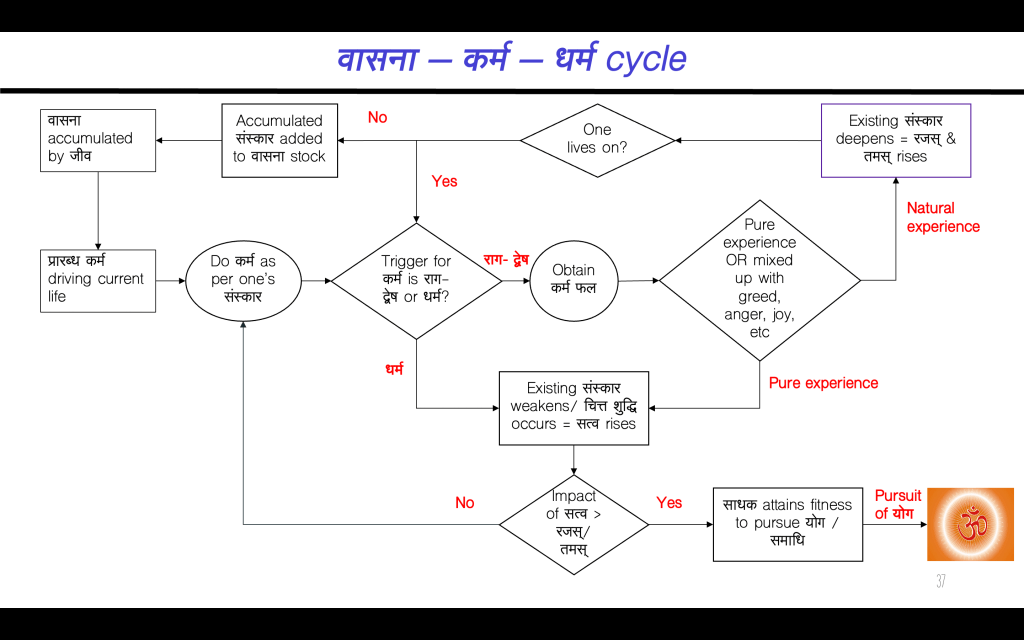
4:36/ 38 (2) – ज्ञान is the highest purifier. When one gains it, all past सुकर्म & दुष्कर्म get burnt up. कर्म is visualized as seeds within our minds which keep sprouting till we live life with कर्तृत्व भाव. We keep having life experiences of various types going through the roller coaster of moods till we work with कर्तृत्व भाव – it will not end. All कर्म with कर्तृत्व keep generating fresh seeds that are planted in our minds thus compelling us to repeat कर्म as per the nature of seeds again and again. Once ज्ञान descends into one’s persona, the योग दर्शन शास्त्र says that these seeds start burning up all सुकर्म & दुष्कर्म. Such seeds cannot thus create further plants/ trees (meaning new experiences). Over time, practice of कर्मयोग will burn up all seeds and one remains in a state of ज्ञान forever.
श्रद्धावाँल्लभते ज्ञानं तत्परः संयतेन्द्रियः । ज्ञानं लब्ध्वा परांशान्तिमचिरेणाधिगच्छति ॥४.३९॥
One who has श्रद्धा (श्रद्धावान्), who is committed to that (तत्परः) (ज्ञान) who is master of one’s senses (संयतेन्द्रियः) gains (लभते) ज्ञानम्. Having gained (लब्ध्वा) the ज्ञानम् one immediately (अचिरेण) gains (अधिगच्छति) absolute (पराम्) peace (शान्तिम्).
अज्ञश्चाश्रद्दधानश्च संशयात्मा विनश्यति । नायं लोकोऽस्ति न परो न सुखंसंशयात्मनः ॥४.४०॥
One who has no discrimination (अज्ञः), and (च) who has no श्रद्धा (अश्रद्दधानः), and (च) one who has a doubting mind (संशयात्मा) perishes (विनश्यति). Because, for the one with a doubting mind (संशयात्मनः), this (अयम्) world (लोकः) is not (न) there (अस्ति), nor (न) the world beyond (परः), nor (न) happiness (सुखम्).
4:39/40 (1) – Gem श्लोक for छात्र. The first requirement for a छात्र is श्रद्धा. Translated usually as faith, आदि शंकर defines this as an attitude of complete conviction in the words of the शास्त्र and instructions of the गुरु. One must entertain no doubts about following शास्त्र stipulations to gain ब्रह्मज्ञान. Doubting or cynical minds cannot achieve success – even in normal matters as well as on ब्रह्मज्ञान. When we get Usain Bolt or Sachin or Warren Buffet as our teacher, one entertains no doubt of their capability on athletics/ cricket/ investment advice. All our questions to them are thus directed to get the most out of them. Similarly, all our questions on शास्त्र must not entertain any doubt on their approaches and our questions are thus directed only to know them better. Avoid cynicism – do not be a संशयात्मा. Next – be तत्परः meaning hyper eager/ hyper keen to learn. Once when रामकृष्ण was bathing, a शिष्य asked him as to why he is unable to experience ब्रह्म despite years of practice. रामकृष्ण can caught hold of the neck of the शिष्य, pushed it inside water, drew him out after a while and told him – “if your keenness for ब्रह्मज्ञान is as intense as your keenness to come out of water when you were underwater, you will achieve ब्रह्मज्ञान.” Do we have such an intensity or do we harbour संशय on its utility/ truth? Lastly, श्रीमद्भगवद्गीता stresses on a person having विवेक (ability to distinguish between right and wrong) to apply his mind and not blindly accept all words of the गुरू or written words in the texts in a suboptimal manner. Continually question and rationalize the wisdom within the शास्त्र/ गुरुवाक्य using विवेक.
4:39/40 (2) – One who has no mastery over senses, no विवेक and is always in a cynical frame of mind, can such a person ever learn anything at all? We pursuing Engineering/ Medicine/ Finance, etc because we had श्रद्धा over the texts we refer to for study as well as have conviction about the utility of pursuing careers through such study. Had we been unsure of future benefit of such pursuits, we would not have pursued these at all. We similarly go for a certain holiday because we have श्रद्धा in its ability to give us joy; if we were unsure, we would not have even booked such a holiday. Keep senses in control too. Sense control is done even during exams. Even when we play tennis, we keep our senses relating to eating/ movie watching in control or else we cannot even play tennis. Similar control is expected when pursuing the Highest. Thus, entertain no doubts about the path of a कर्मयोगी – that appears to be the message by भगवान् here.
योगसन्न्यस्तकर्माणं ज्ञानसंच्छिन्नसंशयम् । आत्मवन्तं न कर्माणिनिबध्नन्ति धनञ्चय ॥४.४१॥
O अर्जुन (धनञ्चय), actions (कर्माणि) do not (न) bind (निबध्नन्ति) the one who has renounced कर्म through योग (योगसन्न्यस्तकर्माणम्), whose doubts have been completely severed by ज्ञान (ज्ञानसंच्छिन्नसंशयम्) and the one who is together (आत्मवन्तम्).
तस्मादज्ञानसम्भूतं हृत्स्थं ज्ञानासिनात्मनः । छित्त्वैनं संशयंयोगमातिष्ठोत्तिष्ठ भारत ॥४.४२॥
Therefore (तस्मात्), O भारत, slaying (छित्त्वा) with the sword of ज्ञान (ज्ञानासिना) this (एनम्) doubt (संशयम्) about the self (आत्मनः), which is born of अज्ञान (अज्ञानसम्भूतम्), which is rooted in the mind (हृत्स्थम्), get up (उत्तिष्ठ) and take to (आतिष्ठ) योगम् (कर्मयोग).
4:41/42 – श्रीकृष्ण tells here that actions do not bind one who does योगसन्न्यस्तकर्माणम् meaning one who has renounced कर्म. So use ज्ञान and cut the sword of अज्ञान (of not fighting the war). So fight war like a कर्मयोगी. This confuses अर्जुन since he is unable to understand what is meant by doing संयास of कर्म. ‘Do कर्म’ and ‘do संयास of कर्म’ seem contrary to each other and this takes us to अध्याय 5 titled as संयासयोग. Thus while distinction between ज्ञान and कर्म appears to have been resolved, भगवान् words created a new doubt triggering a question from अर्जुन which marks the start of a new अध्याय.
 Adhyatma Writings