
Chapter named भक्ति योग
एवं सततयुक्ता ये भक्तास्त्वां पर्युपासते। येचाप्यक्षरमव्यक्तं तेषां केयोगवित्तमाः।।12.1।।
12.1 अर्जुन said Among those (तेषां) devotees (भक्ता:) who (ये), in this same way (एवं), are always dedicated (to You) (सततयुक्ता) and meditate onto (पर्युपासते) You (त्वां), and those again (who meditate) (ये च अपि) on the formless (अव्यक्तम्) अक्षर, who (के) are the best knowers of योग (योगवित्तमाः)?
श्री भगवानुवाच
मय्यावेश्य मनो ये मां नित्ययुक्ता उपासते। श्रद्धया परयोपेतास्ते मेयुक्ततमा मताः।।12.2।।
12.2 The भगवान् said! Those who (ये) placing (आवेश्य) their minds in Me (मयि मन:), being always committed (नित्य युक्ता), and being endowed (उपेता) with ultimate trust (परया श्रद्धया) seek Me (माम् उपासते), they (ते) are considered (मता:) to be the best knowers of योग(युक्ततमा) by Me.
12:1-2 – अर्जुन asks भगवान् which भक्त He prefers / favours ; भक्त to worship His Divine forms (सगुण) with unmitigated भक्ति (सगुण भक्ति) vs. those भक्त who attempt to find His true reality as the अव्यक्त ब्रह्म (or निर्गुण form). The answer by भगवान् seems to favour the सगुण भक्त who adores and is immersed totally in the total form of भगवान् but the other path is much harder for the unprepared /novice. This seems practical advice by a Master to advocate for the doable path by साधक (achieve some success in chosen path) vs advocating a difficult path that is prone to being abandoned. This does not necessarily imply that one path is superior to another; there are many paths to the top of the mountain and it would make sense to choose paths that play to one’s core strengths/ natural स्वभाव recognizing fully that some paths are favoured by many for a reason ; the path less travelled can be lonely and that can be irksome to some 😃 This question often gets debated by practitioners as to which idea of भगवान् is true – निर्गुण or सगुण and is thus a critical question. The next few verses do show which path भगवान् prefers. Choose as per one’s inclination as we all will surely get to the same place irrespective of the path.
ये त्वक्षरमनिर्देश्यमव्यक्तं पर्युपासते। सर्वत्रगमचिन्त्यं च कूटस्थमचलंध्रुवम्।।12.3।।
संनियम्येन्द्रियग्रामं सर्वत्र समबुद्धयः। ते प्राप्नुवन्ति मामेव सर्वभूतहितेरताः।।12.4।।
12.3-4 Whereas those who (ये तु) seek Me (पर्युपासते) as अक्षर which cannot be described (अनिर्देश्यम्), formless (cannot be seen by senses) (अव्यक्तं), that which is present everywhere (सर्वत्रगम्), which cannot be conceived by the mind (अचिन्त्यं), which remains (true) in the apparent (कूटस्थम्), immovable (अचलम्) and permanent (ध्रुवम् च), completely master (संनियम्य) their organs (इन्द्रियग्रामं), whose vision remains same (समबुद्धयः) towards everything (सर्वत्र) and who are dedicated (रता:) to the welfare (हिते) of all beings (सर्वभूत), they (ते) attain (प्राप्नुवन्ति) only Me (माम् एव).
12: 3-4 भगवान् clarifies that those who worship the निर्गुण aspect of ब्रह्म Absolute Truth (अक्षर, the imperishable; अनिर्देश्यम् – the indefinable; अव्यक्तं – the unmanifest ; अचिन्त्यं – the unthinkable; कूटस्थम् – the unchanging) can also attain union with HIM. This can be attempted by controlling the senses (drawing oneself inward), modifying one’s temperament (calm without bursts of volatile emotion) and beyond the limited power of human senses and being engaged in selfless work for the welfare of all.
सक्तचेतसाम्ऽधिकतरस्तेषामव्यक्तासक्तचेतसाम्। अव्यक्ता हि गतिर्दुःखंदेहवद्भिरवाप्यते।।12.5।।
12.5 Among those (तेषाम्) whose mind is committed (आसक्त चेतसाम्) to the Formless (अव्यक्तम्), affliction (or difficulty) (क्लेश:) is greater (अधिकतर:), because (हि) a goal (गति:) of reaching (अवाप्यते) the Formless (अव्यक्ता) is difficult (दु:खं) for those who are देहवत् (identified with their body) (देहवद्भि:)
12:5 भगवान् cautions again that worship of the निर्गुण ब्रह्म is very challenging /difficult. It is a reasonable proposition to assume that for most of us who have an affinity with a physical form of भगवान् will find the सगुण path easier to focus one’s मन versus focussing on the dry/intellectual/impersonal form of ब्रह्म. There are probably very few folks, disciples of Adi Shankara or Ramana Maharishi who may have achieved success on this path of worship of ब्रह्म.
In these verses, in a sense, भगवान् has dispensed with the need for a debate on which is better. Both are good and, as we saw in the eighth chapter – All types reach Her. What is therefore probably key is to know ourselves first before we choose a style. If we like going for a holiday and experience a sense of WOW in one place that is more than another, we are गुण oriented. If we feel good at eating out on weekends or eating our favourite food items vis a vis others or if we feel great among friends vis a vis other colleagues or if we like certain kind of music and feel repelled at other kind of music, we are गुण oriented. And a गुण oriented person will tend to be better at सगुण उपासना. One must note that even a सगुणी knows that the ultimate is beyond गुण but still he must do सगुण उपासना since he has a body. And why just a सगुणी, even the great आदि शंकर has set up temples and prescribed rituals that the शंकरमठ आचार्य still follow to date. So how does one do सगुण उपासना vis a vis one who does निर्गुण उपासना? That then becomes the key question.
If we have a preference for बुद्धि, we may focus on सरस्वती as our इष्ट in our home and be part of book clubs, distribute books to others and spend more time in libraries outside our home. If we are feminine oriented, we may chant ललिता सहस्रानन and read देवी भागवतम् in our home and engage in women emancipation by focusing on women’s issues outside the home. If we are physical strength oriented, we do हनुमान् उपासना at home and focus on health and strength issues on the outside. All these are types of सगुण उपासना. Over time, a high level of engagement with our इष्ट will make us adopt धर्म oriented behaviour not just in our choice of profession but we end up seeing the presence of our इष्ट in all aspects. Thus, a strength oriented person will start observing strength even in the acts of an ant and one will be forced to expand strength to include mental strength too. One oriented towards books will realize that ज्ञान is not just bookish one but also in simple acts done by all in daily life from where learning can happen. This expansion will make us see similarity in deeds of all देवता as representing all facets. Once we reach this level, a certain type of “acceptance for all” seeps in automatically within us. All our subsequent acts then get done with the principle of “acceptance for all” working at all times. We thus end up doing धर्म at all times instead of getting swayed by our own गुण preference. We thus become ready for निर्गुण idea and all our acts post this level become निर्गुण उपासना.
ये तु सर्वाणि कर्माणि मयि संन्यस्य मत्पराः। अनन्येनैव योगेन मां ध्यायन्तउपासते।।12.6।।
तेषामहं समुद्धर्ता मृत्युसंसारसागरात्। भवामि नचिरात्पार्थमय्यावेशितचेतसाम्।।11.7।।
12.6 Whereas, O पार्थ! those who (ये तु) seek (Me), giving up (संन्यस्य) all action (सर्वाणि कर्माणि) unto Me (मयि), having Me as their ultimate (मत्पराः), and meditating on Me (मां ध्यायन्त उपासते) with undivided discipline (अनन्येनैव योगेन), for them (तेषां) whose mind (चेतसाम्) is absorbed (आवेशित) in Me (मयि), I (अहम्) become (अहम् भवामि) before long (नचिरात्) their liberator (समुद्धर्ता) from the ocean (सागरात्) that is संसार (filled with) death (मृत्यु).
12: 6-7 – भगवान् says that the path to escape the relentless cycle of life and death (संसार सागरात्) is one of absolute and complete renunciation (path of वैराग्य) which includes renouncing/giving up all कर्म, mediating with unwavering भक्ति on भगवान् as the Absolute, and merging both मन and बुद्धि with the भगवान्. This requires a temperament of total surrender of one’s entire being to भगवान्, accompanied by an utter lack of desire to engage with the material world. This is a viable path for the rare wise who meditate in the mountains away from the chaotic material, real-life world and its duality of responsibilities and attractions.
य्येव मन आधत्स्व मयि बुद्धिं निवेशय। निवसिष्यसि मय्येव अत ऊर्ध्वं नसंशयः।।12.8।।
12.8 Place the mind (मन आधत्स्व) on Me alone (मयि एव); in Me (मयि) place the बुद्धि (बुद्धिं निवेशय). There is no doubt (न संशयः) that hereafter (अत ऊर्ध्वं) you will abide (निवसिष्यसि) in Me alone (मयि एव).
अथ चित्तं समाधातुं न शक्नोषि मयि स्थिरम्। अभ्यासयोगेन ततोमामिच्छाप्तुं धनञ्जय।।12.9।।
12.9 If (अथ) you are unable (न शक्नोषि) to establish (समाधातुं) the mind (चित्तं) steadily (स्थिरम्) on Me (मयि), then, O धनञ्जय, seek (इच्छ) to attain Me (माम् आप्तुम्) through the योग of continuous practice (अभ्यास योगेन).
12:8-9 – भगवान् is advising अर्जुन to unrelentingly focus both मन and बुद्धि on HIM as the ultimate goal to be attained – thus one can abide in the भगवान् alone . Given its difficulty, भगवान् adds that those who find it hard to restrain their मन (monkey mind) i.e repeated practice becomes essential wherein every time the मन wavers , the भक्त gently brings it back to fix on भगवान्. 12:8 may be taken as a simple definition of भक्ति in which he also emphasizes that “without doubt”, one will attain the highest if we fix our मन/ बुद्धि on Him. But is it easy? When people say भक्ति is easy, it becomes evident that this is because most think that भक्ति is simply to sit in front of a deity or to love all while श्रीकृष्ण is defining भक्ति as something else altogether. Note that श्रीकृष्ण does not use of the word love or प्रेम anywhere though most of us tend to associate love with भक्ति. We love our kids because they have come out of us. We love our parents because they have done त्याग for us. We thus love anyone only because we owe some aspect of our life to such other person. So love is an outcome and once this comes about, we are able to fix our minds on kids, career, etc because these mean something to us. Similarly, भक्ति can come only with ज्ञान and which is why focus of Ch nine & ten focussed on conveying the importance of the highest Truth of what भगवान् really means. Once this “information” seeps in and realization dawns, only then will भक्ति comes about and only then will love follow as an outcome. Without ज्ञान, no भक्ति is possible.
.
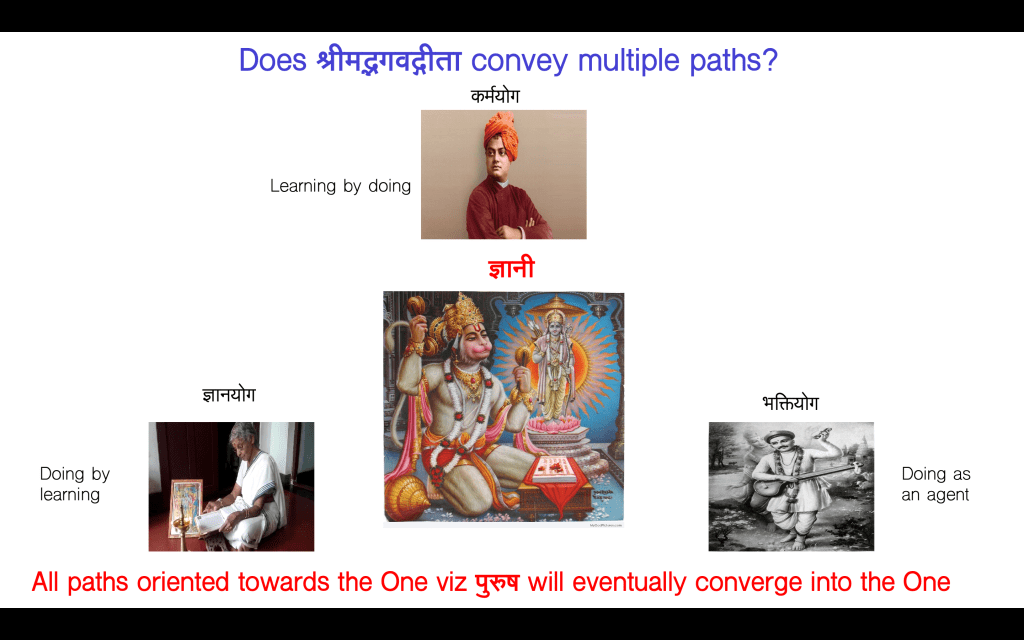
Note that भगवान् Himself does not use the word भक्तियोग though people after Him named this chapter as भक्तियोग. भगवान् uses कर्मयोग, ज्ञानयोग, संयासयोग, ध्यानयोग, etc but not भक्तियोग. योग thus may be taken as युक्ति, यत्न, means, orientation, etc. The end outcome through use of these means is भक्ति. And once one is established in भक्ति, the goal is achieved. One may therefore see that भक्ति cannot be achieved till one does relentless practice, reading, introspection, etc and whichever योग one pursues, भक्ति slowly expands till one no longer requires any means to achieve भक्ति and one becomes a natural भक्त
At the lowest level is भक्ति of the तमोगुण kind. This person chants the name of कृष्ण from time to time, lights up a दिया daily at home, goes to मंदिर off and on. There is no thinking about the depth of भगवान्, no real living of life knowing all comprehensive aspect of भगवान् and possibly does the above actions more out of fear or merely repeating what his or her parents followed all their life. Then we have भक्ति of the रजोगुण kind. This person does intense reading if intellectual oriented or intense activity in the form of meditation classes, doing intense पूजा, doing Homa/ Abhishekha at मंदिर, wearing visible religious symbols as a matter of pride, etc. This kind of भक्त tends to be argumentative, selectively reads the lives of Saints to emulate acts that resemble their sensibilities and looks down upon other orientations or makes fun of them. But they do think about भगवान् deeply in their lives. Most of us are probably at this stage. Then we have भक्ति of the सत्वगुण kind. They are composed, calm, genuinely see the operation of भगवान् in all beings. They find joy reading also and they also indulge in जप, नित्यपूजा, etc and do not prefer one over the other. They find the same level of satisfaction in doing any act since they see भगवान् operating at all places. They also argue when necessary or keep quiet when necessary. They are actually convinced but do नित्यसाधना since they do not want to fall down from their zone of joy. This can be as aspiration for all of us. Last, we have a भक्त beyond गुण who is of the परमहंस or तुकाराम kind. They are deeply immersed आत्मा who are beyond all – they are nothing else but भगवान् in human forms.
12.10. If (अथ) you are (असि) incapable (असमर्थ:) of even this [steady] practice (अभ्यासे अपि), be (भव) one for whom actions (कर्म) dedicated to (attain) Me (मत्) is the chief aim (परम:). Even by performing (कुर्वन् अपि) actions (कर्माणि) for Me (मद् अर्थम्), You shall attain (अवाप्स्यसि) success (सिद्धिम्).
अथैतदप्यशक्तोऽसि कर्तुं मद्योगमाश्रितः। सर्वकर्मफलत्यागं ततः कुरुयतात्मवान्।।12.11।।
12.11 If (अथ), being committed (आश्रितः) to My Yoga ( मद्योगम्) , you (असि) are unable (अशक्त:) to do (कर्तुम्) even this (एतद् अपि), in that case (तत:), being one whose mind is disciplined (यत् आत्मवान्), please (कुरू) give up (the false notion of being the author of) the results of (फल#त्यागं) all actions (सर्वकर्म).
12:10-11 – This (12:10) shloka focusses on कर्म योग for those who temperamentally are unsuited for “ध्यान योग” i.e are unable to practice restraining their mind to focus on भगवान्. For such people, who may tend to be more “action-oriented” (vs “contemplative oriented”), the कर्म योग path is to perform all कर्म such that everything we do is meant for भगवान् such that the most important aspect/aim becomes to offer all actions/activities to भगवान्. However (12;11), if circumstances are such that this is not possible/challenging , then another avenue in कर्म योग is to continue to perform कर्म /धर्म but give up the notion of “ownership” to the rewards/ results of one’s activities. It is critical to also remember that भगवान् is very clear about the fact that inaction or shirking from one’s responsibilities is not an option.
श्रेयो हि ज्ञानमभ्यासाज्ज्ञानाद्ध्यानं विशिष्यते। ध्यानात्कर्मफलत्यागस्त्यागाच्छान्तिरनन्तरम् ।।12.12।।
12.12 Understanding (with practice) (ज्ञानम्) is surely superior (श्रेयो हि) to practice (अभ्यासात्); Contemplation (with understanding) (ध्यानम्) surpasses (विशिष्यते) Understanding (ज्ञानात्). The renunciation of the results of works (कर्मफलत्याग:) (excels) Contemplation (ध्यानात्). From renunciation (त्यागात्), Peace (शान्ति:) follows immediately (अनन्तरम्).
12:12 – This is a complex श्लोक; ज्ञान योग (cultivation of knowledge of the आत्मा) is better than the imperfect/ difficult practice (अभ्यास) (without ज्ञान) of restraining the मन to focus on भगवान्. ध्यान योग (contemplative meditation on भगवान्) is better than imperfect ज्ञान of आत्मा ; कर्म योग that involves renunciation of कर्म (attributing all कर्म to भगवान्) and/or giving up “ownership” to फल of कर्म is better than imperfect ध्यान on the आत्मा. कर्म योग performed in the spirit of renunciation (निष्काम कर्म) results in peace of mind. Achieving peace of मन through कर्म योग, one can raise / realize the आत्मा through knowledge of आत्मा (viz ज्ञान योग) and through ध्यान (ध्यान योग) which is the goal i.e. realization of ब्रह्म – a mind not at peace and/or attached to काम is an impediment to realization of आत्मा). Thus निष्काम कर्म by providing equanimity/peace of mind paves the path for our मन to engage in ध्यान योग and gain ज्ञान of आत्मा (ज्ञान योग).
नास्ति बुद्धिरयुक्तस्य न चायुक्तस्यभावना । न चाभावयतः शान्तिरशान्तस्य कुतःसुखम् ॥२.६६॥
For the one who is not tranquil (अयुक्तस्य) there is (अस्ति) no (न) knowledge (बुद्धिः). For the one who is not tranquil (अयुक्तस्य), there is no (न च) contemplation (भावना). And (च) for the one who is not contemplative (अभावयतः), there is no (न) peace (शान्तिः). For the one who has no peace (अशान्तस्य) how can there be (कुतः) happiness (सुखम्)?
अभिनवगुप्त gives His comments as below:
We say that ज्ञान of Oneness or absorption into the Divine is better than अभ्यास because ज्ञान comes as a result of अभ्यास. If अभ्यास does not result in ज्ञान, there is no use of pursuing such अभ्यास. However, ध्यान viz the identity with भगवान् is better than ज्ञान because only through ध्यान does one attains भगवान् which excels all other objects of ज्ञान. When ध्यान is completed, i.e. when identity with भगवान् is realized, only then is it possible to renounce the कर्म फल since one realizes that one is really an instrument of भगवान्. Otherwise how can one surrender the कर्म फल to भगवान् when the nature of भगवान् remains hidden from him? And only when one is able to renounce कर्म फल, one is able to achieve the state of शांति. Thus start with limited practice which should take us to ज्ञान of Oneness of भगवान् which should take us to ध्यान which should take us to a state where we realize that we are not the doer. Once one reaches this state, one achieves शांति.
This approach is interesting since it does not say one branch is better than the other but actually suggests that one branch must lead to the another or else we are struck at previous level. So start with क्रिया like नित्यपूजा, जप, chanting, etc being simple practices. These pursued over a period of time must necessarily take us to a state where we question the reason behind these and as we investigate further, we can connect with their purpose and thus get ज्ञान of Oneness. This ज्ञान of Oneness excites us further and we intensify our efforts to focus on the truth of Oneness and these deeper efforts are nothing else but ध्यान. And once we achieve सिद्धि in ध्यान, we really start experiencing Oneness everywhere in the form described in chapter ten. At this stage, we fully lose the idea of doer-ship (कर्तृत्व भाव) as अहंकार breaks away from us. Once अहंकार goes away, we are at peace in the सत्-चित्-आनन्द state. People who are thus at various preliminary states are thus given a direction to tell them what their efforts must eventually lead to.
12.13 He who is not hateful (अद्वेष्टा) towards any creature (सर्वभूतानां), who is friendly (मैत्रः) and compassionate (करुण एव च), who has no idea of ‘mine’ (निर्मम:) and the idea that “I” (am only this body-mind) (निरहङ्कारः), who is सम under दुःख and सुखः (सम दुःख सुखः), who is accommodative (क्षमी) ;
सन्तुष्ट: सततं योगी यतात्मा दृढनिश्चयः। मय्यर्पितमनोबुद्धिर्यो मद्भक्तःस मे प्रियः।।12.14।।
12.14 He who is ever content (सन्तुष्ट: सततं), who is a योगी, who has disciplined (यतात्मा), who has firm conviction (दृढनिश्चयः), with mind and बुद्धि resolved in Me (मयि अर्पित मनो बुद्धि:) – who is (य:) devoted to Me (मद्भक्तः), that one (स:) is dear to Me (मे प्रिय:).
12.15 Of whom (यस्मात्) the world (लोक:) is not afraid (नउद्विजते), and who (य: च) is not afraid (न उद्विजते) of the world (लोकात्), and the one who (य: च) is freed (मुक्त:) from elation (हर्ष:), intolerance (अमर्ष:), fear (भय) and anxiety (उद्वेगै), that one (स:) is dear to Me (मे प्रिय:).
अनपेक्षः शुचिर्दक्ष उदासीनो गतव्यथः। सर्वारम्भपरित्यागी यो मद्भक्तः समे प्रियः।।12.16।।
12.16 Without dependence (on anything for happiness) (अन् अपेक्षः), who is clean (externally and internally) (शुचि:), who is adept (दक्ष:), who is neutral (उदासीन:), who is not shaken by fear (गत व्यथः), completely renounced all (doership in) activities (सर्व आरम्भ परित्यागी) – he who is (in this way) devoted to Me (यो मद्भक्तः), that one (स:) is dear to Me (मे प्रिय:).
12:15-16 – The characteristics of an ideal भक्त are further described in detail. Again, mostly self- explanatory.
यो न हृष्यति न द्वेष्टि न शोचति न काङ्क्षति। शुभाशुभपरित्यागीभक्तितमान्यः स मे प्रियः।।12.17।।
12.17 He who (य:) does not get elated (न हृष्यति), nor does become displeased (न द्वेष्टि), does not grieve (नशोचति), does not require/ anticipate (न काङ्क्षति), who (naturally and) completely renounces (परित्यागी) (the status of being the doer and experiencer in) pleasant and unpleasant activity (शुभ अशुभ), who thus has devotion (भक्तिमान् य:)- that one (स:) is dear to Me (मेप्रिय:).
समः शत्रौ च मित्रे च तथा मानापमानयोः। शीतोष्णसुखदुःखेषु समःसङ्गविवर्जितः।।12.18।।
12.18 He who is same (समः) towards (another who takes himself or herself as) an enemy or a friend (शत्रौ चमित्रे च), towards respect and disrespect (मान अपमान य:), who is alike to both cold and heat (शीतोष्ण), pleasure and pain (सुखदुःखेषु), and who is free from all attachments (समः सङ्गविवर्जितः);
तुल्यनिन्दास्तुतिर्मौनी सन्तुष्टो येनकेनचित्। अनिकेतःस्थिरमतिर्भक्तितमान्मे प्रियो नरः।।12.19।।
12.19 The person for whom censure and praise are alike (addressing only this body or mind but not one’s self) (तुल्य निन्दा स्तुति), disciplined in speech (मौनी), satisfied (सन्तुष्ट:) with whatever (happens) (येन केन चिद्), homeless (अनिकेत:), whose knowledge is firm (स्थिरमति:), who thus has devotion (भक्तिमान् य:)- that one (नर:) is dear to Me (मे प्रिय:).
ये तु धर्म्यामृतमिदं यथोक्तं पर्युपासते। श्रद्दधाना मत्परमा भक्तास्तेऽतीवमे प्रियाः।।12.20।।
12.20 Those indeed who (ये तु) follow (पर्युपासते) this (इदं), as was told (यथा उक्तं), that is in keeping with धर्म(धर्म्याम्) and (is an expression of and leading to) complete freedom (अमृतं), who are endowed with conviction (in My teaching) (श्रद्दधाना), for whom I am paramount (मत् परमा) – such devotees (भक्ता:) as those are (ते) exceedingly dear to Me (अतीव प्रिया:).12:17-20 – The characteristics of an ideal भक्त are further detailed – being सम is key which may be seen as critical lack of/ no distinction between the dualities most of us are embroiled in life (joy/ sorrow, success/ failure, friend/ for, auspicious / inauspicious etc etc… the goal is to go beyond the duality and focus on the oneness of ब्रह्म. भगवान् states that भक्त (with traits described from श्लोक 13-19) following the path of धर्म and focusing on HIM as paramount are dear to Him.
 Adhyatma Writings