
Chapter name is गुणत्रय विभाग योग
श्री भगवानुवाच
परं भूयः प्रवक्ष्यामि ज्ञानानां ज्ञानमुत्तमम्। यज्ज्ञात्वा मुनयः सर्वे परां सिद्धिमितो गताः।।14.1।।
14.1 The भगवान said – I will again (भूयः) declare (प्रवक्ष्यामि) that most profound knowledge (ज्ञानमुत्तमम्) of all knowledge (ज्ञानानां), having known which (यद् ज्ञात्वा) all the sages (सर्वे मुनयः) have gone to (गताः) the supreme perfection (परां सिद्धिम्) from this (body) (इत:).
इदं ज्ञानमुपाश्रित्य मम साधर्म्यमागताः। सर्गेऽपि नोपजायन्ते प्रलये न व्यथन्ति च।।14.2।।
14.2 Following (उपाश्रित्य) this knowledge (इदं ज्ञानम्), they, having attained (आगता:) My (मम) same nature (साधर्म्यम्), do not arise (न उपजायन्ते) even at the manifestation (सर्गे अपि) (of a new Universe) nor fall (न व्यथन्ति च) at the dissolution (प्रलये).
14:1/2 (1) – This ज्ञान that I am imparting, know that several मुनि in the past have practiced it. So this is not new ज्ञान. And this approach to ज्ञान is a consistent line – even श्रीकृष्ण never claims originality. In भारत, a वैदिक-aligned person sees himself as sitting in the lap of Mother वेद all the time. Any insight into Truth about purpose of life is thus seen in two ways – if fresh ideas come forth, he feels comfortable once these find validation within the वेद. Equally, cryptic lines from within the वेद are brooded upon and investigated which have given new insights into the truth behind life all around us. Thus if बुद्धि is taken as a beautiful river flowing, वेद is seen as banks that keep the river in check as it journeys its way towards the सागर. And several मुनि have taken this वैदिक path in the past and reached Me.
14:1/2 (2) – There is a funny side impact of this दृष्टि which should probably limit itself to अध्यात्म ज्ञान but is extrapolated foolishly to all types of ज्ञान. Alberuni writes about this when he visited भारत around 1025 AD. He states that people in भारत felt that theirs is the only place from where any ज्ञान has emanated and all ज्ञान conveyed anywhere in the world is traceable to the वेद. However, when these people came across ज्ञान that they were unfamiliar with, they asked Alberuni to name the ऋषि from भारत took this ज्ञान to the other country 😀. We of course see traces of this silly दृष्टि emanating today too from some people. Of course, we have an equally opposite tribe today who, owing to ignorance about ancient thought of भारत, opine that nothing valuable has ever come out of here. And between these two extremes, life goes on….. 😀
14:1/2 (3) – Once one attains the ज्ञान about गुण, they attain Me (मम साधर्म्यम् आगता:). This line is interesting – here, भगवान् says that the मुनि attains the धर्म of भगवान्. And what is the धर्म of भगवान्? It is सत्-चित्-आनन्द रूप. So success is not exactly expressed as merging into Infinite but merely gaining the धर्म of भगवान्. And hence He adds, once one attains this state, one is never born or dies even after the विश्व ceases to exist. This intuitively also means that one still exists but in a सत्-चित्-आनन्द state. It is difficult to conceive this – the analogy often used is of the नदी merging in the सागर. When a नदी joins the सागर, does the नदी water cease to exist? No – it remains within the सागर. But it does not retain its नदी धर्म and it acquires the सागर धर्म. But in this mass of indistinguishable नदी that is the सागर, how does the नदी feel within the सागर? Does it feel happy or the “it” does not exist as “it” because there is no “it”? We cannot imagine this state and this will remain an unsaid till we are within the सागर. So do you want to be the सागर? 😊
मम योनिर्महद्ब्रह्म तस्मिन् गर्भं दधाम्यहम्। संभवः सर्वभूतानां ततो भवति भारत।।14.3।।
14.3 My womb (मम योनि:) is the great ब्रह्म (महत् ब्रह्म). In that (तस्मिन्) I (अहम्) implant the seed (गर्भं दधामि). From that (तत:), O भारत! is (भवति) the manifestation (संभवः) of all beings (सर्वभूतानां).
सर्वयोनिषु कौन्तेय मूर्तयः सम्भवन्ति याः। तासां ब्रह्म महद्योनिरहं बीजप्रदः पिता।।14.4।।
14.4 For those (तासां) forms which (या: मूर्तयः) arise (सम्भवन्ति) in all wombs (सर्वयोनिषु), O कौन्तेय, the (original) womb (योनि:) is महद् ब्रह्म. And I (अहं) am the father (पिता) who implants the seed (बीजप्रदः).
14:3/4 (1) – He has impregnated महद् ब्रह्म viz His own womb and the विश्व got created. महद् ब्रह्म is thus be taken as प्रकृति here (a uni-cellular organism comes to mind here 😀). In the पुराण, ब्रह्मा is shown as an old MAN who is identified as the creator. But viewed from the दृष्टि of this verse, a creature cannot create anything unless a seed is implanted within itself. ब्रह्मा on his own is incapable of सृष्टि. And श्रीकृष्ण is saying here that He is the seed giving father and the womb giving mother too. And equally, in all wombs (meaning in all kinds of lives), it is Him or His seeds and His (or Her) womb (named as महद् ब्रह्म here) that create life in all. Fascinating, is it not?
14:3/4 (2) – The comment being made here is that while male and female may be material causes in the physical world, the decision as well as action to manifest life within is that of भगवान्. LIFE has to thus decide first that IT intends to manifest. If we scroll back to chapter ten, did भगवान् not say that He is the sexual desire (a limited expression of the word काम) in all beings? So the intent of भगवान् to expand gets facilitated by getting the sexual desire instituted within beings. This is also be akin to humans switching on a toy; the decision to switch on off is made by the human and not the toy. Similarity, the decision to manifest life as well as execute it is made by भगवान् and we are toys merely sing His tune – of course thinking that it is our tune 😀- that is the idea here.
14:3/4 (3) – A small side comment – question often comes up among हिन्दूs as to why is it that except here and there, we do not have देवालय of ब्रह्मा? In many पुराण, ब्रह्मा role is more of an executor of an action than the decision maker. He gets the idea of how to shape the विश्व from पुरुष and he gets the material from प्रकृति. And his job is merely to project विश्व as per the instruction manual. Texts like योग वसिष्ठ state that in every such new projection, the shape and form of the विश्व keeps changing as per the सङ्कल्प of भगवान् and thus the same principles do not apply every time a new विश्व gets projected. So value of परुष-प्रकृति is primal and hence देवालय for them is valid – executor is merely executing an instruction and no देवालय is deemed necessary. Thus, the parameter of what is seen as “divine” and what is not needs to the understood, whether we agree with it or not, to interpret the answer to such questions🤔.
सत्त्वं रजस्तम इति गुणाः प्रकृतिसंभवाः। निबध्नन्ति महाबाहो देहे देहिनमव्ययम्।।14.5।।
14.5 सत्त्वं, रज: and तम are (इति) the गुणाः that arise from (संभवाः) the प्रकृति. They bind (निबध्नन्ति) the changeless embodied one (देहिनम् अव्ययम्) in the body (देहे), O महाबाहो.
तत्र सत्त्वं निर्मलत्वात् प्रकाशकम् अनामयम्। सुखसङ्गेन बध्नाति ज्ञानसङ्गेन चानघ।।14.6।।
14.6 Among these (तत्र), सत्त्वं, since it is free from impurity (निर्मलत्वात्), is illuminating (प्रकाशकम्) and free from affliction (अनामयम्), and (yet) it binds (बध्नाति) by attachment to pleasure (सुखसङ्गेन) and by attachment to knowledge (ज्ञानसङ्गेन), O अनघ.
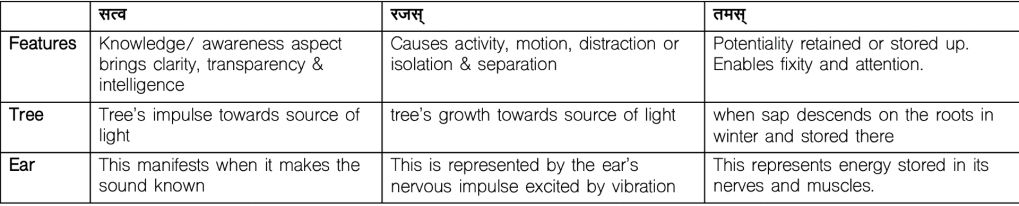
14:5/6 (1) – गुण is intrinsic to प्रकृति. प्रकृति provides the material in the form of twenty-four components and shape that this material takes is fashioned by the गुण. Similarly, clay is the material used to make a pot while the shape of the pot is given by गुण in the mind of the potter. In pre-creation, त्रिगुण are in a state of equilibrium but the पुरुषोत्तम injects His seed into प्रकृति; it creates a गुण imbalance and creation of the विश्व gets actuated. This also means that once we are somehow able to regain the state of equilibrium of गुण within ourselves, the need for further activity is dispensed with. This is the state of मोक्ष. But can we do that? We will come to that later, not as yet here.
14:5/6 (2) – सत्व is like pure water. It does not have मल viz impurity. Because there is no मल, it is transparent enabling one to see the bottom of the river. If our mind is pure, our (mental) vision becomes clear denoted here as प्रकाशकम्. And learning is the best when one is in सत्व since one’s equipment’s are fully objective. And because the vision is clear, no दोष (in terms of bad कर्म) attaches to a person who acts in a सत्व mode. अनामय in हिंदी stands for one who is healthy or without any दोष or रोग.
14:5/6 (3) – So logically, सत्व is good and सत्वकर्म are always beneficial, right? “Not really” is the answer. सत्वकर्म also bind a person. So a सत्व oriented person is attracted to pleasure he derives from experience of learning. Pleasure here does not mean अध्यात्मिक bliss but includes simple pleasures of life. So if one experiences joy when someone gives a massage to us, the ability to experience such a joy comes from सत्व. Thus, even a lazy person experiences joy because he has सत्व within him. So one with a high level of सत्व may get addicted to ज्ञान.
14:5/6 (4) – Obsession with शास्त्र is also an obsession only. Because he has अनुभव of joy in reading books or learning about art, carpentry, rafting, etc., one keeps on learning such topics. While this may appear good, do note that art, cooking, etc are also happenings within प्रकृति and will not give us insight into पुरुष. So while सत्व is noble, it may not take us to the पुरुषोत्तम unless the aspect of ज्ञान is oriented towards पुरुष. Worse, a person addicted to ज्ञान gets disturbed if he is unable to read books or the environment is too noisy and thus not conducive for learning. Thus, सत्व also creates a binding owing to such addictions.
14:5/6 (5) – And now a personal take. We have संगीत being sung by people. One variety of संगीत is of a लौकिक variety where the singer expresses joy by singing in an beautiful tune or conveying words that appeal our body & mind. Second type of संगीत is of a धार्मिक one where someone like लता मंगेश्कर or बीलमुरलीकृष्ण picks up a भजन or कीर्तन and sings beautifully thus giving joy to the singer as well as listeners – this appeal is both at मन/शरीर level as well as at our बुद्धि. A सत्वगुणी is one who gets happiness both from संगीत of a लौकिक as well as of a धार्मिक type. But there is a third variety which I will give the name of अध्यात्म संगीत like that of त्यागराज or मीरा where the संगीत is an outcome of intense भक्ति where one is stirred by Oneness and song/ dance is an expression of आनन्द at this level. Our सत्वगुणी is not still at the level of अध्यात्म संगीत for which he has to shed his सत्वगुण also.
14:5/6 (6) – Now in our festivals, enjoyment is mixed with पूजा and all of you must have had an experience where the food made for the festival is served only after पूजा is over. Thus, सत्व अनुभव is wedded to देव अर्चन and food on this day is not just the routine food but becomes a प्रसाद. Same goes for all kinds of enjoyment in any festivals – first योग, then भोग or else the भोग without योग will become the cause of रोग 😀 making it difficult to uplift us beyond सत्वगुण.
रजो रागात्मकं विद्धि तृष्णासङ्गसमुद्भवम्। तन्निबध्नाति कौन्तेय कर्मसङ्गेन देहिनम्।।14.7।।
14.7 Know (विद्धि), O कौन्तेय, that रज: is of the nature of (आत्मकम्) attraction (राग) springing from (समुद्भवम्) longing (तृष्ण) and attachment (आसङ्ग) It (तद्) binds (निबध्नन्ति) the embodied one (देहिनम्) with attachment to activity (कर्मसङ्गेन).
तमस्त्वज्ञानजं विद्धि मोहनं सर्वदेहिनाम्। प्रमादालस्यनिद्राभिस्तन्निबध्नाति भारत।।14.8।।
14.8 Whereas (तु), know (विद्धि) तम: – for all those identified with the body (सर्व देहिनाम्) – as delusion (मोहनं) (ie as the lack of discerning the difference between oneself and objects of desire) born of is born of false knowledge (अज्ञान जं). It (तद्) binds (निबध्नन्ति), O भारत, with carelessness (प्रमाद), laziness (आलस्य) and sleepiness (निद्राभि:).
14:7/8 (1) – The foundation of रजस् is राग or attachment. Some aspect of प्रकृति attracts us and we then experience two feelings out of this attraction – we experience तृष्णा viz a deep longing to possess what we do not own. And this drives us towards pursuing all कर्म to possess the object of our तृष्णा. And along with this, we experience आसंग viz a deep drive to protect what we already own. Thus, seeking best investment options, security of our house, applying creams that continue to make us feel young, etc are interesting outcomes that come on account of रजस् present in us. Essentially, we become कर्म oriented and pursue lots of कर्म throughout life owing to presence of रजस् within us.
14:7/8 (2) – तमस् creates मोहनं meaning infatuation for a person or an object when one is in तमस् – since this enchantment is not based on wisdom, it causes distraction. When विष्णु took मोहिनी रूप, the असुर became distracted from the pursuit of अमृत and pursued मोहिनी instead. This ability to get distracted comes from तमस्. प्रमाद is translated as carelessness, negligence or inability to concentrate. Owing to तमस्, we take decisions based on laziness (meaning short cuts) or those that promote sleep (we do not book movie tickets at 9am though logically the tickets are cheapest at this time so as to not compromise the Sunday morning sleep 😀). When तमस् overpowers us, we tend to study not for ज्ञान but to pass exams. While we may pass the exams too, we will remain in अज्ञान. A तमस् person when forced to work becomes blind with rage. He does not know even how to behave himself, with whom to talk and what and cannot know if a certain action is possible or impossible.
14:7/8 (3) – Do not see these traits as value judgements being passed. These are merely expressed as traits present in all of us. All of us possess त्रिगुण and so do animals, plants, etc. It is just that one गुण is dominant at a certain point while another गुण at another point.
14:7/8 (4) – An interesting point to note is that one sees lesser activity orientation in both सत्वगुणी and one with तमस्. A person sleeping at the base of Everest inside a tent is doing no activity while a person who has reached the top also does no activity. So both do not accumulate कर्म or accumulate very little कर्म. A तमस् works for the wrong reasons (self-esteem, status, etc) and therefore distracted while doing work owing to मोह or आलस्य within him. A सात्विक works for धर्म, is alert, has good grasping ability and thus works very efficiently & effectively in a detached form and remains balanced. A रजस् is guided by ambition, loves work and usually loses himself in work; he finds meaning in life with his work orientation and is very irritated with Swamiji or Ashrams where there is quietitude since he finds people who do not do work as irrational and lazy 😀. Hence he accumulates a lot of कर्म – both good and bad on account of his work orientation.
सत्त्वं सुखे सञ्जयति रजः कर्मणि भारत। ज्ञानमावृत्य तु तमः प्रमादे सञ्जयत्युत।।14.9।।
14.9 सत्त्वं binds one (सञ्जयति) into pleasure, रजः to action (कर्मणि), O भारत. But (तु) तमः, veiling knowledge (ज्ञानम् आवृत्य), indeed (उत) binds one (सञ्जयति) into carelessness (प्रमादे).
14:9 (1) – सत्व creates liking for pleasure but addiction to such pleasures will lead to obsessions. These obsessions could include pursuits such as religious books, art, classical music, etc. Though these pursuits may be nobler than other so-caller “rustic” 😀alternatives, excessive engagement with these will keep us away from a much greater jewel. Beauty is – this jewel can be experienced without pursuing anything or by pursuing anything. So while सत्व is certainly beneficial than रजस् & तमस्, it also can cause unhappiness if one is not alert to their dangers.
14:9 (2) – रजस् makes one obsessively activity oriented. They get disturbed sitting down and doing nothing. A quiet place may be seen as an आश्रम by a सत्व person while a रजस् person may liken such a place to a cremation ground while one with तमस् is very happy in an आश्रम thinking that he can sleep well in such a place – each perceive differently though the place is the same. We see retired people continuing to work even though they are financially sound – this is because they are at peace only by being in a state of continual work. They get angry seeing lazy people and are surprised how one can merely sit at one place for hours doing nothing. A रजस् person should ideally not be taught nuances of ध्यान – he will not be able to sit down but will equally convince you as to why you are also wasting time doing ध्यान 😀.
14:9 (3) – Our best friend is तमस्. Owing to his inability to grasp things owing to his inability to concentrate, his learning is hampered. And owing to absence of learning ability, he mixes up one thing for another. He just does not get it. No matter how many times one explains to a तमस् person, like a dog’s tail which does not straighten, he returns to the same argument. And one senses that most of his arguments are lazy superficial arguments which he may have heard from others. To win arguments, our friend will turn to Google and take something that may help in winning arguments – he is not interested in Truth while सत्व will also use Google but in a manner that takes him closer to Truth. So do not waste your time on a तमस् oriented person but if we are such a person ourselves, enjoy the bliss of अज्ञान 😀.
14:9(4) – Within our body viz लंका (island), there are three brothers – रावण as रजोगुण, कुंभकर्ण as तमस् and विभीषण as सत्व. Question is – who is ruling our लंका? If it is रावण, one must try our best to reason and give sensible advice to moderate its extroverted-ness. When this fails, सत्व will have to reach out of ईश्वर viz राम viz पुरुष (भक्ति) to save लंका. राम will certainly fight for you to subdue रजस् & तमस् and after winning the war, install you as the king of लंका. Even कुंभकर्ण is an educated person and gives sensible advice to रावण to return Sita. But because of sleep orientation, he cannot make the right decision of seeking out राम but instead fights for रावण. Because of this, he perishes. This is अध्यात्म रामायण which has been the basis of learning रामायण by wise persons for many centuries.
रजस्तमश्चाभिभूय सत्त्वं भवति भारत। रजः सत्त्वं तमश्चैव तमः सत्त्वं रजस्तथा।।14.10।।
14.10 सत्त्वं arises (भवति) by overwhelming (अभिभूय) रजः and तमः, O भारत. रजः arises by (overwhelming) तमः and सत्त्वं, similarly (तथा) तमः by (overwhelming) रजः and सत्त्वं.
14:10 (1) – One immediate tendency of people when they learn new terms is to apply this to their spouse 😀 . Maybe भगवान् was worried about this and this श्लोक is meant to curb such infantile tendencies. Apply the गुण ideas not to assess others but to primarily assess yourself (one may do this once one is reasonably refined). Later, भगवान् will give ideas on how to recognize the signs.
14:10 (2) – All three गुण are present in all of us. However, all of them are not dominant at all times. Within us, there are times when सत्व is dominant and in this state, other two are subservient to सत्व. At other times, रजस् or तमस् are dominant. Thus, when one is reading or learning, सत्व is dominant, when one is doing an intense activity, रजस् is dominant while when one is sleeping, तमस् is dominant. All three operate within us at all times and life is not conceivable if either one of them is not dominant at any point of time.
14:10 (3) – However, as per गुरुs, impact or benefit of an action is the result of the ordering of the गुण structure. रजस् backed by तमस् makes us pursue body/mind based desires, तमस् backed by रजस् makes one do क्रिया but use short cuts and cut corners (lazy intellectuals), रजस् backed by सत्व makes one take up to aggressive social service while सत्व backed by रजस् makes us pursue minimal activity that is necessary for pursuit of धर्म.
14:10 (4) – A ब्राह्मण is one in whom सत्व is primary while रजस् is secondary, a क्षत्रिय is one where रजस् is primary while सत्व is secondary, a वैश्य is one where रजस् is primary while तमस् is secondary and शूद्र is one where तमस् is primary while रजस् is secondary. And equally, one can argue that each person can be a ब्राह्मण, शूद्र, etc at various times in our life. As per our texts, तमस् is responsible for creation of physical body, रजस् for our प्राण शक्ति (you must be familiar with the idea of पञ्चप्राण viz प्राण, व्यान, अपान, उदान & समान) and सत्व for our बुद्धि (for details, read तत्नबोध).
14:10 (5) – In the natural way of things, सत्व is dominant in the morning, रजस् during the day and तमस् in evening/ night. Students are thus advised to pick up a new topic of study early in the morning, focus on practical during the day and do revision only in the evening. As per our natural structure of our body, सत्व is dominant when we are young, रजस् in middle years and तमस् in old age. आश्रम system is built around this idea too – keep सत्व dominant and study अध्यात्म ज्ञान (and other ज्ञान necessary for survival) when one is young (ब्रह्मचर्य), keep सत्व dominant and be धार्मिक even while engaged in intense activity (गृहस्थ), keep सत्व dominant and take up an advisory role as diseases start taking the body over (वानप्रस्थ) and keep सत्व dominant as body is naturally more inclined towards तमस् so as to give ourselves fully to contemplation of ब्रह्म (सन्यास).
सर्वद्वारेषु देहेऽस्मिन्प्रकाश उपजायते। ज्ञानं यदा तदा विद्याद्विवृद्धं सत्त्वमित्युत।।14.11।।
14.11 When knowledge as light (प्रकाश:) illumines (उपजायते) from all gateways (सर्वद्वारेषु) (i.e., the senses) in this body (अस्मिन् देहे), then (तदा) one should indeed know that (इति विद्यात् उत) सत्त्वं has increased (विवृद्धम्).
लोभः प्रवृत्तिरारम्भः कर्मणामशमः स्पृहा। रजस्येतानि जायन्ते विवृद्धे भरतर्षभ।।14.12।।
14.12 Greed (लोभः), (physical) restlessness (प्रवृत्ति), undertaking of work (कर्मणाम् आरम्भः), unrest (अशम:) and longing (स्पृहा) – these arise (एतानि जायन्ते), O भरतर्षभ, when रज: has increased (विवृद्धे).
अप्रकाशोऽप्रवृत्तिश्च प्रमादो मोह एव च। तमस्येतानि जायन्ते विवृद्धे कुरुनन्दन।।14.13।।
14.13 Dullness (अप्रकाशो), absence of (physical) activity (अप्रवृत्ति), carelessness (प्रमाद:) and even delusion (मोह एव च) – these arise (एतानि जायन्ते), O कुरुनन्दन, when तम: has increased (विवृद्धे).
14:11/13 (1) – We have thus far seen two aspects on गुण – the लक्षणम् (characteristics) and बन्धप्रकार (how these bind). Today, we will see the गुणलिंगानि viz how to identify presence of a गुण. Later, we will see the गति: (what happens after life) and फलम् (what happens in this life) of each गुण. When सत्व is dominant, one can grasp easily from all द्वार viz doorways to the world. द्वार within us are our five senses and the मन. Because when मन is calm, one is able to grasp whatever one listens, sees, smells, etc most appropriately. In addition, one is able to apply this ज्ञान in the proper manner without getting distracted by paraphernalia owing to one’s unbiased orientation.
14:11/13 (2) – Our रजस् friend is driven by राग. He wants to always DO something. He cannot sit idle. Greed word is not to be seen as negative here. This man is ambitious and wants to acquire stuff, people or objects THOUGH he may not need them. Most of humanity will have this trait within them. And he will start various new initiatives since he is always excited to do something or the other. Anyone who is active and continually in a “doing” mode can be said as one in whom रजस् is dominant. One accumulates maximum कर्म when one is in this mode since “doer-ship” is highest in रजोगुण.
14:11/13 (3) – तमस् man is my best friend. His grasping power is challenged owing to his innate preference for doing nothing and he thus takes more time to understand anything. He is lazy. He is distracted. He prefers least effort with maximum outcome. He mixes up things and more prone to over-reaction when asked to study/ work by giving intelligent sounding वितण्ड वाद. Do not teach meditation to this person – he will fall asleep 😀.
14:11/13 (4) – Now imagine what is the outcome when two people of different dominant गुण orientations marry one another? 😀 In plants, तमस् is dominant since there is no movement or learning. In animals, it varies though one sees a mix of रजस् and तमस् operating while सत्व is tertiary limited and used only for survival and nothing else. देव is one whose सत्वगुण is higher, असुर is one whose रजोगुण is more prominent while राक्षस is one in whom तमोगुण is more prominent. In मनुष्य alone, there is a possibility of co-existence of all three गुण though here too, रजोगुण is dominant like असुर.
We have this idea of a “made for each other” couple. We can argue that couples with similar गुण orientation can indeed be made for each other since they will understand each other quite well. But a “made for each other” couple may not be an ideal couple since both may be sleepy head तमोगुणी’s 😀. But the best case couple would be that where both have dominant सत्वगुण so that even when one of them lapses into a lower गुण from time to time, the other can provide the balance to uplift the other. But better still is where the couple orients their सत्वगुण towards पुरुष rather than merely enhancing each others’ अहंकार. But such couples will be extremely rare.
Question: What is the diff. Between जाति and वर्ण? Is the best गुण to possess not dependent on what your job is? If you are a carpenter, ticket collector, handy man, better have a wife who too is same. So that if u get tamas and lazy, spouse can goad you into action
Response: One is born in a कुल or family and one ends up being driven in life by कुलधर्म. One then ends up taking a profession and thus ends up being part of a जाति. Some of us here are part of जाति of doctor, जाति of engineers, etc and are thus bound by जातिधर्म of our chosen profession. Priests are called as belonging to ब्राह्मण जाति since they are devoted to activity that relates to ब्रह्म. वर्ण is something more innate in terms of गुण orientation explained earlier. One may be born in a SC family and thus he belongs to SC कुल. Same person may be appointed as a temple priest in Tirupati and he thus forms part of ब्राह्मण जाति. We can call Ambedkar also as a ब्राह्मण in a व्यावहारिक sense since he used his बुद्धि (which is driven by सत्वगुण) to frame our Constitution. But his वर्ण in determined by whether सत्वगुण is dominant within him throughout life. And this is something that others cannot know. The person himself knows this or the people close to him know this. Highest aspiration as per अध्यात्म is thus to become ब्राह्मण वर्ण where सत्वगुण is dominant throughout life and one gets an opportunity to go beyond गुण during this life itself.
रावण was born in ब्राह्मण कुल, his जाति was क्षत्रिय while excessive रजस् and तमस् turned him into a राक्षस.
यदा सत्त्वे प्रवृद्धे तु प्रलयं याति देहभृत्। तदोत्तमविदां लोकानमलान्प्रतिपद्यते।।14.14।।
14.14 But (यदा) upon सत्व being predominant (सत्त्वे प्रवृद्धे), when (तु) an embodied one (देहभृत्) dies (प्रलयं याति), that one proceeds to (प्रतिपद्यते) the pure worlds (अमलान् लोकान्) of those who know the highest (उत्तम निदाम्).
रजसि प्रलयं गत्वा कर्मसङ्गिषु जायते। तथा प्रलीनस्तमसि मूढयोनिषु जायते।।14.15।।
14.15 (a) Upon रज: being predominant (सत्त्वे प्रवृद्धे), after dying (प्रलयं गत्वा), one (देहभृत्) is born (जायते) among those committed to (the results of) actions (कर्मसङ्गिषु). (b) Similarly (तथा), upon तम: (तमसि), having died (प्रलीन:), one is born (जायते) among the womb of those (योनिषु) who lack discriminative faculties (मूढ).
14:14/15 (1) – We covered this idea in chapter eight on the future path of people once they die. As was conveyed earlier, वेद divides the world into fourteen लोक with the Earthly plane seen as seventh with six planes above where life is more सूक्ष्म than पृथ्वी and seven planes below where life is more स्थूल. All लोक above पृथ्वी are भोग-लोक where one merely obtains अनुभव of सुख and all लोक below पृथ्वी are planes where one is continually experiencing दु:ख. Earth लोक is where कर्म is done, accumulated as well as अनुभव of both सुख & दु:ख obtained.
14:14/15 (2) – A सत्व dominant lifestyle takes us to स्वर्ग while तामसिक् lifestyle takes us to नरक लोक. However, we have discussed earlier that life in these planes too is temporary and once the कर्मफल for life in these planes is exhausted, one returns to the कर्मलोक viz the भूलोक to continue from where one has left off. Too much of रजोगुण continues to keep us in मवुष्यलोक.
14:14/15 (3) – We may also say that one with सत्व orientation is born in a सात्विक family where his lifestyle can continue from where he left off. Similarly, one with राजसिक or a तामसिक् person will be born in families that suit their temperament. A तामसिक् one is born among animals or plants. Logically, one with तमस् only wants to eat and sleep so being born as an animal is a perfect fit to his orientation – why waste human life for just eating and sleeping? 😀 But another way of thinking is conceivable in respect of trees – a high level ज्ञानी may seek तमोगुण lifestyle of a tree with a long lifespan so that he can do ध्यान without getting distracted by रजोगुण or सत्वगुण tendencies. After all, the body we take is not our real identity and as long as one who is inside us is detached from the प्रकृति influence of body, what we seek from a certain life more key than what we have worn as our body.
14:14/15 (4) – In real life, we will find both “for” and “against” examples of these ideas. Can we be sure that this theory has any validity? What is the meaning of “continuing” family profession as against “rebellion”? So if a son whose father was in edible oil business abandons this and gets into Telecom (Mittal from Airtel), how do we view this rebellion? Well!!! for all this big rebellion, रजस् still remains his main गुण – nothing has really changed 😀. This is a pop-rebellion. One is not a सत्वगुणी if he works in an academic institution if his focus is more on promotions or to become a Dean viz a राजसिक् orientation. So we must observe the world and ourselves more deeply with this eye before we use words like rebellion or free will.
14:14/15 (5) – Key point is that while all of us may have come into a certain family owing to a certain reason, we have free will to pursue whatever कर्म we want to take up. Nature of कर्म is not the big deal really – whether one is a lawyer or doctor or carpenter or a housemaid. What is key is the गुण-mix that we bring to the table. So study oneself deeply on this aspect, understand one’s own dominant गुण operating most of the time and rebellion to move from तमोगुण to सत्वगुण is a genuine rebellion. Choice of गुण is our free will and as are our choices, so determine the outcomes. Do note however that any choice still keeps us in the zone of प्रकृति.
कर्मणः सुकृतस्याहुः सात्त्विकं निर्मलं फलम्। रजसस्तु फलं दुःखमज्ञानं तमसः फलम्।।14.16।।
14.16 They say that (आहु:), for virtuous action (सुकृतस्य कर्मणः), the result (फलम्) (being) connected to सत्व (सात्त्विकं), is free from impurity (निर्मलं). But for रज: (रजस: तु), the result (फलं) is (अस्तु) pain (दुःखम्); and for तम:, the result (फलम्) is अज्ञानं.
14:16 (1) – This simple but potent श्लोक gives the फल that one will obtain from a कर्म backed by each गुण. Thus, a सत्वकर्म done with perfect understanding of the situation will result in clearing of मल (or cobweb of confusion) within us – this process of purification is referred to as चित्त शुद्धि. Our मन becomes purer when we do an objective act. The idea is that a सत्वकर्म is an कर्म that is an objective or unbiased कर्म. Also, some of the bad कर्म accumulated earlier gets exhausted as the मल gets cleared up by a सत्वकर्म. Simple example could be that my prejudice of not taking women in my team may get cleared if I appoint a woman based on her merit and then realize that my previous prejudice was unfounded.
14:16 (2) – A राजसिक् action leads to दु:ख. Why? When one sets out to watch a movie, one watches it and gets enjoyment. How can this be taken as दु:ख? Of course, सुख अनुभव happens in the short term but with memory associating सुख with a certain कर्म, one will end up repeating such an कर्म again and again. And one cannot rule out the possibility that one may not obtain what one seeks again causing frustration and anger. And assuming I get the same joy out of multiple experiences, repeating action again and again takes one further away from अध्यात्म as one continually is established in the mode of seeking सुख in life from limited keeping us focusing energies on the limited only. Desire fulfilment does not contain joy in a स्वाभाविक sense or else all people should experience same joy from the same कर्म (which we know is not the case). And with age, these limited joys (like watching a movie or eating Samosa) will not materialize as in younger age causing frustration and anger. Thus, the end result is always दु:ख by seeking joys from the limited. In कथा उपनिषद्, we have this idea that there are always two choices with people – प्रेय मार्ग and श्रेय मार्ग. The former gives short term joy but long term pain while the latter seems a tough choice initially but is always beneficial in the long run. रजस् infested decisions are essentially life choices that promote प्रेय मार्ग.
14:16 (3) – Our तामसिक् बंधु remains in अज्ञान. कर्म done with a lack of understanding keeps one in अज्ञान only. Such a lazy person may get a good job owing to past कर्म but by remaining lazy, even in a good environment, he will either not learn or will learn wrongly. His vision remains stunted and his scope to expand is ruled out. Even if he is working, he thrives on delivering minimal work and there is no attempt made to understand the reason behind all events. Such persons are probably best if someone else thinks for them and they follow blindly. Since on their own, learning eludes their मन. So if a तामसिक् person wants success in life, he must allow his life to be guided by a सात्विक् person – over time, by virtue of this good association, his बुद्धि will evolve from its innate तामसिक् nature.
सत्त्वात्सञ्जायते ज्ञानं रजसो लोभ एव च। प्रमादमोहौ तमसो भवतोऽज्ञानमेव च।।14.17।।
14.17 From the सत्त्व arises (सञ्जायते) ज्ञानं, and from रजस: लोभ, from तमस: arise (भवत:) carelessness (प्रमाद:) and delusion (मोह:), and, indeed अज्ञानम् (अज्ञानम् एव च).
ऊर्ध्वं गच्छन्ति सत्त्वस्था मध्ये तिष्ठन्ति राजसाः। जघन्यगुणवृत्तिस्था अधो गच्छन्ति तामसाः।।14.18।।
14.18 Those who live a life predominantly in सत्व (सत्त्वस्था) rise upwards (ऊर्ध्वं गच्छन्ति); those who abide in रजस् (राजसाः) stay in the middle (मध्ये तिष्ठन्ति); and those, abiding in the तमस्, who are situated in the condition (वृत्त स्था) of this bottom गुण (जघन्य-गुण), go downwards (अधो गच्छन्ति).
14:17/18 (1) – These श्लोक present a summary of what was said earlier. So no comments are necessary. I will illustrate what we learnt thus far with an example. Let us take a case when a beggar comes in front of us. How will one infested with गुण behave?
14:17/18 (2) – A तमोगुणी is infested with अज्ञान. So if this person has read in papers that giving money to a beggar is encouraging begging, he will not give. Or if this parents used to always donate money, he too will emulate that. He cannot and will not apply his own reasoning. A रजस् is smarter. He wants fame and tax benefit. He will not give unless he gets something. So he may donate when he sees someone else watching him donate and will praise him. Or else, he will donate if he gets a tax benefit. If there is no gain, he will not donate.
14:17/18 (3) – Our सत्व बंधु wants to do धर्म. Through use of reasoning, he has developed conviction on धर्म ग्रंथ or a strong sense of what is धर्म & अधर्म. His heart is filled with compassion and ideas of Universal brotherhood. So with this noble intent, he will donate. But if he sees the beggar cheating, he will not donate and may give a word of advice to the beggar in a calm manner and move on. He guides his life based on wisdom of शास्त्र (or his own compass of धर्म) and this own reasoning on applying शास्त्र to the situation at hand.
14:17/18 (4) – But we will have a fourth option by one who is a गुणातीत (to be conveyed from श्लोक 19). This man is beyond गुण. He sees the whole world as Him. He has compassion not just for the beggar but also for Bill Gates. He is moved by the plight of people still infested with प्रकृति. He sees all as part of His body. So what will He do? He may donate, He may slap the person, He may curse the person, He may invite him home….. Whatever is most apt for that part of His body will be done by Him. Key point is – unlike our सत्व person who develops compassion and DOES a धार्मिक act, a गुणातीत does not need a trigger for compassion since he is innately compassionate towards all. So while a सत्व person DOES an act of धर्म, whatever a गुणातीत does, that becomes धर्म.
14:17/18 (5) – So questions are asked as to why श्रीकृष्ण advice to अर्जुन to fight should have credibility while in the past, He Himself ran away from a battle with जरासन्ध and thereby acquired a unique name of रण्छोडदास. But because श्रीकृष्ण always does धर्म only, we are compelled to rationalize why श्रीकृष्ण what He did and thereby get a greater insight into the puzzle of our knowledge of धर्म. Thus, external कर्म may look the same in case of all three types but there is a world of difference behind the trigger for the decisions taken by each person.
नान्यं गुणेभ्यः कर्तारं यदा द्रष्टानुपश्यति। गुणेभ्यश्च परं वेत्ति मद्भावं सोऽधिगच्छति।।14.19।।
14.19 When (यदा) the seer (द्रष्टा) sees (अनुपश्यति) that there is not (न) a doer (कर्तारं) other than (अन्यं) the गुण (गुणेभ्यः), and knows (वेत्ति) (the आत्मा) as beyond (परं) the गुण (गुणेभ्य च) , (then) that one (स:) attains to (अधिगच्छति) My nature (मद्भावं).
गुणानेतानतीत्य त्रीन्देही देहसमुद्भवान्। जन्ममृत्युजरादुःखैर्विमुक्तोऽमृतमश्नुते।।14.20।।
14.20 Crossing beyond (अतीत्य) these (एतान्) three गुण (त्रीन् गुणान्) which arise in the body (देह समुद्भवान्), and freed from (विमुक्त:) birth, death (जन्म-मृत्यु), ageing and pain (जरा-दुःखै), the embodied one (देही) attains immortality (अमृतम् अश्नुते).
14:19/20 (1) – An important श्लोक. One must note that the idea of स्थितप्रज्ञ in chapter two, the traits of a भक्तियोगी in chapter twelve and persona of गुणातीत given here are exactly the same. All have connected with their पुरुष status which is their real nature. श्रीकृष्ण uses the word मद्भावं अधिगच्छति meaning they attain My state. In chapter thirteen, it was stated that such a person has decoupled from प्रकृति. Here too, this person is stated to have decoupled from गुण. He watches his own गुण act in the world. He watches that at times when provoked by others, his रजस् gets activated and he gets angry. At other times, his सत्व gets activated in his प्रकृति complex and his reaction is calmer. He just watches knowing that these reactions are not him but that of प्रकृति.
14:19/20 (2) – गुणेभ्यश्च परं is the goal when one takes on the role of a साक्षी. And this साक्षी neither has birth, old age, pain, etc. In fact, he watches death of the body too but he is calm since he does not identify himself with these states. Have we not all wondered as to why the “I” within us felt the same when we were 10, 20… and now (close to) 50. This “I” does not age but if it mixes up and mis-identifies with the body, it has pain, it ages, etc.
14:19/20 (3) – We have an unusual predicament. We have a body complex which we have been told is प्रकृति composed of अहंकार, चिद् आभास (meaning borrowed चेतना), गुण and other components. The nature of this complex is innately गुण-oriented. So no matter what कर्म we do, we will just move from one गुण to another. Even so-called good deeds have limited utility beyond a point since body complex cannot change its गुण orientation. At best, if I was earlier a daft ignorant person when infested with तमोगुण, once I take on to सत्वगुण, I still remain body-oriented and can be called as a “virtuous ignoramus”. And being noble does not mean I become wise automatically. But a साक्षी is by nature निर्गुण and can never be tainted. So how does this body complex ever become गुणातीत or a साक्षी? Do we do nothing?
14:19/20 (4) – It must be clear that DOING any कर्म cannot take us to गुणातीत state. This is because DOING is at the level of प्रकृति while आत्मा is अकर्ता. However, there is still a need to cultivate सत्व. We have seen earlier that cultivation of सत्व removes the मल within us. Our mind becomes pure, unbiased and objective. If in this state, instead of getting caught in सात्विक अहंकार, we turn our attention towards पुरुष, we then realize that the truth behind our borrowed identity is not permanent. The moment this idea sets in experientally, our higher Self or आत्मा takes over and we become free. The hold of प्रकृति within us gives itself up and पुरुष takes over. So just like a pole-vaulter holds on to the pole till he uses it to jump but leaves it once he is in air, we let go of the dominance of प्रकृति and we become free.
अर्जुन उवाच
कैर्लिंगैस्त्रीन्गुणानेतानतीतो भवति प्रभो। किमाचारः कथं चैतांस्त्रीन्गुणानतिवर्तते।।14.21।।
14.21 अर्जुन said What are the marks (कै: लिंगै:) of one who has (भवति) crossed beyond (अतीत:) these (एतान्) three Gunas (त्रीन् गुणान्), O प्रभो? What is his behaviour (किम् आचारः)? And how (कथं च) does one cross beyond (अतिवर्तते) these (एतान्) three गण (त्रीन् गुणान्)?
श्री भगवानुवाच
प्रकाशं च प्रवृत्तिं च मोहमेव च पाण्डव। न द्वेष्टि सम्प्रवृत्तानि न निवृत्तानि काङ्क्षति।।14.22।।
14.22 The भगवान् said He hates not (न द्वेष्टि) illumination (प्रकाशं), nor activity (च प्रवृत्तिं) nor even delusion (च मोहम् एव च), O पाण्डव, while these prevail (सम्प्रवृत्तानि), nor longs for them (न काङ्क्षति) when they cease (निवृत्तानि).
उदासीनवदासीनो गुणैर्यो न विचाल्यते। गुणा वर्तन्त इत्येव योऽवतिष्ठति नेङ्गते।।14.23।।
14.23 He who (य:) remaining (आसीन:) seemingly indifferent (उदासीनवत्), is not disturbed (न विचाल्यते) by the गुण (गुणै:); who (य:) abides (अवतिष्ठति), ‘It is the Gunas that move,’ (इति एव गुणा वर्तन्ते) and so rests unshaken (न इङ्गते) (from this ज्ञान);
14:21/23 (1) – अर्जन asks a question similar to one asked in Ch 2. What are the लिंग or unique markers of a गुणातीत? What is the आचरण of one who is a गुणातीत? And how does one become a गुणातीत? श्लोक today answers the question of लिंग of a गुणातीत.
14:21/23 (2) – Such a person does not hate being in any mode. This is an interesting दृष्टि. People in love with their job feel the joy in working or people who enjoy books feel the joy in reading books. But when they are not indulging in these, they become distressed. भगवान् however says – do not hate सत्व, कर्म or even your infatuations. He is not saying – “love these” but instead saying – “do not hate these”. People who are new to अध्यात्म learn ideas about वैराग्य wrongly and start hating themselves for being joyful. And foolishly, they try to cultivate dislike for job, family, money, pleasure, etc and always wear a serious attitude. To prevent such well-intentioned though foolhardy behaviour, भगवान् says that while a गुणातीत also plays, eats, works, dances, etc., he does not hate such कर्म. And equally, he does not long for such कर्म when he does not indulge in them. This is a very interesting attitude. Do not hate sleep. Do not hate your love for books. Do not hate intense activity while you are loving it. And do not long for what you do not have. Work for gaining what you need while simultaneously not longing for them.
14:21/23 (3) – गुण come and go within our प्रकृति complex. Indulge in them when you have to. And indulge in these fully when these are needed. But once the कर्म ceases, move on. When work in job is over, go home with joy. When you leave home, enjoy work fully. When you play, indulge in the game completely. If rain spoils the game, go home joyfully. When a person shows such लिंग, know such a person to be गुणातीत.
14:21/23 (4) – When श्रीकृष्ण was in नन्दग्राम, He was a doting पुत्र of यशोदा. When He left नन्दग्राम for मथुरा, He never looked back. If this is the attitude, how is a गुणातीत different from a selfish person who uses people when they are needed but never looks back? One needs to be careful here. A selfish person engages with the world for filling up his प्रकृति. Not only he but even the world knows that they are engaging with one who wants to merely fill his stomach. And there is no joy for anyone in engaging with such a person. On the other hand, a गुणातीत is the आत्मा of all. श्रीकृष्ण gave यशोदा so much completeness, she knew that श्रीकृष्ण was always with her even though He is not around. When सुदामा met श्रीकृष्ण and returned home, even though his home was filled with riches, these did not startle him since he was full with bliss of meeting श्रीकृष्ण. A गुणातीत lives and acts for पुरुष and there is no trace of selfishness in Him. And when all are always a part of Him, He is a fountain of bliss wherever He is, or is not.
14:21/23 (5) – A line by Osho in his book on श्रीकृष्ण always stays with me – when श्रीकृष्ण standing in the centre is playing रासलीला with various गोपिका, each गोपिका felt that श्रीकृष्ण is dancing with her only. While “seemingly” indifferent, these is a phenomenal level of पूर्णत्वम् that श्रीकृष्ण is able to infuse in each of His engagement with the world that such infusion of पूर्णत्वम् remains with each person for the rest of their lives. This is the आचरण of a. गुणातीत that remains the aspiration for a योगी in the path of अध्यात्म विद्या.
समदुःखसुखः स्वस्थः समलोष्टाश्मकाञ्चनः। तुल्यप्रियाप्रियो धीरस्तुल्यनिन्दात्मसंस्तुतिः।।14.24।।
14.24 Who is the same in pleasure and pain (सम दुःखसुखः), who dwells in the Self (स्वस्थः), to whom a clod of earth (लोष्ट), stone (अश्म) and gold (काञ्चनः) are alike (सम), for whom the pleasant (प्रिय) and unpleasant (अप्रिय:) are (objectively viewed) the same (तुल्य), who is firm (धीर:), and to whom censure (निन्दा) and praise (आत्म-संस्तुतिः) are as one (तुल्य).
मानापमानयोस्तुल्यस्तुल्यो मित्रारिपक्षयोः। सर्वारम्भपरित्यागी गुणातीतः स उच्यते।।14.25।।
14.25 He who is the same (तुल्य) in respect (मान) and disrespect (अपमानयो:), and the same (तुल्य:) to siding friend and enemy (मित्र-अरि पक्षयोः), and who has completely renounced (परित्यागी) (the doership) in all activities (सर्व आरम्भ) – that one (स:) is called (उच्यते) गुणातीतः.
14:24:25 (1) – These श्लोक convey the आचरण of a गुणातीत; these were seen earlier in chapter two while describing a स्थितप्रज्ञ. The meaning of these श्लोक is quite self-evident. Such a person is aligned to धर्म all the time. And because he is aligned to धर्म, he is indifferent to सुख/ दु:ख, gold or clod of earth, मित्र/ शत्रु, मान/ अपमान, etc. I particularly like two words – धीर: & स्वस्थ:. धीर: means firm. What is he firm about? He is firm in his connection with the पुरुष and all actions are done from this standpoint just like a soldier is firm in his commitment to the country despite going through personal pain during a war. And because he is firm in his identity as पुरुष, he is indifferent to elements of प्रकृति like सुख-दु:ख, मान-अपमान, etc. And while स्वस्थ: is translated as healthy, it is a mix of two words स्व means Self while स्थ: means situated. Thus, स्वस्थ: is one who is established in his आत्मा viz the पुरुष. This is the mark of real health.
14:24/25 (2) – There is a story of a man who develops a sudden वैराग्यम् and decides to leave home permanently. He tells his wife that he intends to leave the house for good. The wife being a smart woman who knew her husband well tells the husband that she will also take संयास along with him. The husband was a little disturbed initially but eventually agrees to her company. Now as they were walking on the road, the husband comes across wealth on the road. He gets worried that his wife may see the wealth and get tempted. So he quickly covers the wealth with मिट्टी. When his wife asks him the reason for his strange conduct, he replies that wanted to protect her from getting attracted to wealth. The wife replies that a true वैराग्यम् state means that one becomes incapable of distinguishing between gold and earth. Since the husband however is still seeing them differently, she tells him that he is suffering from pop-वैराग्यम् and tells him to quietly return home 😀. The husband meekly complies.
मां च योऽव्यभिचारेण भक्तियोगेन सेवते। स गुणान्समतीत्यैतान् ब्रह्मभूयाय कल्पते।।14.26।।
14.26 The one (य: च) who seeks (सेवते) Me (मां) with unswerving (अव्यभिचारेण) भक्तियोग, that one (स:) crossing beyond (समतीत्य) these गुण (एतान् गुणान्), becomes fit (कल्पते) for being ब्रह्म (ब्रह्म-भूयाय).
ब्रह्मणो हि प्रतिष्ठाऽहममृतस्याव्ययस्य च। शाश्वतस्य च धर्मस्य सुखस्यैकान्तिकस्य च।।14.27।।
14.27 Because (हि) I am (अहं) the basis (प्रतिष्ठा) of ब्रह्म, the deathless (अमृतस्य) and changeless (अव्ययस्य च), ever the same or eternal (शाश्वतस्य), is धर्म (धर्मस्य) (that which supports) and unfailing fulfilment (एकान्तिकस्य सुखस्य च).
14:26/27 (1) – These श्लोक answer the last question viz how does one become a गुणातीत? And the answer is अव्यभिचारेण भक्तियोगेन – unswerving भक्ति is the basis. Once again, भक्ति is given as a driver (while कर्मयोग, ज्ञानयोग and ध्यानयोग are methods that can be applied by us on our प्रकृति orientation). And what is भक्ति? It is the relentless focus on Oneness. It is the eternal joy of पुरुष revelling in its original state of Oneness (even while it remains in various bodies). Once one attains सत्वगुण, one’s बुद्धि becomes सूक्ष्म enough and there is an opportunity to pursue the three paths with more intensity and on surer ground. No matter how tired a mother feels, the drive to feed her child makes her get up and gather enough energy to feed her child. Yearning for Oneness is similarly the fuel that powers a जीव to continue to be on the path of अध्यात्म. Without अव्यभिचारेण भक्तियोगेन orientation, pursuing the three paths will not yield much benefit.
14:26/27 (2) – Using the गुण template, let us see whether all people who do देव अर्चन (my favourite 😊) can be labelled as “religious”? In popular दृष्टि, one who does देव अर्चन is called as a “religious” person while others as “irreligious”. Is this true? One infested with तमोगुण will do देव अर्चन just to follow a tradition or the word of his parents. But since he prefers sleep, he will either do a short cut or if acquainted with New Age books, he will give good alibis (See!!! even Eckhart Toelle does not do it 😊). One infested with रजोगुण will do देव अर्चन without भक्ति or selfish reasons and his अर्चन will have ostentation and noise apart from looking down upon others or labelling them. A सत्वगुणी is not yet a भक्त but values भक्ति as a goal; he is thus as उपासक. He sees देव अर्चन as one mode of उपासना and while his अर्चन may or may not have ostentation, he does this out of love and is calm and joyful inside. Or he may prefer other forms of उपासना like ध्यान and may thus get up early morning to do ध्यान. Beyond these three is a भक्त or a गुणातीत. He is in a नित्यपूजा mode either while doing देव अर्चन or while eating or while doing a bath or while playing. His actions are not just उपासना (since he has crossed this state) and done out of भक्ति. So one can locate oneself more clearly by having a गुण दृष्टि and work out our path to कैवल्य, if the path appeals of course 😊.
14:26/27 (3) – So to achieve the गुणातीत state, one must be clear that one’s real identity is not प्रकृति स्थ: (ie situated in प्रकृति) but actually पुरुष स्थ: or ब्रह्म. And this state is अमृत viz immortal. This state is अव्यय viz that it is ever full or पूर्णम् (or cannot be cut into parts). This state is eternal (शाश्वतस्य). This state is धर्म meaning that this is the real truth or state of being on one’s existence viz our सत्-चित्-आनन्द state. It is the state of one pointed happiness. Now if we imagine the state of mind when we reach the summit of Everest – for a brief moment at least, time stops, we are in a state of bliss and nothing else disturbs the mind. Now if this feeling of high is permanently with us, that is our real home. Let us keep this लक्ष्य in mind and do साधना.
Thus ends the गुणत्रय विभाग योग: which is चतुर्दश अध्याय:
Some notes post Ch 14 on idea of 4th state
श्रीकृष्ण gave only a small glimpse on गुण in Ch 14 given that other aspects on गुण were not relevant for the discussion. गुण idea is also used in two ways given below though I must add that I am not stating these as an expert. Indian texts have always expressed longing to achieve the 4th state. Thus, state of गुणातीत is the 4th state beyond the त्रिगुण of सत्व, रजस् and तमस्.
तुरीया अवस्था or समाधि अवस्था is the 4th state beyond the three states of experience viz जाग्रत (waking), स्वप्न (dream) and सुषुप्ति (deep sleep). While our बुद्धि/मन complex are active consciously in जाग्रत अवस्था, they are active unconsciously in स्वप्न अवस्था. The बुद्धि/मन complex become latent or dormant in सुषुप्ति अवस्था but the beauty is that our body gets complete rest & energy only when बुद्धि/मन complex are inactive (either during ध्यान or getting deep sleep). Who gives this energy to it? This is the आत्मा or life principle within which is actually giving energy to the बुद्धि/मन complex. So is there a way we can get this energy even while बुद्धि/मन complex are awake and active? That is the समाधि अवस्था which comes about when we live life with बुद्धि/मन complex giving up their doership. If we live with doership, बुद्धि/मन complex keeps consuming energy but if we live without it, बुद्धि/मन complex become instruments of आत्मा and they retain their energy for effective engagement with the world.
In ध्यान, what we are seeking is the state of bliss that comes after chanting ॐ; this bliss that comes in the state of silence viz the 4th state. ॐ itself is divided into three parts viz आ, ऊ & म्. आ represents ब्रह्मा who is a प्रतीक of रजस् and we are asked to focus on the part of navel and below when chanting आ. रजस् denotes movement or creation and both these functions are below the navel. ऊ represents विष्णु who is a प्रतीक of सत्व which preserves or maintains the body and we are asked to focus on the part above navel and below base of the throat when chanting ऊ. सत्व denotes preservation and this functions in the form of heart, digestive system, lungs, etc are situated in this zone.
म् represents शिव who is a प्रतीक of तमस् which destroys or changes the body and we are asked to focus on the part above the base of the throat when chanting म्. तमस् denotes death or change and both these happen constantly owing to the operation of ज्ञानेन्द्रिय & मन which primarily operate in this zone. If ज्ञानेन्द्रिय & मन are rightly focussed, they will lift us to the fourth state. If not, they will keep us in प्रकृति which is the zone of change and death.
But the One who stands beyond these three states of त्रिमूर्ति is पुरुषोत्तम (or परमात्मा or महाविष्णु or महादेव or श्रीमता) who is the 4th state. All these different names represent the same subtlest essence of the Universe and reside in or located at a परम् धाम (or वैकुंठ or कैलाश or मणिद्वीप or at सहस्रार चक्र (at the top of our skull)). This is our highest reality, this is our real home, this is the 4th state and a goal and aspiration for all people in the line of ब्रह्मविद्या.
Question: Would appreciate any suggestions on books to buy them and learn?
Response:
- प्रकरण ग्रंथ viz तत्वबोध, अपरोक्षानुभूति by Chinmaya & विवेकचूडामणि by स्वामी रंगनाथनंदरामायण & श्रीमद्भागवतम् by Kamala Subramanium.
- As for Upanishads, stick to Chinmaya publications start with Isha, Aitareya, Prana and Kena, etc., followed by tougher ones like Chandogya, Shweta and Brihadaranyaka. You can download free from swami-krishnananda.org on these topics but his books are slightly difficult.
- Any books on lives of Saints – there are good books on Saints of Maharashtra, Guru Nanak, Tamil Saints like Alwars and Nayannars to recent ones like Ramakrishna and Ramana. Even Mystics outside India like Rumi, etc are helpful though not essential.
- Then read full text or रामायण & श्रीमद्भागवतम् with original Sanskrit verses and translation. For रामायण, Gita Gorakhpur press is good while for श्रीमद्भागवतम् read Swami Tapasyananda. If you can manage, Devi भागवतम्, it will be good.
- Yoga Patanjali Sutra by Edwin Bryant.
- Soundarya Lahari and/ or Sri Lalitha Sahasranama and/or Vishnu Sahasranama and/or Aditya Hridayam – translation of these works. Good translations are difficult to find but do chant these with meanings if possible.
- Jivanmukti Viveka and Ashtavakra Gita
- Laghu Yoga Vashishta.
There are many more but as you do a mix of Listening the Gurus and reading, भगवान् Herself will show the way. Also, doing Yoga (preferably authentic than the ‘Power Yoga’ types) daily is also very helpful. Now and then, also read books on Indian History (Wonder that was India by Basham and Cultural History of India by Ramakrishna Publications available at Chennaimath.org.)
The issue with Gurus is that all the Gurus in English and Hindi do not seem to be talking on all the topics. The best thing to do would be to type the topic, say Atmabodha, on YouTube and some videos will come up. Then listen to these guys and then zoom into one whom you can connect with. There is a lot of trial and error involved here. In English, I like the depth of knowledge of Swami Paramarthananda, on Siva Sutras and Yoga Sutras, Swami Nithyananda has done a good job, on Bhagavatam, in Hindi, I have found Kripalu Maharaj quite good though his style can seem boring. Swami Sharadananda From Chinmaya Ashram has also delivered a few good lectures. So go to YouTube with your topic and search – this is the best approach.
 Adhyatma Writings