
Part of ऋग्वेद
शान्ति मंत्र
ॐ वाङ् मे मनसि प्रतिष्ठिता मनो मे वाचि प्रतिष्ठितमाविरावीर्म एधि ॥
वेदस्य म आणीस्थः श्रुतं मे मा प्रहासीरनेनाधीतेनाहोरात्रान् सन्दधाम्यृतं वदिष्यामि सत्यं वदिष्यामि ॥
तन्मामवतु तद्वक्तारमवत्ववतु मामवतु वक्तारमवतु वक्तारम् ॥
| ॐ, वाङ् – speech, मे – my, मनसि – in मन, प्रतिष्ठिता – seated, established, मनो – मन, मे – my, वाचि – in speech, प्रतिष्ठितम् – seated, established, rooted, आविर-आवीर मे एधि -ब्रह्म reveal Yourself to me, वेदस्य – of the वेद theme, मे आणीस्थ = may I master, श्रुतं – that (I have) heard, मे – my, मा – do not, प्रहासी: – forsake, अनेन – by this, अधीतेन – by studies, अहोरात्रान् – days & nights, सन्दधामि – continuously live, ऋतं – truth, वदिष्यामि – think (speak), सत्यं – truth, वदिष्यामि – think (speak), तत् – that (truth), माम् – me, अवतु – protect, तत् – that (truth), वक्तारम – one who speaks (teacher); अवतु – protect, तत् – that (truth), वक्तारम – one who speaks (teacher); अवतु – protect, तत् – that (truth), वक्तारम – one who speaks (teacher); | ॐ! May my वाक् (speech) be rooted in my मन, May my मन be rooted in my वाक् (speech); ब्रह्म – reveal Yourself to me. Oh! मन and वाक् (speech), enable me to grasp the Truth the वेद teaches. Let not what I have heard forsake me. Let me continuously live my days and nights in my studies. I think Truth, I speak Truth, May that (truth) protect me. May that protect the teacher; protect me; protect the teacher; protect the teacher. |
॥ ॐ शान्तिः शान्तिः शान्तिः॥
॥ अथ ऐतरेयोपनिषदि प्रथमाध्याये प्रथमः खण्डः ॥
ॐ आत्मा वा इदमेक एवाग्र आसीन्नान्यत्किञ्चन मिषत् । स ईक्षत लोकान्नु सृजा इति ॥ १॥
| ॐ, आत्मा, वा – verily, indeed, इदम् – एक – one, एव – only, अग्र – in the start, आसीत् – was, न – not, अन्यत् – other, किञ्चन – anything, मिषत् – winking स – He, It, ईक्षत – thought, लोकान् – worlds, universes, नु – indeed, सृजा – (I) project (create), इति – thus ॥ १॥ | In the beginning, indeed, आत्मा alone was this (the universe). Nothing else active whatsoever that winked It thought “Let me project the universes” |
व्याख्या: The ultimate reality, this final substance, is constituted of the essence of everything, and it is our very आत्मा. It is the आत्मा because it is the root substance of all things which are in the position of an effect. Universe (and everything within it) is the effect while the आत्मा (or ultimate reality) as the cause is the substance of everyone and everything. It is the Total Substance of all created beings, and so it is called ब्रह्म. The Total Substance is ब्रह्म, and the same thing conceived as the essence of particular beings is known as the आत्मा. Even as there cannot be a cause behind the final cause, there cannot be an आत्मा behind the आत्मा, for the very basic substance is what is called the आत्मा. The ultimate in us is the आत्मा. The ultimate in the cosmos is ब्रह्म. There cannot be anything other than this Universal Reality.
उपनिषद् states that आत्मा was the all in the beginning; and it has become all “this” (इदम्) viz the universe/ cosmos. The universe (as the effect) is manifested from out of this Total Substance, ब्रह्म, which is the आत्मा, or the Self, of the universe. So, the total effect came out of the Total Cause. From ब्रह्म came the universe. Question may then arise – if आत्मा is the “cause” and universe is the “effect”, how are these two related to each other? Does आत्मा cease to exist after it became the universe? And the answer is – the effect is not disconnected from the cause. The universe seems to have descended in such a way that it has not isolated itself from the Absolute vitally. There is no vital disconnection between the effect and the cause. There is some sort of relationship always. There is an inscrutable relationship, अनिर्वचनीय संबंध, between the effect and the cause. There is not an absolute identity because there is a manifestation (a projection has indeed happened). It is not an absolute manifestation (that is disconnected from the source) because we can see our relationship with the cause. This relationship between परमात्मा and मनुष्य, the “absolute” and “relative”, is unintelligible. This relationship is the beginning of all cosmological questions, the theories of creation and doctrines of every kind. Once projection (or creation) is admitted as a fact of empirical experience, everything that devolves from it is also accepted. We are only to accept the fact of the projection (or creation) of the universe, and we are made at once to accept everything else also, automatically. There is a gradual evolution by an increase in the density of manifestation at lower levels. The Absolute (viz the आत्मा) however never loses hold of the universe.
स इमाँ ल्लोकानसृजत । अम्भो मरीचीर्मरमापोऽदोऽम्भः परेण दिवं द्यौः प्रतिष्ठाऽन्तरिक्षं मरीचयः । पृथिवी मरो या अधस्तात्त आपः ॥ २॥
| स – It (He), इमाँ – all these, लोकान् – worlds, असृजत – Project (create), अम्भ: – आकाश (space), मरीची: – rays, मरम् – death, आप: – water (liquidity), अद: that one, अम्भः – that which holds the waster (cloud); परेण – above, beyond, दिवं – स्वर्ग, द्यौः – sky, प्रतिष्ठा – is the support, अन्तरिक्षं – sky, मरीचयः – the world beyond स्वर्ग, rays (of the Sun), पृथिवी, मर: – death, या – which (is), अधस्तात् – underneath, ता: – that (is); आपः – water (liquidity) २॥ | It created these लोकs, viz अम्भ:, मरीची:, मरम्, आप:. That which is beyond heaven is अम्भः. दिवं is its support. The sky is मरीचयः. The earth is मर. The worlds that are below are the आपः. |
व्याख्या: The आत्मा, as the Creator, does not stand as an extra-cosmic substance unrelated to its projection (or creation). The उपनिषद् rules out totally any coming of a fresh effect from the cause. The immanence of the cause in the effect is admitted. It is the immanence of the cause in the effect that creates an aspiration in us for higher values. When we ask for परमात्मा, it is परमात्मा speaking from within. The cause is speaking to itself from the bottom of the effect when there is an aspiration on the part of the effect to move towards the cause. This circumstance of the cause being hiddenly present in every effect is called the immanence of the cause in the effect. Then we say that परमात्मा is present in the world.
The आत्मा is not outside the cosmos. It is not fashioning the world as a potter makes a pot or a carpenter makes a table. It is not like that. It is one with the substance of things in immanence, as clay is present in the pot out of which the pot is manufactured, or as wood is present in the table out of which it is made. So, we cannot be isolated from the substance of the cause. Thus, there was an entry of the cosmic substance into this cosmic effect – this is the first act of परमात्मा – the entry of the absolute into the relative in its universal fashion. It became the cosmic पुरुष, to speak in ordinary terms, the महापुरुष or पुरुषोत्तम. The absolute, unrelated to the created universe became the cosmic determining factor of the universe. This is the Great Being spoken of in the पुरुषसूक्त and the various शास्त्र which speak of the all-pervading or omnipresent character of परमात्मा. We always speak of the omnipresent nature of परमात्मा by which we mean the cause is hidden in the effect – immanently present, and not isolated from the effect.
What is a लोक? Through translated as world, a more appropriate expression here will be “field of experience”. In the previous मंत्र, since the आत्मा expressed that It wants to project the universe, such a projection is nothing else but a platform or a field within which experience can come about. And four such लोकs are given here – अम्भ:, मरीची:, मरम्, आप:. अम्भ: refers to the area above the atmosphere, मरीची: (usually translated as rays) refers to atmospheric space, मरम् refers to death and it essentially means a plane of existence where the fundamental aspect of every object is finitude or mortality (“all that is born, dies”) viz the Earth. Lastly, the area that lies beneath the surface of the world, the region of gross matter, the realm of minerals and water is indicated by the term आपः. Says आदि शंकर – “Though the worlds are constituted by the five elements, still, because of the predominance of water (etc. in them), they are referred to, by the synonyms of water (etc.) as अम्भ:, मरीची:, मरम्, आप:”. स्वामि चिन्मयानन्द says that projection of the Universe is aligned to (or designed as per) the collective वासनाs that reside within the हिरण्यगर्भ – and the four bands given here, each accommodating the play of certain type of वासनाs – in their combination become a complete a satisfactory set of लोकs for all types to lives fully and enjoy entirely each of their respective वासनाs.
Projection of लोकs is also expressed like this – there are three लोकs above स्वर्ग लोक called as मह:, जन:, तप: and सत्यम् – these and their आधार, viz द्यौ (सुव: लोक), these are collectively referred to as अम्भ: here. Below these लोक is referred to as अन्तरिक्ष (or भुव: लोक) in which are established सूर्य, चंद्र and all the नक्षत्रs – all of them give out rays and these are therefore referred to as मरीची here. Below अन्तरिक्ष comes the पृथ्वी लोक which is referred to as मरम् here and लोक within पृथ्वी exists पाताल लोक which is referred to as आप: here. We often find multiple descriptions of the Universe – त्रिलोक, चतुर्दश भुवन or सप्त लोक – all these multiple expressions refer to the same classification as given here.
स ईक्षतेमे नु लोका लोकपालान्नु सृजा इति ॥ सोऽद्भ्य एव पुरुषं
समुद्धृत्यामूर्छयत् ॥ ३॥
| स – It (He), ईक्षत – thought, इमे – these, नु – indeed, लोका – worlds, लोकपालान् – world protectors, नु – now, सृजा – (let me) project, इति – that, स – It (He), अद्भ्य – from the waters एव – alone, पुरुषं, समुद्धृत्य – having drawn forth, अमूर्छयत् – shaped ॥ ३॥ | It reflected, “Here now are the worlds. Let me create world protectors”. Then It raised the पुरुष from the waters (and) shaped it |
व्याख्या: With the material ecosystem established (in the previous मंत्र), आत्मा now says “Let me create world protectors”.
Says आदि शंकर – “Having created the four लोकs that provide support for the fruits of action (viz कर्म) as well as the materials for those fruits’ of all creatures, परमात्मा deliberated; again thus: ‘these then are the लोकs created by Me, which will perish if they are devoid of protectors. Accordingly, for their preservation let Me create the protectors of the लोकs.’ After deliberating thus, परमात्मा having gathered up पुरुष, a form possessed of head, hands, etc from the water, itself – from the पञ्चभूत in which water predominated, and from which परमात्मा had created (the लोक, viz) अम्भ:, etc. – just as a potter gathers up a lump of clay from the earth; (परमात्मा) gave shape to it – that is to say, fashioned it by endowing it with limbs”. This पुरुष is also known as ब्रह्मा since from ब्रह्मा, all लोकपालकs and प्रजापतिs emerged who in turn, created all the beings in the Universe.
Who exactly is this पुरुष? पुरुष must NOT be understood as the first living being but it represents the total gross (स्थूल) forms termed as विराट. For the time being, it is only a shape just as a chicken in the egg, tree in the seed or foetus in the womb. All the processes of development, that happen in the Cosmos, are repeated by each being within the womb. And this rudimentary shape eventually takes the shapes that we witness in the universe today – simply put, a rudimentary विराट formed initially eventually becomes the fully-formed विराट (as we will see in the later मंत्रs).
मंत्र may thus be summed up by stating that the father conditioned by desires prepared a field (लोकs) and placed the seed in a medium of fluid or water, which grows in the womb into a shapeless shape, which is to develop later into distinct organs, and ultimately gain the form of a fully grown being.
स्वामि चिन्मयानन्द expresses in a beautiful list of words, the entire process of projection as below:
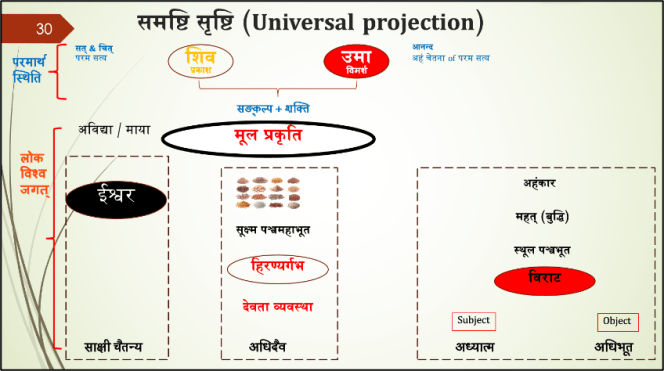
“I alone am the Universe, my स्थूल form represents the विराट, the सूक्ष्म form represents in its totality, the हिरण्यगर्भ and the कारण शरीर is in its macro-cosmic existence nothing other than ईश्वर – and transcending them all, the चेतना in Me is Supreme, the substratum for the entire world of नाम and रूप. I alone, one-without-a-second, remain reveling in myself before all these लोकs were projected”.
स्वामि चिन्मयानन्द says that for any experience to happen, one needs to have 1) a field of experience, 2) thoughts on having a certain experience as well as 3) life energy (in the form of our own sincerity, perseverance, willing and wishing). The लोक given in the previous मंत्र refer to the fields of experience, thoughts on having a certain experience likened to the collective वासनाs (desires) of all living beings while life energy may be likened to being the “protectors” mentioned in this मंत्र. The Supreme conditioned by the total वासनाs – It planned the four लोकs; then It charged that thought with the Supreme Will and thus It created the protectors or rulers of the world.
One more question may arise here – what does projection of पुरुष from the “waters” (अद्भ्य) mean? “Waters” may be likened to मूल प्रकृति or the entire physical universe existing at a root or primal level – this is the original or primal state of all matter (प्रकृति) when there is no differentiation of any kind (just as clay or mud does not have any particular shape) – and it is from this मूल प्रकृति that contains the basic raw material from within which the universe and all life is projected out of and given specific shape to take a certain नाम and रूप. Both त्रिगुण and पञ्चभूत are present innately in their original form within the मूल प्रकृति
तमभ्यतपत्तस्याभितप्तस्य मुखं निरभिद्यत यथाऽण्डं मुखाद्वाग्वाचोऽग्निर्नासिके निरभिद्येतं नासिकाभ्यां प्राणः ।
प्राणाद्वायुरक्षिणी निरभिद्येतमक्षीभ्यां चक्षुश्चक्षुष आदित्यः कर्णौ निरभिद्येतां कर्णाभ्यां श्रोत्रं
श्रोत्रद्दिशस्त्वङ्निरभिद्यत त्वचो लोमानि लोमभ्य ओषधिवनस्पतयो हृदयं निरभिद्यत हृदयान्मनो मनसश्चन्द्रमा नाभिर्निरभिद्यत नाभ्या अपानोऽपानान्मृत्युः शिश्नं निरभिद्यत शिश्नाद्रेतो रेतस आपः ॥ ४॥
| तम् – him, अभ्यतपत् – heated, तस्य – of that, अभितप्तस्य – of the heated (lump), मुखं – face, निरभिद्यत – cleft in, यथा – as, अण्डं – egg, मुखाद् – from the face, वाक् – speech, वाच – from speech, अग्नि:, नासिके – nose, निरभिद्येतं – came forth, नासिकाभ्यां – from the nostrils, प्राण – power of smell, प्राणाद् – from the power of smell, वायु: – atmosphere, अक्षिणी – eyes, निरभिद्येतम – came forth, अक्षीभ्यां – from the eyes, चक्षु: – the power of vision, चक्षुष: – from the power of vision, आदित्यः – सूर्य, कर्णौ – ears, निरभिद्येतां – burst forth, कर्णाभ्यां – from the ears, श्रोत्रं – capacity to hear, श्रोत्रद् – from the capacity of hearing, दिश: – quarters (directions), त्वक् – skin, निरभिद्यत – burst forth, त्वच: – from the skin, लोमानि – hairs, लोमभ्य – from the hairs, ओषधि: – plants, वनस्पतय: – trees, हृदयं, निरभिद्यत – burst forth, हृदयात् – from the हृदय, मन, मनस: – from the मन, चंन्द्रमा – moon, नाभि: – navel, र्निरभिद्यत – burst forth, नाभ्या – from the navel, अपान:, अपानात् मृत्यु:, शिश्नं – generative organ, निरभिद्यत – burst forth, शिश्नाद् – from the generative organ, रेत: – seed, रेतस – from the seed, आपः – waters ॥ ४॥ | He deliberated with regard to Him (i.e. विराट). As He (i.e. विराट) was being deliberated on, His (i.e. विराट) mouth parted, just as an egg does. From the mouth emerged वाक् (speech); from वाक् came अग्नि. The nostrils parted; from the nostrils came out the sense of smell; from the sense of smell came वायु (Air). The two eyes parted; from the eyes emerged the sense of sight; from the sense of sight came the सूर्य. The two ears parted; from the ears came the sense of hearing; from the sense of hearing came the Directions (दिक् देवता). The skin emerged; from the skin came out hair (i.e. the sense of touch associated with hair); from the sense of touch came the Herbs and Trees. The हृदय took shape; from the हृदय issued the internal organ (मन); from the internal organ came the चंद्र. The navel parted; from the navel came out the organ of ejection; from the organ of ejection issued Death. The seat of the procreative organ parted; from that came the procreative organ; from the procreative organ came out आप (Water or liquidity).’ |
व्याख्या: Projection of the universe as conveyed by the मंत्र is summarized below for ease of reference:
| SN | From | First projection | देवता (created from first projection) |
| 1 | मुखं (Mouth) | वाक् (speech) | अग्नि (Fire or heat) |
| 2 | नासिकाभ्यां (Nostrils) | प्राण (power of smell) | वायु (Air/ atmosphere) |
| 3 | अक्षीभ्यां (eyes) | चक्षु: (the power of vision) | आदित्यः (सूर्य) |
| 4 | कर्णाभ्यां (ears) | श्रोत्रं (capacity to hear) | दिश: (quarters or directions) |
| 5 | त्वच: (skin) | लोमानि (hairs) | ओषधि: (plants) & वनस्पतय: (trees) |
| 6 | हृदयं (heart) | मन (mind) | चंन्द्रमा (moon) |
| 7 | नाभि: (navel) | अपान: | मृत्यु: |
| 8 | शिश्नं (generative organ) | रेत: (seed) | आपः (waters) |
To facilitate the projection of the universe (aligned to वासनाs), परमात्मा does तपस्या and this तपस्या led to emanation of various changes in the form of हिरण्यगर्भ पुरुष – all these changes in the form have come about to enable परमात्मा to experience the universe.
How do we understand this explanation of the projection? Manifesting of विराट is happening in a unique manner at the Cosmic or universal level. The beauty of this manifestation is a fact which we should never forget when we go further: the function comes first, and the देवता comes afterwards. There is the मन first, thought afterwards, and the चंद्र subsequently. The अक्षीभ्यां (eyes) is first, चक्षु: (the power of vision) comes afterwards, and the सूर्य still afterwards. The guardians or the देवता of the various functions in their cosmical setup are subsidiary to the Ultimate Cause (viz the one आत्मा). They are not the controlling elements (unlike individual beings, which we will take up later).
The universe was an effect of the आत्मा. For the आत्मा, the Universe does not stand in the position of a cause outside, stimulating इंद्रिय to activity, unlike how it happens to us at an individual level. The presence of an object stimulates our इंद्रिय and the मन, and then we become conscious of the object. Then we establish a relationship with the world outside. The world is first, and we come afterwards here in this individual, empirical state. But there at the level of आत्मा, it was not like that. The world was subsequent; while in the case of our own awareness of ourselves, we as individual living beings become the consequents – FROM THE LENS OF आत्मा, WE AS INVIDIDUAL BEINGS HAVE AN UPSIDE-DOWN VIEW OF REALITY .
How do we explain each of the projections? Column 1 provides a list of गोलय (the physical aperture or gross equipment), Column 2 provides the related इंद्रिय associated with the गोलय and Column 3 provides the name of the related presiding देवता. One must note the distinction between the गोलय and the इंद्रिय here – while nose, eyes, etc may be seen as the physical receptacles, the special sense-centre situated in the brain corresponding to each organ is referred to as the इंद्रिय. देवता refers to the capacity to perceive and may be seen as the “material conditions necessary for each type of perception”. Let us now take up each item of projection:
- अग्नि is the देवता of speech (वाक्) – we use words like “fiery” speeches, “heated” arguments or “hot” discussions . Commentators have stated that consumption of hot things improve our capacity to speak as well as by consumption of Ghee (akin to pouring ghee into अग्नि). We also see that for the hoarse throat of a speaker or a musician, the treatment is to drink a glass of hot pepper-water with a spoon of ghee poured into it.
- वायु (air) is the देवता for smell – we all know that smell (or fragrance) is transmitted via air as the medium of transfer and without this medium, there is no way the smell of a sense object can be known by the sense organs.
- Physical eye is the गोलय, इंद्रिय is the power of vision (दृष्टि) and the presiding देवता is सूर्य. सूर्य may thus be seen as having emerged from the eye of ब्रह्मा (Cosmic Eye) – if सूर्य was not there to shed light and bless the objects of eye, colour and form, none of us would have been able to enjoy vision.
- गोलय is the organ of hearing (ears), इंद्रिय is the capacity to hear sounds while दिश (directions) is the presiding देवता. All of us know that sound travels in the medium of space – sound waves can only travel in the medium of air and no air can come to occupy where there is no space. दिश (directions) thus becomes the presiding देवता for transmission of sound.
- Hairy growth upon the surface of the total structure is beautifully put in a parallelism with the frail herbs and the gigantic forest trees on the surface of the globe – here, the ऋषि indicates the entire vegetable kingdom in the universe (and not any special type of trees only). Just as hairs grow on the body, not because of individual’s own accord, so too, the vegetable kingdom without locomotion or intelligence grows from the surface of the Earth.
- In वेद, हृदय is identified as the गोलय while मन (which includes बुद्धि) is the इंद्रिय and presiding देवता being चंद्र. It may seem odd for people acquainted with science as to why should a small body like चंद्र be, in any way, connected with the मन. For this, one must probably ask – why has the physical moon seen by us be called by the name चंद्र? Just as चंद्र is dependent on सूर्य for its light, मन too gets its चेतना from the आत्मा – both are thus “borrowing”. Besides, in the normal course too, we see connection between चंद्र and the मन – lovers become extremely sentimental and emotional under चंद्र, some doctors in asylums have highlighted that lunatic inmates are out of control during the full-moon. Also, on a full-moon night, any wound sustained is observed to bleed more than on other days – relationship between चंद्र and मन can thus be surmised in normal life too.
- अपान is one of the five types of प्राण. Expression of life in a living body which effectively throws out the waste matter from the body and also ejects out its seeds is called as अपान. अपान is located at its headquarters in the navel area (just of power of vision is localized in the eyes). The principle of rejection or ejection is the principle of death (मृत्यु) and in almost all average individuals, at the time of मृत्यु, there is an explosive activity of the अपान
- Lastly, the generative organ is गोलय, semen is the seed and आप is given as the देवता by the ऋषि here.
॥ इत्यैतरेयोपनिषदि प्रथमाध्याये प्रथमः खण्डः ॥
॥ अथ ऐतरेयोपनिषदि प्रथमाध्याये द्वितीयः खण्डः ॥
ता एता देवताः सृष्टा अस्मिन्महत्यर्णवे प्रापतन्
। तमशनापिपासाभ्यामन्ववार्जत् । ता एनमब्रुवन्नायतनं नः प्रजानीहि यस्मिन्प्रतिष्ठिता अन्नमदामेति ॥ १॥
| ता एता – these, देवताः, सृष्टा – so created, अस्मिन् – in this, महति – great, अर्णवे – sea, प्रापतन् – they fell, तम् – him, अशना – to hunger, पिपासाभ्याम् – to thirst, अन्ववार्जत् – subjected, ता: – they, एनम – to him, अब्रुवन् – said, आयतनं – an abode, नः – for us, प्रजानीहि – find out, यस्मिन् – wherein, प्रतिष्ठिता – being established, अन्नम – food, अदाम – we may eat, इति – that | These देवताs, that had been created, fell into this vast ocean. Then, He subjected them to hunger and thirst. They said to Him, `Provide an abode for us, staying where we can eat food.’ |
व्याख्या: What was the consequence of this division created within ब्रह्मा? The उपनिषद् says that the first consequence is an intense feeling of hunger and thirst. Hunger and thirst became the immediate consequence for the देवताs on account of their isolation from the whole – this is very important. देवताs became mortal – Mortality is the consciousness of the isolation of the part from the Whole; and then every disease crops up at once. And how can this hunger and thirst gain satisfaction? This can only be satisfied through a medium of experience – there must be therefore two things – 1) a vehicle, a body to gain experience and 2) food, that must appease this hunger & thirst. So, they asked for an abode – “Give us a body. Give us a vehicle. We want a house to stay in”.
Another question may come up here – the मंत्र says that the देवताs fell into महति अर्णवे, viz the great ocean. The ocean being referred to here is the ocean of संसार. And what is the characteristic of संसार? It is finitude. Says आदि शंकर: “the world which is like a vast ocean, that is filled with the water of sorrow arising from अज्ञान, काम and कर्म; that is infested with huge sea animals in the form of acute रोग and आयु and मृत्यु; that has no beginning, end, and limit, and provides no resting place; that affords only momentary respite through the little joys arising from the contact of इंद्रिय and विषय; that is full of the high waves in the shape of hundreds of दु:खs, stirred up by the gale of hankering for the objects of the five senses; that resounds with the noise of cries and shrieks of ‘alas! alas!’ etc., issuing from the beings condemned to various नरक लोकs like महारौरव”.
Given the above, it is important to reiterate the meaning of the word, देवता, here. देव is used here in etymological meaning, derived from its root, which means “to illumine” (द्योतनात्). The देवताs preside over the various localized functions of life in the body, were created and thereafter were thrown into this world of endless agitations, constant changes, inner storms and outer tribulations. The capacity in the इंद्रिय (sense-organs) to illumine the world of विषय (sense-objects), is meant here by the word, देवता. Thus, these देवताs, representing the impulses-in-the-sense-organs to see, hear, smell, touch, taste, speak, etc – all those faculties were thrown into the world of plurality constituted of the विषय (sense-objects) (such as forms, sounds, tastes, etc). Not only were they thrown into the world of plurality and constant change, but they were also shot with the pangs of hunger and thirst and naturally, all the organs felt a thirst and hunger, at once, irresistible and insufferable, to enjoy and fulfil themselves. Whipped up by these impulses, they approached the विराट and demanded separate “place of residence” wherein they can each house themselves and through the instrumentation of their respective equipment: “we may eat food”.
Key message from this मंत्र is that once one is cut-off from the whole, one is thrown into a state of unrest – referred to as संसार and thereby thrown into a state to return back to one’s original state of being – and hunger & thirst are a manifestation of this effort to return back to the whole. This will get clearer as we go further.
ताभ्यो गामानयत्ता अब्रुवन्न वै नोऽयमलमिति । ताभ्योऽश्वमानयत्ता अब्रुवन्न वै नोऽयमलमिति ॥ २॥
ताभ्यः पुरुषमानयत्ता अब्रुवन् सुकृतं बतेति पुरुषो वाव सुकृतम् । ता अब्रवीद्यथायतनं प्रविशतेति ॥ ३॥
| ताभ्य: – for them (देवताs), गाम् – body of a cow, आनयत् – was brought, ता: – they, अब्रुवन् – said, न – not, वै – indeed, न: – for us, अयम् – this, अलम् – sufficient, इति – that ताभ्य: – to them, अश्वम् – (form of a) horse, आनयत् – was brought, ता: – they, अब्रुवन् – said, न – not, वै – indeed, न: – for us, अयम् – this, अलम् – sufficient, इति – that | For them He brought a cow. They said, ‘This one is certainly not adequate for us.’ For them He brought a horse. They said, ‘This one is certainly not adequate for us.’ |
| ताभ्यः – to them, पुरुषम्, आनयत् – brought, ता: – they, अब्रुवन् – said, सुकृतं – well done, बत् – indeed, इति – that, पुरुष:, वाव – alone, सुकृतम् – masterpiece, ता – to them, अब्रवीत् – he said, यथायतनं – into the respective abode, प्रविशत् – enter, इति – that | For them, He brought a पुरुष (human being). They said, This one is well formed; पुरुष indeed is a masterpiece’ To them He said, `Enter into your respective abodes.’ |
व्याख्या: The देवताs were given the abode of cow followed by horse but both were deemed inadequate. One may infer here that all lower forms (plant and animal kingdom) are referred to here by pointing to the cow and the horse – and all these forms (as compared with a human being) were experienced as inadequate to quench the thirst and satiate the hunger of the देवताs. ब्रह्मा then created पुरुष and they chose this abode to satisfy their need to satiate hunger & thirst. The ऐतरेय उपनिषद् is very precise and does not go into long details of the evolutionary process of the individual body (unlike some other texts). Clearly, a sub-optimal vehicle is not satisfactory and देवताs therefore chose पुरुष as the appropriate vehicle to satiate hunger & thirst. ब्रह्मा then told the देवताs – enter your respective abodes.
अग्निर्वाग्भूत्वा मुखं प्राविशद्वायुः प्राणो भूत्वा नासिके
प्राविशदादित्यश्चक्षुर्भूत्वाऽक्षिणी प्राविशाद्दिशः
श्रोत्रं भूत्वा कर्णौ प्राविशन्नोषधिवनस्पतयो लोमानि भूत्वा
त्वचंप्राविशंश्चन्द्रमा मनो भूत्वा हृदयं प्राविशन्मृत्युरपानो
भूत्वा नाभिं प्राविशदापो रेतो भूत्वा शिश्नं प्राविशन् ॥ ४॥
| अग्नि:, वाक्, भूत्वा – having become, मुखं – from mouth, प्राविशत् – entered, वायु:, प्राण:, भूत्वा – having turned, नासिके – from nostrils, प्राविशत् – entered, आदित्य:, चक्षु: – eyes, भूत्वा – having become, अक्षिणी – from eyes, प्राविशत् – entered, दिश: – quarters (directions), श्रोत्रं – the hearing, भूत्वा – having become, कर्णौ – ears, प्राविशन् – entered, ओषधि: – herbs, वनस्पतयो – trees, लोमानि – hairs, भूत्वा – having become, त्वचं – skin, प्राविशं – having entered, चंद्रमा – moon, मन, भूत्वा – having become, हृदयं, प्राविशन् – having entered, मृत्यु, अपान, भूत्वा – having become, नाभिं – navel, प्राविशन् – having entered, आप, रेतो – seed, भूत्वा – having become, शिश्नं – generative organ, प्राविशन् – entered | अग्नि entered into the mouth taking the form of the वाक् (organ of speech); वायु entered into the nostrils assuming the form of the sense of smell; the सूर्य entered into the eyes as the sense of sight; the दिश (Directions) entered into the ears by becoming the sense of hearing; the ओषधि (Herbs) and वनस्पति (Trees) entered into the skin in the form of hair (i.e. the sense of touch); the चंद्र entered into the हृदय in the shape of the मन; मृत्यु entered into the navel in the form of अपान (i.e. the vital force that presses down); आप entered into the limb of generation in the form of semen (i.e. the organ of procreation). |
व्याख्या: If we read the above closely, within an individual, there is a reversal of process. The उपनिषद् mentions that when the देवताs were originally projected from the body of विराट, there was first the location of the function (e.g., mouth); then there was the urge of the expression of that location (e.g., speech) and then the देवता, अग्नि, manifested itself – and so on with every other function. The देवताs are not independent but were dependent on विराट from which they were projected.
But now, what has happened is that when the देवताs entered the पुरुष, there was a reversal of the whole process. The functions in an individual correspond to the universal functions in the same way as functions in a reflected image correspond to the functions in the original that is reflected. Or, to give another example, when we look at our face in a mirror, there is a reflection of the face seen in that mirror but there is a reversal of parts taking place – the right looks left and the left looks right. Some such distorted reversal of processes took place when the देवताs entered the body of the individual; instead of the mouth projecting the speech and then the अग्नि, or the देवता coming thereafter, अग्नि entered into the body as वाक् and found the mouth as the abode. So, अग्नि is the controller here, and we are dependent. We are the effects. The effect in the universal status becomes the cause in the individual realm. So, the जीवis different from ईश्वर in this manner, though it has come from ईश्वर only. It is a tremendous difference, notwithstanding the identity of essence, because of the same देवताs operating there as well as here.
Via this मंत्र, the ऋषि makes it clear that the “individual” is none other than the Cosmic – as कृष्ण says in the श्रीमद्भगवद्गीता – जीव is an अंश of ईश्वर and continues to have the same qualities as ईश्वर just as water of an ocean taken into a cup will have the same qualities as the entire ocean. A fundamental idea expressed in the वेद is that ब्रह्माण्ड (Macrocosm) = पिंडण्ड (Microcosm) and when a योगी realizes this truth, He exclaim with joy, “I am ब्रह्म”.
तमशनायापिपासे अब्रूतामावाभ्यामभिप्रजानीहीति ते अब्रवीदेतास्वेव
वां देवतास्वाभजाम्येतासु भागिन्न्यौ करोमीति । तस्माद्यस्यै कस्यै
च देवतायै हविर्गृह्यते भागिन्यावेवास्यामशनायापिपासे भवतः ॥ ५॥
| तम् – to him, अशनाया-पिपासे – hunger & thirst, अब्रूताम् – said, आवाभ्याम् – for both of us, अभिप्रजानीही – find out (the abode), इति – (having heard) that, ते – to them, अब्रवीत् – (भगवान्) said, एतसु एव – among these, देवतासु – देवताs, आभजामि वाम् – assign you both, एतासु – among these, भागिन्न्यौ – share, करोमि – (I) do, इति – that, तस्माद् – therefore, यस्यै कस्यै – whichever, च – also, देवतायै – for the देवता, हवि: – oblation, गृह्यते – partake, भागिन्यौ – sharers, एव – indeed, अस्याम् – in it (oblation), अशनाया-पिपासे – hunger & thirst, भवतः – be (you two) | To Him Hunger and Thirst said, `Provide for us (some abode).’ To them He said, `I provide your livelihood among these very देवताs; I make you share in their portions.’. Therefore, when oblation is taken up (for being offered) for any deity whichsoever, Hunger and Thirst become verity sharers with that देवता. |
व्याख्या: When this individual experience takes place in the body of the human personality on account of the entry of these देवताs in the manner mentioned, something else also happens. There is immediately a grabbing attitude of the individual in respect of the food that is necessary for the satisfaction of the appetite. The food also was created in the form of this objective universe, and it has to be grasped by the इंद्रिय. The particular function in the human individual especially by which food is grasped and assimilated is the अपान. The food that we throw into the alimentary canal is digested and absorbed by the अपान वायुin our system; the organs cannot have this kind of experience. For example, by speaking about food we cannot be satisfied; by seeing food we will not be satisfied; by hearing about food we will not be satisfied; only by absorbing it through the अपान through the alimentary system can we be satisfied.
This again is symbolic of every kind of food that the senses require. They have a desire to contact objects merely for the sake of maintaining their original status. It is a very artificial way, no doubt, that they are inventing, but they have no other alternative. The object of the senses is the medium through which the appetite of the individual is satisfied. This appetite is nothing but the hunger of the self to come in union with the Universal, from which it has been isolated.
We are not hungry in the ordinary sense. Any amount of food that we eat, whatever may be the diet that we take, cannot satisfy us because our real requirement is not this food. Something else is the need; and that need is very deep. It is like the very deep-rooted chronic illness of which we have no knowledge on the superficial surface. This illness is referred to as अविद्या (ignorance) which precedes every kind of action in the direction of the possession of the requirements of the senses. We run after things on account of an अविद्या, which covers our consciousness, of the reason behind the very existence of this hunger.
There is only one need that we have, and not more than one – the need to become one with THAT from which we have separated, and out of which we have been thrown – that is all. The देवताs within are hungering. It is not the tongue or the ear or the nose that asks for things; it is the देवताs within that are hungry. इंद्र, वरुण, सूर्य, etc., are the देवताs which are superintending over every part of our body. They are the rulers, they are the masters, they are the actual occupants of this habitat called this body. They ask for a reunion and a rehabilitation with the status they have lost. This hunger for reunion with the Universal manifests itself in a diversified form through the senses as desire to see, desire to hear, desire to taste, desire to touch, and so on. Hence, these are artificially created tentative satisfactions, because no other satisfaction is available. When everything has gone, whatever is available satisfies us.
Question may then arise – did the human body as an abode meet the expectations of the देवताs to satisfy their hunger and thirst? The human individuality also is found inadequate to the purpose because of the fact that it is conditioned by the five sense organs and the mind, which works in terms of the activities of the senses. The restless activities of the senses for contact with objects throughout the day, in all the walks of life, are for the appeasement of the hunger of the आत्मा. But we fail miserably in this attempt because our activities in life are not a remedy for the trouble in which we are at present. We seem to be satisfied only because we have not understood what our problems are. We are totally ignorant of our actual situation. The senses are tired of these activities. They get exhausted. How long can we go on grabbing things? We can do it for one day, one month, one year, ten years; but throughout our life we cannot engage ourselves in this activity. It is futile, ultimately. It is futile because it does not satisfy us. Whatever be the possession that we have, it will not satisfy us.
॥ इत्यैतरेयोपनिषदि प्रथमाध्याये द्वितीयः खण्डः ॥
॥ अथ ऐतरेयोपनिषदि प्रथमाध्याये तृतीयः खण्डः ॥
स ईक्षतेमे नु लोकाश्च लोकपालाश्चान्नमेभ्यः सृजा इति ॥ १॥
सोऽपोऽभ्यतपत्ताभ्योऽभितप्ताभ्यो मूर्तिरजायत । या वै सा मूर्तिरजायतान्नं वै तत् ॥ २॥
| स – He (भगवान्), ईक्षत – said, इमे नु – here now, लोका: – worlds (senses), च – and, लोकपाला: – protectors of the लोक viz देवताs, च – and, अन्नम् – food, एभ्यः – for them, सृजा – (let me) project; इति – thus | He thought, `Here now are the लोकs and देवताs. Let Me create food for them.’ |
| स: – he, अप: – waters (पञ्च महाभूत in their most सूक्ष्म form is indicated here), अभ्यतपत् – brooded over, ताभ्य: – from the (waters), अभितप्ताभ्य: – from those thus brooded over, मूर्ति – material form, अजायत – sprang up, या – which, वै – indeed, सा मूर्ति: – that material form, अजायत – sprang up, अन्नं – food, वै – indeed, तत् – that | He deliberated with regard to the water. From the water, thus brooded over, evolved a form. The form that emerged was verily food. |
व्याख्या: Food comes from the waters. What does waters mean here? मूल प्रकृति, which means the material aspect of the universe prior to differentiation into the diversity that all of us experience. Thus, root matter represented by पञ्चभूत (आकाश, वायु, अग्नि, आप and पृथ्वी) and त्रिगुण (सत्व, रजस् & तमस्) but present in an undifferentiated manner is मूल प्रकृति (prior to the differentiation) and expressed as “अप: (waters)” here. Universe, or the world of organic matter, is thus the food for the देवताs. Thus, आत्मा not only created abodes and given them hunger & thirst, but world has also been additionally created to enable the देवताs to consume food. Thus, projection of the universe involves projection of subjects on one side which seek consumption and objects of consumption on the other.
तदेनत्सृष्टं पराङ्त्यजिघांसत्तद्वाचाऽजिघृक्षत् तन्नाशक्नोद्वाचा ग्रहीतुम् ।
स यद्धैनद्वाचाऽग्रहैष्यदभिव्याहृत्य हैवान्नमत्रप्स्यत् ॥ ३॥
तत्प्राणेनाजिघृक्षत् तन्नाशक्नोत्प्राणेन ग्रहीतुं स यद्धैनत्प्राणेनाग्रहैष्यदभिप्राण्य हैवान्नमत्रप्स्यत् ॥ ४॥
तच्चक्षुषाऽजिघृक्षत् तन्नाशक्नोच्चक्षुषा ग्रहीतु/न् स यद्धैनच्चक्षुषाऽग्रहैष्यद्दृष्ट्वा हैवानमत्रप्स्यत् ॥ ५॥
तच्छ्रोत्रेणाजिघृक्षत् तन्नाशक्नोच्छ्रोत्रेण ग्रहीतुं स यद्धैनच्छ्रोतेणाग्रहैष्यच्छ्रुत्वा हैवान्नमत्रप्स्यत् ॥ ६॥
तत्त्वचाऽजिघृक्षत् तन्नाशक्नोत्त्वचा ग्रहीतुं सn यद्धैनत्त्वचाऽग्रहैष्यत् स्पृष्ट्वा हैवान्नमत्रप्स्यत् ॥ ७॥
तन्मनसाऽजिघृक्षत् तन्नाशक्नोन्मनसा ग्रहीतुं स यद्धैनन्मनसाऽग्रहैष्यद्ध्यात्वा हैवान्नमत्रप्स्यत् ॥ ८॥
तच्छिश्नेनाजिघृक्षत् तन्नाशक्नोच्छिश्नेन ग्रहीतुं स यद्धैनच्छिश्नेनाग्रहैष्यद्वित्सृज्य हैवानमत्रप्स्यत् ॥ ९॥
| तत् – that, एनत् – this (food), सृष्टं – so projected (created), पराङ् – (the enjoyer man) turned away, अत्यजिघांसत् – sought to flee away, तत् – that (man), वाचा – by speech, अजिघृक्षत् – tried to catch, तत् – that, न – not, अशक्नोद् – could, वाचा – by speech, ग्रहीतुम् – to catch, स – he, यत् ह – indeed were, एनत् – this (food), वाचा – by speech, अग्रहैष्यत् – (able to) seize, अभिव्याहृत्य – by merely talking, ह एव – verily, अन्नम् – food, अत्रम् – food, अत्रप्स्यत् – be satisfied | This food, that was created, turned back and attempted to run away. He tried to take it up with speech. He did not succeed in taking it up through speech. If He had succeeded in taking it up with the speech, then one would have become contented merely by talking of food. |
| तत् – that, प्राणेन – by smell (by breath), अजिघृक्षत् – willing to catch, तत् – that, न – not, अशक्नोत् – could, प्राणेन – by smell (by breath), ग्रहीतुं – to grasp, to catch, स – he, यत् – if, ह – indeed were, एनत् – this (food), प्राणेन – by breath (by इंद्रिय), अग्रहैष्यत् – catch it, अभिप्राण्य – by smelling, ह एव – indeed, merely, अन्नम् – food, अत्रप्स्यत् – satisfied | He tried to grasp that food with the sense of smell. He did not succeed in grasping it by smelling. If He had succeeded in grasping it by smelling, then everyone would have become contented merely by smelling food. |
| तत् – that, चक्षुषा– by eyes, अजिघृक्षत् – willing to catch, तत् – that, न – not, अशक्नोत् – could, चक्षुषा – by eyes, ग्रहीतुं – to grasp, to catch, स – he, यत् – if, ह – indeed were, एनत् – this (food), चक्षुषा– by eyes, अग्रहैष्यत् – (able to) catch it, दृष्ट्वा – by seeing, ह एव – indeed, merely, अन्नम् – food, अत्रप्स्यत् – satisfied | He wanted to take up the food with the eye. He did not succeed in taking it up with the eye. If He had taken it up with the eye, then everyone would have become satisfied by merely seeing food. |
| तत् – that, श्रोत्रेण– by hearing, अजिघृक्षत् – willing to catch, तत् – that, न – not, अशक्नोत् – could, श्रोत्रेण– by hearing, ग्रहीतुं – to grasp, to catch, स – he, यत् – if, ह – indeed were, एनत् – this (food), श्रोत्रेण– by hearing, अग्रहैष्यत् – (able to) catch it, श्रुत्वा – by hearing, ह एव – indeed, merely, अन्नम् – food, अत्रप्स्यत् – satisfied | He wanted to take up the food with the ear. He did not succeed in taking it up with the ear. If He had taken it up with the ear, then everyone would have become satisfied merely by hearing of food. |
| तत् – that, त्वचा – by skin, अजिघृक्षत् – willing to catch, तत् – that, न – not, अशक्नोत् – could, त्वचा – by skin, ग्रहीतुं – to grasp, to catch, स – he, यत् – if, ह – indeed were, एनत् – this (food), त्वचा – by skin, अग्रहैष्यत् – (able to) catch it, स्पृष्ट्वा – by touching, ह एव – indeed, merely, अन्नम् – food, अत्रप्स्यत् – satisfied | He wanted to take it up with the sense of touch. He did not succeed in taking it up with the sense of touch. If He had taken it up with touch, then everyone would have been satisfied merely by touching food. |
| तत् – that, मनसा – by मन, अजिघृक्षत् – willing to catch, तत् – that, न – not, अशक्नोत् – could, मनसा – by मन, ग्रहीतुं – to grasp, to catch, स – he, यत् – if, ह – indeed were, एनत् – this (food), मनसा – by मन, अग्रहैष्यत् – (able to) catch it, ध्यात्वा – by thinking, ह एव – indeed, merely, अन्नम् – food, अत्रप्स्यत् – satisfied | He wanted to take it up with the mind. He did not succeed in taking it up with the mind. If He had taken it up with the mind, then everyone would have become satisfied by merely thinking of food. |
| तत् – that, शिश्नेन – by generative organs, अजिघृक्षत् – willing to catch, तत् – that, न – not, अशक्नोत् – could, शिश्नेन – by generative organs, ग्रहीतुं – to grasp, to catch, स – he, यत् – if, ह – indeed were, एनत् – this (food), शिश्नेन – by generative organs, अग्रहैष्यत् – (able to) catch it, विसृज्य – by emission, ह एव – indeed, merely, अन्नम् – food, अत्रप्स्यत् – satisfied | He wanted to take it up with the procreative organ. He did not succeed in taking it up with the procreative organ. If He had taken it up with the procreative organ, then everyone would have become satisfied by merely ejecting food. |
व्याख्या: These certainly are an unusual set of मंत्रs (and may seem childish too). It must however be interesting to note that the idea of food varies from देवता to देवता. Sound is food for the ear while thought is the food for the mind. “Food” thus has a wider connotation than physical food that we eat via the mouth. The respective domain of each देवता is different and the “food” that each देवता consumes thus is different. And clearly, their functions are not inter-changeable and are limited – as the above set of मंत्र shows. Thus, physical food cannot be consumed by speech, smell, eyes, ears, skin, mind and the generative organ – which देवता is then eligible for consumption of food?
तदपानेनाजिघृक्षत् तदावयत् सैषोऽन्नस्य ग्रहो यद्वायुरनायुर्वा एष यद्वायुः ॥ १०॥
| तत् – that, अपानेन – by out-breath, अजिघृक्षत् – willing to catch, तत् – that, न – not, आवयत् – consumed it , स – he, एष: – this (अपान वायु), अन्नस्य – of food, ग्रह – that which catches, यद्वायु: – that वायु (अपान), अन्नायु: – chief cause in supporting life by food, वै – well-known, एष: – this, यत् – if, वायु: | He wanted to take it up with अपान. He took it up. This is the devourer of food. That vital energy which is well known as dependent on food for its subsistence is this vital energy (called अपान). |
व्याख्या: As conveyed earlier, it is not the mouth or the tongue that consumes food. While these are specific instruments or tools performing a certain action in the process of food consumption, it is अपान वायु that consumes food. The particular function in the human individual especially by which food is grasped and assimilated is the अपान. अपान is the down out-breath, the flow of breath, the flowing movement down the alimentary canal and it is this peristaltic movement that is capable of consuming the food that is taken in and which does not allow the morsels of food swallowed down from retracing their steps and coming out.
स ईक्षत कथं न्विदं मदृते स्यादिति स ईक्षत कतरेण प्रपद्या इति । स ईक्षत यदि वाचाऽभिव्याहृतं यदि प्राणेनाभिप्राणितं यदि
चक्षुषा दृष्टं यदि श्रोत्रेण श्रुतं यदि त्वचा स्पृष्टं यदि मनसा ध्यातं यद्यपानेनाभ्यपानितं यदि शिश्नेन विसृष्टमथ कोऽहमिति ॥ ११॥
स एतमेव सीमानं विदर्यैतया द्वारा प्रापद्यत । सैषा विदृतिर्नाम द्वास्तदेतन्नाऽन्दनम् ।
तस्य त्रय आवसथास्त्रयः स्वप्ना अयमावसथोऽयमावसथोऽयमावसथ इति ॥ १२॥
| स – It (the projector), ईक्षत – thought, कथं – how, नु – indeed, इदं – this, मदृते (मद् + ऋते) – without me, स्यात् – can be, इति – so that, स – It (the projector), ईक्षत – thought, कतरेण – by which, प्रपद्या – shall I enter, इति – thus, स – It (the projector), ईक्षत – thought, यदि – if, वाचा – by speech, अभिव्याहृतं – speaking be done, यदि – if, प्राणेन – by nose (breath), अभिप्राणितं – smelt, यदि – if, चक्षुषा – by eyes, दृष्टं – seen, यदि – if, श्रोत्रेण – by ears, श्रुतं – heard, यदि – if, त्वचा – by skin, स्पृष्टं – touched, यदि – if, मनसा – by मन, ध्यातं – thought of, यदि – if, अपानेन – by अपान, अभ्यपानितं – eaten, यदि – if, शिश्नेन – by generative organ, विसृष्टम् – emitted, अथ – then, क: – who, अहम् – am I, इति – that | He thought, `How indeed can it be there without Me?’ He thought, `Through which of the two ways should I enter?’ He thought, `If utterance is done by the organ of speech, smelling by the sense of smell, seeing by the eye, hearing by the ear, feeling by the sense of touch, thinking by the mind, the act of drawing in (or pressing down) by अपान, ejecting by the procreative organ, then who (or what) am I?’ |
| स – It (the projector), एतम् – this, एव – alone, सीमानं (the boundary of the body – मूर्धा), suture of the skull, विदर्य – having split or opened, made a hole, एतया – by this, द्वारा – by that door, प्रापद्यत – entered, सा एषा – that is this, विदृति: नाम – named as विदृति or cleft, द्वा – door, तत् – that, एतत् – this, नान्दनम् – productive of joy, तस्य – of Him (भगवान्), त्रय: – three, आवसथा – dwelling places, त्रय: – three, स्वप्ना – conditions of sleep (dream), अयम् – this is, आवसथ: – dwelling place, अयम् – this is, आवसथ: – dwelling place, अयम् – this is, आवसथ: – dwelling place, इति – that | Having split up this very end, He entered through this door. This entrance is known as विदृति (the cleft entrance). Hence it is delightful. Of Him there are three abodes – three (states of) dream. This one is an abode, this one is an abode, this one is an abode. |
व्याख्या: If we follow the description so far, it is evidently clear that the instruments of perception and inner activity have been first of all created. And these instruments have been provided with their respective faculties (देवताs). In the previous मंत्र, food also has been supplied which can nourish and sustain the देवताs and in their attempt to consume the food, all of them get their respective fields of expression. One may say therefore – the act of projection is over… but is it?
Just like a hospital without patients or a school without students, such a projection has no utility. It is here that विराट asks Itself – “How can all this remain without Me?” The aggregate or assemblage of the various faculties, perceptions and activities, though they can individually perceive the thing and feel and function in their own fields, cannot provide for us a total integral experience. For example, if one enters a jungle, skin tells one that the stones are hard and Sun is hot, eye tells one a four-footlong match of green stripes on yellow background, ears tell one of the sound of a roar, nose may tell about the smell of a wild animal … and yet, one will not be able to synchronize all these ideas together and understand at one and the same moment that the striped animal is smelling and the roar is coming from it, that it is a tiger and its embrace is not very healthy for a continued physical existence in the world and therefore, one’s legs should carry immediately to a place where the tiger will not reach. The owner of the assemblage is something other than the constituents of the assembly. Thus, a house is not built for the dignity of the pillar or the strength of the walls or the preservation of the floor – it is made generally to house the master who is an independent entity and who can, at his will, walkout of the assemblage of parts and faculties or walk-in as he pleases. Similarly, this great assemblage of parts and faculties cannot have any justification or any sense of fulfilment without Me.
Question now arose for the आत्मा – by which द्वार do I enter the शरीर? The doubt is regarding two choices available to the आत्मा to enter the body – via the feet and via the top of the skull. As per वेद, प्राण enters the body by the forepart of the feet. प्राण refers to the gross life energy. Is प्राण different from the आत्मा? They are not – just as light and heat are expressed separately but represent two aspects of the one, क्रिया शक्ति activities of the शरीर is referred to as प्राण while the more subtler activity of life in the deeper layers of its implication, the ज्ञान शक्ति, is called as आत्मा. आत्मा then decides to enter the body via the crown of the top of the skull which is seen as the most sacred and important of all biological parts in us. This part is referred to as the विदृति here – one may ask that since आत्मा is everywhere, what does “entering the body” mean? One may see this as a figurative explanation given of a particular sequence in an activity that was simultaneous and almost homogenous. Just as a potter does not create a space within the pot after the pot is made but in fact works within the space, the mud also remained in space and once the pot is fully made, space occupies the pot space too, our body too is built is Truth, it seemingly exists in Truth, activates in Truth, gets enveloped by Truth and pierced through and through by Truth – despite this, we “see” the body develops first as a child, develops various faculties (speech, walking, etc) and reproductive activity as the last. What we thus see or experience as an ego-filled individual is a “sequence” while Truth always exists at all times.
The door through which आत्मा (viz आनन्द by nature) had entered the physical structure, that cleft on the crown is called नंदनम् – meaning the place of आनन्द. The ऋषि of the उपनिषद् adds further – the आत्मा has three dwelling places and three states of being. The three states of being are called as जाग्रत्, स्वप्न and सुशुप्ति, viz the waking state, the dream state and the deep-sleep state. जाग्रत् अवस्था is when we are awake and conscious of ourselves and the objects of the world, in the स्वप्न अवस्था too, we are aware of objects of the dream in our dream condition while in the सुशुप्ति अवस्था, we are aware of the total absence of the objects belonging to both the other two states – आत्मा thus is available in all three states of being and the awareness commonly exhibited in all three states is defined here as the आत्मा or the Reality which had entered the physical structure. And what are the three abodes of आत्मा in each of these states? वेद states that आत्मा is located in the right eye in the जाग्रत् अवस्था, throat in the स्वप्न अवस्था and heart-space in the सुशुप्ति अवस्था – this is aligned to the योगशस्त्र which identifies these locations throbbing with higher activities in each of these three अवस्थाs. आदि शंकर adds that the three abodes may also be taken as the body of the father, womb of the mother and one’s own body.
स जातो भूतान्यभिव्यैख्यत् किमिहान्यं वावदिषदिति ।स एतमेव
पुरुषं ब्रह्म ततममपश्यत् । इदमदर्शनमिती ३ ॥ १३॥
| स – It (He), जात: – having born, भूतानि – beings, creatures, अभिव्यैख्यत् – gazed around, किम् – who, इह – here, अन्यं – other, वावदिषत् – can I proclaim or name, इति – thus, स – It (He). एतम् एव – indeed, पुरुषं, ब्रह्म, ततमम् – over spreading all, अपश्यत् – realized, saw, इदम् – this (परब्रह्म, परमात्मा), अदर्शनम् –(I have) seen, इति – that | Having been born, It (He) looked around on beings. It (He) gazed around upon the creatures. How should he speak of any other? What else is there besides the आत्मा for me to name? It (He) saw indeed this very पुरुष, ब्रह्म, over-spreading all. With wonder, It (He) said to Itself (Himself) “Oh! I have seen this”. |
व्याख्या: This मंत्र is to be seen as an expression of wonder. This passage tries the describe the experience of आत्मा when It – having entered शरीर in its native purity, wisdom and self-knowledge – looked out upon the pluralistic phenomenal world through the various equipment of the इंद्रिय, the मन and बुद्धि. And what did It experience? “It is me everywhere” – It could, in and through the इंद्रिय, emotions and ideas, perceive nothing but Its own essential nature everywhere! At the perception of this पुरुष over-spreading all, It cried out, in the ecstasy born out of the Divine inspiration which is the lot of everyone experiencing that tranquility of a stilled mind, ‘Oh! I have seen this.”
Put another way, the आत्मा alone was, before the projection – having created the form and having housed the various faculties of vision, etc in it, when It consciously entered without any self-forgetfulness, and gazed out into the world of plurality through the equipments of vision and knowledge, could yet realize and experience Its own transcendent nature and enjoy Its own divinity reflected in and through the pluralistic world. And why is all this important for a साधक? It is – since the goal of each साधक is to reach the same stage of ecstasy that पुरुष experienced here and such a साधक too will cry once this state is attained by exclaiming, “Oh! I have seen this”.
तस्मादिदन्द्रो नामेदन्द्रो ह वै नाम । तमिदन्द्रं सन्तमिन्द्र इत्याचक्षते परोक्षेण ।
परोक्षप्रिया इव हि देवाः परोक्षप्रिया इव हि देवाः ॥ १४॥
| तस्मात् – therefore, इदन्द्र: नाम – named or called इदन्द्र, इदन्द्रो ह वै नाम – indeed known as इदन्द्र, तम् इदन्द्रं सन्तम् – him who is इदन्द्र, इन्द्र:, इति – as इंद्र, आचक्षते – is called, परोक्षेण – indirectly, परोक्षप्रिया – fond of the cryptic (indirect) names, इव – indeed, हि – as it were, देवाः, परोक्षप्रिया – fond of the cryptic (indirect) names, इव – indeed, हि – as it were, देवाः | Therefore, His name is इदन्द्र. He is verily known as इदन्द्र. Although He is इदन्द्र, they call Him indirectly इंद्र; for the देवताs are verily fond of indirect names, the देवताs are verily fond of indirect names. |
व्याख्या: Because the पुरुष saw the all-pervading ब्रह्म, subjectively as “this” (इदम्) , the Supreme Truth is called as इदन्द्र. When we feel respect and reverence, there we do not generally address the individual directly by their personal name, but we either use a pet name or a reverential name. This is done for such a one who is a noted genius in his own walk of life. देव is essentially one who appreciate being addressed indirectly, they are परोक्ष प्रिय:. Therefore, though इदन्द्र is the नाम that applies to one who has seen/ experienced ब्रह्म, out of respect, a shorter name, इंद्र is given to such a one.
॥ इत्यैतरेयोपनिषदि प्रथमाध्याये तृतीयः खण्डः ॥
॥ अथ ऐतरोपनिषदि द्वितीयोध्यायः ॥
ॐ पुरुषे ह वा अयमादितो गर्भो भवति यदेतद्रेतः
।तदेतत्सर्वेभ्योऽङ्गेभ्यस्तेजः संभूतमात्मन्येवऽऽत्मानं बिभर्ति
तद्यदा स्त्रियां सिञ्चत्यथैनज्जनयति तदस्य प्रथमं जन्म ॥ १॥
| ॐ पुरुषे – in the human being, ह वै – indeed, अयम् – this, आदित: – at first, गर्भो – embryo, भवति – becomes, यत् – which, एतत् – this is, रेतः – seed, तत् – that, एतत् – this, सर्वेभ्य: – from all, अङ्गेभ्य: – from parts, तेजः – strength (and vigour), संभूतम्म् – is accomplished (extracted) as essence, vigour, आत्मनि – in the आत्मा, एव – indeed, आत्मानं – the आत्मा, बिभर्ति – bears, तत् – that, यदा – when, स्त्रियां – into a womb, सिञ्चति – pours, अथ – then, एनत् – this, जनयति – makes it born, तत् – that, अस्य – his, प्रथमं – first, जन्म – birth | In human being indeed is the आत्मा first conceived. That which is this semen is extracted from all the limbs as their vigour. He holds that आत्मा of his in his own आत्मा. When he sheds it into his womb, then he causes it to be born. That is its first birth. |
व्याख्या: At the start of this section comprised of five मंत्र, pregnant women are asked to leave (and they are asked to return after completion of this section). Since this section explains the various stages in which a child grows from the moment of the insemination, the ऋषि perhaps felt that the pregnant mothers would thereby come to entertain sex thoughts which, in their turn, might harm and destroy the mental life of the child – hence the instruction, “Pregnant woman, please retire!”
In this chapter, the process of procreation is analyzed, and viewed from the standpoint of philosophy wherein the science of sex becomes only handmaiden. Here, we have a detailed description of the various stages through which the metamorphosis takes place before a father becomes himself his own son! If this is once realized, the unit of society, the home, will be properly re-organized well, the community, society, nation, even the world will organize themselves upon a much more equitable sense of mutual understanding and with a deeper sense of mutual love and brotherhood.
Coming to this मंत्र, it is the जीव who first manifests as a sperm in the body of the father. Who is a जीव? जीव means the Supreme conditioned by the individual’s वासनाs who moves about possessing मन & बुद्धि (which, in turn, is a product of entire past lives in thoughts and actions). It demands a fit abode (vehicle) through which to gain for itself a complete fulfilment of all its desires in the world of experiences. The reproductory fluid is the essence of assimilated food (derived from the essence of life existing in plants and animals consumed) and every seed represents the essence in that individual and one may say that one lives as the seed in one-self. The seed is thus nothing but an essence of one-self. When it is poured into the reproductory system there is an emergence of the man out of himself. Thus, the first birth of that individual being is when, as a seed, is delivered into the womb (unlike the usual understanding that the first birth is when the child comes out of the womb). Says आदि शंकर – “This self (that is the man), (offers) this self of his (that is the semen), to that self of his (that is the wife).”
तत्स्त्रिया आत्मभूयं गच्छति यथा स्वमङ्गं तथा । तस्मादेनां न हिनस्ति । साऽस्यैतमात्मानमत्र गतं भावयति ॥ २॥
| तत् – that, स्त्रिया – with a woman, आत्मभूयं – of (her) own, गच्छति – becomes, यथा – as, स्वम् – one’s, अङ्गं – limb, तथा – then, तस्मात् – therefore, एनां – to this (woman, i.e., mother), न – not, हिनस्ति – hurt/ injure, सा – she (that woman), अस्य – his (her husband), एतम् – this (seed), आत्मानम् – आत्मा, अत्रगतं – thus (having) come to her (body); भावयति – nourishes | That becomes non-different from the wife, just as much as her own limb is. Therefore (the foetus) does not hurt her. She nourishes this आत्मा of his that has entered here (in her womb). |
व्याख्या: The seed that has reached the womb becomes a part of the mother as intimately connected to her as her various other internal organs. Since it has become a part of herself just like her breast etc., therefore it does not hurt her; this is the idea. She, that pregnant woman; understanding this self, of her husband; as having entered here-into her womb; nourishes, protects it – by avoiding food etc. that are injurious to the foetus and by accepting such food etc. as are favourable to it.
सा भावयित्री भावयितव्या भवति । तं स्त्री गर्भ बिभर्ति । सोऽग्र एव कुमारं जन्मनोऽग्रेऽधिभावयति ।
स यत्कुमारं जन्मनोऽग्रेऽधिभावयत्यात्मानमेव तद्भावयत्येषं लोकानां सन्तत्या ।
एवं सन्तता हीमे लोकास्तदस्य द्वितीयं जन्म ॥ ३॥
| सा – she, भावयित्री – nourisher (of the foetus), भावयितव्या – fit to well-nourish, भवति – becomes, तं – him (her husband), स्त्री – the own woman, गर्भ – an embryo in her womb, बिभर्ति – bears, स: – he (the father), अग्रे – before, एव – itself, कुमारं – child, जन्मन: – birth, अग्रे – before, अधि-भावयति – after (birth), nourishes, स – he (the father), यत् – which, कुमारं – the child, जन्मन: – birth, अग्रे – before, अधिभावयति – nourishes (after birth), आत्मानम् – himself, एव – alone, तत् – that, भावयति – nourishes, एषं – of these, लोकानां – of worlds, सन्तत्या – for the continuation, एवं – thus, सन्तता – continued, हि – indeed, इमे – these, लोका: – the worlds, तत् – that, अस्य – his (father’s), द्वितीयं – second, जन्म – birth | She, the nourisher, becomes fit to be nourished. The wife bears that embryo (before the birth). He (the father) protects the son at the very start, soon after his birth. That he protects the son at the very beginning, just after birth, thereby he protects his own self for the sake of the continuance of these worlds. For thus is the continuance of these worlds ensured. That is his second birth. |
व्याख्या: The mother nourishes the child both physically (by ensuring good quality of assimilated food) and mentally (by inculcating good quality of thoughts). Since the child in the womb is none other than its father’s own essence, he has to feel a great debt of gratitude to his wife who is providing for himself as asylum to grow and express, in due time, as his own child. Since she nourishes the child in her womb, she is to be nourished well and lovingly nursed before, during and after her confinement. The father has a great duty additionally to cater to the development of the child and in thus nourishing the child, he is, but nourishing himself, as the child is not any different from himself. The sperm grown, by now into a fully developed foetus is now born into the outer world as a child and this becomes the second birth. The ऋषि here adds another idea as to why must the father protect the child – it is for the continuance of these worlds. Says आदि शंकर – “For these worlds will cease to continue if everyone should stop procreating sons etc. The idea is this – since these worlds thus continue to flow like a current through the continuity of such acts as the begetting of children, therefore these acts should be undertaken for the non-stoppage of the worlds, but not for the sake of emancipation.”
सोऽस्यायमात्मा पुण्येभ्यः कर्मभ्यः प्रतिधीयते । अथास्यायामितर आत्मा
कृतकृत्यो वयोगतः प्रैति ।
स इतः प्रयन्नेव पुनर्जायते तदस्य तृतीयं जन्म ॥ ४॥
| स: – he (the son), अस्य – of his (father’s own), अयम् – this, आत्मा, पुण्येभ्यः – for पुण्य, कर्मभ्यः – for कर्मs, प्रतिधीयते – is initiated, अथ – then, अस्य – this (son), अयम् – this (father), इतर – other, आत्मा, कृतकृत्य – sense of inward satisfaction, वयोगतः – having reached ripe old age, प्रैति – departs, स – he, इतः – from here, प्रयन् – having departed, एव – alone, पुन: – again, जायते – – is born, तत् – that, अस्य – his, तृतीयं – third, जन्म – birth | This आत्मा of his (viz the son) is deputed (by the father) for the performance of पुण्य कर्म. Then this other आत्मा of his (that is the father of the son), having got his duties fulfilled and having advanced in age, departs. As soon as he departs, he takes birth again. That is his third birth. |
व्याख्या: Traditionally, one aligned to the वैदिक way of life has to undertake कर्म as aligned to the शस्त्र (do संध्या वन्दनम्, go यज्ञ, etc) apart from his daily divine services, at home. Once a child reaches the right age, the father passes on this knowledge of पुण्य कर्म (meaning कर्म aligned to the शस्त्र viz both नित्य and नैमित्तिक कर्म). Since these कर्म have stopped in recent times, one may therefore take this मंत्र to mean that the father must educate the child to live a life of धर्म. And once the child becomes an adult, the father quietly retires and leaves the body at a ripe age. This जीव, then seeks its identity with another suitable form in a fitting external atmosphere to eke out its required set of experiences, and this birth of the departed father again in the world is to be understood as the third birth. स्वामि चिन्मयानंद states that the three births may be seen as three generations (past, present and future) but all these three representing the essential one-ness of all the जीवs – it is the same one that is born again and again and the chord of oneness binds the past, present and the future – and here too, it does not exclude other layers of life represented by the animal and vegetable kingdoms. That the ground is common for the entire living world that procreates, belonging to all the three periods of time, is being indicated here by the मंत्र.
तदुक्तमृषिणा गर्भे नु सन्नन्वेषामवेदमहं देवानां जनिमानि
विश्वा शतं मा पुर आयसीररक्षन्नधः श्येनो जवसा निरदीयमिति ।
गर्भ एवैतच्छयानो वामदेव एवमुवाच ॥ ५॥
| तत् – that, उक्तम् – said, ऋषिणा – by a ऋषि, गर्भे – in the womb, नु – yet, सन् – being, एषाम् – अनु अवेदम् – knew well, अहम् – I, देवानां – of the देवताs, जनिमानि – births, विश्वा – all, शतं – hundred, मा – me, पुर – citadels (dwelling places), आयसी: – made of iron, अरक्षन् – confined guarded, अधः – down, below (dawn of wisdom), श्येन: – a hawk, जवसा – with swiftness, निरदीयम् – I flew, इति – that, गर्भ – in the womb, एव – even, एतत् – this, शयान: – lying, वामदेव, एवम् – thus, उवाच – said | This fact was stated by the seer: `Even while lying in the womb, I came to know of the birth of all the देवताs. A hundred iron citadels held me down. Then, like a hawk, I forced my way through by dint of the knowledge of the आत्मा.’ वामदेव said this while still lying in the mother’s womb. |
व्याख्या: Here, the ऋषि quotes a मंत्र from the ऋग्वेद which reports the declaration of ऋषि वामदेव made even while He was in the womb of the mother. In the very womb, ऋषि वामदेव realized the आत्मा and it only makes us realize that आत्मा can be realized, not only in any of the different stages-of-life (आश्रमs) but even in the pre-natal existence, if one chooses to realize It.
And since ऋषि वामदेव came to experience the चैतन्य in Him to be the आत्मा within him, even while in the womb, and to that extent, since he could witness the growth of the पञ्चकोश, the development of the various इंद्रिय and the slow flowering forth of the faculties that go into the composition of a full life-form, He declared – “I knew all the births of the देवताs”. And even though the great ऋषि had this illumination, He complains that He used to now and then get identified with the different matter envelopments and thus come to feel himself confined in a “hundred iron citadel” – शतं पुर:. But the greatness of ऋषि वामदेव was that he developed the capacity like a hawk, thanks to realizing connect with the आत्मा to rise above the levels aloft to great heights of tranquility and freedom – and thus not get caught in the binds of प्रकृति.
स एवं विद्वानस्माच्छरीरभेदादूर्ध्व उत्क्रम्यामुष्मिन् स्वर्गे लोके
सर्वान् कामानाप्त्वाऽमृतः समभवत् समभवत् ॥ ६॥
| स – He (वामदेव ऋषि), एवं – thus, विद्वान् – having realized, अस्मात्– from this, शरीरभेदात् – after the destruction of शरीर, उर्ध्व – upward, उत्क्राम्य – having be-taken, ascended, अमुष्मिन् – in this, स्वर्गे लोके, सर्वान् – all, कामान् – desires, आप्त्वा – having attained, अमृतः – eternal state, समभवत् – became, समभवत् – became | He, ऋषि वामदेव, realizing this आत्मा, betook on his upward path and after destruction of the शरीर, attained all desires in the स्वर्ग लोक and attained the eternal state of being – attained the eternal state of being. |
व्याख्या: The ऋषि asks the pregnant woman to return to the discussions here.
This section concludes by highlighting the great success of ऋषि वामदेव. The ऋषि, having realized the आत्मा, lost all His identifications with the शरीर, मन and बुद्धि and got Himself awakened to the परमात्मा चैतन्य which is His immortal real nature. And thus, having realized the आत्मा, the individual no more can get back into misconceptions and false identifications. And when it is said that ऋषि वामदेव attained to स्वर्ग after destruction of the शरीर, it DOES NOT mean after death of the body – it means that once realization of आत्मा happens, EVEN IF SUCH A PERSON CARRIES A BODY, he is perfectly free from the idea that he identity is linked to the शरीर. Such a one may make use of the शरीर and बुद्धि as an owner makes use of the vehicle for the purpose of easy transport. In this knowledge-born-detachment, the entity comes to experience in the “infinite स्वर्ग” (meaning in the experience of the आत्मा), an exhaustive satisfaction of all its desires. Here, “desires” does not mean desires cultivated by one when one is in an अज्ञान mode (and thus courting desires of the world) but means the all-blissful experience of the infinite perfection when the जीव engages with the आत्मा and comes to recognize its homogenous nature, and becomes सनातन.
Simply put, till one identifies oneself with the finite, one will keep circling a life of birth and death but when one realizes one’s own eternal changeless state of being, the infinite, one becomes अमृतः. The realm of the आत्मा lies beyond the reach of death.
॥ इत्यैतरोपनिषदि द्वितीयोध्यायः ॥
॥ अथ ऐतरोपनिषदि तृतीयोध्यायः ॥
ॐ कोऽयमात्मेति वयमुपास्महे कतरः स आत्मा । येन वा पश्यति येन
वा शृणोति येन वा गन्धानाजिघ्रति येन वा वाचं व्याकरोति येन
वा स्वादु चास्वादु च विजानाति ॥ १॥
| ॐ क: who, अयम् – this, आत्मा, इति – that, वयम् – we, उपास्महे – do उपासना of, कतरः – which of the two (आत्माs mentioned in the previous section), स: that, आत्मा, येन – by whom, वा – or, पश्यति – sees, येन – by whom, वा – or, शृणोति – hear, येन – by whom, वा – or, गन्धान् – fragrance, अजिघ्रति – smells, येन – by whom, वा – or, वाचं – speech, व्याकरोति – utters येन – by whom, वा – or, स्वादु taste, च – and, अस्वादु – not tasteful, च – and, विजानाति – knows | ॐ! Which is It that we do उपासना of, as this आत्मा? Which of the two is the आत्मा? Is It that by which one sees, and by which one hears; also, by which one smells odour, and by which one utters speech, and by which one knows what is tasteful and what is not tasteful? |
व्याख्या: This section provides a satisfactory conclusion of the entire उपनिषद्. Here, ऋषि is trying to explain that the आत्मा working through its conditioning (उपाधि) is called as सोपाधिक (meaning, with उपाधि). In its pure state of being, the आत्मा is निरुपाधिक (unconditioned) – the light in the bulb is सोपाधिक (electricity) while the energy called electricity is, in its nature, निरुपाधिक. जीव is the सोपाधिक आत्मा while pure आत्मा is निरुपाधिक आत्मा.
The student therefore is asking a pertinent question – if we are asked to do उपासना of the आत्मा, which of the two आत्माs do we do उपासना of – the सोपाधिक आत्मा or the निरुपाधिक आत्मा? Earlier in this उपनिषद्, the students have heard the ऋषि talk about two आत्माs – one in the form of प्राण enters via the feet of the जीव while the other enters via the cleft of the skull – on which one must one do the उपासना? Says आदि शंकर that the students have raised this question owing to the doubt given here: Two entities are perceived in this body: One is the instrument (प्राण), diversified into many forms, through which one perceives; and the other is the perceiver, inferable from the fact of the occurrence of recognition through memory of what was perceived with different senses.’ Of these two, that through which one perceives cannot be the Self. Which, again, is that one organ that has become diversely differentiated?
यदेतद्धृदयं मनश्चैतत् । सञ्ज्ञानमाज्ञानं विज्ञानं प्रज्ञानं मेधा
दृष्टिर्धृतिमतिर्मनीषा जूतिः स्मृतिः सङ्कल्पः क्रतुरसुः कामो वश इति ।
सर्वाण्येवैतानि प्रज्ञानस्य नामधेयानि भवन्ति ॥ २॥
| यत् – which (spoken of earlier), एतत् – this, हृदयं, मन: च – and, एतत् – this, सञ्ज्ञानम् – consciousness or perception, आज्ञानं – direction or injunction, विज्ञानं – wisdom or understanding, प्रज्ञानं – intelligence or knowledge, मेधा – ability to understand, retentive power, दृष्टि: – perception, vision or insight, धृति: – fortitude, firmness, मति: – thought, मनीषा – independent thinking, जूतिः – mental depression (owing to disease, etc), स्मृतिः – memory, सङ्कल्पः – imagination, क्रतु: – resolution or firmness, असुः – life, काम: – attachment, वश – ambition or love, इति – thus, सर्वाणि – all, एव – indeed, एतानि – these, प्रज्ञानस्य – of the consciousness, नामधेयानि – the indirect names, भवन्ति – becomes | That which is known as the हृदय, this मन…. that is सञ्ज्ञानम् (consciousness or perception), आज्ञानं (direction or injunction), विज्ञानं (wisdom or understanding), प्रज्ञानं (intelligence or knowledge), मेधा (retentive power or capacity to remember the import of शास्त्र), दृष्टि: (vision or insight), धृति: (firmness, or perseverance), मति: (thought), मनीषा (independent thinking), जूतिः (mental depression), स्मृतिः (memory), सङ्कल्पः (recollection or imagination), क्रतु: (resolution or firmness), असुः (life or vitality), काम: (desire or attachment), वश (ambition or love) and such others …..all these, indeed, are names of प्रज्ञानम् (consciousness) |
व्याख्या: While in the previous मंत्र, we are told that आत्मा illumines the activities of the इंद्रिय, here, we are told that all the inner faculties in man are nothing other than the different manifestations of the same आत्मा when it expresses through the same मन at different moods under different stresses. When आत्मा plays through the मन according to the stress made on the मन, it produces the expression of the different faculties such as will, thought, intelligence, insight, impulse, memory, light, desire, and so on – all these are nothing else but प्रज्ञानम् (consciousness or परमात्मा चैतन्य)
एष ब्रह्मैष इन्द्र एष प्रजापतिरेते सर्वे देवा इमानि च
पञ्चमहाभूतानि पृथिवी वायुराकाश आपो
ज्योतींषीत्येतानीमानि च क्षुद्रमिश्राणीव ।
बीजानीतराणि चेतराणि चाण्डजानि च जारुजानि च स्वेदजानि चोद्भिज्जानि
चाश्वा गावः पुरुषा हस्तिनो यत्किञ्चेदं प्राणि जङ्गमं च पतत्रि
च यच्च स्थावरं सर्वं तत्प्रज्ञानेत्रं प्रज्ञाने प्रतिष्ठितं
प्रज्ञानेत्रो लोकः प्रज्ञा प्रतिष्ठा प्रज्ञानं ब्रह्म ॥ ३॥
| एष – this is, ब्रह्मा, एष – this is, इन्द्र, एष – this is,, प्रजापति, एते – these, सर्वे – all, देवा, इमानि – these, च – And, पञ्च, महाभूतानि, पृथिवी, वायु:, आकाश, आप, ज्योतींषी – – अग्नि, इति – that, एतानि – these, इमानि – these, च – and, क्षुद्र – small, मिश्राणि – creatures, इव – as, बीजानि – seeds, इतराणि – others, च – and, इतराणि – others, च – and, अण्डजानि – egg-born, i.e., birds, etc., च – and, जारुजानि – womb-born i.e., humans and animals, च – and, स्वेदजानि – sweat-born, i.e., lice, etc., च – and, उद्भिज्जानि – born of earth, i.e., trees, etc., च – and, अश्वा – horses, गावः – cows, पुरुषा – human beings, हस्तिनो – elephants, यत्किञ्च – whatever, इदं – this, प्राणि – breathing things, living creatures, जङ्गमं – moving on feet, च – and, पतत्रि – flying in the sky, च – and, यत्-च – that also, स्थावरं – motion-less, immovable, सर्वं – all, तत् – that, प्रज्ञा – consciousness, नेत्रं – eye, that by which one is endowed with substance, प्रज्ञाने – in the consciousness, प्रतिष्ठितं – is rooted, प्रज्ञा – consciousness, नेत्र – is the eye, लोकः – world, प्रज्ञा – consciousness, प्रतिष्ठा – basis, प्रज्ञानं – consciousness, ब्रह्म | This is ब्रह्मा, this in इंद्र, this is प्रजापति, this again is all the देवताs and the पञ्चमहाभूत viz पृथ्वी, वायु, आकाश, आप and अग्नि, all the small creatures and the other seeds of creation, the egg-born, the womb-born, sweat-born, earth born viz trees, etc., horses, cattle, human beings, elephants and all the breathing things that are here – the moving or flying or immovable – all these are guided by प्रज्ञानं and are supported by प्रज्ञानं. The universe has प्रज्ञानं as its guide (eye). प्रज्ञानं is the basis of all; indeed, प्रज्ञानं is ब्रह्म. |
व्याख्या: Just as we had an exhaustive list to indicate the entire psychological and intellectual world within us, so too, in this मंत्र we have got a long list which in its purview brings almost the entire world of substances within its consideration. This world is an expression of हिरण्यगर्भ ब्रह्म at a cosmic level (viz the same as प्राण at an individual level). After thus indicating the entire list of living creatures, oviparous and viviparous, that move and fly above, ऋषि wants to bring under the embrace of his conception the inert substances of the world also, and so, uses the word immoveable (स्थावरं). All these are nothing but different modifications of the same आत्मा which is the centre of our own selves too. Thus, the world of objects indicated by the मंत्र cannot have any existence without the changeless infinite immortal factor, the आत्मा.
This आत्मा which is the substratum, the centre within the personality layers, which makes the various personalities dynamic and active – this आत्मा in me is the आत्मा everywhere, in every form, making it everywhere possible for those ego-centric beings to exist. We are thus not talking of सोपाधिक आत्मा but the निरुपाधिक आत्मा – meaning the चैतन्य principle that illumines the entire inner world and the world outside and brings them within the purview of our individual subjective awareness. Ornaments may be many (सोपाधिक आत्मा) but the gold within all of them is one (viz the निरुपाधिक आत्मा). गंगा water in ten different sized & coloured bottles will mean गंगा is conditioned by the bottles (सोपाधिक आत्मा) but inside all the bottles is the same unconditioned गंगा (निरुपाधिक आत्मा). Similarly, आत्मा as such is pure and serene, divine and infinite, eternal and perfect, one without a second, formless and yet available for our own innermost experiences.
ऋषि ऐतरेय therefore declares प्रज्ञानं ब्रह्म (This Consciousness is ब्रह्म) and is called as one of the four महावाक्य (the other three being तत् त्वम् असि – छाँदोग्य उपनिषद्, अयम् आत्मा ब्रह्म from माण्डुक्य उपनिषद् and अहम् ब्रह्म अस्मि from बृहदारण्यक उपनिषद्). We already know that all-pervading reality is referred to as ब्रह्म while चैतन्य that functions within us “seemingly” conditioned by our equipments is called as the आत्मा. That which comprehends everything, that which grasps objects and enjoys them, that which pervades everything is आत्मा. In this मंत्र, it is said that प्रज्ञानं (or consciousness) as such, which is the life spark in human entity, is the ब्रह्म in the sense that the space in a cup is not different from and is one with the space in which the universe is moving. This उपनिषद् is famous and popular because of this महावाक्य viz प्रज्ञानं ब्रह्म.
Says आदि शंकर – “That Entity, thus dealt with, when freed from all distinctions created by the limiting adjuncts, is without stain, without taint, without action, quiescent, one without a second, to be known as ‘नेती नेती’ (Not this, not this), by the elimination of all attributes, and (It is) beyond all words and thoughts. That very Entity, which is the omniscient परमात्मा – because of the association with the limiting adjunct of very pure intelligence – and is the ordainer of the common seed of all the unmanifested universe, assumes the name of अन्तर्यामी (the Inner Controller) by virtue of being the Guide. That Entity Itself assumes the name of हिरण्यगर्भ, who identifies Himself with (cosmic) intelligence which is the seed of the manifested world. That Entity Itself gets the name of विराट, प्रजापति, who has as His limiting adjunct the (gross, cosmic) body born first within the cosmic egg; and It comes to be known as the देवताs, अग्नि, etc., by assuming their (respective) limiting adjuncts (viz वाक्, etc.) born from that egg. Similarly, ब्रह्म gets the respective names and forms as conditioned by the divergent bodies, ranging from that of ब्रह्मा to that of a clump of grass. It is the same Entity that has become diversified according to the variety of the limiting adjuncts and is known in every way and is thought of multifariously by all creatures as well as the logicians. And there are the स्मृति शस्त्र, Some call this very Entity अग्नि, some call It मनु, and some प्रजापति. Some call It इंद्र, while others call It प्राण and still others, the नित्यब्रह्म’, etc.”
स एतेन प्राज्ञेनाऽऽत्मनाऽस्माल्लोकादुत्क्रम्यामुष्मिन्स्वर्गे लोके सर्वान्
कामानाप्त्वाऽमृतः समभवत् समभवत् ॥ ४॥
| स: – he, एतेन – by this, प्राज्ञेन – consciousness, आत्मना – by आत्मा, अस्मात् – from this, लोकात् – world, उत्क्रम्य – having ascended, अमुष्मिन्स्वर्गे – in that स्वर्ग, लोके – world, सर्वान् – all, कामान् – desires, आप्त्वा – attaining, अमृतः – eternal, समभवत् – became, समभवत् – became इति ॐ – thus ॐ | Through this आत्मा that is प्रज्ञानं, he ascended higher up from this world, and getting all desires fulfilled in that स्वर्ग लोक, he became eternal, he became eternal! Thus, ॐ |
व्याख्या: Continuing the story of ऋषि वामदेव, the गुरु here concludes exactly as he has concluded in the previous section. In realizing the आत्मा within himself, ऋषि वामदेव experienced the infinite Reality and thereafter, he could no longer come back to the lower identifications with his शरीर and मन. The ordinary experiences of life are no longer available for such a person of realization, but he lives in his own infinite experience of bliss absolute in himself, desiring nothing, wanting nothing, expecting nothing, beyond all finite imperfections and miseries – a master of circumstances, a ruler of his own generation – there the ऋषि walks the earth in the strides of परमात्मा (since he has become the eternal – अमृतः).
इति ॐ is the traditional way in which a sacred book is concluded.
॥ इत्यैतरोपनिषदि तृतीयोध्यायः ॥
ॐ वाङ् मे मनसि प्रतिष्ठिता मनो मे वाचि प्रतिष्ठितमाविरावीर्म
एधि वेदस्य म आणीस्थः श्रुतं मे मा प्रहासीरनेनाधीतेनाहोरात्रान्
सन्दधाम्यृतं वदिष्यामि सत्यं वदिष्यामि तन्मामवतु
तद्वक्तारमवत्ववतु मामवतु वक्तारमवतु वक्तारम् ॥
| ॐ, वाङ् – speech, मे – my, मनसि – in मन, प्रतिष्ठिता – seated, established, मनो – मन, मे – my, वाचि – in speech, प्रतिष्ठितम् – seated, established, rooted, आविर-आवीर मे एधि -ब्रह्म reveal Yourself to me, वेदस्य – of the वेद theme, मे आणीस्थ = may I master, श्रुतं – that (I have) heard, मे – my, मा – do not, प्रहासी: – forsake, अनेन – by this, अधीतेन – by studies, अहोरात्रान् – days & nights, सन्दधामि – continuously live, ऋतं – truth, वदिष्यामि – think (speak), सत्यं – truth, वदिष्यामि – think (speak), तत् – that (truth), माम् – me, अवतु – protect, तत् – that (truth), वक्तारम – one who speaks (teacher); अवतु – protect, तत् – that (truth), वक्तारम – one who speaks (teacher); अवतु – protect, तत् – that (truth), वक्तारम – one who speaks (teacher); | ॐ! May my speech be rooted in my मन, May my मन be rooted in my speech; ब्रह्म – reveal Yourself to me. Oh! मन and वाक् (speech), enable me to grasp the Truth the वेद teaches. Let not what I have heard forsake me. Let me continuously live my days and nights in my studies. I think Truth, I speak Truth, May that (truth) protect me. May that protect the teacher; protect me; protect the teacher; protect the teacher. |
॥ ॐ शान्तिः शान्तिः शान्तिः॥
 Adhyatma Writings