
This blog gives a schematic overview of the key activities that form part of a South Indian marriage. Even within South India, there are significant variations from region to region and community to community, but the broad steps are aligned to the below. For this blog, the following two are the key reference documents:
- “Vivaaha Samskara in Grihya Sutras of the Four Vedas”
- “Hindu Wedding Rituals – Symbolism and Significance” by Shubha B Subbarao
This blog does not get into the actual मंत्रs used within the Vedic Wedding (since that is a separate topic in itself requiring a detailed treatment).
General background on types of संस्कार and definition of विवाह
Traditionally, there is an acceptance of 16 संस्कार referred to as षोडश संस्कार; these are
| १ | गर्भाधानम् | Conception | ९ | कर्णवेध | Ear piercing |
| २ | पुंसवनम् | Ritual of birth of a son | १० | विद्यारंभ | Teaching of alphabets for first time |
| ३ | सीमन्तम् | Parting of hair of pregnant wife | ११ | उपनयन | कर्म for wearing the sacred thread |
| ४ | जातकर्म | कर्म done at birth of a child | १२ | वेदारम्भ | Beginning of study of शास्त्र |
| ५ | नामक्रिया | Naming ceremony | १३ | केशान्त (गोदान) | कर्म of shaving beard for the first time |
| ६ | निष्क्रामम् | कर्म when child taken out for first time | १४ | समावर्तन | Ritual bath at the end of studentship |
| ७ | अन्नप्राशन | कर्म when child is given solid food for the first time | १५ | विवाह | Marriage |
| ८ | चूडाकर्म | The first haircut of a child | १६ | अंत्येष्ठि | Funeral rites |
विवाह is one the most important संस्कार – the word विवाह comes from the root विह् which means to carry and विवाह signifies the journey of the bride to her husband’s home with elaborate rituals prescribed for it. Other words used for marriage are पाणिग्रहण (which means “holding of hand”), परिणय (which means “circumambulating around अग्नि”), उद्वाह which also comes from the root विह् and means wedding and उपयाम (which means “bringing closer” where the bride is moving closer to her husband’s household). विवाह thus represents a journey of the bride to her husband’s house to become a partner in the stage of गृहस्थ आश्रम of her husband. There is a line in ताण्ड्य महाबाह्मण (VIII.10.1):
इमौ वै लोकौ सहास्तां तौ वियनतावभूतां विवाहं विवाहवहै सह नावस्त्विति
“Heaven and Earth were once together but they separated, then they said, “Let us have a marriage, let there be cooperation between us”.
Importance of marriage
From the lens of Vedic philosophy, विवाह is seen as coming together of पुरुष and प्रकृति and they come together in marriage to prolong creation (सृष्टि). As per शतपथ ब्राह्मण,
अर्धो ह वा आत्मनो यज्जाया तस्माद्यावज्जायाम् न विन्दते नैव तावत्प्रजायते असर्वो हि तावद्भवति । अथ यदैव जायाम् विन्दतेSथा प्रजायते तर्हि हि सर्वो भवति ।
The wife is indeed the half of one’s own self; therefore, as long as man does not secure a wife and beget a child, he remains incomplete. When a man gets a wife, and begets progeny, only then he becomes complete.
Says मनूस्मृति – अपत्यम् धर्म कार्याणि शुश्रूष रतिरुत्तमा | दाराधीनास्तथा स्वर्ग: पितृणाम् आत्मनश्च ह ||
Offspring, religious rites, faithful service, highest conjugal happiness and bliss of स्वर्ग for one’s ancestors and oneself depend on one’s wife alone.
And there is a श्लोक in the आपस्तम्ब धर्म सूत्र – जायापत्योर्न विभागो विद्यते पाणिग्रहणाध्दि सहत्वम् कर्मसु |
A man and a woman should perform religious acts together as a married couple and there is no question of separation between them.
विवाह in the वेद
Oldest reference to विवाह comes in the tenth मंडल of the ऋग्वेद which states the following:
सोमो वधू युर भवदश्विनास्तामुभा वरा । सूर्याम् यतपत्ये शम्संतीम् मनसा सविताददात् ।।
सोम (Moon), is desirous of a bride and the two अश्विन negotiated on his behalf with सविता (Sun) for the hand of his daughter, सूर्या. सविता knowing that his daughter liked the alliance gave her to सोम.
10th मंडल of the ऋग्वेद describe steps to be followed in the विवाह कर्म – steps here were quite simple and further steps are elaborated in the अथर्ववेद, and much later in the multiple texts of गृह्य सूत्र aligned to each वेद.
The following क्रिया are described in the ऋग्वेद for a marriage:
- Negotiation and selection of the bride
- Selecting an auspicious day
- पाणिग्रहण
- Carrying the bride to her new home in a chariot
- Consummation of the marriage
Within the अथर्ववेद, the following क्रिया are mentioned:
- Selecting an auspicious day
- Ritual bath of the bride
- पाणिग्रहण
- अश्मारोहण
- लाजा होम
- Journey to the groom’s house
- Sitting on a bull’s hide
- Consummation of the marriage
Other क्रिया like सप्तपदी and ध्रुव अरुन्धत्ति दर्शन were introduced much later. विवाह does not feature in the यजुर्वेद and सामवेद though it is found in the गृह्य सूत्रs aligned to these वेद.
Forms of marriage
The गृह्य सूत्र have referred to eight types of marriage – this does not refer to the various types of marriage ceremony as such but the way a bride is acquired. Ceremony tends to be common after the bride and groom come together in the following various ways given below.
| ब्राह्म | The father gives his daughter to a worthy groom invited by him |
| दैव | Bride given to the priest as part of fee for यज्ञ |
| प्राजापत्य | Bride is given in marriage to a worthy groom who asks for her hand |
| आर्श | Groom gives the gift of a cow and a bull to the father of the bride in exchange for her hand |
| गांधर्व | Marriage by mutual consent between the bride and the groom |
| आसुर | Bride is purchased by the groom from her father |
| राक्षस | Bride is forcibly carried away by the groom |
| पैशाच | Seduction of a bride while she is asleep or drugged |
आपस्तम्ब धर्म सूत्र says – यथायुक्तो विवाह: तथायुक्ता प्रजा भवति
The character of the children will depend on the type of marriage gone through. आश्वलयन says that a son born of ब्राह्म विवाह will bring purification to twelve descendants and twelve ancestors on both sides; a son born of दैव विवाह will bring purification to ten descendants and ten ancestors on both sides, a son born of प्राजापत्य विवाह will bring purification to eight descendants and eight ancestors on both sides and a son born of आर्श विवाह will bring purification to seven descendants and seven ancestors on both sides. The texts add that other forms of marriage were not expected to produce progeny of good character.
One must note that स्वयंवर style of marriage is missing from this list. स्वयंवर is seen as similar to the गांधर्व form of marriage. In this commentary on याज्ञावल्क्य स्मृति, वीरमोदित्य says as follows:
त्वम् मे पतिस्त्वम् मे भार्येत्येवम् कन्यावरयो: परस्परम् नियमबन्धात् पित्रादिकर्तृकदाननिरपेक्षाद्यो: विवाह: स गान्धर्व इत्यर्थ:
“Without expectation of action from parents, if the man and woman decide to accept each other as wife and husband, it is गांधर्व विवाह”
With this background, let us know enter into the process of विवाह listing the various key steps that form part of the entire ceremony from end to end and a brief overview of actions taken during each क्रिया that is undertaken as a part of each such step.
High Level Flowchart of the process of विवाहम्

नान्दि
नान्दि देवताs refer to the presiding deities engaged with during the विवाह. This क्रिया involves the following:
- The feet of the elders are washed by the parents of the bride and parents of the groom.
- Turmeric and vermillion are applied on their feet along with some flowers (referred to as पाद-पूजा).
ग्रह यज्ञ
- वंदना of the नवग्रह is undertaken. The nine ग्रह are –
| ग्रह | Associated grains |
| सूर्य | Wheat |
| चंद्र | Rice |
| मङ्गल | Kabuli Chana (Chickpea) or Bengal Gram |
| बुध | Moong Dal or Green Gram |
| गुरु | Chana Dal or split Bengal Gram |
| शुक्र | Soya |
| शनि | Til or Sesame |
| राहू | Urad (Kaalaa Chana) or Black Gram |
| केतू | Ulavalu (or Kulthi in Hindi) or Horse Gram |
- Following the नवग्रह पूजा, the कुलदेवता is worshipped.
- A new Saree is wrapped around a stick and an ornament is tied around the top. A leafy branch from a particular tree (Banyan, Mango, Jackfruit, etc) symbolizing the कुलदेवता is also placed on a silver platter filled with rice.
- कुलदेवता is then called upon for वंदना and the plate carrying the tree branch is taken around to perform the आराधना of the porch and the altar of the विवाह ceremony.
- Following this, आराधना of गणपति देवता is undertaken.
- Last, अग्नि देवता is called upon as a witness during the यज्ञ and स्तुति and gifts (such as clothes, rice and Ghee) are offered to the देवता
वरपूजा (welcoming the groom)
- This takes place in the evening prior to the विवाह day. The bride’s relatives and parents await the arrival of the groom and his family and are received with great excitement and garlanded with fragrant flowers before being escorted inside to the accompaniment of नादस्वर music
- After they settle in and freshen up, they are treated to delicious snacks and hot beverages, such as बादाम milk, coffee or tea.
- मंडप refers to a place where the विवाह कर्म is undertaken. In the centre of मंडप is अग्नि – this is a पवित्र स्थल and all are expected to be dignified around it (including ensuring that no slippers or shoes are worn here)
- Groom and his family arrive at the मंडप in traditional costumes – गणेश आराधना is first undertaken once one enters this space. Following this, the पुरोहित commences the विवाह कर्म
- Groom is asked to perform आचमन and अंगस्पर्श (former refers to sipping जल and latter referring to touching one’s limbs using right hand with जल)
- Groom is considered as an incarnate of विष्णु and honoured with garland, fresh clothes and eyeliner applied to the eyes.
- At the ujm,, fathers of both the groom and the bride sit facing each other and solemnize the final विवाह ceremony with the पुरोहित chanting relevant मंत्र in which names of the groom and the bride together with their ancestors are cited in the presence of friends, relatives and invitees. Both parents exchange a sweet preparation (e.g., dry coconut-sugar mixture or some other savoury as per local custom)
- Bride’s mother presents the groom’s mother with a basket full of snacks and invites her and the family to join them for a delicious hot dinner after the विवाह कर्म is concluded.
- The bride is beautifully adorned in all her finery and make-up and escorted to the मंडप – groom’s mother presents her with a new sari and jewellery. Bride exits the मंडप to return wearing the new sari and jewellery.
- Groom’s mother presents her with five kinds of fruits, five dry coconuts, five blocks of jaggery and split peas. Some are eaten while most are placed on a try to be held on the lap of the bride.
- After the आरती, blessings are sought from the gathering and the elders.
The विवाह
On the day of the विवाह, early in the morning, the parents of both the bride and the groom, sister of both the bride and the groom are anointed with oil for the ritualistic bath. Both are then set for the below:
गौरी पूजा
- गौरी पूजा is a key event to be performed by the bride. She is decked in a new beautiful sari, jewellery, moon-shaped bindi on the forehead, a flower garland and a flower decked braid with lots of fresh fragrant flowers. Bride looks like an अवतार of श्री लक्ष्मी.
- Bride wears a special pendant on her neck given by her mother after which she performs the गौरी पूजा
- Groom’s mother with a group of lady relatives and friends presents a sari to the bride which is draped like a shawl over her shoulders.
- Bride is presented with a finger ring and bangles. Groom’s mother guides her through the गौरी पूजा which includes various स्तोत्र and स्तुति of the देवी. Mother of the bride then guides her to present a bouquet (that has various goodies) to the groom’s mother and five other married ladies.
- Bride remembers सावित्री & शचि and seeks her blessings for marital bliss and also seeks longevity of her husband. The श्लोक chanted for well-being of the family is – सर्वमङ्गलमाङ्गल्ये शिवे सर्वार्थसाधिके ।
शरण्ये त्र्यम्बके गौरि नारायणि नमोऽस्तु ते ॥ - After the groom’s mother assists the bride in the गौरी पूजा, all then proceed to the काशी यात्रा
काशी यात्रा
- काशी यात्रा has several interpretations – one view is that this क्रिया is a continuation of the ancient Hindu practice of the groom going over to काशी to pursue Vedic education followed by return to start the married life. Another view is that since the groom had intended to go over to काशी, the bride’s parents persuade the groom to stay back and take on the गृहस्थ आश्रम by marrying the bride.
- Groom who is headed for काशी is dressed in a धोती, turban and carries a few accessories for his travel (umbrella, walking stick, some groceries comprising coconut, jaggery and a little bag of betel nut)
- Groom utters a श्लोक that means “I am marrying a woman in order to propitiate the race and this is the reason for my entering गृहस्थ आश्रम. May इंद्र bless the good relationship between my bride and me. May देवी आर्यम bless our married life and make it strong”.
- In the meanwhile, five ladies offer prayers and fill up pots with water (symbolic of गंगा) and bring it to the main hall to the accompaniment of music. A banana leaf is spread over the floor close to the मंडप and covered with rice grains. Water-filled pots are placed over this and decorated with flowers.
मधुपर्क
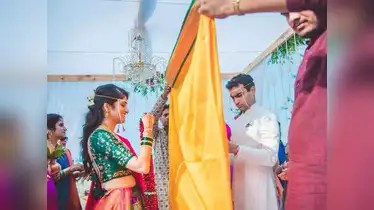
- The groom, treated as an अवतार of विष्णु, is shown with utmost sign of humility and respect. His feet are washed with water by the bride’s parents and he is requested to take his seat inside the मंडप.
- The groom then offers his प्रणाम to ईश्वर in order to fulfill his duties, to be prosperous and encompass all सद्गुण. He asks for the same for the children he hopes to have.
- After this क्रिया, father of the bride presents the groom with gifts, such as clothes, jewellery and mattresses.
- The groom accepts मधुपर्क (mixture of milk, yogurt, ghee, honey and bananas. After this, he concludes with an आचमन
- The groom, already on the altar with his parents, eagerly awaits the arrival of the bride. A curtain or screen is held separating groom and the bride in such a way that they cannot see each other
वधू आगमन (arrival of the bride at the मंडप)
- Carrying special ingredients (e.g., cumin seeds, jaggery), the bride who is seen as an अवतार of श्री महालक्ष्मी is escorted to the मंडप by her maternal uncle and other relatives.
- After the मङ्गलाष्टक are narrated by the पुरोहित, the curtain/ screen between the bride and the groom is drawn away. The bride and the groom see each other and sprinkle the cumin-jaggery mixture on each other’s heads.
- The couple exchange वरमाला – the groom does वंदना of वरुण, बृहस्पति, इंद्र and सूर्य to protect his family.
- The groom expresses seeking a wife bestowed with all-pervading good nature, one who can bring happiness and prosperity to his family, maintain peace, be pious in the household, be the bearer of children and who will carry the family tree ahead.
कन्यादान
- The father of the bride gives her away to the bridegroom. The bride’s parents present the parents of the groom with a tray full of flowers, fruits and coconuts.
- The specific मंत्र are chanted both by the parents of the bride and parents of the groom separately signifying offering of the bride and receiving of the bride into the groom’s family.
- Both मंत्र represents promises made in front of the assembled priests and guests who bear witness to this important क्रिया – they are presented with the ताम्बूल and their blessings sought.
- This is followed by गोत्रप्रवर where the priests announce the गोत्र of the families of the bride and the groom. गोत्र of the previous three generations of the bride and the groom is chanted.
- The permission of all who are gathered, the elders and the देवताs is sought through the chanting of the मंत्रs – a coconut is placed in the cupped hands of the bride along with तुलसी and her hands are gently laid on top of the cupped hands of the groom.
कन्याम् कनक संपन्नाम् कनका भरणैर्युथम् दास्यामि विष्णुवे तुभ्यम् ब्रह्मलोकजिगीशया ……
“This bride filled with radiance and adorned with gold ornaments, I give to you, O अवतार of श्रीविष्णु, so that you may win ब्रह्मलोक. This bride will reside by you at all times. Holding the देवताs as witnesses, hereby give this bride to you in marriage. This bride who is talented, good natured, of good character, simple, yet so perfect is given to you, one of good character and intelligence. May you succeed in all four आश्रम of life – धर्म, अर्थ, काम and मोक्ष! I give you this bride whole-heartedly with my word and total mindset”.
- The bride’s parents first pour three spoons of water over the coconut, symbolizing the giving away of their daughter in marriage. Members of the bride’s family do likewise.
- As the groom clasps the right hand of the bride, he repeats the following oath thrice – the bride does the same – धर्मेच अर्थेच कामेच नाथिचरामि (In धर्म, material commitments and my needs, I shall consult you, take your consent and act upon, I shall not violate these).
- On this occasion, the bride and the groom are presented with gifts made of silver that they can use in the नित्य देवता पूजा. The groom also has to take a व्रत that he will never perform any यज्ञ or धर्म क्रिया without his wife by his side.
कंकण धारण
- Five couples are invited to the वेदिका in the मंडप to sit around the groom and the bride. They draw out a cotton thread from the कलश and take the thread around the new couple (कंकण). The bride and the groom tie the पवित्र thread around the wrists of each other, to ward off any evil.
- The gathered couples pray to the serpents of the three worlds and the Lord of Serpents, वासुकि, to protect the new couple from any harm. They pray to इंद्र for strength and to श्री लक्ष्मी to ward off any evils. Then, दर्भ is rolled into a bun and placed on the bride’s head on which is placed a small wooden yoke (symbolically, the yoke signifies responsibilities of the family)
मांगल्य धारण
- In this step, the groom ties मांगल्य (मंगलसूत्र) around the neck of the bride. The मांगल्य pendant tied to the sacred thread symbolizes the groom’s life and signifies togetherness with her husband forever.
- The thread coated with हल्दी and anointed with सिंदूरम्, kept over jaggery cubes and rice, is treated with respect seeking the blessings of महादेवी. Blessings are sought from the assembled elders.
- At the auspicious मुहूर्त, the groom tied the मांगल्य around the bride’s neck. The loud and continuous नादस्वर music and the drum-beats, shun any inauspicious sounds. This is also referred to as the घट्टी मेला.
- The श्लोक that is chanted for this occasion is
माङ्गल्यं तन्तुनानेन मम जीवनहेतुना।
कण्ठे बध्नामि सुभगे त्वं संजीव शरदं शतम्।।
“O Good Natured One! For the fulfilment of life, I hereby tied this sacred necklace around your neck. May you life happily for a hundred years (with me)”.
- The groom ties three knots on the मांगल्य and with this, the groom accepts his bride as his equal partner in life.
- The groom’s sister and other female relatives come up to the वेदिका in the मंडप and bless the bride and her मांगल्य by applying हल्दी and सिंदूरम्. This represents a significant क्रिया within the विवाह ceremony post which the bride becomes a member of the groom’s family.
अक्षतारोपण
- Prior to this क्रिया, rice grains are washed and dried. The bride and the groom shower this rice over each other’s head to signify prosperity.
- The groom and the bride exchange flower gardens thrice each – the groom holds a pot filled with water as he chants the कपिल वाचन मंत्र which means the following:
“Let there be no obstacles in life. Let there be prosperity, peace and success. Let there be good health. Let is bring good tidings. May good dees, children, spiritual well-being and wealth be bestowed. May our birth stars merge with other auspicious stars and the moons and bring good to all.’
- The groom and the bride seek the blessing of elders. Couple exchanges gifts. आरती is performed. Rice grains, betel nut and coins are tied to the white draps-over sari of the bride.
पाणिग्रहण
- पाणिग्रहण is the acceptance of bride into the groom’s family. The groom holds the right hand of the bride with his right hand.
- मंत्र chanted is as follows:
गृम्णामि ते सौभगत्वाय हस्तं मया पत्या जरदष्टिर्यथा सः ।
भगो आर्यमा सविता पुरंपिर्मह्यं त्वादुर्गाईपत्याय देवा: ||
“O Bride! I accept your hand for good luck, and together may we reach old age. The देवताs have given you to me and blessed me to become your husband.”
(sidenote of this क्रिया – it is believed that to beget sons, grooms should clasp only the thumb of the bride, to beget daughters, they should hold only the four fingers, excluding the thumb, and to beget both sons and daughters, groom must clasp the entire hand).
सप्तपदी
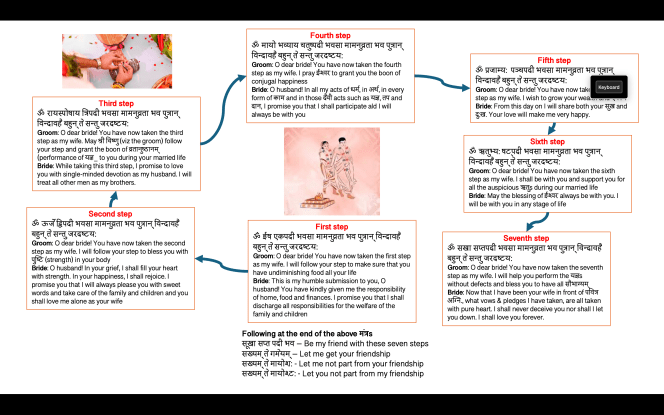
- This is the most important ceremony of the विवाह – as it confirms the marriage and sanctifies it. Only after this ceremony are the couple affirmed and accepted as married religiously and socially – the groom and the bride become husband and wife.
- Seven little heaps of rice are arranged on a plantain leaf. The groom slides a silver toe ring on the second toe of each foot of his bride. Then he holds the toe and places it on the heap of rice.
- A मंत्र is recited as the couple take each step together.
- With each of the seven steps, a particular मंत्र is decided and blessings of श्री विष्णु are sought. And at each step, the following vows are taken:
- Bride’s sari and groom’s dhoti are tied together at one end in a knot. Holding hands together, the couple go around the पवित्र अग्नि with the groom stepping with his right leg to the north side or east side of अग्नि along with his bride.
प्रधान होम
- The groom performs the प्रधान होम. The पवित्र अग्नि are offered first to सोम for creating the bride, then to गंधर्व, अग्नि and lastly to इंद्र.
- शस्त्र indicate that अग्नि bears witness to the unification of the bride with the groom, seconded by वायु and voted by चंद्र and सूर्य
- Groom says “You were approved by चंद्र, विश्ववसु, गंधर्व and अग्नि who along with cattle and wealth gave you to me
- So chanting, the groom takes a vow that he will perform the यज्ञ. He fills his bride’s palms with puffed rice which they together offer to अग्नि and seek its blessings
- There are ten होम मंत्र and 16 आहुतिs – at the end of each of the मंत्र ending with स्वाहा, ghee is offered to the अग्नि
शिलारोहण and लाज होम
- शिलारोहण is performed to pray for the resolution of the bride to stand firmly against any upsets in married life.
- During this कर्म, the bride is led by the groom to stand on a slab of stone (शिला) and वंदना is offered to ईश्वर to make her strong and undistracted as a stone.
- The brother of the bride helps her out in लाज होम. He hands her puffed rice. The bride and the groom together offer the puffed rice as an आहुति to अग्नि while she prays for his longevity.
- अग्नि is considered as one of the forms of आर्यम and होम is done to please अग्नि. आर्यम पूजा is done by unmarried girls to obtain a good husband. The groom and the bride go around अग्नि three times to see blessings of अग्नि
हरि भूमा
- The क्रिया of the bride and the groom eating together from a single banana leaf is called as हरि भूमा. This signifies the concept of staying their life together.
- Five banana leaves are laid out in such a way that they overlap each other to make one large eating surface for the bride and the groom. Rangoli and lamps are placed around them as decorations and special snacks are served.
- Couples sitting along with the newly-weds urge them to feed each other with large pieces of snacks and crack jokes teasing both. Idea is to make couple comfortable with each other as well as the larger family around them
अरुंधति दर्शन
- The ध्रुवक्षिति मंत्र is chanted to do वंदना of the important नक्षत्र in the sky – अरुंधति, ध्रुव and the सप्तऋषि मंडल.
- अरुंधति is the wife of ऋषि वशिष्ठ and known for her staunch भक्ति towards her husband.
- The newly-wed couple is led outside the विवाह मंडप to gaze at the sky to seek blessings of अरुंधति – even if the विवाह is in day-time, the couple is asked to gaze at the sunny sky in the direction of the pole star and then return back inside.
- To all married women, अरुंधति represents woman’s aspiration, woman’s realization, woman’s beauty, woman’s devotedness to the husband, plus power of धर्म in infinite measure.
नागोली
- Following the विवाह, स्तुति of देवताs is undertaken again along with offerings made. Rice grains, coloured with five hues, are arranged in the form of a lake. Outlines of elephants are made with rice and salt on either side of the lake for a trading game to be played by the bride and the groom.
- A कलश with a lemon tied around the neck is filled with water and kept on the rice outline. देवी गौरी, a mirror, कलश, fruits and coconuts are arranged in a plate.
- A व्रत is taken to perform the नाकबल्लि (or नागोली) ceremony. पूजा of श्री गणेश is undertaken. All 33 कोटि देवता are seen as residing within the कलश who are invited to the ceremony along with their horses and weapons.
- The bride is presented with another saree at this time and another मांगल्य is given to the bride to ward off obstacles.
- Five women are invited to the मंडप and each dedicated with a special task. They carry plates filled with bananas, ghee, water and lamps.
- Bride’s brother carries a knife pierced with a lemon in his right hand. He goes around the अग्नि with all the women following – then the groom’s mother offers आहुति to the देवताs and presents gifts to the women followed by an आरती. The groom presents the brother-in-law with gifts.
- The bride and the groom are given पान with nuts to eat as a part of this ritual.
- The bride and the groom then hold each other’s hands and pray to इंद्र and शचि for their blessings – games are organized, and such games bring out the qualities of both the bride and the groom (sporting spirit, kindness, strength and cooperation).
- Last action is where bride’s brother gives the bride a handful of parched rice grains which she hands to the groom, who on her behalf offers it to अग्नि.
गृहप्रवेश
- Ceremony is undertaken to welcome the bride to the home of the groom.
- During a गृहप्रवेश, a होम is undertaken to venerate अग्नि, सूर्य and इंद्र. Prosperity, wealth and happiness are sought. Wife and husband are equal partners and pray for a long life together. अग्नि is offered cooked rice during the होम
- Post the ceremony, the bride proceeds with the groom and family members towards the groom’s quarters. The bride’s feet are washed at the entrance of the groom’s house. The bride prays to the threshold and gently knocks down a cup filled with rice and jaggery into the home as she enters the home with her husband (symbolic of spreading prosperity into her new home). They do पूजा of the देवताs and seek blessings of the elders.
- The groom’s parents receive gifts and the bride is gently made to sit on the laps of the groom’s parents (since in earlier days, age of marriage was much lesser, the idea of placing the girl in groom’s parents symbolizes that she will continue to be safe in her new home too).
- Role of the bride is seen as key in holding the family together – and this is emphasized in the various क्रिया undertaken throughout the विवाह.
आशीर्वाद
In this concluding क्रिया, the bride and the groom take off the कंकण. The parents offer पूजा to the देवताs and seek blessings of the priests to culminate the austerities. आशीर्वाद, blessings of elders is when the couple pay tribute to the elders, by doing नमस्कार to them.
ॐ तत् सत्
 Adhyatma Writings