
कठोपनिषत्
(part of कृष्ण यजुर्वेद)
ॐ
॥ अथ कठोपनिषद् ॥
Says आदि शंकर: The word उपनिषद् is derived by adding उप (near) and नि (with certainty) and षद्, meaning to split up (destroy), go (reach, attain) or loosen. And by the word उपनिषद् is denoted the knowledge of the knowable entity presented in the book that is going to be explained. How is knowledge associated with the word उपनिषद्?
- Knowledge is called उपनिषद् by virtue of its association with this significance – knowledge splits up, injures, or destroys the seeds of worldly existence such as अज्ञान etc., in the case of those seekers of मोक्ष who, after becoming detached from the काम for the seen and unseen objects, approach (उप, षद्) the knowledge that is called उपनिषद् and that bears the characteristics to be presented hereafter, and who then deliberate on it with steadiness and certainty (नि), or
- Knowledge of ब्रह्म is called उपनिषद् because of its connection with the idea of leading to ब्रह्म, inasmuch as it makes the seekers after मोक्ष, who are possessed of the qualities already mentioned, attain the supreme ब्रह्म.
कठोपनिषत् is special for various reasons – the text talks about ब्रह्म in a clear and direct manner and thereby making the content easy to understand. Some श्लोक in the श्रीमद्भगवद्गीता are found word-to-word within कठोपनिषत् making one realize why this is such an important text. The commentary below is a reproduction of the commentary given by Swami Krishnananda, barring edits to shorten the narrative (though hopefully not ignoring the meaning). Lastly, some मंत्रs given here are also chanted within our own homes as a part of the daily पूजा कर्म or संध्या वन्दनम् – thereby signifying the impact of this text in our own daily lives. Let us read on.
ॐ सह नाववतु । सह नौ भुनक्तु । सहवीर्यं करवावहै । तेजस्वि नावधीतमस्तु । मा विद्विषावहै ॥ॐ शान्तिः शान्तिः शान्तिः ॥
| ॐ (symbol of पर ब्रह्म), सह – together, नौ – (both) us, अवतु – (let Him) protect, सह – together, नौ – (both) us, भुनक्तु – come to enjoy (bliss of ज्ञान), सह – together, वीर्यं – vigour, करवावहै – (let us both) do, तेजस्वि नौ – invigorating, अधीतम्-अस्तु – what we study, मा – never, विद्विषावहै – quarrel with each other | Let Him protect us both (the teacher and the taught) together (by revealing knowledge). May He protect us both (by keeping safe the results of knowledge). May we attain vigour together. Let what we study be invigorating. May we not quarrel with each other |
Part I – Canto I
ॐ उशन् ह वै वाजश्रवसः सर्ववेदसं ददौ । तस्य ह नचिकेता नाम पुत्र आस ॥ १॥
तँ ह कुमारँ सन्तं दक्षिणासु नीयमानासु श्रद्धाविवेश सोऽमन्यत ॥ २॥
पीतोदका जग्धतृणा दुग्धदोहा निरिन्द्रियाः । अनन्दा नाम ते लोकास्तान् स गच्छति ता ददत् ॥ ३॥
स होवाच पितरं तत कस्मै मां दास्यसीति । द्वितीयं तृतीयं तँ होवाच मृत्यवे त्वा ददामीति ॥ ४॥
| ॐ, उशन् ह वै – desirous (of स्वर्ग), वाजश्रवसः – son of वाजश्रवस्, सर्व-वेदसं – all that he possessed, ददौ – gave away, तस्य ह – to him, नचिकेता:- नचिकेतस्, नाम – by name, पुत्र – son, आस – there was (had) | Once, desirous of स्वर्ग, the son of वाजश्रवस् (गौतम) gave away everything. He had a son, नचिकेतस्, by name. |
| तँ ह – into him, कुमारँ – son, सन्तं – being (though) good, दक्षिणासु – (when) the दक्षिणा, नीयमानासु – being distributed, श्रद्धा – reverential faith, (driven by) anxiety for the father, आविवेश – entered, स: – he, अमन्यत – thought | At the presents were being distributed, श्रद्धा entered his heart who was still a boy. He thought |
| पीतोदका – (the cows that) have drunk waster (for the last time), जग्धतृणा – eaten grass (for the last time), दुग्धदोहा- have yielded all their milk (and are now too old to yield any more), निरिन्द्रियाः – barren (are unable to give birth anymore because of age), अनन्दा – joyless, नाम – verily, ते – those, लोका: – worlds, तान् – them, स – he, गच्छति – goes, ता ददत् – presents | He goes to those लोक that are known as joyless, who gives away the cows that have drunk water and eaten grass (for good), whose milk has been milked (for the last time) and which have become barren |
| स ह – he, उवाच – said, पितरं – to his father, तत – O! Father, कस्मै – to whom, मां – me, दास्यति इति – will you give,द्वितीयं – for the second, तृतीयं – for the third time, तँ – to him, ह उवाच – said, मृत्यवे – to death, त्वा – you, ददामि – I give, इति – thus | He said to his father, “O father! To whom will you offer me? He spoke to him a second and a third time. To him (the father) said, “To death I offer you”. |
व्याख्या: वाजश्रवस् (or गौतम) is performing a यज्ञ that goes by the name विश्वजित with the intention of gaining स्वर्ग. The condition of this particular kind of यज्ञ, which is performed for the attainment of स्वर्ग after death, is that the person aspiring for this joy of the celestial world should offer, as दान, everything that one has. Whatever one considers as one’s belonging should be offered in gift, in दान, so that after this performance of the यज्ञ one has nothing to call one’s own.
His observant son, नचिकेत, observes that his father is giving cows away as दान to the ब्राह्मण who had attended and performed the यज्ञ – but these cows were old, barren and not capable of giving any milk. What does a दान? दान means the giving of that which we love most. It does not mean simply giving something. Our heart has to go a little bit by the process of alienation, and our joy should diminish a little because of a part of our joy going to contribute to the joy of another person. नचिकेत knew therefore that giving barren cows as दान will be harmful to his father and instead of स्वर्ग, he will experience the opposite as a result of his actions.
Out of concern to ensure that his father obtains the appropriate फल by conduct of the यज्ञ, and since he considers himself as a “belonging” of his father, नचिकेत kept on pestering his father by asking him – “To whom will you give me?”. And the father gets irritated with this pestering and gives a shocking response – “To death I offer you”.
बहूनामेमि प्रथमो बहूनामेमि मध्यमः । किँ स्विद्यमस्य कर्तव्यं यन्मयाऽद्य करिष्यति ॥ ५॥
अनुपश्य यथा पूर्वे प्रतिपश्य तथाऽपरे । सस्यमिव मर्त्यः पच्यते सस्यमिवाजायते पुनः ॥ ६॥
| बहूनाम् – of many (sons & disciples), एमि – I go (hold rank), प्रथम: – first, बहूनाम् – of many (sons & disciples), एमि – I go (hold rank), मध्यमः – mediocre, किँस्विद् – what might be, यमस्य – of यम, कर्तव्यं – to do (duty), यत् – which, मया – by me, अद्य – now, करिष्यति – can do | (नचिकेतस् thought) – “Among many, I am the first; at times, I am mediocre (meaning I was never a third rate); what is the undertaking of यम that is being achieved through me (who is thus given to यम)? |
| अनुपश्य – remember, यथा – how, पूर्वे – our ancestors (who came before us), प्रतिपश्य – consider, तथा – thus, अपरे – others (sages and holy men of the day), सस्यम् इव – like corn, मर्त्यः – mortal, पच्यते – decays (ripens and falls), सस्यम् इव – like corn, आजायते – born, पुनः – again | Consider successively how your ancestors behaved, and consider how others have (now). Man decays and dies like corn, and emerges again like corn. |
व्याख्या: This was a very terrible thing for the boy to hear. “You ask me to go to death? It is to death that you are going to offer me as a दान? After all, what is the wrong that I have committed that I should be consumed by the jaws of death? Maybe among people I am not the best, maybe I am at least middling in quality, but am I the worst that I should go to death? What is the Lord of Death about to do with me? Should I die for no fault of mine? Anyway, these words have come from the mouth of my dear father. He wants me to go to death. Father, stick to your words. Do not withdraw these words.”
नचिकेत is a sensitive child and knows that his father will experience pangs of regret. He therefore tells his father that death is not the end – just as corn decays, falls on the ground but rises up again, death is not the end and there is therefore no reason for this father to experience any regret. Someone in the 21st century may argue – why should नचिकेत listen to his father and court मृत्यु? But the same people will be surprised with the actions of राम to accept the word of दशरथ and and go to the अरण्य. Since the words of his father were uttered at the sacred space of a यज्ञ, they cannot be allowed to go waste – hence, नचिकेत respects these words and proceeds to यम लोक.
वैश्वानरः प्रविशत्यतिथिर्ब्राह्मणो गृहान् । तस्यैताँ शान्तिं कुर्वन्ति हर वैवस्वतोदकम् ॥ ७॥
आशाप्रतीक्षे संगतँ सूनृतां चेष्टापूर्ते पुत्रपशूँश्च सर्वान् । एतद्वृङ्क्ते पुरुषस्याल्पमेधसो यस्यानश्नन्वसति ब्राह्मणो गृहे ॥ ८॥
तिस्रो रात्रीर्यदवात्सीर्गृहे मे-ऽनश्नन् ब्रह्मन्नतिथिर्नमस्यः । नमस्तेऽस्तु ब्रह्मन् स्वस्ति मेऽस्तु तस्मात्प्रति त्रीन्वरान्वृणीष्व ॥ ९॥
| वैश्वानरः – (like) वैश्वानर (a type of अग्नि), प्रविशति – enters, अतिथि – guest, र्ब्राह्मणो – ब्राह्मण, गृहान् – house, तस्य – to him, एताम् – these, शान्तिं – quieten, कुर्वन्ति – they do, हर – fetch, वैवस्वत – O वैवस्वत! (son of विवास्वान viz the Sun) उदकम् – water | A ब्राह्मण enters a house like वैश्वानर, Men give this water to quieten him. O वैवस्वत! Fetch water. |
| आशा – hopes, प्रतीक्षे – expectation, संगतँ – (पुण्य gained in) company with good people, सूनृतां – friendly discourses, च इष्टापूर्ते – secret यज्ञ, charitable deeds and pious gifts, पुत्र – children, पशूँ – animals (material wealth), च – and, सर्वान् – all एतद् – this वृङ्क्ते – are destroyed, पुरुषस्य – of the humans, ल्पअमेधस: ignorant, यस्य – to whose, अनश्नन् – without taking food, वसति – stays, ब्राह्मणो – ब्राह्मण, गृहे – in the house | Hope and expectations, results of company of good people, पुण्य acquired sweet and friendly discourses, beneficial result of secret यज्ञ, दान कर्म and pious gifts, children and cattle – all these are destroyed in the case of an ignorant man, in whose house a ब्राह्मण guest stays without taking food |
| तिस्र: three, रात्री: – nights, यत् – as, अवात्सी: – you have dwelt, गृहे – in the house, मे – mine, अनश्नन् – without taking food, ब्रह्मन् – O ब्राह्मण!, अतिथि – guest, नमस्यः – venerable, नम: – prostrations, ते – into you, अस्तु = be, ब्रह्मन् O ब्राह्मण!, स्वस्ति – good, मे – to me, अस्तु = befall, तस्मात् – therefore, प्रति – in return (of the three nights), त्रीन् – three, वरान् – boons, वृणीष्व – you choose | Says यम: O ब्राह्मण!, since you have lived in my house for three nights without food, a guest and an adorable person as you are, let my salutations be to you, and let good accrue to me (by averting the fault arising) from that (lapse). Ask for three वरं, one in respect of each (night). |
व्याख्या: Who is saying these words given against मंत्र 7 and 8? Commentators state that the queen of यम is making this statement. The story goes that नचिकेत goes to यमलोक and waits outside for three days – no one notices नचिकेत and he remains standing at the gates of यमलोक without food or water. Now, नचिकेत is seen as a guest who was not expected to come to यमलोक. उपनिषद् later says that a guest, an अतिथि, is one who comes as a surprise (since the guest has come at an unexpected तिथि) and a guest must therefore be treated like ब्रह्म (or परमात्मा) (since anything un-expected may be seen as the intent of परमात्मा). Moreover, if the अतिथि is a ब्राह्मण, the owner of the house will lose all पुण्य if such an अतिथि is not looked upon properly. A ब्राह्मण is like a burning flame and hence water is offered to quieten the flame; else, the flame will burn up the house of the owner. The उपनिषद् lists all types of पुण्य one may lose if a ब्राह्मण अतिथि is not offered food (and water) after coming to one’s house. Clearly, not taking good care of a guest has significant implications!!!!!
यम acknowledges his error and knowing the stature of नचिकेत not as a young boy but a self-controlled ब्राह्मण with a lot of accumulated तपस् शक्ति, यम offers three वर (boons) to him as a compensation for making him stand for three days at the gates of यम लोक.
शान्तसंकल्पः सुमना यथा स्याद् वीतमन्युर्गौतमो माऽभि मृत्यो । त्वत्प्रसृष्टं माऽभिवदेत्प्रतीत एतत् त्रयाणां प्रथमं वरं वृणे ॥ १०॥
यथा पुरस्ताद् भविता प्रतीत औद्दालकिरारुणिर्मत्प्रसृष्टः । सुखँ रात्रीः शयिता वीतमन्यु त्वां ददृशिवान्मृत्युमुखात् प्रमुक्तम् ॥ ११॥
| शान्तसंकल्पः – be pacified, सुमना – be kind, यथा स्याद् – (let him) may be, वीतमन्यु: – free fom anger, गौतम: – गौतम, मा: – me, अभि – towards, मृत्यो – O मृत्यु, त्वत् – by you, प्रसृष्टं – sent away, मा – me, अभिवदेत् – may greet, प्रतीत – recognize me, एतत् – this, त्रयाणां – of the three (boons), प्रथमं – first, वरं – boon, वृणे – I choose | O मृत्यु देवता! Of the three वरं, I ask this one as the first, viz that (my father) गौतम may become freed from the anxiety, calm of mind, freed from anger towards me, and he may recognize me and talk to me when freed by you |
| यथा – as, पुरस्ताद् – before, भविता – will be, प्रतीत – will recognize, औद्दालकि आरुणि: – (another name of father of नचिकेत), मत् – from me, प्रसृष्टः – released, सुखँ – joyfully, रात्रीः – nights, शयिता – (will) sleep, वीतमन्यु – free from anger, त्वां – you, ददृशिवान् – when he sees, मृत्युमुखात् – from the jaws of मृत्यु, प्रमुक्तम्- released | यम replies – Having recognized (you), औद्दालकि आरुणि will be (possessed of affection) just as he had before. Seeing you freed from the jaws of death, he will get over his anger and will, with my permission, sleep happily for many a night. |
व्याख्या: Before we get into details, a question may come up – how come नचिकेत is able to even converse with यम? One may then be reminded that there is another famous conversation of सावित्री with यम that comes up in the महाभारत (as well as various पुराण) – it should become evident that नचिकेत, despite being a little boy, possesses a high level of तपस् शक्ति and recognizing this, यम is engaging in a conversation with the boy.
The first वर asked for may be seen in various ways. Simplistically, one may understand that the primary worry of नचिकेत will be about the emotional state of the father – he rightly understands that the father may be disturbed by his own words as well as even angry on नचिकेत for having left him (as दशरथ also was unhappy when राम decides to respect the word of दशरथ and go to वन). नचिकेत therefore seeks emotional calmness for his own father and यम grants this immediately. But there is a deeper way to understand this exchange.
There is an अध्यात्मिक (mystical) way also to appreciate the depth of this वर. Death is said to be the greatest instructor and educator of people. One who has faced it will, to a large extent, know the secret of life, because death is the secret that is hidden from our vision throughout our earthly life. Most of us live our daily lives in this world minus the consciousness of death – it appears something distant (even for those who may have reached an old age). It is often said that what we call life in this world is only a camouflage which death has put on. It is an incessant dying that we are experiencing in this world, which we mistake for actual continuous life. As is known to all, any movie played on a screen involves little pieces of pictures totally different from one another giving the impression, illusorily, of a motion picture, with people walking about, speaking, singing and dancing. It is an illusory presentation presented to our senses, which cannot catch up to the speed of the movement of the pictures. If the power of the eyes can be adjusted to the speed of the motion picture, we will see each picture moving separately. Inasmuch as our visual capacity is inferior to the velocity of the movement of the pictures in a cinema, we mistake the isolated bits for a continuous stream of motion. In a similar manner, the ruling principle in this world is movement, which is the very structure of everything. World is a परिणाम, says पतंजलि in the योगसूत्र where परिणाम transformation. Everything moves; everything is heading towards something else every moment of time. Nothing is………everything is becoming. If this is the law of life and this is what is actually happening in the world, death is actually what we call life, and our knowledge is nothing but a shadow of ignorance. Cells in the body keep dying daily but we do not have the सूक्ष्मता to observe it. One who has faced death, one who has actually encountered it, understood it and learnt a lesson from it, would not anymore be a human being. He would be a super-person, a superman and when such a person returns to the world, the world sees him differently – those who know the story of Ramana Maharishi know that the beginning of this greatness began from his own death experience and his life changed after encountering death – and the Ramana who came out of this indeed is seen as a superman even today by many.
In the above context, looking at the वर, the father will mean the world – and this world will no longer show any anger towards नचिकेत – नचिकेत will become free after returning to Earth since his own दृष्टि of the world will be significantly different after his encounter with मृत्यु. When we return to this world after having faced death, it means to say, having plunged very deeply into the constituent death-like features of the world, it shall no more be a fearsome ogre before us. Calm and quiet will be the world before us. It will not be a terrifying medium of material presentations, as it is to us now. We will not be a servant of the world anymore; it shall be our servant. Control over things follows from the inner knowledge of the constituents of the objects. Wherever there is insight, there is also strength over the things of which we have an insight. The world can no longer be a source of trouble to us since we have already encountered death – it will therefore be affectionate to such a person. That is the deeper meaning one may infer from this exchange.
स्वर्गे लोके न भयं किंचनास्ति न तत्र त्वं न जरया बिभेति । उभे तीर्त्वाऽशनायापिपासे शोकातिगो मोदते स्वर्गलोके ॥ १२॥
स त्वमग्निँ स्वर्ग्यमध्येषि मृत्यो प्रब्रूहि त्वँ श्रद्दधानाय मह्यम् । स्वर्गलोका अमृतत्वं भजन्तएतद् द्वितीयेन वृणे वरेण ॥ १३॥
| स्वर्गे लोके – (in the) स्वर्ग लोक, न – no, भयं – fear, किंचन – whatsoever, अस्ति – there is, न – not, तत्र – there, त्वं – you, न – nor, जरया – old age, बिभेति – they fear, उभे – in both, तीर्त्वा – having crossed, अशनाया – hunger, पिपासे – thirst, शोकातिग: – above grief, मोदते – rejoices, स्वर्गलोके | In स्वर्ग, there is no fear- you are not there (O यम!), (and) nobody is struck with fear because of old age. Having transcended both hunger and thirst, and crossed over sorrow, one rejoices in the स्वर्गलोक. |
| स – that, त्वं – you, अग्निँ स्वर्ग्यम् – that leads to स्वर्ग, अध्येषि – know, मृत्यो – O मृत्यु!, प्रब्रूहि – explain, त्वँ – you, श्रद्दधानाय – full of श्रद्धा, मह्यम् – to me, स्वर्गलोक:, अमृतत्वं – eternality, भजन्ते – attain, एतद् – this (the secret of that यज्ञ अग्नि), द्वितीयेन – by the second, वृणे – I pray for, वरेण – by the boon | 0 मृत्यु! such as you are, you know that अग्नि which leads to स्वर्ग. Of that, you tell me who am full of श्रद्धा. The dwellers of स्वर्ग get an eternal state. This I ask for through the second वरं. |
व्याख्या: नचिकेत now talks about स्वर्ग लोक to यम – यम is not present in स्वर्ग लोक (meaning it is a लोक where there is no death). नचिकेत asks knowledge about the अग्नि that will lead one to स्वर्ग. स्वर्ग लोक is a state where there are only three conditions of life there—birth, childhood and youth—but no decay, no old age, no death. There is no fear in that kingdom. Hunger and thirst do not torment the ones living there. Please instruct me into this विद्या, the secret knowledge of a great unknown यज्ञ, because it is difficult to imagine what kind of यज्ञ it could be which can transform a mortal into a deathless being in the स्वर्ग लोक. This is the second वर.
प्र ते ब्रवीमि तदु मे निबोध स्वर्ग्यमग्निं नचिकेतः प्रजानन् । अनन्तलोकाप्तिमथो प्रतिष्ठां विद्धि त्वमेतं निहितं गुहायाम् ॥ १४॥
लोकादिमग्निं तमुवाच तस्मै या इष्टका यावतीर्वा यथा वा । स चापि तत्प्रत्यवदद्यथोक्तं अथास्य मृत्युः पुनरेवाह तुष्टः ॥ १५॥
तमब्रवीत् प्रीयमाणो महात्मा वरं तवेहाद्य ददामि भूयः । तवैव नाम्ना भविताऽयमग्निः सृङ्कां चेमामनेकरूपां गृहाण ॥ १६॥
| प्र – well, ते – to you, ब्रवीमि – I will tell, तत् – that, उ – verily, मे – from me, निबोध – learn, स्वर्ग्यम् – that leads to स्वर्ग, अग्निम्, नचिकेतः, प्रजानन् – well knowing, अनन्त-लोकाप्तिम् – a means to the attainment of the eternal स्वर्ग, अथो – and, प्रतिष्ठां – support of the universe, विद्धि – know, त्वम् – you, एतं – this, निहितं – seated, गुहायाम् – in the cavity of (the heard of the learned) | 0 नचिकेतः, being well aware of the अग्नि that is conducive to स्वर्ग, I shall tell you of it. That very thing you understand, with attention, from my words. That अग्नि which is the means for the attainment of स्वर्ग and which is the support of the world, know it to be established in the हृदय (of the enlightened ones). |
| लोकादिम् – source of the world, अग्निम्, तम् – that, उवाच – said, तस्मै – to him (नचिकेत), या – what (class of), इष्टका – bricks, यावती: – how many, वा – and, यथा वा – and how (to be placed), स – he, च – and, अपि – also, तत् – that, प्रत्यवदत् – repeated back, यथोक्तं – as explained, अथ – so, अस्य – at this, मृत्युः – यम, पुन: – again, एव – even, आह – said, तुष्टः – being pleased | यम told him (नचिकेत) of the अग्नि that is the source of the world, the class and number of bricks, as also the manner of arranging for the अग्नि. And he (नचिकेत), too, repeated verbatim, with understanding, all these as they were spoken. Then मृत्यु (यम), being satisfied with this, said again: |
| तम् – him, अब्रवीत् – said, प्रीयमाण: – being delighted, महात्मा – the magnanimous, वरं – boon, तव – to you, इह – here, this, अद्य – now, ददामि – give, भूयः – additional, तव- इव – after you, नाम्ना – by name, भविता – shall be, अयम् – अग्नि, सृङ्कां – necklace, च – and, इमाम् – these, अनेक-रूपां – multi-formed, गृहाण – you take | Feeling delighted, that magnanimous one said to him, out of favour towards you, I now grant again another वरं. This अग्नि will be known by your name indeed. And accept this multi-formed necklace as well. |
व्याख्या: यम grants the second वर by teaching नचिकेत about the अग्नि knowing which one can then obtain access to स्वर्ग लोक. What अग्नि is being referred to here that is being conveyed as the source of the world as well as support of the world? भाष्याकारs refer to this अग्नि as वैश्वानर अग्नि or the विराट (also known as वैश्वानर तत्त्व), details of which उपासना are described in the 5th chapter of the छान्दोग्योपनिषत्. This great root of the world, the knowledge of which will make one endowed with immense power and endless suzerainty, is not just spread out outside. It is also in the deepest recesses of one’s own हृदय. The secret of this विद्या is indirectly revealed, though not clearly and publicly, when it is told to us that this universal root of the world is also in the हृदय of every person. यम, the Master who teaches नचिकेत here in this उपनिषद्, mentions once again that the root of the world—which is the cause of unlimited rulership of the whole world, of the cosmos—this root is within us. Thus, the secret lies here, that the attainment of this universal rulership is tantamount to acquiring control over one’s own self because it is the essence of our own being, while it is also the essence of the whole world outside. And the entire details of this अग्नि are conveyed to नचिकेत.
What do we mean by use of the word “bricks” here? In a typical external अग्नि that most are familiar with, there is a यज्ञ अग्नि within a अग्नि कुंड which itself is made by putting bricks arranged in a specific geographic shape. It cannot be seen just as a material brick here because of the fact that the यज्ञ, which is the subject of this verse, does not seem to be a material offering. The object of attainment is non-material because it is everywhere, and inside us also. These bricks are nothing but certain patterns of thinking. They are modes of thought, adjustments of one’s चेतना, and processes of conditioning oneself. These are the bricks, and a tremendous type of initiation is necessary for this. To conceive a universal that is inside us, our चेतना has to be adjusted in such a way that is ordinarily a total impossibility. So, these bricks are not material substances weighing some kilograms; they are bricks of one’s चैतन्य.
Further, it is evident from the above exchange that नचिकेत happened to be a brilliant शिष्य who possessed the necessary qualifications to receive this विद्या. Great purification is necessary even to grasp the import of what this विद्या is. नचिकेत understood it, practised it, and conquered death. This is the उपनिषद् for conquering death. – यम was so pleased with नचिकेत (a गुरु is always happy or joyful to receive a शिष्य who is supremely qualified) that a fourth वर is granted – the अग्नि taught was also given the नाम of नचिकेत अग्नि and the specific विद्या known as नचिकेत विद्या.
Last, there is a reference to अनेक-रूपां सृङ्कां – a multi-formed necklace – what could this mean since the detail is not elaborated. Here the भाष्याकारs come to our aid when they say that this necklace of many hues, contours and colours mentioned in this मंत्र is actually the विद्या of the mystery of life and death, of the process of कर्म itself. One of the greatest secrets of the world is the mystery of कर्म—how actions produce complementary reactions, what kind of फल is the outcome of what kind of action that we perform, and what is actually the connection between birth and death. We know these words, but their actual import is difficult to immediately grasp. Why is it necessary for us to be born? If we had not been born, what is the harm? Having been born, why should we die? If we do not die, what is the harm? And why should every action produce a reaction? These are the multifaceted hues of life in this world. The secret of this is also given here in the form of a necklace — mystical, invisible, unsubstantial, intangible. Power and glory are attached to this धार्मिक necklace. This is a new kind of वर that was granted — a fourth one, as it were.
त्रिणाचिकेतस्त्रिभिरेत्य सन्धिं त्रिकर्मकृत्तरति जन्ममृत्यू । ब्रह्मजज्ञं देवमीड्यं विदित्वा निचाय्येमाँ शान्तिमत्यन्तमेति ॥ १७॥
त्रिणाचिकेतस्त्रयमेतद्विदित्वा य एवं विद्वाँश्चिनुते नाचिकेतम् । स मृत्युपाशान् पुरतः प्रणोद्य शोकातिगो मोदते स्वर्गलोके ॥ १८॥
एष तेऽग्निर्नचिकेतः स्वर्ग्यो यमवृणीथा द्वितीयेन वरेण । एतमग्निं तवैव प्रवक्ष्यन्ति जनासः तृतीयं वरं नचिकेतो वृणीष्व ॥ १९॥
| त्रिणाचिकेत: – one who has performed नचिकेत अग्नि three times, त्रिभि: with the three, एत्य – having attained, सन्धिं – union, त्रि – three, कर्मकृत् – (one who has) performed the duties, तरति – crosses, जन्ममृत्यू – birth and death, ब्रह्म-जज्ञं – born of ब्रह्म, देवम् – bright (fire), ईड्यं – adorable, विदित्वा – having understood, निचाय्य – realizing, इमाँ – this, शान्तिम्, अत्यन्तम् – ever-lasting, एति – attains | One who, getting connection with the three, piles up the नचिकेत अग्नि thrice, and undertakes three kinds of duties, crosses over birth and death. Getting knowledge of that omniscient One who is born of ब्रह्म and is the praise-worthy देव, and realizing It, one attains ever lasting शांति |
| त्रिणाचिकेत: – one who has performed नचिकेत अग्नि three times, त्रयम् – three, एतत् – these, विदित्वा – having known, य: – who, एवं – thus, विद्वान् – the knower, चिनुते – performs, नाचिकेतम् – the नाचिकेत अग्नि, स: – he, मृत्यु-पाशान् – the chains of मृत्यु, पुरतः – before, प्रणोद्य – destroying, throwing away, शोकातिग: – free from शोक, मोदते – rejoices, स्वर्गलोके – in स्वर्ग लोक | One who performs the नाचिकेत यज्ञ thrice after having known these three (factors), and he who having known thus, accomplishes the नाचिकेत यज्ञ, casts off the chains of मृत्यु even earlier, and crossing over शोक rejoices in स्वर्ग लोक. |
| एष – this, ते – they, अग्नि, नाचिकेतः – O नचिकेतः, स्वर्ग्यो – that leads to स्वर्ग, यम् – which, अवृणीथा – you have chosen, द्वितीयेन – by the second, वरेण – boon, एतम् – this, अग्निं – अग्नि (यज्ञ), तव एव – you alone, प्रवक्ष्यन्ति – will call, जनासः – people, तृतीयं – third, वरं – boon, नचिकेतो – O नचिकेतः, वृणीष्व – you choose | O नचिकेत ! this is for you the वरं about the अग्नि that leads to स्वर्ग, for which you prayed through the second वरं. People will speak of this अग्नि as yours indeed. O नचिकेत ! ask for the third वरं. |
व्याख्या: यम gives दीक्षा नचिकेत of the वैश्वानर अग्नि, which is the origin of the universe. What is the threefold विद्या, the threefold getting united? We must look to the भाष्याकारs here again because the words are too mystical. The three-times performance is identified with the practice of a kind of उपासना which consists, first of all, in receiving विद्या from a गुरु – श्रवण, then contemplating it inwardly in one’s own mind, delving deeply into it – मनन, and converting that विद्या into the very being of one’s own self – निधिध्यास. Some other भाष्याकारs have stated that three-times performance may also mean one who has inwardly united through instructions by means of वेद, स्मृति and गुरु – since ज्ञान comes to us through the वेद, स्मृति and knowledgeable people (गुरुs).
And what do we mean by three कर्म (or duties) performing which, one becomes free from मृत्यु? The three कर्म are – यज्ञ, दान and तप. The 17th chapter of the श्रीमद्भगवद्गीता dwells in detail on these three duties – some of the key श्लोकs are reproduced here for the benefit of the readers.
यज्ञ
अफलाकाङ्क्षिभिर्यज्ञो विधिदृष्टो य इज्यते। यष्टव्यमेवेति मनः समाधाय स सात्त्विकः।।17.11।।
17.11 That यज्ञ which is in accordance with the शास्त्र (and is) performed by persons who do not hanker after results, and is performed with the resolve that it is “simply to be done as a यज्ञ”, that यज्ञ is predominantly सत्व.
Limited meaning of यज्ञ involves worship to a देवता by offering the देवता an आहुति in अग्नि. However, this has a much wider meaning than worship to a deity. In its wider meaning, any act of seeking a certain kind of देव शक्ति (धन, ऐश्वर्य, बाहुशक्ति, बुद्धिबल, ज्ञान, etc) by offering one’s own body and mind into the fire of self-effort is यज्ञ. A सात्विक यज्ञ seeks such देव शक्ति merely to discharge one’s धर्म and not for personal fame, insulting others, etc. He undertakes such यज्ञ (where one gives self-effort and one obtains शक्ति in return) since it is enjoined in the शास्त्र convinced that this is the right thing to do. He seeks no personal benefit from the यज्ञ except for seeking such देव शक्ति to discharge his धर्म.
तप
देवद्विजगुरुप्राज्ञपूजनं शौचमार्जवम्। ब्रह्मचर्यमहिंसा च शारीरं तप उच्यते।।17.14।।
तपस् pertaining to the body is said to be पूजा of the देव, of those initiated into study of शस्त्र, the गुरू’s, the wise, taking to cleanliness, straight-forwardness, ब्रह्मचर्यम् and अहिंसा.
अनुद्वेगकरं वाक्यं सत्यं प्रियहितं च यत्। स्वाध्यायाभ्यसनं चैव वाङ्मयं तप उच्यते।।17.15।।
तपस् in the form of speech is said to be the speech that is not agitating, is truthful, and both pleasant and beneficial as well as the self-study and practice of the वेद.
मनःप्रसादः सौम्यत्वं मौनमात्मविनिग्रहः। भावसंशुद्धिरित्येतत्तपो मानसमुच्यते।।17.16।।
तपस् pertaining to the mind is said to be this – mental clarity, cheerfulness, discipline over (inner speech), mastery (in general) over the mind and clean intentions.
श्रद्धया परया तप्तं तपस्तत् त्रिविधं नरैः। अफलाकाङ्क्षिभिर्युक्तैः सात्त्विकं परिचक्षते।।17.17।।
That threefold तप, practised with supreme श्रद्धा by disciplined ones (नरैः) who do not require/ anticipate results – they call it तप of सात्विका.
दान
दातव्यमिति यद्दानं दीयतेऽनुपकारिणे। देशे काले च पात्रे च तद्दानं सात्त्विकं स्मृतम्।।17.20।।
17.20 दान that is given (with the thinking) “(it is simply) to be given”, without regard to (the others’) ability to (return the) favour, at the proper place and time and to a deserving person – that is held to be predominantly सत्व.
All human activities can actually be classified into these three – we exert for living by indulging in give and take activities(यज्ञ), such exertion is based on being discipline in terms of one’s conduct and we share what we may have obtained by means of यज्ञ (not as owners but as an agent of ईश्वर).
Great conditions are put here: thrice performing, in a threefold manner, viz श्रवण, मनन and निधिध्यास and performing three कर्म — यज्ञ, दान & तप. Such a person is free from death and overcomes birth and death. Such a one becomes omniscient by knowing this, the root of the universe, वैश्वानर, which is rooted in ब्रह्म. Knowing this, one becomes endowed with eternal peace।
येयं प्रेते विचिकित्सा मनुष्ये-ऽस्तीत्येके नायमस्तीति चैके । एतद्विद्यामनुशिष्टस्त्वयाऽहं वराणामेष वरस्तृतीयः ॥ २०॥
| या – that, इयं – this, प्रेते – when dead, विचिकित्सा – doubt, मनुष्ये – in मनुष्य, अस्ति – does exist, इति – thus, च – and, एके – some, अयम् – this, न अस्ति – does not exist, इति – thus, च – and, एके – some, एतत् – this, विद्याम – shall like to know, त्वया – by you, अनुशिष्ट: – being taught, अहं – I, वराणाम् – among the वर, एष – this, वरतृतीयः- third वर | This doubt that arises, consequent on the death of a मनुष्य – some saying, ‘It exists’, and others saying ‘It does not exist’ – I would know this, under your instruction. Of all the वर, this one is the third वर |
व्याख्या: While the first two वर, though intense, may be seen as ordinary by most people, the third one is stunning in its scope – the fundamental question that has been plaguing human beings for a long time – “Does आत्मा exist?” यम is stunned by this question – it is not normal for a boy to seek an answer to this question – and while यम knows that नचिकेत is special, He is not ready to respond to this question as we will see in later verses.
देवैरत्रापि विचिकित्सितं पुरा न हि सुविज्ञेयमणुरेष धर्मः । अन्यं वरं नचिकेतो वृणीष्व मा मोपरोत्सीरति मा सृजैनम् ॥ २१॥
देवैरत्रापि विचिकित्सितं किल त्वं च मृत्यो यन्न सुज्ञेयमात्थ । वक्ता चास्य त्वादृगन्यो न लभ्यो नान्यो वरस्तुल्य एतस्य कश्चित् ॥ २२॥
| देवै: – by the देवs, अत्र – on this (point), अपि – also, विचिकित्सितं – have doubted, पुरा – in olden times, न हि – verily, it is not, सुविज्ञेयम् – easy to understand, अणु: – subtle, सूक्ष्म, एष – this, धर्मः – principle, subject, अन्यं – another, वरं, नचिकेतो – O नचिकेत !, वृणीष्व – choose, मा – do not, मा उपरोत्सी – press me, मा – me, सृज – give us, release, एनम् – this | Says यम – With regard to this, even the देवs entertained doubts in earlier times; for being subtle, this subject is not truly comprehended. 0 नचिकेत! ask for some other वर; do not press me on this; give up this that is demanded of me. |
| देवै: – by the देवs, अत्र – on this (point), अपि – also, विचिकित्सितं – have doubted, किल – indeed त्वं – you, च – and, मृत्यो – O मृत्यु (यम), यत् – which, न – not, सुज्ञेयम् – easy to understanding, आत्थ – say, वक्ता – one who tells (teacher), च – and, अस्य – to this, त्वादृक् – like you, अन्य: – no other, न लभ्य: – cannot be found, न अन्य: – no other, वर – boon, तुल्य – equal, एतस्य – of this, कश्चित् – any | Says नचिकेत – Even the देवs entertained doubt with regard to this thing; and 0 मृत्यु ! you too say that It is not easy to know. Since any other teacher like you who can tell of this can be found, no other वर is comparable to this one. |
शतायुषः पुत्रपौत्रान्वृणीष्वा बहून्पशून् हस्तिहिरण्यमश्वान् । भूमेर्महदायतनं वृणीष्व स्वयं च जीव शरदो यावदिच्छसि ॥ २३॥
एतत्तुल्यं यदि मन्यसे वरं वृणीष्व वित्तं चिरजीविकां च । महाभूमौ नचिकेतस्त्वमेधि कामानां त्वा कामभाजं करोमि ॥ २४॥
ये ये कामा दुर्लभा मर्त्यलोके सर्वान् कामाँश्छन्दतः प्रार्थयस्व । इमा रामाः सरथाः सतूर्या न हीदृशा लम्भनीया मनुष्यैः । आभिर्मत्प्रत्ताभिः परिचारयस्व नचिकेतो मरणं माऽनुप्राक्षीः ॥ २५॥
| शतायुषः – who may live hundred years, पुत्रपौत्रान् – children and grandchildren, वृणीष्वा – you ask for, बहून्पशून् – many cattle (material wealth), हस्ति – elephants, हिरण्यम – gold, अश्वान् – horses, भूमे – in the world, महत् – vast/ great, आयतनं – territory (kingdom), वृणीष्व – you ask for, स्वयं च – and yourself, जीव – live, शरदो – years (autumn seasons), यावत् – as many, इच्छसि – you like/ desire | Says यम – Ask for children and grandchildren who will live a hundred years. Ask for many cattle, elephants, and gold, and horses, and a vast expanse of the earth. And you yourself live for as many years as you like. |
| एतत् – this, तुल्यं – equal to, यदि – if, मन्यसे – consider, वरं, वृणीष्व – you ask for, वित्तं – wealth, चिरजीविकां – long life, च – and महाभूमौ – wide earth (long, vast kingdom), नचिकेत, त्वम् – you, एधि – become (be a king), कामानां – of all desires, त्वा – you, कामभाजं – the enjoyer, करोमि – I shall make | If you think some other वरं to be equal to this, ask for that. Ask for wealth and long life. 0 नचिकेत, you become (a ruler) over a vast region. I make you fit for the enjoyment of (all) enjoyable desires. |
| ये ये – whatever, कामा – objects of desire, दुर्लभा – difficult to obtain, मर्त्यलोके – in all लोक of mortals, सर्वान् – all, कामाँ – objects of desire, छन्दतः – according to your choice, प्रार्थयस्व – ask for, इमा – these, रामाः – attractive women, सरथाः – with chariots, सतूर्या – with musical instruments, न हि – not indeed, ईदृशा – such (maidens). लम्भनीया – enjoyable, मनुष्यैः – by mortals, आभि: – with them (maidens), मत्प्रत्ताभिः – given by me, परिचारयस्व – be attended on, नचिकेत, मरणं – (about death), मा – do not, अनुप्राक्षीः – question about | Whatever things there be that are desirable but difficult to get – pray for all those cherished things according to your choice. Here are these women with chariots and musical instruments such are surely not to be had by mortals. With these, who are offered by me, you get yourself served. 0 नचिकेत! do not inquire about death. |
व्याख्या: As is evident from persistence of नचिकेत seeking an answer to the most difficult question, यम is reluctant to respond to this question. यम indeed offers the best that any person can seek – wealth, fame, healthy and happy family, kingship, etc. The offer may be seen as alluring for all normal beings – नचिकेत is however a ज्ञानी and he continues to insist that he needs an answer to the question about death and state of आत्मा after one’s body dies.
श्वोभावा मर्त्यस्य यदन्तकैतत् सर्वेंद्रियाणां जरयन्ति तेजः । अपि सर्वं जीवितमल्पमेव तवैव वाहास्तव नृत्यगीते ॥ २६॥
| श्वोभावा – ephemeral, मर्त्यस्य – of the mortal मनुष्य, यत् -whatever there is अन्तक – O मृत्यु !, एतत् – this, सर्वेंद्रियाणां – of all the इंद्रिय, जरयन्ति – wear out, तेजः – vigour, अपि – also, सर्वं – all जीवितम् – life, अल्पम् – is short, एव – indeed, तव इव – you alone (may remain), वाहा: – horses, तव – you, नृत्य-गीते – dance and song | Says नचिकेत – O मृत्यु (यम), ephemeral is these, and they waste away the vigour of all the organs that a man has. All life, without exception, is short indeed. Let the vehicles be yours alone; let the dances and songs be yours. |
व्याख्या: Clarity of thought of नचिकेत needs to be appreciated. He seems to be telling यम – “You have told so many things. I have heard it. You want me to enjoy all these things. How will I enjoy them except through the sense organs, which will one day wear out? Tomorrow may be the last day. Bubble-like is this world which can burst at any moment, and worn-out sense organs cannot enjoy anything. What is the good of living a long life with worn-out sense organs? The energy, the vitality and the capacity to enjoy gradually diminish day by day as age progresses. Do you want me to live for the longest number of years and become old and decrepit? Even the longest life is very short in the life of eternity that is ahead of us. What is the good of telling me I can have a long life? Take all your chariots, take all your music, take all your dances. I do not want them. Take them back.”
न वित्तेन तर्पणीयो मनुष्यो लप्स्यामहे वित्तमद्राक्ष्म चेत्त्वा । जीविष्यामो यावदीशिष्यसि त्वं वरस्तु मे वरणीयः स एव ॥ २७॥
अजीर्यताममृतानामुपेत्य जीर्यन्मर्त्यः क्वधःस्थः प्रजानन् । अभिध्यायन् वर्णरतिप्रमोदान् अतिदीर्घे जीविते को रमेत ॥ २८॥
यस्मिन्निदं विचिकित्सन्ति मृत्यो यत्साम्पराये महति ब्रूहि नस्तत् । योऽयं वरो गूढमनुप्रविष्टो नान्यं तस्मान्नचिकेता वृणीते ॥ २९॥
| न – not, वित्तेन – with wealth, तर्पणीयो – satisfied, मनुष्य:, लप्स्यामहे – we will get, वित्तम अद्राक्ष्म – have seen, चेत् – if, त्वा – you, जीविष्याम: – we shall live, यावत् – so long, ईशिष्यसि – you rule, त्वं – you, वर: – boon, तु – but, मे – to me, वरणीयः – to be craved for, स – he, एव – alone | मनुष्य is not to be satisfied with wealth. Now that we have met you, we shall surely get wealth. We shall live as long as you will rule. But the वर that is worth praying for by me is that alone. |
| अजीर्यताम् – un-decaying, अमृतानाम् – the eternal, उपेत्य – having approached, जीर्यन् – being perishable, मर्त्यः – the mortal, क्वधःस्थः – existing on the Earth (plane) down below, प्रजानन् – well knowing, अभिध्यायन् – having scrutinized, वर्ण: – beauty, रति: – love, प्रमोदान् – the enjoyments of, अतिदीर्घे – in the long, जीविते – life, क: – who, रमेत – will rejoice | What decaying mortals living in the world below and possessed of knowledge, after having approached the company of the un-decaying and the eternal, will rejoice in the long life, after he has pondered over the nature of the pleasures produced by song and sport (beauty and love) |
| यस्मिन् – in which, इदं – this, विचिकित्सन्ति – people doubt, मृत्यो – O मृत्यु!, यत् साम्पराये – passing beyond, महति – great, ब्रूहि – tell, न: us, तत् – that, य: – which, अयं – this, वर:, गूढम् अनुप्रविष्ट: – become mysterious, न अन्यं – no other, तस्मात् – therefore, नचिकेत:, वृणीते – chooses | O मृत्यु! Tell us that in which people have this doubt, and which is about the great passing beyond (i.e., supreme life after death). नचिकेत does not choose any other वर but that (concerning the आत्मा) of which the knowledge is hidden (mysterious) |
व्याख्या: After meeting one who is eternal, how can one be attracted to things which are mortal? This is what नचिकेत says. This is not an ordinary sentence but a pregnant one – the core urging of धर्म is to seek eternality. And the steps one follows is to seek the eternal from the options/ engagements around us and slowly but surely, graduate to eternality. What does this mean?
There is a value hierarchy within धर्म – what lasts longer is more valuable than what is temporal. And the most eternal तत्व (or substance) is ब्रह्म that is MOST valuable (the only aspect which has any value) and all else derive their value from ब्रह्म only. Even in normal day-to-day conduct, the value of teak furniture is higher than furniture made out of engineered wood (since teak furniture lasts longer). Value assigned to a running river is higher than that assigned to a pond next door but value of an ocean is much higher since it signifies depth, eternality and stability (as compared with other water bodies). Value of a tree is higher than a single fruit that grows on the tree, value of the forest that nurtures the tree is higher than a single tree within the forest, value of the Earth is higher than the value of a single forest within it, value of the Sun is higher than value of the Earth (since it is the Sun that sustains the Earth) and above all, the value of ईश्वर is the highest since It is the one that sustains crores of Sun present within the Universe – note that each successive aspect indicated here exists for a longer period than the previous aspect but more importantly, is also the cause and sustainer of the previous aspect. And what lasts the longest is the one that is eternal viz परमात्मा. It is in this context that one must evaluate the pregnant depth of the statement made by नचिकेत to यम – “What decaying mortals living in the world below and possessed of knowledge, after having approached the company of the un-decaying and the eternal, will rejoice in the long life, after one has pondered over the nature of the pleasures produced by song and sport (beauty and love)”. Or one may put this in more simple words – Can one who has tasted a sip of दैवी अमृतम्, will they ever experience joy any longer in the taste of ordinary मधु!!!!
Note that question asked by नचिकेत – what lies beyond “महति साम्पराये” which means “great death”? What does “great death” mean? He was not ignorant. He does not want to know only about the rebirth condition of the जीवात्मा. He wants to know something more. Perhaps that is the reason why यम does not want to say anything. नचिकेत is asking, “What happens to the जीवात्मा when it is finally divested of individuality itself, which is the greatest death?” He does not want to know what happens at the physical death. It is the death of individuality itself. This is a terrible question. Nobody can tell us where परमात्मा was before It created the world, because It cannot sit anywhere. Our minds cannot
comprehend this truth. There is some great point indeed in यम not being ready to answer the question. “Subtlest and most secret is this question. I shall not ask for any other वर.” नचिकेत will not ask for any other वर. Only this, only this, only this. Very insistent, very persistent, very wise indeed is this great, exemplary student of the highest आध्यात्मिक experience, नचिकेत.
॥ इति काठकोपनिषदि प्रथमाध्याये प्रथमा वल्ली ॥
Part I
Canto II
अन्यच्छ्रेयोऽन्यदुतैव प्रेय-स्ते उभे नानार्थे पुरुषँ सिनीतः । तयोः श्रेय आददानस्य साधु भवति हीयतेऽर्थाद्य उ प्रेयो वृणीते ॥ १॥
श्रेयश्च प्रेयश्च मनुष्यमेतः तौ सम्परीत्य विविनक्ति धीरः । श्रेयो हि धीरोऽभि प्रेयसो वृणीते प्रेयो मन्दो योगक्षेमाद्वृणीते ॥ २॥
स त्वं प्रियान्प्रियरूपांश्च कामान् अभिध्यायन्नचिकेतोऽत्यस्राक्षीः । नैतां सृङ्कां वित्तमयीमवाप्तो यस्यां मज्जन्ति बहवो मनुष्याः ॥ ३॥
| अन्यत् – One, श्रेय – the preferable, अन्यत् – another, उत – and, एव – indeed, प्रेय: – the pleasurable, ते – these, उभे – both, नाना – different, अर्थे – objectives, पुरुषँ – man, सिनीतः – chains, binds, तयोः – of these two, श्रेय – the good, आददानस्य – who chooses, साधु – good (blessed), भवति – becomes, हीयते – deviated, अर्थात् – from the true end (goal), य: he who, उ – and, प्रेय: – the pleasant, वृणीते – chooses | यम said – “The preferable is different; indeed, and so, indeed, is the pleasurable different. These two, serving divergent purposes, (as they do), bind men. Good befalls him who accepts the preferable among these two. He who selects the pleasurable, falls from the true end”. |
| श्रेय: – the preferable, च – and, प्रेय: – the pleasurable च – and, मनुष्यम्, एतः – approach, तौ – those two, सम्परीत्य – having examined from all sides, विविनक्ति – discriminates, धीरः – wise, श्रेयो हि – the preferable only, धीर: the wise man, प्रेयस: – the pleasurable, अभि वृणीते – prefers, प्रेय: – the pleasurable, मन्द: – the ignorant, योगक्षेमात् – through growth and protection, वृणीते – chooses | Both the preferable and pleasurable approach मनुष्य – the wise person examines them thoroughly and discriminates between the two; the wise person prefers the preferable to the pleasurable, but the ignorant person chooses the pleasurable for the sake of growth and protection (of the body, etc) |
| स त्वं – such as you are, प्रियान् – desirable (beloved), प्रियरूपां च – and pleasant in appearance, कामान् – desires, अभिध्यायन् – judging them, नचिकेत:, अत्यस्राक्षीः – (you have) renounced, एतां – these, सृङ्कां – chains (the path), वित्तमयीम् – road of wealth, न अवाप्त: – has not accepted, यस्यां – in which, मज्जन्ति – drown, बहव: – many, मनुष्याः – people | 0 नचिकेत! you, such as you are, have discarded, after consideration, all the desirable things that are themselves delightful or are the producers of delight. You have not accepted this path of wealth in which many a man comes to grief. |
व्याख्या: यम starts providing a response to the third वर sought for by नचिकेत – यम provides two modes of conduct, two choices made by all – one referred to as श्रेय मार्ग and other referred to as प्रेय मार्ग – this is the first big idea conveyed by यम. श्रेय मार्ग refers to that which is preferable, the good choice while प्रेय मार्ग refers to that which gives an immediate experience of enjoyment; that which gives pleasure. A crude simple example – while preparing for exams, a student may be tempted to watch a movie during study time. This choice gives an immediate experience of pleasure and hence may be termed as प्रेय मार्ग but the long term consequence could be a sub-optimal performance in the exam. Instead, if the student had given up the temptation to watch the movie, such a student has chosen the श्रेय मार्ग which makes one forego temporary pleasure but represents a long-term good – and thus, preferable.
यम says,“नचिकेत!You are a very good student. Considering the defect of all forms of sensory enjoyment, you have rejected all of them though I offered every one of them in abundance. You carefully bestowed thought on the defective character of even the best joys of this world and you abandoned all of them unceremoniously, though they were there at your disposal in the largest measure conceivable. People get sunk in the mire of wealth. They go deep into this quagmire of the desire for material riches. You did not want it. I offered you a garland of treasures; you were not willing to accept it because it was connected with wealth, and you are far from it. What you have chosen is the श्रेय मार्ग.”
दूरमेते विपरीते विषूची अविद्या या च विद्येति ज्ञाता । विद्याभीप्सिनं नचिकेतसं मन्ये न त्वा कामा बहवोऽलोलुपन्त ॥ ४॥
अविद्यायामन्तरे वर्तमानाः स्वयं धीराः पण्डितंमन्यमानाः । दन्द्रम्यमाणाः परियन्ति मूढा अन्धेनैव नीयमाना यथान्धाः ॥ ५॥
न साम्परायः प्रतिभाति बालं प्रमाद्यन्तं वित्तमोहेन मूढम् । अयं लोको नास्ति पर इति मानी पुनः पुनर्वशमापद्यते मे ॥ ६॥
| दूरम् – wide, एते – these are, विपरीते – opposite (apart), विषूची – leading to different ends, अविद्या – ignorance, या – what, च – and, विद्या इति – as knowledge, ज्ञाता – is known, विद्याभीप्सिनं – desirous of knowledge, नचिकेतसं – नचिकेत, मन्ये – I believe, न – not, त्वा – you, कामा: – object of desires, बहव: – many, अलोलुपन्त – shake | These two, अविद्या and what is known as विद्या, are wide apart and lead to different ends or goals. I believe नचिकेत to be one who is desires of विद्या, for, even many objects of pleasure have not shaken you |
| अविद्यायाम् – in अविद्या, अन्तरे – in the midst, वर्तमानाः – who live, स्वयं धीराः – wise themselves, पण्डितंम् – learned, मन्य-मानाः – fancying themselves, दन्द्रम्य-माणाः – deluded in many crooked ways, परियन्ति – go round and round, मूढा – the ignorant, अन्धेन – by the blind, एव – indeed, नीयमाना – being led, यथा – as, अन्धाः – the blind | Living in the midst of अविद्या and considering themselves intelligent and enlightened, the senseless people go round and round, following crooked routes, just like the blind led by the blind. |
| न – not, साम्परायः – (the way to the) hereafter, i.e., the अध्यात्म means of attaining glorious life after death, प्रतिभाति – is apparent, बालं – to the childish, प्रमाद्यन्तं – ignorant, वित्तमोहेन – by the glamour of wealth, मूढम् – the ignorant, अयं – this, लोक: world, न अस्ति – there is no, पर: – other, इति – thus, मानी – thinkers, पुनः पुन: – again and again, वशम् – control, आपद्यते – attains, मे – my | The means for the attainment of the other world does not become revealed to the non-discriminating man who blunders, being be-fooled by the lure of wealth. One that constantly thinks that there is only this world, and none hereafter, comes under my sway again and again. |
व्याख्या: श्रेय मार्ग is referred to as विद्या here प्रेय मार्ग referred to as अविद्या. यम uses a fascinating phrase that is used even today – “अन्धेनैव नीयमाना यथान्धाः” viz “blind leading the blind”. People following अविद्या are blind and those following them are indeed the blind following the blind. What is अविद्या? अविद्या is non-apprehension of what is really there, and apprehension of what is really not there. अविद्या has two characteristics: आवरण and विक्षेप. आवरण is the veil that covers the आत्मा and prevents it from knowing what is actually there, and विक्षेप is the other aspect of अविद्या which, while it has already screened the perception of the reality away from आत्मा, it compels it to know something which is not there. So, a double tragedy follows for people who are sunk in अविद्या: they do not know what is really there, but they know very well what is not there. They think they are very wise; such are the people in this world.
यम is taking a swipe at those who make statements like “there is a single life” or “there is no other world than what we witness with our eyes today”, etc. These are those who are also called as the चार्वाक or नास्तिक – such persons embody अविद्या in their living and while they may seem learned or wise, they are blind/ ignorant, says यम here.
श्रवणायापि बहुभिर्यो न लभ्यः शृण्वन्तोऽपि बहवो यं न विद्युः । आश्चर्यो वक्ता कुशलोऽस्य लब्धा आश्चर्यो ज्ञाता कुशलानुशिष्टः ॥ ७॥
न नरेणावरेण प्रोक्त एष सुविज्ञेयो बहुधा चिन्त्यमानः । अनन्यप्रोक्ते गतिरत्र नास्ति अणीयान् ह्यतर्क्यमणुप्रमाणात् ॥ ८॥
नैषा तर्केण मतिरापनेया प्रोक्तान्येनैव सुज्ञानाय प्रेष्ठ । यां त्वमापः सत्यधृतिर्बतासि त्वादृङ्नो भूयान्नचिकेतः प्रष्टा ॥ ९॥
| श्रवणाय – to hear, अपि – even, बहुभि: – by many, य: – who (the आत्मा), न लभ्यः – not available, शृण्वन्त: – having heard, अपि – even, बहव: – many, यं – who, न – not, विद्युः – have known, आश्चर्य: – wonderful, वक्ता: – who tells the teacher, कुशल: – proficient, अस्य – to this, लब्धा – the recipient (शिष्य), आश्चर्य: – wonderful, ज्ञाता – who comprehends, कुशल: अनुशिष्टः – taught by a proficient/adept (गुरु) | Of that (आत्मा), which is not available for the mere hearing to many, (and) which many do not understand even while hearing, the expounder is wonderful, and the receiver is wonderful; wonderful is he who knows under the instruction of an adept. |
| न – not, नरेण – by a human being, अवरेण – with inferior intellect, प्रोक्त – instructed, एष – this (आत्मा), सुविज्ञेयो – easy to be known, बहुधा – in various ways, चिन्त्यमानः – to be thought of, अनन्य – not by other (superior), प्रोक्ते – when taught, गति: – goal (way), अत्र – here, न अस्ति – there is no, अणीयान् – subtler, हि अतर्क्यम – verily not to be argued अणु-प्रमाणात् – than the subtlest | The आत्मा is not certainly adequately known when spoken of by an inferior person; for It is thought of variously. But when It is taught by another (superior one who has become identified with It), there is no (other) with regard to It. For It is beyond argumentation, being subtler even than the subtlest. |
| न एषा – not this, तर्केण – by (mere) argumentation (applying logic), मति: – knowledge about आत्मा, आपनेया – attainable, प्रोक्ता – said (taught), अन्येन – by another, एव – indeed, सुज्ञानाय – by easy comprehension, प्रेष्ठ – dear one, यां – that, त्वम् – you, आपः – have obtained, सत्य धृति: – endowed with true resolution (or fixed in सत्य (truth)), बतासि – you are, त्वादृङ् – like you, भूयात् – may he be, नचिकेत, प्रष्टा – the enquiries | This wisdom that you have, O dearest one, which leads to sound knowledge when imparted only by someone else (other than the logician), is not to be attained through argumentation. You are, O compassionable one, endowed with true resolution. May our questioner be like you, O नचिकेत. |
व्याख्या: Before getting into the actual elucidation on the आत्मा, यम says that this subject is very सूक्ष्म (subtle) and not all minds have the capability of perceiving this ज्ञान. It is very rare to find someone who can talk on this topic (since this requires the person to have अनुभव of आत्मा and this is very rare) and equally, it is rare to find a person who has the necessary capability to assimilate the ज्ञान relating to the आत्मा. There are people who listen to it, but nothing enters their brain. Some sound is made, and some words enter, but what is the meaning of it? What exactly is meant by saying that there is a world above this earth? What exactly is meant by saying that the आत्मा can exist independent of the physical individuality? Who can understand all these things? Even if one is told this, one will not be able to understand it. If anybody can talk and make one understand what it is, that teacher must be a great wonder indeed, and if anyone can receive this knowledge, that student must also be a great wonder.
This cannot be known unless it is taught by a person who is here designated as अनन्य. The word अनन्य also occurs in the श्रीमद्भगवद्गीता which means ‘a person who is non-separate’. अन्य means ‘different’ or ‘separate’; अनन्य means ‘not separate’, ‘not distant’, ‘not isolated from’. There is no hope for the student unless such a one is initiated or taught by one who is अनन्य, who is non-different from that which he teaches. A professorial knowledge is not what is meant here, because learning of an academic type is not necessarily a part of the very life and existence of the academician. Knowledge has to be non-different from the person who wields this knowledge. It is not enough if we know; we have to be that very thing which we know. The knowledge of Truth should be the very essence of our existence. We are an embodiment of that great wisdom which we are imparting to the student. Otherwise, if we stand apart from the knowledge, the knowledge will be there in the study or in the books, and it will not be there in us. If the knowledge that emanates from us in the form of instruction is not an emanation of our own being but it is a modulation of language, an arrangement of words in a linguistic style, that knowledge will not be of any utility, because what counts finally is the being of the person, rather than the words of the person. The knowledge of the गुरु, the teacher, is a ray, a light that emanates from the very existence of the गुरु, or the teacher. The knowledge is nothing but an illumination of the teacher. There is no possibility of achievement of any kind unless one is instructed by a person who is अनन्य, non-different from Truth itself, virtually a ब्रह्मनिष्ठ. One who is established in the knowledge of ब्रह्म is a ब्रह्मनिष्ठ.
Knowledge about the आत्मा is अणीयान् अणु-प्रमाणात् – it is subtler than the smallest material particle in the universe, the अणु. Gross words, words that we use in language for outer expression, cannot become adequate vehicles to convey this knowledge which is subtler than even the subtlest sound. Of all principles in the world, sound can be regarded as the subtlest. Light is also very subtle. But here is something subtler than light and heat, subtler than sound, subtler than anything that we can think of in terms of the five elements—शब्द, स्पर्श, रूप, रस and गंध — on account of the intense secrecy and atomic character. Here ‘atomic character’ does not mean a physical characteristic that is attributed to the आत्मा, but the impossibility of perceiving it as an object of the इंद्रिय. Only that which is physically characterised can be seen by the इंद्रिय. It is superphysical. Its subtlety lies in the fact that it is not an object of knowledge; it is knowledge itself. Because of this reason, ordinary secular instruction of any kind will not be of any utility here. We must be instructed by one who is veritably a ब्रह्मनिष्ठ.
यम adds that argument is not a means of right knowledge. Logic is not going to help us. Logic is an intellectual activity, and as the intellect itself is a feeble medium of the individual egoistic personality, our argument, logic or disputation of any kind is not going to be of utility.
यम is therefore extremely pleased to get a student who has the capability to perceive the deepest truths – it is said that गुरुs who has become a ब्रह्मनिष्ठ and established in the स्थिति of सत्, चित् and आनन्द become very excited to share this अनुभव with all – and they experience frustration since no one in the world has reached a state where they are in a position to comprehend the highest truth. And when finally, such a student comes, they are unable to contain their joy – such is the joyful state of the great यम while conversing with नचिकेत.
जानाम्यहं शेवधिरित्यनित्यं न ह्यध्रुवैः प्राप्यते हि ध्रुवं तत् । ततो मया नाचिकेतश्चितोऽग्निः अनित्यैर्द्रव्यैः प्राप्तवानस्मि नित्यम् ॥ १०॥
कामस्याप्तिं जगतः प्रतिष्ठां क्रतोरानन्त्यमभयस्य पारम् । स्तोममहदुरुगायं प्रतिष्ठां दृष्ट्वा धृत्या धीरो नचिकेतोऽत्यस्राक्षीः ॥ ११॥
| जानामि अहं – I know, शेवधि: – treasure (results of कर्म), इति – that, अनित्यं – temporal, न – not, हि – verily, अध्रुवैः – by the non-eternal, प्राप्यते – is obtained, हि – for, ध्रुवं – eternal, तत् – that, तत: – yet, मया – by me, नाचिकेत अग्नि, चित: – propriated, अनित्यै: – with perishable, द्रव्यैः – things, प्राप्तवान् अस्मि – I have obtained, नित्यम् – eternal | Know that the treasure is transient for, that which is Eternal is not obtained by things which are non-eternal. Therefore, (yet), the नाचिकेत अग्नि has been propriated by me with the perishable things, and have (thereby) obtained the Eternal |
| कामस्य – of desires, आप्तिं – the fulfilment, जगतः – of the world, प्रतिष्ठां – foundation, क्रतो: – of the यज्ञ, आनन्त्यम् – endless (rewards), अभयस्य – of fearless-ness, पारम् – the other shore, स्तोमम् – praise-worthy, महत् – great, उरुगायं – wide extended sphere, प्रतिष्ठां – abode of आत्मा, दृष्ट्वा – having seen, धृत्या with firm resolve, धीर: – the wise, नचिकेत:, अत्यस्राक्षीः – you have rejected | The end of all desires, the foundation of the world, the endless rewards of यज्ञ, the other shore where there is no fear, the praise-worthy, the great and the extended sphere and the abode of the आत्मा – all these though having seen, and being wise, O नचिकेत:, you have with a firm resolve rejected them all |
व्याख्या: “You are greater than me” – so joyful is यम to receive a student like नचिकेत that he continues to express admiration of the student. यम seems to say – “I have performed this वैश्वानर अग्नि यज्ञ – despite knowing that the outcome was not eternal. I have obtained the position of यम. But you are special, नचिकेत!!! Despite obtaining knowledge of the वैश्वानर अग्नि यज्ञ which gives you access to everything, you have rejected these and decided to seek a वर to know about आत्मा. Admirable indeed, you are!!!!”
An interesting point is made here – to obtain an end that is eternal, one cannot resort to or use non-eternal objects (यज्ञ द्रव्य or use of mind & intellect). The ends and the means should have coherence between themselves. There cannot be a means which is not connected with the nature of the end, nor can there be an end which has no connection with the nature of the means. So, they are not two different, isolated phases of knowledge. Hence, impermanent means cannot procure permanent realities. What is there permanent in this world? Nothing whatsoever. We see everything coming and going. The world is in a state of flux. People die, all things perish, and the whole system of creation is going to be dissolved at the end of pralaya. Therefore, nothing in this world can be regarded as a means to the knowledge and realisation of the Eternal, implying thereby that we should not be attached to anything in this world. We should not cling to impermanent things, which are just the stuff of this world. And since नचिकेत rejected the impermanent, he becomes a fit student for the highest ज्ञान.
तं दुर्दर्शं गूढमनुप्रविष्टं गुहाहितं गह्वरेष्ठं पुराणम् । अध्यात्मयोगाधिगमेन देवं मत्वा धीरो हर्षशोकौ जहाति ॥ १२॥
एतच्छ्रुत्वा सम्परिगृह्य मर्त्यः प्रवृह्य धर्म्यमणुमेतमाप्य । स मोदते मोदनीयँ हि लब्ध्वा विवृतँ सद्म नचिकेतसं मन्ये ॥ १३॥
| तं – Him, दुर्दर्शं – difficult to see, गूढम् – subtle, अनुप्रविष्टं – inaccessibly located, गुहाहितं – seated in the cavity of हृदय, गह्वरेष्ठं – dwells in the abyss (a vast bottomless boundless pit), पुराणम् – ancient, अध्यात्म-योग-अधिगमेन – by means अध्यात्म-योग, देवं – देव, मत्वा – having recognized, धीर: – the wise one, हर्ष – joys, शोकौ – and sorrows, जहाति – renounces | The intelligent man gives up happiness and sorrow by developing अध्यात्म-योग (concentration of mind on the आत्मा) and recognizes the ancient देव, who is difficult to be seen, as hidden in the cave of हृदय, dwells in the abyss, is lodged in the intellect, and seated amidst miserable surroundings indeed. |
| एतत् – this (आत्मा), श्रुत्वा – having heard, सम्परिगृह्य – having grasped well, मर्त्यः – the mortal, प्रवृह्य – abstracting, discriminating, धर्म्यम् – aligned to धर्म, अणुम् – subtle, एतम् – this (आत्मा), आप्य – attaining, स – he, मोदते – rejoices, मोदनीयँ – that which causes joy, हि – indeed, लब्ध्वा – having obtained, विवृतँ – wide open, सद्म – the house (abode of ब्रह्म), नचिकेतसं – to नचिकेत, मन्ये – I think | Having heard and well grasped this (आत्मा), the mortal conceiving of the आत्मा which is aligned to धर्म and attaining this subtle आत्मा, rejoices, because he has obtained that which is the cause for all rejoicing. I think that the abode of ब्रह्म is wide open for नचिकेत |
व्याख्या: Says यम that the access to आत्मा is extremely subtle and not perceivable easily. It can be known only through अध्यात्म योग – and what is this योग? The unitedness of the जीवात्मा with ब्रह्म, the manner in which the जीवात्मा of a person gets identified with the higher dimension of itself, the way in which the आत्मा gets united with ब्रह्म, the manner in which the individual identifies himself with the cosmos, the way in which the subject melts into the object, these are some of the characteristics of अध्यात्म योग. Such a one who pursues ब्रह्म is referred to as a धीर which may take to mean a wise one as also a courageous one. And a धीर, once taking on the अध्यात्म योग abandons both the हर्ष and the शोक of this world. Neither is such a one exhilarated at anything one will gain, nor is such a one depressed by anything one appears to lose. And the starts the journey to access ब्रह्म by getting deep into one’s own हृदय. And what happens when one attains ब्रह्म. One rejoices – says, यम. What does rejoicing mean?
प्रिय, मोद and प्रमोद are the three states of joy. We can be happy in three ways. When a dear object is seen, we are happy. That is called प्रिय. When the dear object comes very near, we are happier. That is मोद. When the dear object is completely under our possession, we are happiest. That is प्रमोद. This प्रमोद cannot be had through contact with objects because it is said that we have this highest happiness only when the objects of desire are completely under our possession, but we can never have complete control over anything in this world. Objects always remain as objects; they can never become subjects. Therefore, the subject, which is totally different from the object, can never be in possession of the object. Hence, no one in this world can be happiest. There can be only a comparative degree of प्रिय and मोद but not प्रमोद, the actual possession of joy, is not to be granted to any mortal in this world because possession of a thing is impossible here. Possession implies unity of the subject and the object, which is not possible as long as space and time exist. यम is stating here that नचिकेत is qualified for प्रमोद since he is ready to become one with ब्रह्म (and has given up the need for प्रिय and मोद).
अन्यत्र धर्मादन्यत्राधर्मा-दन्यत्रास्मात्कृताकृतात् । अन्यत्र भूताच्च भव्याच्च यत्तत्पश्यसि तद्वद ॥ १४॥
सर्वे वेदा यत्पदमामनन्ति तपांसि सर्वाणि च यद्वदन्ति । यदिच्छन्तो ब्रह्मचर्यं चरन्ति तत्ते पदं सङ्ग्रहेण ब्रवीम्योमित्येतत् ॥ १५॥
| अत्न्यत्र धर्मात् – other than धर्म and, अत्न्यत्र अधर्मात् – other than अधर्म, अत्न्यत्र – other than, अस्मात् – from this, कृत – effect, अकृतात् – cause, अन्यत्र – other than, भूतात् च – from the past and, भव्यात् च – from the future, यत् – which, तत् – that, पश्यसि – you see, तत् – that, वद – explain | नचिकेत said – “That which you see as other than धर्म and अधर्म, as other than cause and effect, as other than past and the future – tell me that. |
| सर्वे – all, वेदा – वेदs, यत् – which, पदम् – the goal, आमनन्ति – proclaim, तपांसि – acts of तपस्या, सर्वाणि – all, च – and, यत् – which, वदन्ति – declare, यत् – which, इच्छन्तो – wishing for, ब्रह्मचर्यं – life of ब्रह्मचर्य, चरन्ति – lead, तत् – that, ते – your, पदं – goal, सङ्ग्रहेण – briefly ब्रवीमि – I tell, ॐ, इति – thus, एतत् – it is | यम said – “The goal (word) which all the वेदs declare of (praise), which all acts of तपस्या proclaim (or lead to), and wishing for which they lead the life of ब्रह्मचर्य, that goal (word) I will briefly tell you. It is ॐ |
व्याख्या: In asking a question about ब्रह्म, नचिकेत refers to It as a state that is other than धर्म and अधर्म, as well as other than cause and effect, as well as other than past and the future. It is an interesting question indeed – and a true गुरु always gets excited when the शिष्य raises wonderful questions with sincerity and enthusiasm. And then says यम – ॐ is ब्रह्म. ॐ is the final goal that all acts of तपस्या lead to and ॐ is the goal that makes a साधक take on to ब्रह्मचर्य. What is this ॐ? This will be elaborated in the following मंत्रs.
एतद्ध्येवाक्षरं ब्रह्म एतद्ध्येवाक्षरं परम् । एतद्ध्येवाक्षरं ज्ञात्वा यो यदिच्छति तस्य तत् ॥ १६॥
एतदालम्बनँ श्रेष्ठमेतदालम्बनं परम् । एतदालम्बनं ज्ञात्वा ब्रह्मलोके महीयते ॥ १७॥
| एतत् – this, हि – indeed, एव – alone, अक्षरम् – eternal, ब्रह्म, एतत् – this, हि – indeed, एव – alone, अक्षरम् – eternal, परम् – highest, एतत् – this, हि – indeed, एव – alone, अक्षरम् – ज्ञात्वा – having known, य: – who, यत् – which, इच्छति – desires/ seeks, तस्य – to him, तत् – that is | This word is indeed (inferior) ब्रह्म (हिरण्यगर्भ), this word is also the highest (ब्रह्म), one who knows this obtains, verily, whatever (of the two) one desires. |
| एतत् – this, आलम्बनँ – support, श्रेष्ठम् – glorious, एतत् – this, आलम्बनँ – support, परम् – highest, एतत् – this, आलम्बनँ – support, ज्ञात्वा – having known, ब्रह्मलोके – in the ब्रह्म लोक, महीयते – become adored | Most glorious is this support, this is the highest support. One who has realized (known) this support comes to be adored in the लोक of ब्रह्मा |
व्याख्या: ॐ is the principal मंत्र which is attached to every other मंत्र, and it is a sound vibration which produces a sympathetic effect in the system of the person who recites it properly. When we do पुरश्चरण, जप, recitation of ॐ, neither should it be too short, nor too quick, nor too elongated. We have four stages of sound – पर, पश्यंति, मध्यम & वैखरी. Sound has a vibration which starts with the navel, and when we chant ॐ, we should feel a sense of vibration in the navel itself. It should start from the very root of our plexus, corresponding to the navel. It rises up gradually. पर is inaudible, pure vibration, having no characteristic of sound. It is a pressure that we are exerting, and it comes from a source which is beyond the constitution of the physical body. We summon into ourselves, as it were, the forces of nature, all things and everything. “The power of the mountains, the power of the ocean, the power of all the rivers, the power of all the trees in the forest, the power of the sun and the moon and the stars, and the power of the sky, I withdraw into myself.” Let the ego subside. Open up the gates, the doors and the windows of the इंद्रिय. Let in the influx of this force that is universal. Feel like that when you recite ॐ. पर is the soundless origin of the sound process – it is just pressure, a pressure point. It cannot be called sound in a tangible, audible, intelligible sense. It manifests itself into a slightly gross, articulated form in a very minute, subtle way in the next stage, called पश्यंति. It becomes more comprehensible in the sense of getting into an integrality of knowledge when it becomes the third stage, मध्यम; and it actually becomes audible when it is वैखरी. The words that we speak which are listened to, which are audible, which we can hear, these sounds are वैखरी. So, when we chant ॐ it starts with वैखरी, the actual production of an audible sound. From there, it gradually tapers off into the thinness and vaporised ethereal condition of the sound melting into the soundless state.
Says आदि शंकर: “For expression of both हिरण्यगर्भ (stated here as inferior ब्रह्म) as well as परब्रह्म (the Supreme), this letter ॐ is the symbol. Knowing this very letter ॐ as ब्रह्म; whether the परब्रह्म or the हिरण्यगर्भ; anybody wishes for; that becomes one’s own: if it is the परब्रह्म (that one desires), It becomes knowable; if it is the हिरण्यगर्भ, It becomes attainable”. What does this really mean? Note that our real identity is that of परब्रह्म – surrendering the limited identity we have taken on and have been identifying with, giving up our attachment to the desires of the world, an advanced साधक becomes one with ब्रह्म (either as the superior ब्रह्म that is always in सत्, चित् & आनन्द स्थिति) or as हिरण्यगर्भ (स्थिति representing the universe in its primal and comprehensive state of being) – both are ब्रह्म only and both are symbolized by ॐ only.
ॐ is therefore expressed as the highest support since one depending on ॐ alone eventually becomes everything. In the लोक of ब्रह्मा, everyone is like everyone else. They are not human beings; they are आत्माs centred, reflecting one in the other as mirrors reflect one in the other. Everywhere
everything is. Every person is like every other person, everything is everywhere, and everywhere everything is found. This स्थिति is contrast to the स्थिति of आत्मा in भूलोक where the आत्मा gets conditioned into अहंकार, personality, मनस्, प्राण and the शरीर, it appears to be born on account of its apparent limitation within the walls of this physical and psychological personality. However, the impression that the आत्मा is born or the आत्मा dies is an impression created by the false identification of the otherwise all-pervading आत्मा with this little wall of the psychophysical personality.
न जायते म्रियते वा विपश्चि-न्नायं कुतश्चिन्न बभूव कश्चित् । अजो नित्यः शाश्वतोऽयं पुराणो न हन्यते हन्यमाने शरीरे ॥ १८॥
हन्ता चेन्मन्यते हन्तुँ हतश्चेन्मन्यते हतम् । उभौ तौ न विजानीतो नायँ हन्ति न हन्यते ॥ १९॥
| न – not, जायते – is born, म्रियते – dies, वा – or विपश्चित् – the intelligent आत्मा (the all-knowing आत्मा), न – not, अयं – this (आत्मा), कुतश्चित् – from anything elsewhere, न – not, बभूव – came into being, कश्चित् – anything, अजो – unborn, नित्यः – eternal, शाश्वत: – ever-lasting, अयं – this (आत्मा), पुराणो – ancient, न – not, हन्यते – slain,हन्यमाने – being destroyed, शरीरे – the body | “The intelligent आत्मा is not born, nor does It die. It did not spring from anything, and nothing sprang from It. This unborn, eternal, ever-lasting, ancient, is not slain even when the body is destroyed |
| हन्ता – the slayer, चेत् – if, मन्यते – thinks, हन्तुँ – that he slays, हत: – the slain, चेत् – if, मन्यते – thinks, हतम् – killed, उभौ – both, तौ – they (two), न – not, विजानीत: – know well, न अयं – this (आत्मा) does not, हन्ति – slay, न – not, हन्यते – is slain | If the slayer thinks “I slay” and if the slain thinks “I am slain”, then both of them do not know well. This slays not nor is This slain. |
व्याख्या: This मंत्र is similar to a श्लोक in the second chapter of the श्रीमद्भगवद्गीता expressing more or less the same idea as is given here. आत्मा is eternal – it is birthless and it never dies. It does not come from somewhere, because it is everywhere. It does not become something else when it appears to be born. Even when the body perishes, it does not perish. The सूर्य in the sky, without whom we cannot do anything, good or bad, is not responsible for any good or bad in this world. Neither the virtues nor the evils of the world can manifest themselves if the सूर्य is not to be there in the sky, yet the virtues and the evils of the world are not connected with the सूर्य in any manner whatsoever. So is the case with the आत्मा that is responsible for anything that we are to do. ब्रह्म is backing us up as an ocean of force behind us, but it does not get involved in this action of ours. Even as space is not involved in what is contained in the vessel and the sun is not involved in what is happening in the world, so also the universal आत्मा that is ब्रह्म is not involved in any action.
If person imagines himself to be a destroyer, if he thinks that he is really a destroyer, and if a person who is apparently destroyed or killed feels that he is struck with death and destruction, neither of these know the truth properly. The impulsion, the आत्मा that is necessary for creative activity of any kind—creating or killing, or whatever it is—that आत्मा which is essential, without which the body will be deadened and no activity would be possible, that आत्मा which is finally responsible for good deeds and bad deeds, even the worst of deeds, that आत्मा is not involved in the goodness or the badness of the deeds. The killer does not kill, and the killed is not killed, because of the fact that the thing that is really responsible for making such actions possible cannot be killed, and is not killed, because it is Pure आत्मा. Neither the killer nor the killed, appearing to be identified with this action and experience, knows the truth.
अणोरणीयान्महतो महीया-नात्माऽस्य जन्तोर्निहितो गुहायाम् । तमक्रतुः पश्यति वीतशोको धातुप्रसादान्महिमानमात्मनः ॥ २०॥
| अणो: – of the subtlest, अणीयान् – subtler, महत: than the greatest, महीयान् – greater (bigger), आत्मा, अस्य – its, जन्तो: – of the living beings, र्निहित: – is seated, गुहायाम् – in the cavity of हृदय, तम् – that, अक्रतुः – desire-less, पश्यति – realizes, वीतशोक: free from sorrow, धातु: – of the इंद्रिय and मनस्, प्रसादात् – grace (through purity and tranquillity), महिमानम् – majesty, आत्मनः – of the आत्मा | The आत्मा that is subtler than the subtlest, and greater than the greatest, is seated in the cavity of हृदय of each living being. He, who is free from willing and wishing, with one’s मनस् and the इंद्रिय, composed, beholds the majesty of the आत्मा and becomes free from शोक |
व्याख्या: How does one describe आत्मा? From here, some expressions are made by यम about the आत्मा. One’s deepest essence, present in the centre of our being, our हृदय, is the आत्मा. Smaller than the smallest and bigger than the biggest is this आत्मा. Deeper than the deepest, in the recesses of one’s हृदय is this आत्मा. Wider than space is this आत्मा. Because it is you yourself, it is the subtlest, and deepest, and is incomprehensible. Because it is more than space, overstruck by the limits of space itself, it is the remotest, and very big. Very small and very big is this आत्मा. It is conditioned by all names, forms, and activities which are Its limiting adjuncts.
What is the state of mind one must possess to attain the आत्मा? Only those people who are अक्रतुः can behold this आत्मा. अक्रतुः is a peculiar word that is used in this उपनिषद्. This word is also used in the ब्रह्मसूत्र. Meanings attached to this word are several. One of the meanings of अक्रतुः is ‘actionless, motionless and volition-less (without will)’. Says the श्रीमद्भगवद्गीता (6.2): No one can become a योगी unless he is free from creative willing, creative volition, creative determination and decision. If we are able to live a life where it is not necessary for us to create anything in our mind—neither the will to decide, nor to determine, nor to want anything at all—that is the state of संन्यास संकल्प, and that is the state of अक्रतुः, free from any kind of creative will. This उपनिषद् is similarly stating that a साधक who is free from all शोक characteristic of the world, this person who is free from every kind of undertaking, willing and feeling realises this आत्मा.
How must one attain the आत्मा? The उपनिषद् uses another set of words – धातु प्रसादात्. As per आदि शंकर, धातु प्रसादात् means प्रसाद of the धातु. धातु refers to the सप्त धातु (रस, रक्त, मांस, मेदा, अस्थि, मज्जा & शुक्र) of the शरीर, the constituents of the mind, the structure of the personality – its cessation, its harmony, its alignment, its uniformity of action, calmness of the entire personality, is considered asधातु प्रसाद. The stability, harmony, equilibrium, alignment, calmness, etc., of the very constituents of our personality is the cause for the perception of the आत्मा. When we are calm and quiet, and our personality ceases completely, we behold the आत्मा from inside. If we however listen to Ramanuja, Madhva and others, धातु प्रसाद refers to “Grace of the परमात्मा” – this thus becomes a भक्ति doctrine which believes that human effort alone is not enough – ईश्वर is responsible for everything in regard to us, but we must surrender ourselves to ईश्वर. This is the factor of grace operating in the personality of the human being in spiritual living. As a साधक, both may be internalized as the basis to orient oneself and with साधना, one will be able to choose one’s own approach to seek the आत्मा. And eventually discover the presence of आत्मा in one’s own हृदय.
आसीनो दूरं व्रजति शयानो याति सर्वतः । कस्तं मदामदं देवं मदन्यो ज्ञातुमर्हति ॥ २१॥
अशरीरँ शरीरेष्वनवस्थेष्ववस्थितम् । महान्तं विभुमात्मानं मत्वा धीरो न शोचति ॥ २२॥
| आसीन: – sitting, दूरं – far, व्रजति – travels, शयान: – lying down, याति – goes, सर्वतः – everywhere, क: – who, तम् – that, मद अमदं – who rejoices and who does not rejoice, देवं, मदन्य: – other than myself, ज्ञातुम् – to know, अर्हति – is able | While sitting, It travels far away; while sleeping, It goes everywhere. Who but I can know that देव who is both joyful and joyless? |
| अशरीरँ – body-less, शरीरेषु – in the bodies, अनवस्थेषु – perishable (impermanent), अवस्थितम् – seated, महान्तं – Great/ Supreme, विभुम् – all pervading, आत्मानं – आत्मा, मत्वा – having realized, धीर: – the wise, न – not, शोचति – grieves | The wise man who knows the आत्मा as body-less, seated firmly in perishable bodies, great and all-pervading, does not grieve. |
व्याख्या: A set of contrary descriptions is given here. How can आत्मा, while sitting, travel far away? We can use an easy analogy here – space is everywhere and one may technically say that space does not move but is sitting. But wherever one goes (whether on Earth or to a far-away galaxy), space appears to have reached such a place before us (this is because space is everywhere and in an un-moving state of being – moving is relevant to a जीव who is bound by limitations of शरीर and मनस्. आत्मा is however more subtle than space and therefore, आत्मा may thus be seen as sitting but travels far away.
“While sleeping, it goes everywhere” – what does this mean? It is the presence of इंद्रिय that brings the idea of space, difference, separation, etc within an individual; however, once one goes to sleep, senses cease to work. If the आत्मा, when conditioned by various contradictory limiting equipment, is possessed of opposite qualities like rest and motion, permanence and impermanence, etc., Sleep this means the cessation of activities of these limiting equipment which limit the आत्मा and आत्मा then acquires its general characteristics of being everywhere, that is the idea expressed here. There is neither joy nor sorrow in that आत्मा. मदामदं is the word used here. It is the state where there is no joy and no sorrow. Who can know it? Only a great Master like यम can know it, and perhaps नचिकेत may know it.
One who knows that seated in the deepest essence within one’s own हृदय is the truth that is all-pervading and despite occupying diverse bodies (that of देवता, पशु, etc), it remains itself eternally, how can any kind of शोक be experienced by such a person? शोक comes owing to thinking of ourselves as limited and separate from the other and being non-permanent. When one however realizes that all is one and all is आत्मा, why should any form of शोक touch that person.
नायमात्मा प्रवचनेन लभ्यो न मेधया न बहुना श्रुतेन । यमेवैष वृणुते तेन लभ्यः तस्यैष आत्मा विवृणुते तनूꣳ स्वाम् ॥ २३॥
नाविरतो दुश्चरितान्नाशान्तो नासमाहितः । नाशान्तमानसो वाऽपि प्रज्ञानेनैनमाप्नुयात् ॥ २४॥
| न – not, अयम् – this, आत्मा, प्रवचनेन – by the study of the वेद, लभ्य: – be attained, न मेधया – not, by intelligence, न – nor, बहुना – much, श्रुतेन – by hearing, यम् – whom, एव – alone, एष – this, वृणुते – chooses, तेन – by him, लभ्यः – is attained, तस्य – his, एष – this, आत्मा, विवृणुते – reveals, तनूम् – true nature (real form), स्वाम् – its own | This आत्मा cannot be attained by the study of the वेद nor by intelligence, not by much hearing. It is gained by one who chooses (focusses full time, does ध्यान, etc) this (आत्मा) alone. To such a one, आत्मा reveals Its true nature. |
| न – not, अविरत: – un-refrained, दुश्चरितात् – from bad conduct (wickedness), न – not, शान्त: – composed/ calm, न – not, असमाहितः – whose mind is not concentrated/ focussed, न – not, अशान्त-मानस: – whose mind is not tranquil, वा – or, अपि – also, प्रज्ञानेन – by knowledge, एनम् – this, आप्नुयात् – can obtain | One who has not desisted from bad conduct, whose senses are not under control, whose mind is not concentrated, whose mind is not free from anxiety (about the result of concentration), cannot attain this आत्मा through knowledge. |
व्याख्या: Who can gain insight of the आत्मा? As per आदि शंकर, it is known by the seeker who seeks परमात्मा as non-different from his own आत्मा, it is known by the knower only, it is sought by the one who seeks, and it is the attainment of That which itself is the seeker of That. Here the path and the goal are identical. The path which leads to the goal is itself the goal. If the path is totally different from the goal, it cannot lead to the goal. A cannot be B; this is the law of contradiction in logic. If the path is different from the goal—if A is different from B—it shall always be different. In the case of that blessed one, the आत्मा reveals itself. The Vaishnavas, on the other hand, read this line as suggesting that unless the grace of the परमात्मा falls on the भक्त, आत्मा cannot be attained by individual effort only.
But whether by our own self or by the grace of परमात्मा, it is clear that आत्मा cannot be attained if:
- One is unable to desist from bad conduct,
- One whose is unable to control the इंद्रिय
- One whose mind is wavering and therefore unable to do ध्यान
- One whose mind is full of anxiety
साधना may therefore choose to focus on addressing the challenges from the above four – once these are put in order, one becomes fit to go on the journey to seek आत्मा.
यस्य ब्रह्म च क्षत्रं च उभे भवत ओदनः । मृत्युर्यस्योपसेचनं क इत्था वेद यत्र सः ॥ २५॥
| यस्य – to whom, ब्रह्म – ब्राह्मण, च – and, क्षत्रं – the क्षत्रिय, च – and, उभे – both, भवत – are, because, ओदनः – cooked rice, मृत्यु:, यस्य: – to whom, उपसेचनं – condiment (curry or pickle), क: – who, इत्था – thus, वेद – knows, यत्र – where, सः – he is | How can one know thus as to where It (the Self) is, for which both the ब्राह्मण and the क्षत्रिय become food, and for which death takes the place of a curry? |
व्याख्या: ब्राह्मण is linked symbolically to ज्ञान while क्षत्रिय linked symbolically to शक्ति. Therefore, when उपनिषद् states that आत्मा eats ब्राह्मण and क्षत्रिय, it means that आत्मा is above ज्ञान and शक्ति. And death is an अचार for It – because आत्मा is beyond death too. That is the idea. It is a great staggering power. One may of course ask – what does “beyond death” mean? The opposite of death is eternality and one may be tempted to state that “beyond death” means to live for a very long time. But that would be wrong – as long as one is operating in the realm of time, one cannot say that one has conquered death. आत्मा is a state of being where time does not exist as a dimension. आत्मा अनुभव should be considered as totally transcending, different from just a long, continuous existence in space and time in the world. It is also not negation; it is positive, a positive something. We cannot define आत्मा positively. We can only say what आत्मा is not, but it is not possible to say what आत्मा is.
इति काठकोपनिषदि प्रथमाध्याये द्वितीया वल्ली ॥
Part I
Canto III
ऋतं पिबन्तौ सुकृतस्य लोके गुहां प्रविष्टौ परमे परार्धे । छायातपौ ब्रह्मविदो वदन्ति पञ्चाग्नयो ये च त्रिणाचिकेताः ॥ १॥
| ऋतं – fruits, पिबन्तौ – (the two) enjoying, सुकृतस्य – of the good कर्म, लोके – in the world, गुहां – in the cavity of the हृदय, प्रविष्टौ – (the two) being seated, परमे – supreme, परार्धे – abode of ब्रह्म, छाया-तपौ – like shadow & light, ब्रह्मविदो – the knowers of ब्रह्म, वदन्ति – call them, पञ्चाग्नयो – the performers of the पञ्च यज्ञ, य: – who, च – and, त्रिणाचिकेताः – those who have propitiated three times the नचिकेत अग्नि | The two who enjoy the fruits of their good कर्म being seated in the cavity of the हृदय, the seat of the Supreme, the knowers of ब्रह्म call them as shadow and light, as also the performer of the पञ्च-अग्नि and those who have propitiated three times the नचिकेत अग्नि |
व्याख्या: This मंत्र is a tough one. Says the मंत्र – Knowers of the पञ्चाग्नि विद्या, as well as those who have performed the नचिकेत यज्ञ three times, tell us that there are two beings living in this world, in this body, enjoying the fruits of actions in the deepest recess of the heart, having a relationship between them as light and shade. There is a reference to the two – who are these two?
They are the ईश्वर and the जीव. Whatever deeds are performed by anyone living in the world or within the शरीर, both these two are involved. The relationship between these two is compared to that of shadow and the light, the छाया and the तप. Both of them collectively enjoy the कर्म फल sitting within the हृदय. ईश्वर and जीव operate in a twofold fashion: externally in the universe, and internally in this body. The ब्रह्माण्ड and ईश्वर are the two beings envisaged cosmically, and the जीव and the आत्मा are the two beings envisioned internally within our own selves. This जीव, this individual आत्मा, eats the fruits of its own actions. It enjoys the fruits of its actions. ईश्वर and the जीव are not identical with each other
in the sense that ईश्वर is cosmic, and therefore has no कर्म. Nothing that affects the जीव can contaminate ईश्वर. Now ईश्वर is said to be connected with the जीव in another way. ईश्वर knows what is happening to the जीव and therefore concerned about what is happening to the जीव. There is a direct give-and-take policy, as it were, between ourselves and Ishvara. Also, the existence of ईश्वर as the controlling power of the universe is determined in a very important sense by the requirements of the जीवs inhabiting the universe, just as the head of a government is having those characteristics which are the conditioning factors in relation to the citizens in the country.
There is an interrelationship between the ब्रह्माण्ड and ईश्वर, who rules the ब्रह्माण्ड. The fate of the ब्रह्माण्ड is the duty of ईश्वर, just as the fate of the country is the duty of the ruling head. Whatever be the condition in which the nation finds itself will be the condition that affects the ruler, because the ruler exists there only to see that the prevailing conditions are harmonious. So ईश्वर controls the ब्रह्माण्ड by bringing about a state of harmony and, in that sense, ईश्वर is related internally; thus, we may say ईश्वर is connected with the जीवs, and only in that sense can we say that the two beings enjoy the fruits of action. The ruler, the king, or the final administrating principle of a country enjoys the fruits of the actions of the subjects of the nation. The ruler is directly affected by it, so they are correlated existences. ईश्वर and the जीवs are correlated, and the existence of ईश्वर is demanded by the necessity of the जीवs to have a ruling power. The necessity for the existence of ईश्वर arises on account of there being a necessity for a dispensing power, and that dispensing of justice will have validity only as long as जीवs exist. This is the reason why the मंत्र seems to say that two beings enjoy the fruits of action.
Such is the difference between जीव and ईश्वर that जीव looks like a shadow, and ईश्वर is eternal light. So both these aspects of the ईश्वर and जीव relationship are mentioned here in this single verse: enjoying the fruits of action simultaneously in a cooperative manner on the one hand, and ईश्वर remaining totally independent on the other hand.
यः सेतुरीजानानामक्षरं ब्रह्म यत् परम् । अभयं तितीर्षतां पारं नाचिकेतँ शकेमहि ॥ २॥
| यः- which, सेतु: – the bridge, ईजानानाम् – for those who perform यज्ञ, अक्षरं – eternal (un-decaying), ब्रह्म, यत् – which is, परम् – Supreme, अभयं – fearless, तितीर्षतां – for those who wish to cross (the ocean of संसार), पारं – the other shore, नाचिकेतँ – the नचिकेत अग्नि, शकेमहि – we may master | May we master that नचिकेत अग्नि which is the bridge for those who perform यज्ञ, as also that which is the Supreme eternal ब्रह्म, fearless, and the other shore for those who wish to cross the ocean of संसार |
व्याख्या: We are now in a position to understand the nature of the नचिकेत यज्ञ. By the performance of such a यज्ञ, one reaches the अक्षरम्, the imperishable ब्रह्म, the Absolute, the परमात्मा. It is a fearlessness granted to all those who are to cross the ocean of mortal existence, संसार as it is called. This ब्रह्म, this परमात्मा, is like a bridge, by walking over which, by traversing which, we can cross over संसार, this mundane existence. This knowledge comes to us through the नचिकेत यज्ञ
आत्मानँ रथितं विद्धि शरीरँ रथमेव तु । बुद्धिं तु सारथिं विद्धि मनः प्रग्रहमेव च ॥ ३॥
इन्द्रियाणि हयानाहुर्विषयाँ स्तेषु गोचरान् । आत्मेन्द्रियमनोयुक्तं भोक्तेत्याहुर्मनीषिणः ॥ ४॥
यस्त्वविज्ञानवान्भवत्ययुक्तेन मनसा सदा । तस्येन्द्रियाण्यवश्यानि दुष्टाश्वा इव सारथेः ॥ ५॥
यस्तु विज्ञानवान्भवति युक्तेन मनसा सदा । तस्येन्द्रियाणि वश्यानि सदश्वा इव सारथेः ॥ ६॥
यस्त्वविज्ञानवान्भवत्यमनस्कः सदाऽशुचिः । न स तत्पदमाप्नोति संसारं चाधिगच्छति ॥ ७॥
यस्तु विज्ञानवान्भवति समनस्कः सदा शुचिः । स तु तत्पदमाप्नोति यस्माद्भूयो न जायते ॥ ८॥
विज्ञानसारथिर्यस्तु मनः प्रग्रहवान्नरः । सोऽध्वनः पारमाप्नोति तद्विष्णोः परमं पदम् ॥ ९॥
| आत्मानँ – the आत्मा (जीव here), रथितं – the Lord of the रथ (who sits within it), विद्धि – know, शरीरँ – body, रथ – chariot, एव – verily, तु – but, बुद्धिं – the intellect, तु – again, सारथिं – charioteer, विद्धि – know, मनः – mind, प्रग्रहम – the reins, एव – verily, च – and | Know the (individual) जीव as the master of the chariot, and the शरीर as the रथ. Know the बुद्धि as the charioteer, and the मन as verily the reins. |
| इन्द्रियाणि – the इंद्रिय, हयान् – horses, आहु: – they say, विषयान् – sense objects, तेषु – to them (the इंद्रिय), गोचरान् – roads, आत्मा, इंद्रिय, मन: – mind, युक्तं – united, भोक्ता – enjoyer, इति – thus, आहु: – they say, मनीषिणः – the wise people | They call the इंद्रिय the horses; the इंद्रिय having been imagined as horses, (know) the objects as the roads. The wise people call that आत्मा the enjoyer when It is associated with शरीर, इंद्रिय and मनस्. |
| य: – (One) who, तु – again, अविज्ञानवान् – devoid of right understanding, भवति – is, अयुक्तेन – with un-restrained, मनसा – the mind, सदा – always, तस्य – his, इंद्रियाणि – इंद्रिय, अवश्यानि – uncontrollable, दुष्ट अश्वा – vicious horses, इव – like, सारथेः- for the charioteer | But the इंद्रिय of that बुद्धि, which, being ever associated with an uncontrolled मन, devoid of discrimination, are uncontrollable like the vicious horses of the charioteer. |
| य: – (One) who, तु – again, विज्ञानवान् – who has right understanding, भवति – is, युक्तेन – controlled, मनसा – the mind, सदा – always, तस्य – his, इंद्रियाणि – इंद्रिय, वश्यानि – controllable, सद् अश्वा – vicious horses, इव – like, सारथेः- for the charioteer | But of that (बुद्धि) which, being ever associated with a restrained मन, is endowed with discrimination, the इंद्रिय are controllable like the good horses of the charioteer. |
| य: – (One) who, तु – again, विज्ञानवान् – who has right understanding, भवति – is, अमनस्कः – thoughtless, of uncontrolled mind, सदा – always, अशुचिः – impure, न – not, स – he, तत् – that, पदम् – goal, आप्नोति – attains, संसारं – the circle of births & deaths, च – and, अधिगच्छति | But he, (that master of the chariot), does not attain that goal, who, being associated with a non-discriminating बुद्धि and an uncontrollable मन, is ever impure; and he attains worldly existence. |
| य: – (One) who, तु – again, विज्ञानवान् – who has right understanding, भवति – is, मनस्कः – one with a controlled mind, सदा – always, शुचिः – ever pure, स – he, तु – indeed, तत् – that, पदम् – goal, आप्नोति – attains, यस्मात् – from where, भूय:- again, न जायते – is never born | That (master of the chariot), however, who is associated with a discriminating बुद्धि, and being endowed with a controlled मन, is ever pure, attains that goal from which he is not born again. |
| विज्ञान-सारथि – one who has intelligence as the charioteer, य: तु – one who, मनः, प्रग्रहवान् – well-controlled rein, नरः – human being, स: – he, अध्वनः – of the journey, परम् – the end, आप्नोति – attains, तत् – that is, विष्णोः – of विष्णु, परमं – Supreme, पदम् – state | The man, however, who has as his charioteer a discriminating बुद्धि, and who has under control the reins of the मन, attains the end of the road; and that is the Supreme state of विष्णु. |
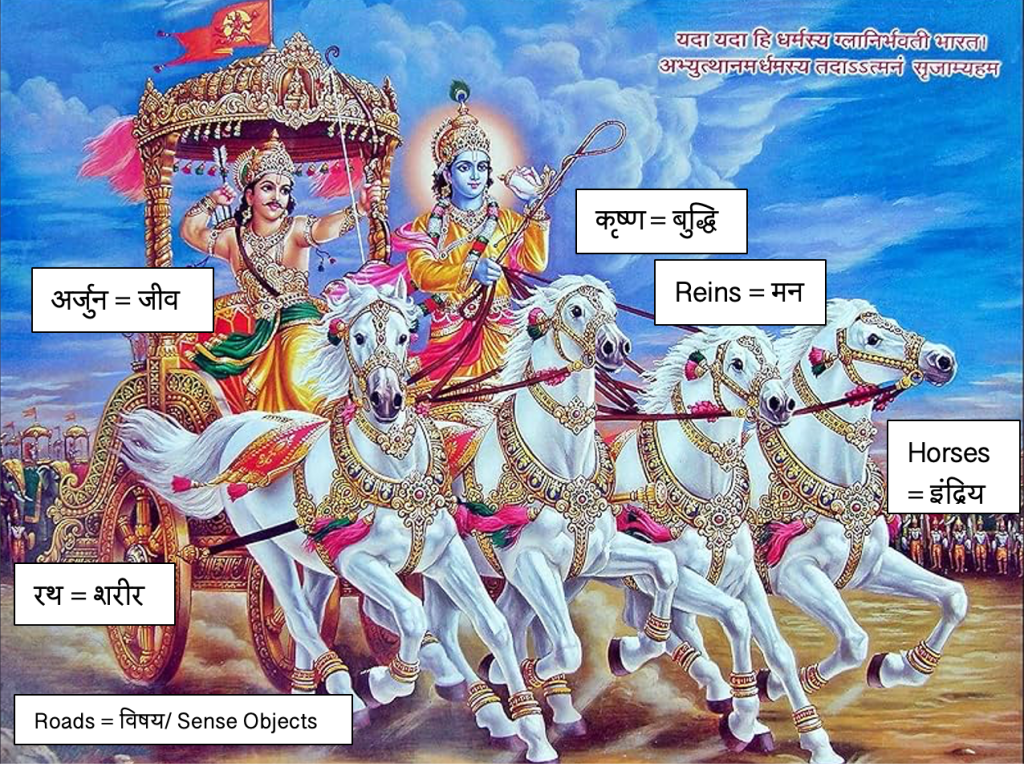
व्याख्या: This imagery is one of the key highlights of the कठोपनिषद and has been taken as-is in the श्रीमद्भगवद्गीता too. The most famous image showing श्रीकृष्ण and अर्जुन on the रथ can be seen on all texts of the श्रीमद्भगवद्गीता and can also be found on temple walls and yearly calendars. And the beauty is – instead of just seeing this as a beautiful image, the idea conveyed by the image must be used as a constant reminder of the अध्यात्म message contained therein.
रथ is the शरीर, the owner of the रथ is the जीव (viz अर्जुन in this case), the जीव gets its experience of life through use of the बुद्धि (intellect) (viz श्रीकृष्ण here), the बुद्धि controls the मन (the reins in the hands of श्रीकृष्ण) and the मन in turns controls the horses, the इंद्रिय who in turn go after शब्द, स्पर्श, रस, रूप and गंध (the sense objects or विषय) which are shown here as the roads on which the रथ and horses run.
While the above text should be self-evident (maybe a tad repetitive), we can take up three key points over here:
Who is the enjoyer?
By “enjoyer”, we mean “experiencer”, the one having अनुभव. So, a question that comes up is – Is आत्मा the enjoyer? And the answer is no (मंत्र 4 above). Who then is the enjoyer? An enjoyer can only be one that has चैतन्य – a table cannot enjoy since it is just inert matter. मन has no चैतन्य of itself, it borrows चेतना from the आत्मा inside. The इंद्रिय are also not the enjoyers of anything, because they are insentient in their nature. The इंद्रिय are there even when we are fast asleep, but none of the इंद्रिय can operate—neither the eyes see, nor the ears hear. Even if we touch a person, he will not feel that we are touching him. The इंद्रिय do not enjoy anything, मन does not enjoy anything, and the आत्मा is also not the enjoyer, because it is all-pervading. Who then is enjoying? A peculiar mixture, a blend or an alignment, we may say—a coming together in a peculiar manner of the आत्मा, the इंद्रिय and the मन —this blend is called the experiencer, the one having अनुभव. The experiencer is an illusion finally, inasmuch as it does not exist by itself. It is only a product by way of a combination of the characteristics of the आत्मा, मन and the इंद्रिय. The enjoyer does not exist by itself. Therefore, all enjoyment in the world is false, it is illusory, it is a metaphysical corollary that follows from this fact of there being no such person as an enjoyer except as a peculiar illusory product created by an apparent coming together of the आत्मा, मन and the इंद्रिय – this blend is referred to as the जीव shown as अर्जुन in the image above. This is a fascinating statement made by this group of मंत्रs.
Why does the image refer to sense objects, the विषय, with the road/ path?
Usually the विषय are connected very, very mysteriously with the इंद्रिय. The इंद्रिय move along the direction of the विषय. The विषय become a kind of help to us rather than a hindrance, because the path along which the रथ moves cannot be regarded as a hindrance. Thus, while it may be fashionable to berate the विषय or look at them as obstacles, but they become aspects of support and they become guiding factors when they are regarded as a manifestation of a hierarchy of guiding forces through whose assistance alone is it possible for us to ascend higher and higher. That the विषय are the lowest support, from which lowest rung of the ladder we have to rise gradually higher and higher. The विषय are not obstacles, spiritually viewed; but un-spiritually viewed as things for indulgence, they are obstacles. The world is a bondage as well as a liberating principle. Wrongly viewed, it is a bondage. Rightly viewed, it is a help. They are the manifestations of the lowest level of the descent of the Absolute in creation. This is the meaning that we have to draw from the significance of objects being the road along which the chariot of the body has to be driven by the charioteer, the बुद्धि.
What is the road to विष्णुपद?
First thing to note is that विष्णुपद is not a place – it is a स्थिति to be attained. It is a स्थिति of the universal being. The destination of a जीव is to regain the state of विष्णुपद. The शरीर is to be utilised as a vehicle of action in the movement of the जीव to विष्णु. There is nothing wrong with our इंद्रिय, मन, etc., but they should be directed properly. पाप is that which is misdirected. A thing is not पाप on its own, but when it performs another’s function it is पाप, just as anything out of place is dirt. So, everything should be in its proper place and yoked properly. The world is a training ground in which the विषय and the इन्द्रिय are occasions for mastering our energies so that they get unified through the इंद्रिय, मन and the बुद्धि. We look weak because all our energies leak out through the इंद्रिय. If we conserve our health and concentrate our effort in a single channel, it is called धारण. This will make us powerful; this is yoga. By the control of the इंद्रिय, मन and the बुद्धि, the जीव becomes fit to realize the विष्णुपद.
इन्द्रियेभ्यः परा ह्यर्था अर्थेभ्यश्च परं मनः । मनसस्तु परा बुद्धिर्बुद्धेरात्मा महान्परः ॥ १०॥
महतः परमव्यक्तमव्यक्तात्पुरुषः परः । पुरुषान्न परं किंचित्सा काष्ठा सा परा गतिः ॥ ११॥
| इन्द्रियेभ्यः – than the इंद्रिय, परा – superior, हि – indeed, अर्था – sense objects, अर्थेभ्य: – than the sense objects, च – and, परं – superior, मनः, मनस: – than the mind, तु – again, परा – superior, बुद्धि: – the intellect, बुद्धे: – than the intellect, आत्मा, महान् – the great, परः – beyond | The sense-objects are higher than the senses, and the mind is higher than the sense-objects; but the intellect is higher than the mind, and the great आत्मा is higher than the intellect. |
| महतः – महत् (beyond the great आत्मा), परम् – superior, अव्यक्तम् – unmanifest, अव्यक्तात् – than the un-manifest, पुरुष:, परः – superior, पुरुषात् – than the पुरुष, परं – superior, न किंचित् – there is nothing, सा – that, काष्ठा – acme, सा – that, परा – superior, गतिः – goal | The Unmanifested is higher than महत्, the पुरुष is higher than the Unmanifested. There is nothing, higher than the पुरुष. That is the culmination, That is the highest goal. |
व्याख्या: Like the previous group of मंत्रs, these two मंत्र are important – and श्रीमद्भगवद्गीता reproduces these verbatim at the end of the third chapter. When one looks at everything in the Universe, there is a hierarchy at play – and the two key principles of this hierarchy are given below:
- The highest or ultimate truth is the most subtle (सूक्ष्म) aspect of the Universe; and
- सूक्ष्म is the (cause) कारण of (gross) स्थूल
Why is this hierarchy useful to know? When one takes on to ध्यान, this hierarchy will enable one to start from the स्थूल and progressively ascend to the सूक्ष्म aspects of the projection of the universe till one eventually reaches the सूक्ष्मतम पदार्थ of the universe, the goal, viz ब्रह्म.
- At the start is the most स्थूल manifestation, the विषय (or the अर्थ) viz the sense objects. The mountains we see, the food we eat, the furniture we use, etc are perceivable to all beings – they represent the lowest form of creation.
- Higher than the विषय are the इंद्रिय which perceive or cognize the विषय. The इंद्रिय are to be considered as somehow superior to the विषय because the manner in which the consciousness of an object arises within is determined by the manner in which the इंद्रिय comprehend the विषय. The way इंद्रिय are designed, in that way, the objects are seen/ experienced. If one’s taste buds are tuned to sweets, sweet sense objects are engaged with. If one has blue spectacles, world will appear blue. Simply put, owing to the tremendous conditioning power of the इंद्रिय over the विषय, they are said to be superior to the objects of their perception.
- Higher than the इंद्रिय are the तन्मात्र viz शब्द, स्पर्श, रस, रूप & गंध — the principles of hearing, touching, seeing, tasting and smelling. These are the subtle rudimentary principles which go to form the power of the इंद्रिय. Therefore, the इंद्रिय can perform only five functions. We can see, we can hear, we can touch, we can smell, and we can taste. We cannot do anything more than this in this world. We see a fivefold manifestation of the universe—पृथ्वी, आप, अग्नि, वायु and आकाश — because of the organs which are fivefold.
- The मन is subtler than even the तन्मात्र (and therefore superior) because it can conceive; it can think the तन्मात्र. मन can understand what शब्द, स्पर्श, रस, रूप & गंध are. मन is potentially सत्व in its nature, though it is also affected with रजस् and तमस्. There is torpidity and immobility on the part of the mind in तमस्. It is distracted many a time on account of रजस्, but it also has some सत्व qualities, on account of which it often feels happy inside. It is intelligent and can understand the pros and cons of things.
- बुद्धि (intellect) is superior to मन. मन generally thinks in an indeterminate manner, but the बुद्धि determinedly cognises, decides and concludes. बुद्धि is purified मन which decides based on the inputs sent into it by the मन – hence, it is superior to मन .
- But there is something superior to the बुद्धि of the human being, which is महत्-तत्व. महत्-तत्व is the cosmic बुद्धि. As per सांख्य दर्शन, प्रकृति is the supreme potential for creation. It is constituted of the properties of सत्व, रजस् and तमस्. In the beginning of things, प्रकृति remains in an equilibrated condition where the three properties are in a state of harmony; therefore, there is no perception or knowledge of anything at that time. Suddenly there is a disturbance of प्रकृति, and one property rises to the surface and has an upper hand over the other two properties, and that particular property becomes the medium for the reflection of the Cosmic Being through it. Various mediums through which the Supreme Being manifests itself are said to be of the cosmic सत्वगुण. The cosmic सत्व pervading all things is महत्, according to the सांख्य दर्शन. It is identifiable with हिरण्यगर्भ-तत्व of the वेदान्त doctrine. Hence, the बुद्धि of individuals is to be considered as only a fraction of this universal बुद्धि, which is महत्-तत्व, which has omniscience and omnipotence, whereas the individual intellect has no such power. It has limited knowledge and limited power.
- But प्रकृति is above महत्-तत्व – this is because we have stated earlier that महत्-तत्व is a manifestation of the ब्रह्म through the सत्व गुण of प्रकृति (also referred to as अव्यक्त); therefore, the very appearance and the very possibility of the existence of such a thing called महत्-तत्व is due to the existence of another principle above it, called प्रकृति.
- The Supreme Being—पुरुष, as it is called, or ब्रह्म as it is called in the वेदान्त—is superior even to प्रकृति, because प्रकृति acts only as a medium of reflecting the original चैतन्य. चैतन्य is the Ultimate Reality. ब्रह्म, पुरुष, is Supreme.
So, why are gradations important? Gradation is given to help a साधक – as the साधक engages with the world or gets into the mode of ध्यान, one starts from sense objects and gradually, one will direct one’s focus by withdrawing from the lower categories to the higher categories eventually culminating in integrating with the पुरुष. There is nothing superior to the पुरुष. That is the goal, and that is the end of all things. That is the final abode, and that is the blessedness which we all seek. It is the goal, the beatitude, the blessedness, and the eternal that we seek in our life. It is the abode of blessedness. Nothing beyond that exists.
एष सर्वेषु भूतेषु गूढोऽऽत्मा न प्रकाशते । दृश्यते त्वग्र्यया बुद्ध्या सूक्ष्मया सूक्ष्मदर्शिभिः ॥ १२॥
यच्छेद्वाङ्मनसी प्राज्ञस्तद्यच्छेज्ज्ञान आत्मनि । ज्ञानमात्मनि महति नियच्छेत्तद्यच्छेच्छान्त आत्मनि ॥ १३॥
उत्तिष्ठत जाग्रत प्राप्य वरान्निबोधत । क्षुरस्य धारा निशिता दुरत्यया दुर्गं पथस्तत्कवयो वदन्ति ॥ १४॥
अशब्दमस्पर्शमरूपमव्ययं तथाऽरसं नित्यमगन्धवच्च यत् । अनाद्यनन्तं महतः परं ध्रुवं निचाय्य तन्मृत्युमुखात् प्रमुच्यते ॥ १५॥
| एष – this, सर्वेषु – in all, भूतेषु – living beings, गूढ: – hidden, आत्मा, न प्रकाशते – does not shine, दृश्यते – is seen, तु – but, अग्र्यया – sharp, बुद्ध्या – by intellect, सूक्ष्मया – through subtle, सूक्ष्म-दर्शिभिः – by the seers of subtle (vision) | This आत्मा is hidden in all beings reveals (itself) not (to all), but is seen (only) by seers of the subtle through sharp and subtle intellect. |
| यच्छेत् – should merge, वाक् – word, मनसी – in the mind, प्राज्ञ: – the wise, तत् – that (mind), यच्छेत् – should merge, ज्ञान – the intellect, आत्मनि – in the intellect, ज्ञानम् – the intellect, आत्मनि महति – into the great आत्मा (ie हिरण्यगर्भ), नियच्छेत् – should sink (submerge), तत् – that, यच्छेत् – should merge, शांते आत्मनि – into the peaceful आत्मा | The discriminating man should merge the (organ of) speech into the mind; he should merge that (mind) into one’s बुद्धि; he should merge the बुद्धि into the महत्; he should merge the महत् into the peaceful आत्मा. |
| उत्तिष्ठत – arise, जाग्रत – awake, प्राप्य – having reached, वरान् – the great (teachers), निबोधत – learn (realize the आत्मा), क्षुरस्य – of a razor, धारा – edge, निशिता – sharp, दुरत्यया – difficult to cross, दुर्गं – hard to tread, पथ: – path, तत् – that, कवय: – the wise, वदन्ति – speak | Arise, Awake! Having reached the great (teachers), learn (realize the आत्मा). Like the sharp edge of a razor is that path, difficult to cross and hard to tread – thus say the wise. |
| अशब्दम् – without sound, अस्पर्शम् – without touch, अरूपम् – without form, अव्ययं – without decay, तथा: – thus, अरसं – without taste, नित्यम् – eternal, अगन्धवत् – without smell, च – and, यत् – that which, अनाद्यनन्तं – neither beginning or an end, महतः परं – beyond (superior to) महत्, ध्रुवं – changeless, निचाय्य – having known (realized), तत् – that, मृत्यु-मुखात् – from the jaws of death, प्रमुच्यते – is freed | One becomes freed from the jaws of death by knowing That which is soundless, touchless, colourless, undiminishing, and, also tasteless, eternal, odourless, without beginning, and without end, distinct from महत्, and ever constant. |
व्याख्या: This पुरुष is present everywhere. The पुरुष manifests itself through प्रकृति, then indirectly through प्रकृति it manifests itself in महत्, through महत् it reflects itself in the बुद्धि, through the बुद्धि it reflects itself in the मन, through the मन it reflects itself through the इंद्रिय, and through the इंद्रिय it illumines the विषय. So, this Supreme पुरुष, though above all things, is also in all things. Though it is transcendent, it is also immanent. Therefore, in a reverse way, the मंत्र here provides a process of ascent via ध्यान. साधक should withdraw the चेतना from the इंद्रिय and fix it in the मन, and then should withdraw the चेतना from the मन and fix it in the बुद्धि. Then should withdraw the चेतना from the बुद्धि and fix it in the महत्. Then should withdraw it from there and fix it in the परम् आत्मा.
that Technically, everyone should be able to engage with the पुरुष since it is everywhere. However, only those who possess sharp and सूक्ष्म बुद्धि – this automatically means that आत्मा is not perceivable via the इंद्रिय.
मंत्र 14 is a great one. उत्तिष्ठत जाग्रत निबोधत !!!!! Arise – Awake – Learn – this is the call from this उपनिषद् goading one to seek the highest. And the goal is not easy – the path is akin to walking on क्षुरस्य धारा (meaning razor’s edge). One is asked to approach the most competent of the teachers (not any teacher). The competent person has been described as one who is identical with the knowledge, or rather, identical with the object of his knowledge. The takeaway message is – The path of परमात्मा is an almost impossible endeavour for inefficient people because it is sharp, subtle, invisible, slippery, and not easy to confront. Therefore, take resort to a great गुरु who has already realized the highest who will guide you. Do not sleep. Wake up, stand up, and be ready for the great onslaught of this आध्यात्मिक conquest.
One can be freed from the jaws of death by knowing that which is above all that is audible, all that is tangible, all that is visible, all that is capable of comprehension through the इंद्रिय. That which cannot be tasted or touched or smelt because of its eternity of character, such a thing which has no beginning and no end, which is above महत्; permanent, ancient, perpetual; knowing that, one is freed from the clutches of death. There is no other way. A proper concentration of the mind every day is necessary to adjust oneself with the requirements of the spiritual reality which masquerades in this very world as the visible objects.
नाचिकेतमुपाख्यानं मृत्युप्रोक्तँ सनातनम् । उक्त्वा श्रुत्वा च मेधावी ब्रह्मलोके महीयते ॥ १६॥
य इमं परमं गुह्यं श्रावयेद् ब्रह्मसंसदि । प्रयतः श्राद्धकाले वा तदानन्त्याय कल्पते । तदानन्त्याय कल्पत इति ॥ १७॥
| नाचिकेत – that of नचिकेत, उपाख्यानं – the story, मृत्यु-प्रोक्तँ – told by यम, सनातनम् – ancient, उक्त्वा – having related, श्रुत्वा – having heard, च – and, मेधावी – the intelligent one, ब्रह्मलोके – in the ब्रह्म लोक, महीयते – is glorified | The intelligent one, having heard and related this ancient story of नचिकेत as told by यम, is glorified in the ब्रह्म लोक |
| य – who, इमं – this (story), परमं – Supreme, गुह्यं – secret (meaning subtle), श्रावयेद् – (repeats) causes to be recited, ब्रह्मसंसदि – before the assembly of ब्राह्मण, प्रयतः – with devotion (purity), श्राद्धकाले – at the time of श्राद्ध, वा – or, तदा – then, अनन्त्याय – for immortality, कल्पते – is made fit, तदानन्त्याय कल्पत इति – then he is fit to obtain immortality, thus | Should anyone, after purification, get this highest secret recited before an assembly of ब्राह्मण, or at the time of श्राद्ध, (then) that (ceremony) becomes conducive to eternal result. |
Self-explanatory
इति काठकोपनिषदि प्रथमाध्याये तृतीया वल्ली ॥
Part II
Canto I
पराञ्चि खानि व्यतृणत् स्वयम्भू-स्तस्मात्पराङ्पश्यति नान्तरात्मन् । कश्चिद्धीरः प्रत्यगात्मानमैक्ष-दावृत्तचक्षुरमृतत्वमिच्छन् ॥ १॥
पराचः कामाननुयन्ति बाला-स्ते मृत्योर्यन्ति विततस्य पाशम् । अथ धीरा अमृतत्वं विदित्वा ध्रुवमध्रुवेष्विह न प्रार्थयन्ते ॥ २॥
| पराञ्चि – going outwards, खानि – the इंद्रिय, व्यतृणत् – created by defects, punished, स्वयम्भू – ब्रह्मा, तस्मात् – therefore, पराङ् – external universe, पश्यति – beholds, न अन्तरात्मन् – not the internal आत्मा, कश्चित् – some, धीरः – the wise, प्रत्यगात्मानम् – the आत्मा within, एक्षत् – sees, आवृत्त – averted (turned inside), चक्षु: – eyes, अमृतत्वम् – eternality, इच्छन् – being desirous of | The self-existent ब्रह्मा created the इंद्रिय with outgoing tendencies, therefore, one sees the outer things and not the inner आत्मा. A rare discriminating man, desiring eternality, turns his eyes away and then sees the indwelling आत्मा. |
| पराचः – external, कामान् – pleasures, अनुयन्ति – pursue, बाला: children, ते – they, मृत्यो: – of death, यन्ति – fall into, विततस्य – widespread, पाशम् – snares, अथ – but, so, धीरा – the wise, अमृतत्वं – eternality, विदित्वा – having known, ध्रुवम – what is eternal, अध्रुवेषु – among the mortal things, इह – in this world, न – not, प्रार्थयन्ते – desire | The unintelligent people follow the external desires. They get entangled in the snares of the widespread death. Therefore, the discriminating people, having known what true immortality is in the midst of impermanent things, do not seek for anything here. |
व्याख्या: Externally oriented are the sense organs – this is how ब्रह्मा has made all beings. By default, whenever anyone talks about knowing, it is understood as knowing something that is perceivable using इंद्रिय (with मन and बुद्धि) “outside” or “externally”. Our understanding is that somewhere far away, the universe began via a big bang and in the process, many objects get created and in this long process, somehow the Sun, Earth and life on earth came about. What is however a challenge to conceive of is that the very act of knowing that we do is happening because of truth that lies within. It is the truth that is powering our eyes, speech, etc and knowing this truth (सत्य) requires us to turn into our own selves. सत्य lies at a space which are not accessible to इंद्रिय or the mind. However, what is required is an application of विवेक (discrimination) in a way that turns us inside. By analysis of the process of the operation of consciousness, महात्माs withdraw their चेतना from its involvement in the externality of things, involvement in the इंद्रिय, involvement in the मन, involvement in the बुद्धि, etc., and turn it back to the original universal source which is महत्-तत्व and परम पुरुष, the ब्रह्म, the Absolute. Only महात्माs can achieve this. Most ordinary आत्माs are sunk in the mire of this erroneous perception caused by the distorted activity of the इंद्रिय.
A साधक is focussed on only one thing – that which is eternal. And that which is eternal is revered. स्वर्ण is revered among metals since its value is eternal. An अश्वत्थ वृक्ष is revered since while generations may come and go, अश्वत्थ वृक्ष remains a witness to multiple generations. पृथ्वी is revered since while civilizations and nations may come & go, पृथ्वी remains. सूर्य is revered since while ग्रहs may burn up, सूर्य will remain, etc. For साधना, a key requirement is to have a taste (and appreciation) for eternal – we then start with what is relatively eternal from objects around us and this दृष्टि will take us to a state of being when our दृष्टि is sharpened and we end up witnessing those aspects which are beyond senses (e.g., देवताs) and such a journey will culminate in ब्रह्म, the only eternal substance that is always there. Those others who however do not yearn for साधक दृष्टि will always be driven by इंद्रिय and this will therefore take such ones from death to death – since they are courting the impermanent (since इंद्रिय can only show us the impermanent), they too will experience death again and again.
येन रूपं रसं गन्धं शब्दान् स्पर्शाꣳश्च मैथुनान् । एतेनैव विजानाति किमत्र परिशिष्यते । एतद्वै तत् ॥ ३॥
| येन – by which (आत्मा), रूपं – form, रसं – taste, गन्धं – smell, शब्दान् – word (sound), स्पर्शांश्च – touch, and, मैथुनान् – dualistic joys (sexual contacts), एतेन – by these, एव – even, विजानाति – cognizes, किम् – what, अत्र – in this world, परिशिष्यते – remains, एतद् – this, वै – verily, तत् – that | That आत्मा by which one cognizes form, taste, smell, sounds and the sexual joys.. what is there unknowable to that आत्मा in this world? This is verily that (आत्मा, that you wanted to know) |
व्याख्या: Says यम to नचिकेत – you wanted to know the आत्मा. So let me tell you – That, with the help of whose light and awareness one beholds things in perception through the eyes, tastes things through the tongue, smells through the nose, hears through the ears, touches with the skin, and contacts in
various ways—with the help of this one thing, all things are known. That is indeed the आत्मा. Having known this, there is nothing more to be known.
स्वप्नान्तं जागरितान्तं चोभौ येनानुपश्यति । महान्तं विभुमात्मानं मत्वा धीरो न शोचति ॥ ४॥
| स्वप्न अन्तं – end of स्वप्न (dream), जागरित आन्तं – objects of the waking state, च – and, उभौ – both, येन – by which, अनुपश्यति – perceives, महान्तं – great, विभुम् – omnipresent, आत्मानं – आत्मा, मत्वा – having known, धीरो = the wise, न – not, शोचति- grieves | Having realized the great and all-pervading आत्मा, through which a man perceives the objects in both the स्वप्न and the जाग्रत् अवस्था, a wise man does not grieve. |
व्याख्या: Each of us identify ourselves with our experiences during waking state and dream state (जाग्रत् अवस्था and स्वप्न अवस्था). However, it is आत्मा which is the reason behind these experiences. It is through this आत्मा that we are able to behold the world in front of us and be conscious of something being there. It is through the light of this आत्मा that we are dreaming and seeing things in dream. It is because of the presence of this आत्मा that we are able to wake up from sleep. Knowing this great आत्मा, the hero treading the path of the जीव will not grieve anymore, will not have sorrow of any kind, because the true आत्मा is the true person. You and I and everyone, and everything in the world, are basically this आत्मा making life possible and giving form and shape to things, and also making things appear attractive, beautiful and worth the while. The value of things in the world, whatever that value be in any capacity whatsoever, is the value of the आत्मा that is peeping through the इंद्रिय and contacting the विषय by means of the perceptual process.
य इमं मध्वदं वेद आत्मानं जीवमन्तिकात् । ईशानं भूतभव्यस्य न ततो विजुगुप्सते । एतद्वै तत् ॥ ५॥
| य – who, इमं – this, मध्वदं – the enjoyer of मधु (honey), वेद – knows, आत्मानं – आत्मा, जीवम् – sustainer of life, अन्तिकात् – proximately, very near, ईशानं – Lord/ Ruler, भूतभव्यस्य – of the past & future, न – not, तत: – thereafter, विजुगुप्सते – one fears, एतद् – this, वै – verily, तत् – that | He who knows this आत्मा, the enjoyer of मधु, the sustainer of life and the ruler of the past and the future, as very near….he fears no more thereafter. This indeed is That. |
व्याख्या: मध्वदं means eater of मधु (honey). मधु is the fruit of the action one performs, and the eater thereof is the जीव, which is nothing but a limited expression of the universal आत्मा reflected, peeping through the three शरीर: कारण, सूक्ष्म and स्थूल शरीर. One who knows this great आत्मा seated in the हृदय of all—the experiencer of the consequences of the deeds performed by itself through its association with the three शरीर — one who knows this आत्मा as independently reigning supreme above the three शरीर, as well as involved in the three शरीर, thereby experiences मधु (the fruits of कर्म). Timeless is this आत्मा, spaceless is this आत्मा, objectless is this आत्मा. It has no limitations of any kind. One who knows this shrinks not from anything, fears not anything, wants not anything.
यः पूर्वं तपसो जातमद्भ्यः पूर्वमजायत । गुहां प्रविश्य तिष्ठन्तं यो भूतेभिर्व्यपश्यत । एतद्वै तत् ॥ ६॥
| यः- who, पूर्वं – in the beginning, तपसो – तप of (ब्रह्म) or knowledge, जातम् – was born, अद्भ्यः पूर्वम् – before the waters (i.e., the five elements), अजायत – was born, गुहां – cave of हृदय, प्रविश्य – having entered, तिष्ठन्तं – he who dwells, य: – who, भूतेभि: – within the five elements (body), र्व्यपश्यत – beholds (realizes), एतद् – this, वै – verily, तत् – that | He who sees the Being (विराट) born of तप of ब्रह्म (knowledge) in the beginning and born (even) prior to the five elements from ब्रह्म (consciousness), who entered the cave of one’s हृदय and dwells within the five great elements (पञ्च–कोश) there (he indeed sees ब्रह्म), This indeed is That (which you have asked for). |

व्याख्या: यम continues to elaborate on ब्रह्म. Who is the seer of ब्रह्म? Just as a living being has a शरीर for enabling one to experience life, the universe is expressed as the शरीर conceived of by ब्रह्म at a cosmic/ universal level – this is named as विराट. This विराट was born of the तप of ब्रह्म (viz knowledge), who was existing even before the पञ्चभूत (आकाश, वायु, अग्नि, आप and पृथ्वी) had been formed and is embedded within the पञ्चभूत, such a one may be said to know ब्रह्म. तप of ब्रह्म may be understood as सङ्कल्प of the परमात्मा to do projection of the ब्रह्माण्ड. The शरीर is the individualised symbol of the physical elements – आकाश, वायु, अग्नि, आप and पृथ्वी, and cosmically (or at the universal level), these elements represent the शरीर of ब्रह्म as विराटस्वरूप. This विराट, who has entered the पञ्चभूत through the form of this universe, is the cause of all things that we call creation as we perceive it, but this विराट is the effect of a great तप of concentration of the सङ्कल्प of the परमात्मा. And one who knows that the विराट entered into the cavity of हृदय of all beings and remains in existence with the पञ्चभूत in the midst of शरीर, इंद्रिय, etc, such a one knows ब्रह्म.
Question may arise here – what does तप of ब्रह्म mean? In the normal sense, तप is equated with fasting, less sleeping, less clothing, etc but this type of तप will not apply to ब्रह्म. Concentration of चेतना, the projection of the will in a given direction, and the embodying of the whole of oneself in the direction which this will has taken, that is real तप. ब्रह्म contemplated, concentrated itself, and did तप in the form of the will to create the ब्रह्माण्ड (universe). And हिरण्यगर्भ then becomes the first creation from which विराट, equivalent to the Cosmic शरीर of परमात्मा emerged. When a साधक therefore sees the Universe, such a one sees this as an expression of शरीर of ब्रह्म and once realizes that the same ब्रह्म is present within one’s own शरीर, such a दृष्टि will make the साधक attain connect with ब्रह्म. यम is telling नचिकेत to develop such a दृष्टि to attain the ultimate goal of human life, viz मोक्ष.
या प्राणेन संभवत्यदितिर्देवतामयी । गुहां प्रविश्य तिष्ठन्तीं या भूतेभिर्व्यजायत । एतद्वै तत् ॥ ७॥
| या – who, प्राणेन – along with प्राण, संभवति – is born, अदिति – the enjoyer, र्देवतामयी – आत्मा of all देवs, गुहां – cavity of the हृदय, प्रविश्य – entered, तिष्ठन्तीं – who abides therein, या – who, भूतेभि: – with the five elements, र्व्यजायत – was born, एतद् – this, वै – verily, तत् – that | That अदिति (हिरण्यगर्भ) expressing as the प्राण (life) having entered and existing as the आत्मा of all faculties within the body of the five great elements and is thus (as if) “born”. This indeed is That (which you have asked for). |
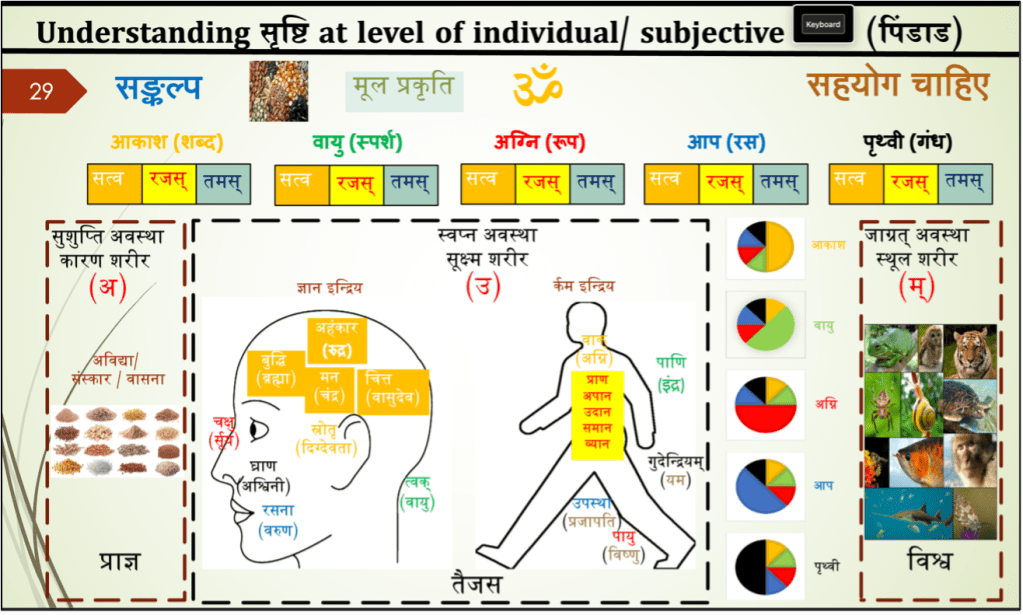
व्याख्या: What is expressed as सूक्ष्म शरीर within living beings (which includes प्राण, कर्मेन्द्रिय & ज्ञानेन्द्रिय) is हिरण्यगर्भ at the universal level – one may say that हिरण्यगर्भ is the सूक्ष्म शरीर of ब्रह्म. And what is special about सूक्ष्म शरीर – it is the देवता व्यवस्था. A देवता is associated with each of the इंद्रियs as shown in the image above. Each इंद्रिय operates on its own without any effort on our part (eyes see, tongue tastes, etc) – the self-existent power present in each इंद्रिय is referred to as the देवता. Thus, if a question is asked as to who is enjoying, it is actually the देवता who power the इंद्रिय who enjoy – it is ears which hear the sound (दिग्देवता), tongue which tastes food (वरुण देवता), eyes which see (सूर्य देवता), etc – and this experiences of enjoyment is passed on to the मन/ बुद्धि complex and then the अहंकार express – “I have heard”, “I have seen”, etc. And just as देवताs power the इंद्रिय within an individual being, देवताs also operate in the Cosmic level and they are connected with हिरण्यगर्भ at the universal level too.
Coming to this मंत्र, हिरण्यगर्भ is the cosmic प्राण unborn among the born individualities of the world, the embodiment of all the देवताs. In the eleventh chapter of the श्रीमद्भगवद्गीता, every देवता was shining in every part of श्रीकृष्ण – that is the हिरण्यगर्भ तत्व – This great unborn Cosmic Being, हिरण्यगर्भ, is in देवताs everywhere, seated in the हृदय of every person, and yet perceived only through the पञ्चभूत, which are the विषय. मंत्र here uses the word अदिति who is described as the mother of all देवताs in all the पुराण and this therefore refers to हिरण्यगर्भ here.
अरण्योर्निहितो जातवेदा गर्भ इव सुभृतो गर्भिणीभिः । दिवे दिवे ईड्यो जागृवद्भिर्हविष्मद्भिर्मनुष्येभिरग्निः । एतद्वै तत् ॥ ८॥
| अरण्यो: – two pieces of wood, i.e., the fire sticks, र्निहित: – lodged, जातवेदा – the omniscient अग्नि, गर्भ – foetus, इव – like, सुभृत: – well-preserved, well-nourished, गर्भिणीभिः – by pregnant women, दिवे दिवे – day by day, ईड्यो – adorable, जागृवद्भि: – by awakened ones, हविष्मद्भि: – by the यज्ञ offerers to the यज्ञ अग्नि, मनुष्येभि: – by human beings, अग्नि:, एतद् – this, वै – verily, तत् – that | The यज्ञ अग्नि lodged in two fire-producing pieces of wood, (as also the अग्नि lodged in the hearts of Yogis) that is well protected – just as much as the foetus by pregnant women – and the अग्नि that is adorable every day by vigilant men with oblation (and contemplation) – that अग्नि too is but this ब्रह्म. |
व्याख्या: By sharing various analogies, यम is expanding the mind of नचिकेत. There are certain types of wood which embody the principle of fire in a greater measure than other pieces of wood. There is a particular tree called the अरणी and when two pieces of wood from this tree are rubbed one over the other, sparks are produced. Sparks emanate even when we strike one stone against another. It shows that fire is embedded everywhere in a subtle, hidden form. As fire is hidden between two fire sticks, as a foetus is hidden in the womb of the mother, this आत्मा is hiddenly present in the heart of all. Every day it is adored, worshipped and glorified by योगीs who perform यज्ञs day in and day out for contacting ब्रह्म, and by all people who are seeking it. This is the cosmic fire, the eternal fire of ब्रह्म.
यतश्चोदेति सूर्योऽस्तं यत्र च गच्छति । तं देवाः सर्वेऽर्पितास्तदु नात्येति कश्चन । एतद्वै तत् ॥ ९॥
| यत: – from which, च – and, उदेति – rises, सूर्य:, अस्तं गच्छति – merges, यत्र – into which, च – and, तं – in that, देवाः – the देवs, सर्वे: – all, अर्पिता: – depend, are fixed, तत् – in that, उ – indeed, अत्येति – goes beyond, transcends, न कश्चन – none, एतद् – this, वै – verily, तत् – that | And that from which सूर्य rises and into which it merges, on that, all the देवs depend and no one goes beyond. This indeed is That |
व्याख्या: We often read literature that early men were in awe of nature of worshipped elements of nature, सूर्य being the most visible manifestation of nature. मंत्र here however states that it is ब्रह्म which is the impulse under whose direction, सूर्य operates. Movement of सूर्य, ग्रह, coming and going of ऋतु – all of them happen on account of the impulse of ब्रह्म. This perfection, this precision, this ordered manner of the movement of things like the सूर्य and चंद्र and नक्षत्र, is all due to the universal controlling power of the आत्मा that is हिरण्यगर्भ, विराट. All the देवताs are embedded in this. The multiple देवताs that people do पूजा of are twinkling sparks of this wondrous दैवत्व universally present everywhere and twinkling in our own हृदय. Nobody can go beyond that. Once we reach that, our movement stops, as the movement of a river stops when it touches the ocean. All our activities cease there, our aspirations find a fulfilment there, and our desires are granted entirely, abundantly. We ourselves cease to be there. We become verily that which we are seeking.
यदेवेह तदमुत्र यदमुत्र तदन्विह । मृत्योः स मृत्युमाप्नोति य इह नानेव पश्यति ॥ १०॥
मनसैवेदमाप्तव्यं नेह नानाऽस्ति किंचन । मृत्योः स मृत्युं गच्छति य इह नानेव पश्यति ॥ ११॥
| यत् – what, एव – indeed, इह – here, तत् – that, अमुत्र – there, यत् – what, अमुत्र – there, तत् अनु – the same (according to that), इह – is here, । मृत्योः – from death, स – he, मृत्युम – tp death, आप्नोति – proceeds, meets, य – who, इह – here, नाना इव – as different, पश्यति – sees | What is indeed here (visible as the world) the same is there (as ब्रह्म); and what is there, the same is here. He proceeds from death to death who sees difference here (between ब्रह्म and the world). |
| मनसा – by mind, एव – indeed, इदम् – this, आप्तव्यं – could be obtained, realized, न इह – not here, नाना – difference, अस्ति – there is, किंचन – anything, मृत्योः – from death, स – he, मृत्युं – to death, गच्छति – goes, य – who, इह – here, नाना इव – as different, पश्यति -sees | This is to be attained through the mind indeed. There is no diversity here whatsoever. He who sees as though there is difference here, goes from death to death. |
व्याख्या: Message conveyed via this मंत्र is significant for a साधक. Whatever is here in this individual is also there in the cosmos – this is also expressed as ब्रह्माण्ड = पिंडण्ड meaning that Whatever is in
this microcosmic individuality of a person is also in the macrocosmic body of परमात्मा. The human being is a cross-section of the cosmic ranges of worlds after worlds, realms over realms, and all the wonders and glories of the cosmos can be seen scintillating within the particles of the bodily individuality of a person. But if anyone sees duality, multiplicity, and does not realise this great oneness that is operating between us and the परमात्मा, such a person will go from death to death and from birth to birth continuously in a cycling movement. No one can avoid birth, death and suffering in the form of संसार, this earthly existence, because of the fact that we do not see this unity operating in all things. We do not realise that the wonder that is everywhere is also the wonder within us.
ब्रह्म needs to be attained by our mind only – so says the मंत्र. But this is not easy. Whatever little साधना most of the people may be doing is insufficient to witness the integral unity of the world and the individual that is being stated here. Mind only sees duality, duplicity, multiplicity. This is where श्रीकृष्ण refers to the operations to two आत्माs within us – the lower one and the higher one. The lower आत्मा is guided by or driven by the इंद्रिय and is therefore external in its orientation. इंद्रिय deprive us of the treasure of wisdom by compelling us to see what is not there owing to these being distorted giving us a vision of a topsy-turvy, erroneous vision of the world. The उपनिषद् tells us the multiplicity that we perceive in the world is a false perception. Many things do not exist. There is only one thing. As a unity, as a blend, as a totality, as a oneness that the world is, we have to see it, but not behold it as a distracted, isolated, fractional, divided world, because the world is not so divided as we wrongly perceive it through the इंद्रिय. Hence, a faculty of subtle, purified, concentrated means is necessary in order that the depth of unity can be seen in the midst of the diversity of otherwise unwanted things in the world, as it were.
अङ्गुष्ठमात्रः पुरुषो मध्य आत्मनि तिष्ठति । ईशानं भूतभव्यस्य न ततो विजुगुप्सते । एतद्वै तत् ॥ १२॥
अङ्गुष्ठमात्रः पुरुषो ज्योतिरिवाधूमकः । ईशानो भूतभव्यस्य स एवाद्य स उ श्वः । एतद्वै तत् ॥ १३॥
| अङ्गुष्ठमात्रः – size of a thumb, पुरुषो – the person (पुरुष), मध्य – in the middle, आत्मनि – of the body, तिष्ठति – sits/ is established, ईशानं – Lord/ Ruler, भूतभव्यस्य – of the past and the future, न ततो – hence forward (after realizing It); विजुगुप्सते – does not fear, एतद् – this, वै – indeed, तत् – that | The Being (पुरुष), of the size of a thumb, resides in the middle of the body. Knowing Him as the ruler of the past and the future, and henceforward (after realizing the पुरुष) fears no more. This indeed is That |
| अङ्गुष्ठमात्रः – size of a thumb, पुरुषो – the person (पुरुष); ज्योति: – flame, light, इव – like, अधूमकः – without smoke, ईशानो – Lord/ Ruler, भूतभव्यस्य – the past and the future, स एव – He alone, अद्य – is today, स उ – he alone, श्वः – (will be) tomorrow, एतद् – this, वै – indeed, तत् – that | The पुरुष, who is of the size of a thumb, is like a light without smoke. He is the ruler of the past and the future. He exists today, and He will exist tomorrow. This indeed is that. |
व्याख्या: आत्मा is अङ्गुष्ठमात्रः, is the size of a thumb and present in the हृदय of all. This imagery of आत्मा being अङ्गुष्ठमात्रः is found across multiple शस्त्र. A साधक doing साधना may imagine आत्मा is be like a small flame located in the centre of one’s हृदय. Just as the vast Sun looks like a twinkling streak when it passes through a small aperture of the window or space inside a pot looks confined to the boundaries of the pot, आत्मा occupies the size of a thumb within the हृदय of all. Because we are trying to see आत्मा using our limited मन & बुद्धि, आत्मा may be conceived of as being an अङ्गुष्ठमात्र.
आत्मा is ज्योति without smoke. While normal fire is accompanied with smoke, आत्मा is pure ज्योति and an advanced साधक will be able to witness आत्मा as pure ज्योति in their own हृदय. Further, आत्मा is eternal. When a body dies, the आत्मा sheds the body and takes the सूक्ष्म शरीर along with it – which includes मन, बुद्धि, संस्कार and प्राण and then moves to take on a new शरीर to continue from where it left off in the previous जन्म. आत्मा is always with the शरीर, with the मन and the बुद्धि and the इंद्रिय. This great आत्मा is parading as a little जीवात्मा in our हृदय is the master of all that is past, present and the future – there is no distinction of past, present and future for this आत्मा.
यथोदकं दुर्गे वृष्टं पर्वतेषु विधावति । एवं धर्मान् पृथक् पश्यंस्तानेवानुविधावति ॥ १४॥
यथोदकं शुद्धे शुद्धमासिक्तं तादृगेव भवति । एवं मुनेर्विजानत आत्मा भवति गौतम ॥ १५॥
| यथो – just as, उदकं – water, दुर्गे – on inaccessible heights (high) mountain ridges, वृष्टं – rained, पर्वतेषु – down the rocks, विधावति – runs down scattered, एवं – so, धर्मान् – Objects, attributes or the selves, पृथक् – different, पश्यं – beholding, तानेव – them only, अनुविधावति – runs after | As water rained on an inaccessible height gets dispersed on (lower) hilly regions, similarly, one who perceives the selves differently, runs after them only. |
| यथो – just as, उदकं – water, शुद्धे – into pure (water), शुद्धम् – pure, असिक्तं – poured, तादृक् एव – the same only, भवति – becomes, एवं – thus, मुने: – of the thinker (sage), विजानत – who knows this unity, आत्मा, भवति – becomes, गौतम – O गौतम | 0 गौतम, as pure water poured on pure water becomes verily the same, so also does become the आत्मा of the man of knowledge who is given to deliberation (on the आत्मा). |
व्याख्या: When rain falls, water is poured on the peak of a mountain. If there is a large depression, like a valley on a mountain of great height, the rainfall will channelise itself through that valley, and there will be a concentrated rush of water in one direction only. But if there are many such little crevices and cracks on the mountain, the downpour of water that falls as rain will be distracted in many directions. The rain of wisdom, which actually falls from the essential आत्मा of man, is distracted in many ways, as the water on a mountain is split in different ways, because of the movement of the five इंद्रिय and the millions of thoughts and feelings. When a person sees many things, thinks many things, feels many things, the चैतन्य will also be diverted along the same channel of diversity in a manifold manner, so that there would be no concentration in life. There will be no sense of unity in personality. There will be unhappiness and a kind of impossibility to choose even what is good and proper or is the aim of one’s life.
However, suppose water is poured on water. If heavy rain pours on a lake or on the ocean, what happens? Water becomes water. It does not move here and there. Like merges in like, and friends unite in a communion of inseparability of substance and character. Milk poured on milk, or water poured on water, is the example of concentrated-ness and communion here the parts are completely inseparable, and they stand not merely united as two parts, but as one indivisible being; so does the आत्मा become. आत्मा stands united with that from where it came, of which it is a part, from which it is inseparable, and which is itself basically, essentially eternal. The आत्मा, becomes one with its original universal nature in the case of a ऋषि or ज्ञानी who has realised it.
इति काठकोपनिषदि द्वितीयाध्याये प्रथमा वल्ली ॥
Part II
Canto II
पुरमेकादशद्वारमजस्यावक्रचेतसः । अनुष्ठाय न शोचति विमुक्तश्च विमुच्यते । एतद्वै तत् ॥ १॥
| पुरम् – city, एकादश – eleven, – gates, अजस्य – of the unborn, अवक्र – not crooked, चेतसः – minded, अनुष्ठाय – having done अनुष्ठान of (focussed upon or doing ध्यान of), न – not, शोचति – grieves, विमुक्त: – being liberated, च – and, विमुच्यते – becomes free (from birth & death), एतद् – this, वै – indeed, तत् – that | This body of eleven gates is indeed of the unborn even minded आत्मा. Having done अनुष्ठान over this, (the seeker) grieves not and the liberated one is ever liberated indeed. This indeed is that. |

व्याख्या: शरीर is expressed as a पुरम्, a city with eleven gates. What are these gates? Two eyes, two nostrils, two ears, one mouth, one genital, one excretion, one navel and finally, the ब्रह्मरंध्र or सहस्रार (located at the top of the head). आत्मा is established within this पुरम्. शरीर is expressed often in the शस्त्र either as one having एकादश-द्वारम् or नव-द्वारम् (city of eleven gates or city of nine gates).
This otherwise indivisible, undistorted intelligence, eternal though it is, appears to be confined within the एकादश-द्वारम् of this शरीर. Concentrating on this, doing ध्यान on this great truth, the परमात्मा, ruling from the centre of our हृदय, is so near us that it is not difficult for us to do ध्यान or fix our attention on आत्मा. The moment we are absorbed in the feeling of our unity with the remotest and the nearest परमात्मा seated in the हृदय, all our griefs depart, and we immediately become मुक्त, free. The उपनिषद् uses a strange language by saying विमुक्त: विमुच्यते – meaning, the liberated one becomes liberated. What is liberation mentioned twice?
In the शस्त्र, there are two ideas with respect to becoming a मुक्त – one called as जीवन्मुक्त and the other called as विदेह-मुक्त. जीवन्मुक्त is a स्थिति a योगी attains while the body continues to exist. And once the शरीर is discarded, one attains the state of विदेह-मुक्त (देह means शरीर and विदेह means ‘without शरीर’). What exactly is the cause of this distinction? For this, one needs a background of three types of कर्म – सञ्चित कर्म, प्रारब्ध कर्म and आगामी कर्म. सञ्चित कर्म refers to कर्म accumulated over multiple past lives, प्रारब्ध refers to कर्म assigned for this specific life one is living while आगामी refers to new कर्म created in the current life based on actions undertaken in this current life. When the साधना of a साधक reaches its pinnacle, not only does all सञ्चित कर्म burn up fully, the साधक stops accumulating आगामी कर्म from one’s day to day conduct – what however remains is the force of the प्रारब्ध that enabled being born in the current life – and the body remains alive even though the person has burnt up all कर्म till प्रारब्ध of the current life is fully exhausted and one then leaves the देह completely. Simply put, the first मुक्ति is the जीवन्मुक्ति स्थिति but the person continues to live on with the शरीर acquired owing to the प्रारब्ध allotted for this life – the second मुक्ति is the विदेह- मुक्ति when the साधक sheds the physical body and becomes one with ब्रह्म.
हँसः शुचिषद्वसुरन्तरिक्षसद्-होता वेदिषदतिथिर्दुरोणसत् । नृषद्वरसदृतसद्व्योमसद् अब्जा गोजा ऋतजा अद्रिजा ऋतं बृहत् ॥ २॥
| हँसः – हंस (Sun, one who moves), शुचिषद् – dwelling in स्वर्ग, वसु: – वायु, अन्तरिक्ष-सद् – existing in the sky (or the intermediate region between पृथ्वी and स्वर्ग), होता – अग्नि of यज्ञ, वेदिषत् – existing in the यज्ञकुंड, अतिथि – guest, दुरोणसत् – one who dwells in the house, नृषत् – dwelling in beings, वरसत् – residing in (higher) देवताs, ऋतसत् – dwelling in यज्ञ, व्योमसद् – dwelling in the sky, अब्जा – born in water, गोजा – born in the earth, ऋतजा – born in the यज्ञ, अद्रिजा – born on the mountains, ऋतं – the true, and बृहत् – the great | As the moving (sun) He dwells in स्वर्ग; As वायु, He pervades all and dwells in the inter-space; as अग्नि, He dwells in the यज्ञकुंड; as a guest, He lives in the house; He lives among human beings; He lives among देवताs; He dwells in सत्य; He dwells in space; He is born in water; He born on the earth; He is born in the यज्ञ; He is born on the mountains; He is unchanging; and He is great. |
व्याख्या: This is a famous मंत्र from the ऋग्वेद and also forms part of the daily संध्या वन्दनम् जप undertaken by those who perform such a जप. This मंत्र is directed towards सूर्य but, as we know from earlier मंत्र, the स्तुति is directed to ब्रह्म. The words used to describe ब्रह्म are:
हंस – This is the luminous Sun of चैतन्य
शुचिषद् – चैतन्य dwelling in स्वर्ग or pure radiance dwelling in the hearts of all
वसु: – वायु or चैतन्य that is moving in the air that blows everywhere
अन्तरिक्ष-सद् –चैतन्य that appears as the vast expanse of space
होता – अग्नि of यज्ञ or चैतन्य that appears as the performer of the यज्ञ
वेदिषत् – चैतन्य that appears as यज्ञकुंड within a यज्ञ
अतिथि – चैतन्य that appears as the guest that comes to one’s गृह
दुरोणसत् – चैतन्य that appears as the vessels, the sanctified pots that are used in the यज्ञ
नृषत् – चैतन्य that appears as beings moving around us
वरसत् – चैतन्य residing in (higher) देवताs
ऋतसत् – चैतन्य appearing as rule & laws that operating the cosmos
व्योमसद् – चैतन्य operating as white space
अब्जा – चैतन्य operating as waters of the ocean
गोजा – चैतन्य appearing as the very earth
ऋतजा – चैतन्य appearing as the ultimate truth
अद्रिजा – चैतन्य appearing as hills and mountains
ऋतं – this is the truth
बृहत् – this is the greatest reality
Wonderful statement! This particular मंत्र has left nothing unsaid. Everywhere everything
is. The Great One is pervading all things. ब्रह्म is the आत्मा.
ऊर्ध्वं प्राणमुन्नयत्यपानं प्रत्यगस्यति । मध्ये वामनमासीनं विश्वे देवा उपासते ॥ ३॥
अस्य विस्रंसमानस्य शरीरस्थस्य देहिनः । देहाद्विमुच्यमानस्य किमत्र परिशिष्यते । एतद्वै तत् ॥ ४॥
न प्राणेन नापानेन मर्त्यो जीवति कश्चन । इतरेण तु जीवन्ति यस्मिन्नेतावुपाश्रितौ ॥ ५॥
| ऊर्ध्वं – upward, प्राणम् – the प्राण, उन्नयति – sends up, पानं – अपान, प्रत्यक् – downwards, अस्यति – throws, मध्ये – in the middle, वामनम् – the adorable one, आसीनं – seated, विश्वे – all, देवा – देवs (senses), उपासते – to do उपासना of | All देवताs do उपासना of that adorable One sitting in the middle, who pushes the प्राण upward and impels the अपान downwards. |
| अस्य – this, विस्रं समानस्य – of him who is separated, शरीर-स्थस्य – one who dwells in the body, देहिनः – to the in-dweller (आत्मा), देहात् – from the body, विमुच्य मानस्य – of him who is freed from the body, किम् – what, अत्र – here (in this body), परिशिष्यते – remains, एतद् – this, वै – indeed, तत् – that | When this आत्मा, who dwells in the शरीर, is separated from the शरीर, He is freed from this शरीर, what remains here (in this शरीर)? This indeed is that. |
| न – not, प्राणेन – by प्राण, न अपानेन – not by अपान, मर्त्य: – the mortal (the living being or the body), जीवति – lives, कश्चन – ever, इतरेण – by some other, तु – indeed, जीवन्ति – they (live), यस्मिन् – on whom, एतौ – these two, उपाश्रितौ – depend | Not by प्राण nor by अपान does any living being live; but it is by some other, on which these two depend, that living beings live. |
व्याख्या: The प्राण is thrown out when we exhale our breath. Who is throwing it out? Somebody is there inside who pushes the breath out. When we inhale the breath, it is pulled in. Who is it that pulls it? There is somebody sitting in between the प्राण and the अपान. The most glorious Being, beautiful, radiant, that Being expels the breath as प्राण, and inhales the breath as अपान. This Great Being, the आत्मा, sitting inside and silently making this subtle act of throwing out and bringing in, this Great One is the most adorable of all the देवता in स्वर्ग. देवता here means the इंद्रिय – for them to continue indulging in their actions, both प्राण and अपान needs to work continually and hence, it is said that देवताs do उपासना of the आत्मा who sits in the middle of the शरीर, our हृदय and enables both प्राण and अपान to work on a continual basis.
When a जीव attains मुक्ति, what remains? Nothing remains – शरीर (including मन and बुद्धि) just dissolve. The drop in the ocean does not have to move in any direction to dissolve itself in the ocean. It sinks into the ocean then and there. The departure from the शरीर is only a way of speaking in the case of people who are ignorant, who are not realised. But in the case of those who are realised, who are ब्रह्मनिष्ठ always, in their case the प्राण does not depart, the मन and the इंद्रिय do not depart. There is nothing that departs; the शरीर is simply cast out. The bubble sinks into the body of the ocean, and the thing that was apparently in one place at once becomes that which is everywhere. That is final मुक्ति.
While we may say that it is breath that is keeping a living being alive and we leave the शरीर when breath stops. But actually, we do not live by breathing; we live by that which causes the breathing. We are living by something which is other than the breathing process, on which the प्राण and अपान are dependent, on which the fivefold प्राण is fixed. Breath is not the source of our life; that which causes the breathing process, which is very important indeed, which is invisible to the eyes, that is what is to be considered as the source.
हन्त त इदं प्रवक्ष्यामि गुह्यं ब्रह्म सनातनम् । यथा च मरणं प्राप्य आत्मा भवति गौतम ॥ ६॥
योनिमन्ये प्रपद्यन्ते शरीरत्वाय देहिनः । स्थाणुमन्येऽनुसंयन्ति यथाकर्म यथाश्रुतम् ॥ ७॥
| हन्त – well, now ते – to you, इदं – this, प्रवक्ष्यामि – I will explain, गुह्यं – secret, subtle, ब्रह्म, सनातनम् – ancient, eternal यथा – what, च – and, मरणं – death, प्राप्य – having obtained, आत्मा, भवति – becomes, गौतम – O गौतम | Well now, O गौतम! I shall tell you of this secret, eternal ब्रह्म; and also, how the आत्मा fares after death. |
| योनिम् – womb, अन्ये – others, प्रपद्यन्ते – go, enter into, शरीरत्वाय – to have a body, देहिनः – embodied आत्मा, स्थाणुम् – plants, अन्ये – others, अनुसंयन्ति – continuously follows, go, यथा – according to, कर्म – action or work, यथा – according to, श्रुतम् – knowledge | Some आत्माs enter the womb to have a body, others go the plants, just according to their कर्म and according to their knowledge. |
व्याख्या: यम now begins a topic about what happens after death. There are only two paths after death – if one has attained मुक्ति, one will align to ब्रह्म स्थिति but one has not been able to attain ज्ञान, I will take on to another शरीर to continue from where one has left in their previous life. The fate of next life is decided by the intensity of कर्म one has acquired – all कर्म done by people are done by differing impulses – intense, middling and mild. Intense thoughts impel deep actions which create deep-seated impressions in the subconscious mind, but mild thoughts produce mild impressions. Every thought is recorded, and nothing goes unrecorded. These impressions are the determining factor
for the reincarnation of the जीव. Strong impressions may seek expression earlier than weak ones. It is not that the present one will be taken first; it depends on the intensity. For karmas there is no past and present. It depends on their intensity. Very powerful कर्म may seek expression even in this very birth itself. When कर्म produce an effect, these effects get buried in the unconscious and subconscious levels, and we do not know what is in our store. Subconscious impressions can rise to the conscious level in this very birth if their intensity is strong enough. It is difficult to escape the nemesis of our thoughts, acts and feelings; we are answerable to them. These karmas are obstinate,
powerful and violent if they are given a long rope, and they will hurl us into samsara, as they have done now. We cannot say what our next birth will be like, because it cannot be said now what karmas will be allotted to us.
The urge for पुनर्जन्म testifies to the eternal nature of the आत्मा. The आत्मा never ceases its efforts toward its मुक्ति, and its efforts in this direction take the form of a series of births and deaths, outwardly manifesting the internal nature of its constitution. The आत्मा never gets the supreme satisfaction that it hopes for in this endless process of achievements. All its efforts are unfortunately
in an erroneous direction, and so instead of immortality, there are only endless births and deaths.
Human beings, and all beings in the phenomenal world, are incapable of diving into this unity at the bottom. They are floating on the surface because their senses are being directed outward right from the time of creation, as mentioned in an earlier मंत्र, and only a few turn inward. Birth and death are correlative, and when one is there, so is the other. If we are born, we have to die; and if we die, we have to be born. There are repeated births and deaths with an interlinking series of experiences, which is called संसार. So long as there is recognition of value in the things of the world, there will be love and hatred for them; and so long as there is love and hatred, desire cannot cease. Desire is an internal urge, and affection for things is an external movement towards the desired object. The births
through which the soul passes indicate the restlessness of the जीव for a search for immortality. But nowhere does the spirit find satisfaction, because love for objects does not touch the bottom unity which we have. Thus, loves and hatreds are far removed from reality. So, births and deaths do not cease, and the जीव enters different bodies in order to experience a set of karmas.
The श्रीमद्भगवद्गीता says that the last thought determines the nature of the next birth, and this indicates the type of life one has to lead if a particular thought is to be engendered at the time of death. The last thought, determined by the earlier ones, may be regarded as the fruit of the tree of life. The time of death is that condition of the whole personality when there is a cessation of the willpower and freedom of thought in the conscious level of our being. We cannot think as we think now. Therefore, the deeper layers of our personality come to outer manifestation at the time of death. Rather than the thought, the feelings come at that time. Thought is deliberate thinking, while feelings are the real personality of the individual. Thoughts may be due to pressure, but feelings are free thought, or unrestricted expression of thought. So one has to be careful of one’s feelings. Hushed thoughts, suppressed feelings, etc., are dangerous, and one has to be careful with them because it is these that we carry with us at the time of death, and not our relatives and wealth.
Thus, the आत्मा can travel through various courses, enter different wombs of species, and again revert to the original status when the कर्म are exhausted. All this happens under one condition: our deeds coupled with our feelings. If we think we have done something, we will have to reap the fruits thereof. This is why कर्म योग is prescribed. Our actions should not bring about a reaction which will cause rebirth. All the कर्म of all previous births will have to seek expression some time or other, and as we go on adding new कर्म in every birth, संसार never ends.
य एष सुप्तेषु जागर्ति कामं कामं पुरुषो निर्मिमाणः । तदेव शुक्रं तद्ब्रह्म तदेवामृतमुच्यते । तस्मिँल्लोकाः श्रिताः सर्वे तदु नात्येति कश्चन । एतद्वै तत् ॥ ८॥
| य: who, एष: – this, सुप्तेषु – while we are asleep, जागर्ति – remains awake, कामं कामं – different types of काम (desire), पुरुषो – the पुरुष, निर्मिमाणः – shaping, तत् – that, एव – indeed, शुक्रं – the pure, तद्ब्रह्म – that ब्रह्म, तदेव – that also, अमृतम् – eternal, immortal, उच्यते – is said/ called, तस्मिँन् – in that, लोकाः – in the various लोकs, श्रिताः – rest, सर्वे – all, तत् – that, उ – indeed, न – not, अत्येति – transcends, कश्चन – none, एतद् – this, वै – indeed, तत् – that | That पुरुष indeed, who keeps awake and goes on shaping (all sorts of) objects of desire even when the इंद्रिय fall asleep, That is the pure; the ब्रह्म, and That is also called the Eternal (Immortal). In That rests all the लोकाः (worlds); none can transcend That. This indeed is that. |
व्याख्या: Independence of आत्मा needs to be realized by a साधक. Just as there is sensation behind the
awareness of objects, thinking behind ordinary sensation, there is आत्मा behind thoughts. Sensation
is to be separated from the awareness of objects, thought from sensation, and consciousness from thought. आत्मा is not mind, mind is not sensation, sensation is not object. Yet due to a mix-up of character, one gets superimposed on the other. Just as the आत्मा that animates thoughts, etc., is different from it, आत्मा is different from sensation and objects both in waking and in dream. आत्मा exists even in deep sleep, on account of which we remember previous experiences. This shows that
आत्मा stands as a witness of all the states. That आत्मा is ब्रह्म; that is the पुरुष. That which stands separated from all phenomena— physical, mental, etc.—is ब्रह्म. That आत्मा is the witness of the desire-filled activities in waking, etc. “All the worlds hang on this pure आत्मा in its universal nature. No one can go beyond this. The moment this realization comes about (not theoretically but in a real sense), transmigration ends here.
अग्निर्यथैको भुवनं प्रविष्टो रूपं रूपं प्रतिरूपो बभूव । एकस्तथा सर्वभूतान्तरात्मा रूपं रूपं प्रतिरूपो बहिश्च ॥ ९॥
वायुर्यथैको भुवनं प्रविष्टो रूपं रूपं प्रतिरूपो बभूव । एकस्तथा सर्वभूतान्तरात्मा रूपं रूपं प्रतिरूपो बहिश्च ॥ १०॥
सूर्यो यथा सर्वलोकस्य चक्षुः न लिप्यते चाक्षुषैर्बाह्यदोषैः । एकस्तथा सर्वभूतान्तरात्मान लिप्यते लोकदुःखेन बाह्यः ॥ ११॥
एको वशी सर्वभूतान्तरात्मा एकं रूपं बहुधा यः करोति । तमात्मस्थं येऽनुपश्यन्ति धीराः तेषां सुखं शाश्वतं नेतरेषाम् ॥ १२॥
| अग्नि:, यथा – just as, एक: – one, भुवनं – world, प्रविष्टो – having entered, रूपं रूपं – every form, प्रतिरूपो – respective forms, बभूव – becomes, एक: – one, तथा – thus, सर्वभूत- अन्तरात्मा – inner आत्मा of all beings, रूपं रूपं – different forms, प्रतिरूपो – according to the form (It enters), बहि: च – and outside, beyond | Just as अग्नि, though one, having entered the world, assumes separate forms in respect of different shapes, similarly, the आत्मा inside all beings, though one, assumes a form in respect of each shape; and (yet) It is outside. |
| वायु: यथा – just as, एक: – one, भुवनं – world, प्रविष्टो – having entered, रूपं रूपं – every form, प्रतिरूपो – respective forms, बभूव – becomes, एक: – one, तथा – thus, सर्वभूत- अन्तरात्मा – inner आत्मा of all beings, रूपं रूपं – different forms, प्रतिरूपो – according to the form (It enters), बहि: च – and outside, beyond | Just as वायु, though one, having entered the world, assumes separate forms in respect of different shapes, similarly, the आत्मा inside all beings, though one, assumes a form in respect of each shape; and (yet) It is outside. |
| सूर्य:, यथा – just as, सर्व-लोकस्य – to all the world (beings), चक्षुः – eyes, न लिप्यते – is not contaminated, चाक्षुषै: by the ocular, बाह्यदोषैः – external defects, एक: one, तथा – so, सर्वभूत अन्तरात्मा – the innermost essence (आत्मा) that resides in all beings, न लिप्यते – is not contaminated, लोक – worldly, दुःखेन – sorrows, miseries, बाह्यः- external (transcends them) | Just as सूर्य, which is the eye of the whole world, is not contaminated by the defects of the external eye, similarly, the आत्मा, that is but one in all beings, is not tainted by the external sorrows of the world. |
| एको – one, वशी – Ruler (Controller), सर्वभूत अन्तरात्मा – the innermost essence (आत्मा) that resides in all beings, एकं – one, रूपं – form, बहुधा – many, various, यः – who, करोति – makes, तम् – Him, आत्मस्थं – as existing within their own आत्मा, ये – those, अनुपश्यन्ति – perceive, धीराः – wise, तेषां – their, सुखं – joy, happiness, शाश्वतं – eternal, ever-lasting, न इतरेषाम् – to none else | (That) One Supreme ruler, the आत्मा of all beings, who makes His one form manifold…those wise ones, who perceive It as existing in their own आत्मा, to them belongs eternal happiness, and to none else. |
व्याख्या: This आत्मा is uniformly present in all things; it is not different in different persons and things. It is not that the आत्मा is big in an elephant and small in an ant. Three examples are given here: the
wind, the sun, and fire. Fire burns equally, without any partiality. It enters various objects and burns in various hues, putting on various contours, not on account of the difference in fire itself, but because of the medium through which it passes. As fire is one in its original state but when it enters the world it puts on various forms, likewise the one आत्मा that is uniformly present in all bodies appears to be various because of the differences in the bodies and intellects. The odour of air is not really its property. We have scent at one place and stink at some other place. Just as the quality of the air does not limit air, the quality being due to the limitations of bodies such as room, vessel and so on, just as the odour that we attribute to the air does not really belong to it, so is the आत्मा free from any container. Like the sun is the आत्मा unaffected. If we spit at the sun, or praise or abuse the sun, it does not affect it. Just as the sun, the eye of all the world, is not affected by the way it is viewed by all people, likewise is the आत्मा transcendent to the world and is unaffected by it. Change, increase, decrease, decay and death are the characteristics of the world. They do not touch the आत्मा. Physical and ethical characteristics, characteristics of the senses and the mind, do not reach the आत्मा, because the आत्मा is far, far removed from the operation of the जीव’s संसार. Without the sun we cannot live, and yet nothing that happens to us affects the sun. Even so, the आत्मा does not take either of our good or bad. Though the आत्मा is immanent, it stands transcendent.
The one controller, the all-pervading आत्मा, single, undivided, indivisible, appears as this manifold universe, as we may appear manifold in dream. To the wise who behold the ब्रह्म abiding in the आत्मा, to them belongs real happiness, and not to anyone else. Permanent happiness belongs only to those who have realised the आत्मा in their own being, and not to those who run after objects.
नित्योऽनित्यानां चेतनश्चेतनानाम् एको बहूनां यो विदधाति कामान् । तमात्मस्थं येऽनुपश्यन्ति धीराः तेषां शान्तिः शाश्वती नेतरेषाम् ॥ १३॥
| नित्य: – eternal अनित्यानां – amongst the non-eternal, चेतन: – intelligent, चेतनानाम् – in the intelligent, एको – one, बहूनां – of many, यो – who, विदधाति – fulfils, कामान् – desires, तम् – him, आत्मस्थं – dwelling in their own आत्मा, ये – those, अनुपश्यन्ति – perceive, धीराः – wise ones, तेषां – their, शान्तिः – peace, calm, शाश्वती – eternal, everlasting, न इतरेषाम् – to none else | It, the eternal among non-eternals, the intelligence in the intelligent, who, though one, fulfils the desires of many…those wise ones who perceive It as dwelling in their own आत्मा, to them belongs eternal peace and to none else. |
व्याख्या: शान्ति is like happiness. शान्ति cannot be had as long as we do not know the way. Silence, or शान्ति, is not absence of outward noise or tumult. Even if all people keep silent, there cannot be real शान्ति, for there will be a burning within. शान्ति is another name for happiness. It is not a dead substance; it is vitality. It is not sleep. शान्ति is attended by आत्मा; it is connected with an awareness of it. Then only has it meaning. If we are wealthy but not aware of it, the fact has no meaning for us. It is awareness that gives meaning to life. As long as we operate under the control of माया, there cannot be शान्ति. शान्ति is the nature of the आत्मा, as is आनन्द. The more we manifest the आत्मा in our life, the more do we become blissful, powerful. Our face glows with radiance. Not only have we peace within, but we can also radiate it outward, like the sun. It is eternal among all the so-called imperishable things of the world. While the objects of the world can be called permanent, they are not eternal; but within them is a permanent substance, the आत्मा. There is a आत्मा behind all things. Intelligence is immanent in human beings, in animals, in the vegetable kingdom. In the subtler realms, such as स्वर्ग, etc., where we are in a दैवी लोक, not in an intellectual world like ours, we are closer to Reality, and the senses become more and more ethereal and less and less useful, so that when we reach the highest, ब्रह्मा-लोक, we do not need the senses at all, and one mirrors the other, one reflects the other. This is the experience where one transcends the world of senses, and so it is the purified intelligence transcending the rationality of the world. Even heavenly satisfactions of the world are only forms of that one Supreme Satisfaction.
The आत्मा is in the same intensity in all beings. If a mirror is clean, it will reflect well. If it is painted with tar or any other colour, it will reflect accordingly. Higher forms of life reveal greater and greater manifestations of the आत्मा, until we come to the human level and even higher ones. When a creeper moves towards the light of the sun, it is seeking the आत्मा in its own blind manner. When trees strike their roots deep inside the earth, it is for the sake of the आत्मा. When birds fly hither and thither in search of food, when animals graze in the field, they are seeking the आत्मा. When we, human beings, work hard, it is not for any other reason but for that आत्मा which we have not yet found. We have been creeping like plants, grazing like animals, and we have not found the आत्मा, because it is not to be found by these means. These variegated forms are the great drama of the आत्मा; but we are involved in it, and so we do not enjoy it. Enjoyment is for the spectator, not for the dramatist. Such is the degeneration into which आत्मा has descended. शान्ति is to those who recognise the one आत्मा as present in their own self, as the supreme Enjoyer, and not as the object of enjoyment.” “Know the Knower, see the Seer, understand the Understander,” says the उपनिषद्. Who is to understand the Understander? There is a strange way of knowing the Knower. It is called आत्मा साक्षात्कार, or Self-realisation. To them who have attained this belongs real शान्ति.
तदेतदिति मन्यन्तेऽनिर्देश्यं परमं सुखम् । कथं नु तद्विजानीयां किमु भाति विभाति वा ॥ १४॥
| तत् – that, एतद् – is this, इति – thus, मन्यन्ते – perceive, think, अनिर्देश्यं – indescribable, परमं – Supreme, सुखम् – joy, happiness, कथं नु – how shall, तत् – that, विजानीयां – I know, किम् – whether, उ – indeed, भाति – shines by itself, विभाति – does it shine (by another light), वा – or | They perceive that indescribable highest joy as “This is That. How shall I know That” Does it shine (of Itself) or does it shine by another light?” |
व्याख्या: How are we to designate the आत्मा as this or that when it is in all things? The wise ones have called it ‘That which Is’. ‘This is That’ is the definition of the आत्मा, and not anything else, because indescribable supreme bliss is that परमात्मा. It cannot be indicated by any symbol. Says यम in a humorous way – “How can I speak about it? How can I understand it and explain it to you? How can I say whether it shines from within or from without? It is within as also without. This wonderful आत्मा, what shall I say about it? It can crop up in any form, here, there, everywhere. Does it shine or is it
reflected through objects? What shall I say? I can only say verily it is That.”
न तत्र सूर्यो भाति न चन्द्रतारकं नेमा विद्युतो भान्ति कुतोऽयमग्निः । तमेव भान्तमनुभाति सर्वं तस्य भासा सर्वमिदं विभाति ॥ १५॥
| तत्र – there, सूर्यो, न भाति – does not shine, न चन्द्र – nor चंद्र, तारकं – nor do the नक्षत्र, न इमा – not these, विद्युतो – lightnings, भान्ति – shine, कुत: – how, अयम् – this, अग्नि:, तम् – that, इव – indeed, भान्तम् – (when It) shines, अनुभाति – shines after, सर्वं – all, तस्य – by Its, भासा – by light, सर्वम् इदं – all these, विभाति – shine | सूर्य does not shine there, nor does the चंद्र, nor do नक्षत्र nor the विद्युत् (lightnings), and much less this अग्नि. When It shines, everything shines after It, by Its light, all these shine. |
व्याख्या: This is a famous मंत्र that even forms part of daily पूजा कर्म. The light of आत्मा is such that even a Sun cannot shine there (meaning the light of crores of Suns will not equal to the light of the आत्मा). Just as the Sun, the same applies even to चंद्र and नक्षत्र – all their glow is of a much smaller brightness as compared with the light of the आत्मा. Looking another way, the Sun representing the बुद्धि, moon representing the मन while नक्षत्र representing the laws of the Universe – all these derive their existence from the आत्मा and all their worth cannot equal the आत्मा. Every light is illumined by That light. Which light can illumine That light? In this मंत्र is a description of the सच्चिदानंद आत्मा.
Just as light can pass through a clear, coloured or broken glass and get reflected accordingly, the
One Reality can reveal itself in different ways. But all these degrees of reality—matter, body, mind, earth, water, fire, air, ether, etc.—are subtleties, varying in intensity, of the same Reality. All lights come from that One Light. That is the joy which sustains us.
इति काठकोपनिषदि द्वितीयाध्याये द्वितीया वल्ली ॥
Part II
Canto III
ऊर्ध्वमूलोऽवाक्शाख एषोऽश्वत्थः सनातनः । तदेव शुक्रं तद्ब्रह्म तदेवामृतमुच्यते । तस्मिँल्लोकाः श्रिताः सर्वे तदु नात्येति कश्चन । एतद्वै तत् ॥ १॥
| ऊर्ध्वमूल – with the roots upwards, अवाक्शाख – with branches downwards, एष: – this, अश्वत्थः – अश्वत्थः (holy fig) tree, सनातनः – eternal, तत् एव – that is indeed, शुक्रं – pure, तत् – that, ब्रह्म, तत् – that, एव – also, अमृतम् – immortal, उच्यते – is called, तस्मिँन् लोकाः – worlds, श्रिताः – rest, सर्वे – all, तत् – that, उ – verily, अत्येति – transcend, न कश्चन – none, एतद् – this, वै – indeed, तत् – that | This is the ancient अश्वत्थ वृक्ष (peepal) whose roots are upwards and branches (spread) below. That is indeed the Pure, that is ब्रह्म, and that is also called the अमृतम् (immortal). In that rest all the worlds and none can transcend it. Indeed, this is That. |
व्याख्या: This exact famous imagery of the world of the inverted tree is found in the 15th chapter of the श्रीमद्भगवद्गीता. This powerful imagery conveys an idea about the world that is fascinating, to say the least. Simply put, it says that the world has its roots upwards and the tree with branches and leaves growing downward. It is अश्वत्थ and it is सनातन (eternal). अश्वत्थ may mean ‘that which is not going to last for a long time’. So, the natural question is – how can something be eternal while at the same time not lasting the next day? This does seem contrary.
The root of the tree is ईश्वर Itself – and because it is transcendent, it is said that the root of the tree is upwards. Even in normal conversations, when we are in a situation when do not know anything about a certain topic, we look up for inspiration – why look up? Ideas from inspiration are up above!!!!! Up above is the space which is the most सूक्ष्म पदार्थ within प्रकृति. And ईश्वर is more सूक्ष्म than प्रकृति. And from most सूक्ष्म state of being only, स्थूल (the physicality) came about – similarly, from that which cannot be seen, that which is unknown, that which is transcendental, the world has come about. Hence, the root of the universe is shown as being upwards.
It is also said that this tree is permanent, yet it is not lasting. Sometimes when we walk on the road at dusk and cannot see things properly, we may see a rope coiled up on the path and mistake it for a snake. Now when did this appearance of the rope as a snake begin? Did it begin yesterday? Did it begin today? It has no beginning. It shall always appear like that. Under given conditions of perception, the rope will always, permanently, appear like a snake. Similarly, therefore, this tree is permanent. There is no beginning and no end for it. Likewise, is this world perception. The world, looking like what it is—or rather, ईश्वर Itself appearing as this universe—did not have a beginning. We cannot say ईश्वर created the world some time back. It is like saying the rope started appearing to be a snake on some day. The rope never began to appear as a snake on some day or at some time. The rope never created this snake-hood from itself, yet it is there. But it is not permanent because the moment light is splashed on the rope, we will immediately recognise that the snake is not there. The snake was there; always it has to be there on account of the dimness of light and our defective perception—but, at the same time, it is not there. So is this world. It is always there. God did not create this world, but the appearance of ईश्वर as this manifested universe has to always be there. Eternally we will see the world, and there is no end for that. We cannot prevent ईश्वर from appearing in this manner of space, time and object. Another analogy is that of a stone – a stone does not exist, what exists are the electrons gyrating vigorously in the form of electronic energy and those who can see this cannot see the stone – however, those equipped with a poor vision will see a stone only and not what makes up the stone. With the same idea, one needs to see the world and its operation.
To conclude the above therefore, ब्रह्म is indeed eternal. But what we see (as a साधक) is something that is not permanent – it is ever changing. And what we see is not the truth – and owing to दृष्टि दोष, what we witness is the impermanent, changing, temporal aspect of the world. In reality, this world that we see is actually the appearance of the immortal purity, as ईश्वर Itself is this universe. All the fourteen लोकs of being are fixed on this चैतन्य, which is of ब्रह्म. Nobody can transcend it; there is nothing above it; it is the final one.
यदिदं किं च जगत् सर्वं प्राण एजति निःसृतम् । महद्भयं वज्रमुद्यतं य एतद्विदुरमृतास्ते भवन्ति ॥ २॥
भयादस्याग्निस्तपति भयात्तपति सूर्यः । भयादिन्द्रश्च वायुश्च मृत्युर्धावति पञ्चमः ॥ ३॥
| यत् – which, इदं – this, किंच – whatever, जगत् – the whole universe, सर्वं – all, प्राण – the प्राण being present, एजति – vibrates, निःसृतम् – having emerged (from ब्रह्म), महद् – great, भयं – fear, वज्रम् – thunderbolt, उद्यतं – uplifted, य – who, एतद् – this, ते – they, विदु: – know, अमृता: – immortal, भवन्ति – become | This whole universe evolved from the ब्रह्म, moves (vibrates) in the प्राण (in the highest ब्रह्म). The ब्रह्म is a great terror, like an uplifted thunderbolt. Those who know this become eternal/ immortal. |
| भयात् – from fear, अस्य – of Him, अग्नि, तपति – burns, भयात् – from fear, तपति – burns, सूर्यः, भयात् – from fear, इंद्र: च – इंद्र and, वायु च – वायु and, मृत्यु – death, धावति – proceeds, पञ्चमः – the fifth | From fear of It, the अग्नि burns, from fear of It shines सूर्य, from fear of It, do इंद्र, वायु and मृत्यु, the fifth, proceed (with their respective functions). |
व्याख्या: All this world, whatever be its form, is a manifestation of the हिरण्यगर्भ–तत्व. By प्राण, it is meant to convey the cosmic energy. The quantum of cosmic energy, which is equilibrated in its nature, with no high and low, and with no disbalance in the distribution of its parts, can be called हिरण्यगर्भ–तत्व, cosmic power. Everything is controlled by this energy. It is like a terror to everybody. ब्रह्म is like a terror to all people. This महत्-ब्रह्म, this हिरण्यगर्भ–तत्व is like an uplifted thunderbolt causing fear to
everyone. Due to fear of It, सूर्य rises in the east. Due to fear of It, चंद्र rises. अग्नि burns, इंद्र and वायु perform their functions, and death itself does its duty because of fear of this Being. Even death is afraid of this great law. It is the central authority ruling the whole cosmos. The idea is that everything appears to be what it is, and everything seems to be functioning in the manner it does because of the law that is there at the back of the constitution of things, and the order that is behind the performance of actions through these constitutions.
There is a diversified action of this universal प्राण. One alone it is, as a central authority in a government, for instance, but it has diversified actions. The power of the government works in different ways in different departments, though it is the same power operating. Similarly, by the fear of this energy, as it were, by the legality, the force, the energy and the compulsion of this universal Prana, all the gods work systematically. Even the gods are afraid. Even death itself is afraid of that. We all live and behave in the manner we do because of the compulsion from the Universal Will. We cannot lift a single finger if that Will is not to be there at the back of this lifting. One leaf cannot fall on our head. As they say, a sparrow cannot sit on us unless the will of ब्रह्म is there behind it. Even a breeze cannot touch our body unless the Original Will dispenses the order that it should touch us. Such is the tremendous control that this cosmic प्राण exercises on everything that is visible and invisible.
इह चेदशकद्बोद्धुं प्राक्षरीरस्य विस्रसः । ततः सर्गेषु लोकेषु शरीरत्वाय कल्पते ॥ ४॥
| इह – here, चेत् – if, अशकत् – is able to, बोद्धुं – to comprehend, प्राक् – before, शरीरस्य – of the शरीर, विस्रसः – death, ततः – then (otherwise), सर्गेषु लोकेषु – in the world of creatable things, शरीरत्वाय – to take a शरीर, कल्पते – is made fit, becomes possible | If here, in this life, one is able to comprehend It (ब्रह्म) before the death of the शरीर, (he will be liberated from the bondage of the world), if not, then one has to take a शरीर (again) in the worlds of creation. |
व्याख्या: Given the opportunity that came to us to live the life of a human being, before the death of the शरीर, one needs to undertake appropriate साधना to attain मुक्ति – if this opportunity is ignored, then one will be constrained to take another शरीर within the creation of ब्रह्म. There are infinite number of ब्रह्माण्डs and as many universes are present, those many potential लोकs may be the location where one can take on another शरीर. The mind will take us to exactly that spot where it is possible for us to fulfil our desires. There is an automatic action spontaneously taking place between the mind that is filled with unfulfilled desires and the location of the world where alone it is possible to fulfil these desires. Everything in the world is interconnected, one with the other. Everything in the world knows everything that is taking place everywhere. Post shedding of शरीर, our thoughts will gravitate to that particular spot where the desires will be capable of manifesting themselves. Any world will attract us. But this will not take place if our individual self, blossoms forth into the परब्रह्म. It is good for us to
realise it before we pass away.
यथाऽऽदर्शे तथाऽऽत्मनि यथा स्वप्ने तथा पितृलोके । यथाऽप्सु परीव ददृशे तथा गन्धर्वलोके छायातपयोरिव ब्रह्मलोके ॥ ५॥
| यथा – as, आदर्शे – in the mirrors, तथा – so, आत्मनि – within one’s own आत्मा, यथा स्वप्ने – as in a स्वप्न, तथा पितृलोके – so in the world of पितृ, यथा अप्सु – as in the water, परि इव ददृशे – seen life reflection (hazy), तथा – and, गन्धर्व लोके – in the लोक of गन्धर्व, छाया आतपयो: इव – as in light and shade, ब्रह्मलोके – in the ब्रह्म लोक | ब्रह्म is seen in the आत्मा as (one sees oneself) in the mirror; in the पितृ लोक, as (one perceives oneself) in dreams, in the गन्धर्व लोक as (one’s reflection) is seen in the water, and in the ब्रह्म लोक, (as distinctly separated) as light and shade. |
व्याख्या: This is an unusual मंत्र. There are many लोकs and how आत्मा is viewed varies from लोक to लोक. In this पृथ्वी लोक, as one sees oneself very distinctly reflected; in a mirror; similarly; here in one’s own बुद्धि the idea is that, when the बुद्धि has become spotless like a mirror, there springs a distinct vision of the आत्मा. In पितृलोक, or the world of the forefathers, the आत्मा is experienced as we see things in dream. We see things in dream, but not very clearly; they are translucent and disturbed. The vision arising from the impressions of the waking state is indistinct; similarly; indistinct is the vision of the आत्मा in the पितृलोक because of being entangled in the enjoyment of the results of work – just as in dreams, our वासनाs play themselves out based on memories of the waking state and active thought is suppressed, experience of आत्मा in पितृलोक is also similarly in-distinct. गंधर्व लोक is still higher up. गंधर्वs are the celestial musicians and dancers who are said to be entertaining इंद्र in स्वर्ग. In that kingdom of गंधर्व, आत्मा is seen as if the sun is reflected in water. Just as there is a disturbance on account of the movement of water, there is no clear perception of the आत्मा even in गंधर्व लोक. Only in ब्रह्मलोक can the distinction between the universal and the individual be seen, as the distinction between light and shade. When the sun is shining in the mid-sky, the light is so intense that we can clearly distinguish that brilliance from the shade cast by a tree. So is the distinction, the clarity, that we can perceive in ब्रह्मलोक, the लोक of ब्रह्मा, where the परम् चैतन्य of the आत्मा will be clearly experienced as distinguished from all that is created and all that is अनात्मा, or other than the आत्मा – however, attaining ब्रह्मलोक remains difficult for all since this can be attained by doing significant amount of कर्म and acquiring ज्ञान. Given the difficulty in attaining ब्रह्मलोक, and given the sub-optimal way in this आत्मा can be experienced both in पितृलोक and गंधर्व लोक, efforts should be made to realize the आत्मा here itself in पृथ्वी लोक
इन्द्रियाणां पृथग्भावमुदयास्तमयौ च यत् । पृथगुत्पद्यमानानां मत्वा धीरो न शोचति ॥ ६॥
| इन्द्रियाणां – of the इंद्रिय, पृथक् – distinct nature, separate existence, भावम् – nature, उदय-अस्त-मयौ – rising and setting, च – and, यत् – that which, पृथक् – distinct nature, separate existence, उत्पद्यमानानां – being produced, in origin, मत्वा – having understood, known, धीरो – wise ones, न शोचति – do not grieve | A wise man knowing well the separated-ness of the existence of the इंद्रिय and their appearance and disappearance to be other than the आत्मा, grieves no more for them. |
व्याख्या: The इंद्रिय do not perform functions continuously. There is the projection of energy through the इंद्रिय, and also the withdrawal thereof. There is the beginning of the action of the इंद्रिय, and also the ending. The इंद्रिय do not work continuously all the twenty-four hours. Who is it that knows that there is a beginning and an end for the functions of the इंद्रिय? Who makes the distinction between the coming and the going of the इंद्रिय? Know that. When we see a thing, we can also hear it, taste it, touch it, and smell it. All five things can be performed at the same time, but do we feel that five different people are doing this? We say, “I am doing this work. I am seeing and hearing and tasting
and smelling and touching.” Who is this ‘I’ that is capable of knowing the different functions simultaneously? You know that you are not working through the इंद्रिय in sleep. When you close your eyes, you are not seeing. When you wake up in the morning, you open your eyes and see things, but you know all these things are taking place in you only. That continuity of चैतन्य which is responsible for the knowledge of the beginning and the end of the powers of इंद्रिय, and also for the distinctions between the various इंद्रिय —that power is what is to be known. Having known that, the great hero of the आत्मा grieves not anymore. Such a one shall not have any sorrow afterwards.
इन्द्रियेभ्यः परं मनो मनसः सत्त्वमुत्तमम् । सत्त्वादधि महानात्मा महतोऽव्यक्तमुत्तमम् ॥ ७॥
अव्यक्तात्तु परः पुरुषो व्यापकोऽलिङ्ग एव च । यं ज्ञात्वा मुच्यते जन्तुरमृतत्वं च गच्छति ॥ ८॥
| इन्द्रियेभ्यः – than the इंद्रिय, परं – beyond than, मनो – the मनस्, मनसः – than the मनस्, सत्त्वम् – बुद्धि (intellect), उत्तमम् – is superior, सत्त्वात् – than the बुद्धि, अधि – beyond, महानात्मा – great आत्मा, महत: – than the great आत्मा, अव्यक्तम् – the unmanifested, उत्तमम् – is superior | The मनस् is superior to the इंद्रिय; the बुद्धि is superior to the मनस्; महत् (the Great आत्मा) is superior to the बुद्धि; the अव्यक्त (Unmanifested) is superior to महत्. |
| अव्यक्तात् – than the अव्यक्त (unmanifested), परः तु – also, पुरुष: – is the पुरुष, व्यापक: – all pervading, अलिङ्ग – devoid of all distinctive marks, एव – verily, च – and, यं – whom, ज्ञात्वा – having realized (known), मुच्यते – is emancipated, जन्तु: – the creature, अमृतत्वं – eternality, च – and, गच्छति – goes | But superior to the अव्यक्त (Unmanifest) is the पुरुष who is pervasive and is, indeed, without worldly attributes, knowing whom the creature (the knower) becomes freed and attains immortality. |
व्याख्या: Both these मंत्रs have come earlier in exactly in the same manner – hence, no commentary is being given here.
न संदृशे तिष्ठति रूपमस्य न चक्षुषा पश्यति कश्चनैनम् । हृदा मनीषा मनसाऽभिक्लृप्तो य एतद्विदुरमृतास्ते भवन्ति ॥ ९॥
| संदृशे – to the sight (form), as an object of vision, न तिष्ठति – is not available, रूपम् – form, अस्य – his, चक्षुषा – with the eyes, पश्यति – sees, न कश्चन – none, एनम् – Him, हृदा – by that which resides in the हृदय, मनीषा – by the बुद्धि (that controls मनस्), मनसा – by the intuition, अभिक्लृप्त: – is revealed, य – who, एतद् – this, विदु: – know, अमृता: – eternal, ते – they, भवन्ति – become | Its form is not to be seen. No one beholds him with the eye. By controlling मनस्, by the बुद्धि and continuous ध्यान, It is revealed. Those who know this (ब्रह्म) become eternal. |
व्याख्या: Those persons become immortal and deathless who are able to visualise inwardly, by insight,
that great light which cannot be beheld through the इंद्रिय. This form of the supreme essence is not to be comprehended within the field of ordinary ocular vision. No one can see Him with the eyes. All-pervading is that Being. How would you see that, inasmuch as it is not an object of the इंद्रिय? ब्रह्म is revealed in actual insight and intuition, which arises in your own heart, in the आत्मा. Having known this, you are immediately selected as heir apparent to the throne of the eternal Being.
यदा पञ्चावतिष्ठन्ते ज्ञानानि मनसा सह । बुद्धिश्च न विचेष्टते तामाहुः परमां गतिम् ॥ १०॥
| यदा – when, पञ्च – five, अवतिष्ठन्ते – are at rest, ज्ञानानि – ज्ञान इंद्रिय, मनसा सह – together with मनस्, बुद्धि – the intellect, च – and, न विचेष्टते – ceases functioning, ताम – that, आहुः – they call, परमां – Supreme, गतिम् – State | When the five ज्ञान इंद्रिय are at rest together with मनस् and when the बुद्धि ceases functioning (become calm), that state they call the highest |
व्याख्या: This मंत्र deals with the practice of योग. The energy of the मन flows through the इंद्रिय. Whenever we see a thing, hear a thing or enjoy any विषय (sense object), a proportion, a part, some measure of the energy of the मन goes outwardly in the direction of that विषय. The more we enjoy विषय, the weaker will we become in our मन, and perhaps in our शरीर also. Mental weakness, inability to remember things, forgetfulness, distraction, all these are characteristics of a weak मन that has exhausted itself by depleting all its energy through the इंद्रिय. योग tells us that the इंद्रिय should not work independently—the eyes go on seeing something, and the ears go on hearing something, etc. The energy that is responsible for the function of these five senses should withdraw itself from communicating itself through these इंद्रिय. Even in practical life, when our मन is distracted, eyes cannot see and if our मन is thinking about a deep topic, ears are unable to hear the sounds played next to it. But योग states that मन must be deliberately withdrawn perceiving no joy in the विषय. By the practice of philosophical analysis and by the power of reason, convincing oneself that there is no great point in the इंद्रिय being indulged so much, we withdraw the energy of the इंद्रिय. What happens then? The मन becomes very strong. When the मन is so concentrated by the energy embedded in it by the withdrawal of the इंद्रिय, it settles itself in the higher reason which contemplates the परमात्मा, and the बुद्धि does not oscillate. The oscillation of the बुद्धि is due to the logical process which it carries on, on account of reports received through the मन from the इंद्रिय. The बुद्धि will not oscillate if the मन is settled, and the मन will be settled if the इंद्रिय do not drag it in the direction of विषय. If this state can be achieved, it is to be considered as the most blessed state, परम गतिम्.
तां योगमिति मन्यन्ते स्थिरामिन्द्रियधारणाम् । अप्रमत्तस्तदा भवति योगो हि प्रभवाप्ययौ ॥ ११॥
| तां – that, योगम् इति – as योग, मन्यन्ते – they call, regard, स्थिराम् – firm इन्द्रिय-धारणाम् – control of the इंद्रिय, अप्रमत्त: – free from all vagaries of मनस्, तदा – then, भवति – becomes, योग: हि – for the योग is, प्रभवाप्ययौ – grows and decays | The firm control of इंद्रिय they regard as योग. Then the योगी becomes free from all the vagaries of मनस्; for the योग is subject to growth and decay |
व्याख्या: यम again emphasizes on the need to control इंद्रिय and मन (as discussed in the previous मंत्र). योग comes & goes – what this means is that it is very difficult for a साधक to undertake योग on a continuous basis. In this practice of sense restraint, and mental control, and the stability of the intellect, or the reason, we must be very cautious because the winds of desire will blow so violently that all the fixity of our reason and our mind, though strong like a tree planted on the earth, will be broken and turned down. Even the strongest tree can be felled by a violent wind. Desires are such tornadoes. Therefore, the उपनिषद् says अप्रमत्त: तदा भवति – Be full of heed, carefulness and vigilance.
नैव वाचा न मनसा प्राप्तुं शक्यो न चक्षुषा । अस्तीति ब्रुवतोऽन्यत्र कथं तदुपलभ्यते ॥ १२॥
| न एव – not verily, वाचा – by speech, न मनसा – not by मनस्, प्राप्तुं – to be reached, शक्य: – is easy, न चक्षुषा – not by the eyes, अस्ति – It is, इति – thus, ब्रुवत: – from those who say, अन्यत्र – otherwise, कथं – how, तत् – that, उपलभ्यते – is realized | It cannot be attained through वाक्, nor through मनस्, nor through चक्षु. How can It be realized otherwise than from those who say, that “It exists”? |
व्याख्या: ब्रह्म cannot be attained just by talking about it or thinking about it or trying to reach it using our eyes. ब्रह्म is “existence”, it is “सत्” (meaning that which exists). When we say a book exists or a chair exists, we assign “existence” to the book or the chair. Instead – this works on the reverse which is that “existence” always IS and book or a chair is a small quality of the universe “existence” principle. Therefore, if universe “exists”, when one asks the question – “where has universe come from”, it is quite easy to infer that “something” has to come from “something” (since “something” cannot come from “nothing”) and that something, at the most primal state of being, is सत्, the “existence” principle which is attributed to ब्रह्म. Therefore, “existence” is always the first and everything else – the world, the universe, the chair, the trees, the space, etc are subsequent manifestations of the first “existence” principle.
How do we conceive ब्रह्म? As pure Existence only. There is no other way. By our इंद्रिय, by our seeing, by our hearing, by our speaking, by our thinking aloud and logically arguing, nothing will come out, because existence is not an object of any of these activities of the faculties. How can we know it except as that which just is, pure Being, pure Be-ness? ‘Being’ is also an inadequate word because it suggests some continuity of process. It is be-ness, as people sometimes say. I just be. So, what is ब्रह्म? अस्ति इति – “It Exists” – that is all.
अस्तीत्येवोपलब्धव्यस्तत्त्वभावेन चोभयोः । अस्तीत्येवोपलब्धस्य तत्त्वभावः प्रसीदति ॥ १३॥
| अस्ति – is (being) existing, इति – thus, एव – alone, उपलब्धव्य: – is to be realized, तत्व भावेन – as the Truth, Reality, च – and, उभयोः – of the two, अस्ति इति एव उपलब्धस्य – of that very आत्मा which was earlier realized as existing, तत्त्वभावः – the true (transcendental) nature, प्रसीदति – becomes favourably disposed | The आत्मा is (first) to be realized as existing, and (then) as It really is. Of these two (aspects), the real nature of the आत्मा that has been known as merely existing, becomes favourably disposed (for self-revelation). |
व्याख्या: Know it, comprehend it, and realise it as pure Existence, सत्. सत्ता-सामान्य is the word used in the योग वशिष्ठ. The general existence of all things is Reality. The particular existences of things are created by नाम & रूप (viz name and form). Thus, general existence, which is सत्ता-सामान्य, the universally pervading Existence, is the Ultimate Being. In that way only can we contemplate it and know it.
There are two concepts: existence and non-existence, being and non-being. Between these two it is up to us to choose the being, and not the non-being. There are some people who say that nothing exists, that there is zero, there is a vacuum, there is शून्यता, that all things go. This is not a proper way of conceiving or contemplating Reality, because existence cannot become non-existence. How can सत् become असत्? Even if we feel that there is such a thing called non-existence, that feeling has to exist. The feeling that something does not exist has to exist. As non-existence is also ubiquitous, the person who affirms non-existence is not actually affirming the non-existence of some particular thing. It is the negation of all things. Therefore, the negation of all things is also an all-pervading concept. This all-pervading concept has to exist in order that this statement may be true; therefore, there is a ubiquitous existence behind even the denial of all things. And therefore, do not choose non-existence. Choose only existence.
यदा सर्वे प्रमुच्यन्ते कामा येऽस्य हृदि श्रिताः । अथ मर्त्योऽमृतो भवत्यत्र ब्रह्म समश्नुते ॥ १४॥
| यदा – when, सर्वे – all, प्रमुच्यन्ते – are destroyed, कामा – desires, ये – which अस्य – his, हृदि – in the हृदय, श्रिताः- dwelling, अथ – then, मर्त्य – the mortal, अमृतो – eternal, भवति– becomes, अत्र – even here (in this शरीर) ब्रह्म, समश्नुते – one attains | When all desires clinging to one’s heart fall off, then a mortal becomes eternal (and he) attains ब्रह्म here. |
व्याख्या: जीवन्मुक्ति can be attained “right here, right now”. In this शरीर itself. One need not imagine this as something that comes about only after one leaves one’s शरीर. And when is this attained? When all काम melt away – and they melt away not by fulfilling each काम but by ज्ञान, one realizes that they are temporal, never-ending and useful. When a साधक has realized the futility of all काम, and there is nothing else left to be desired, such a साधक becomes enlightened by eliminating death which constitutes अज्ञान, काम & कर्म. Death, which constitutes departure, having been destroyed, there remains no possibility of departure and hence, here itself, owing to the cessation of all bondages, like the blowing out of a lamp, a साधक attains ब्रह्म.
यदा सर्वे प्रभिद्यन्ते हृदयस्येह ग्रन्थयः । अथ मर्त्योऽमृतो भवत्येतावद्ध्यनुशासनम् ॥ १५॥
| यदा – when, सर्वे – all, प्रभिद्यन्ते – get shattered, हृदयस्य – of the हृदय (बुद्धि), इह – here (in this शरीर), ग्रन्थयः – knots, अथ – then, मर्त्य – the mortal, अमृतो – becomes eternal, भवति– becomes, एतावद् – this much alone, अनुशासनम् – instructions | When all the knots of the हृदय are destroyed, even while a being is alive, then a mortal becomes immortal. This much alone is the instruction (of all the उपनिषद्s). |
व्याख्या: ललिता सहस्रनाम refers to three ग्रंथि – ब्रह्मग्रंथि, विष्णुग्रंथि and रुद्रग्रंथि. Once a साधक crosses or breaks open these ग्रंथि when tie us down, one becomes qualified to attain the highest. These ग्रंथि are the three cities which शिव broke with one arrow – hence, शिव is known as त्रिपुरारी. As per धर्म, these ग्रंथिs are अविद्या, काम and कर्म. The inability to comprehend the nature of Reality is called अविद्या. This inability to contemplate Reality creates a compulsion to see the world outside, though it is really not there. This is called काम. The desire to perceive a world on account of the inability to perceive Reality creates effort in the direction of the fulfilment of these desires. That is called कर्म. Once these knots are loosened up, the साधना has reached its goal and the साधक becomes eternal.
शतं चैका च हृदयस्य नाड्य-स्तासां मूर्धानमभिनिःसृतैका । तयोर्ध्वमायन्नमृतत्वमेति विष्वङ्ङन्या उत्क्रमणे भवन्ति ॥ १६॥
| शतं च एका च – hundred and one, हृदयस्य – of the हृदय, नाड्य – नाडी (nerves), तासां – of them, मूर्धानम् – towards the crown of the head, अभिनिःसृता – penetrates/ goes out, एका – one, तया – through them, ऊर्ध्वम् – upwards, आयन् – going, अमृतत्वम् – eternality, एति – attains, विष्वक् – different, अन्या – others, उत्क्रमणे भवन्ति – causes worldly states, i.e., death | The nerves of the heart are a hundred and one in number. Of them one passes through (the crown of) the head. Going up through that (nerve) one gets immortality. The others that have different directions, become the causes of death. |
व्याख्या: There are Lakhs of नाडीs (nerve currents), but the main ones are one hundred and one. Among these nerve currents which are spread out throughout the body, one rises to the crown of the head. If the जीव departs through this central nerve current, called the सुषुम्ना, through the crown of the head, one attains immortality. But if the प्राण departs horizontally or inversely through the lower parts of the body, there will be rebirth.
All our desires are horizontal movements; they do not go vertically. They move to the front, to the rear, to the right, to the left, in the direction of objects. Because of the externality, the horizontality of the objects of attraction, the नाडीs and प्राण also move in that direction and compel us to take birth in this very world of objects. But if our चैतन्य rises up through the concepts of higher and higher dimensions of reality to the realms of being which are above, until we reach ब्रह्मlलोक and the Absolute, then the prana will push the consciousness through the सुषुम्ना नाडी and pierce the ब्रह्मरंध्र.
अङ्गुष्ठमात्रः पुरुषोऽन्तरात्मा सदा जनानां हृदये संनिविष्टः । तं स्वाच्छरीरात्प्रवृहेन्मुञ्जादिवेषीकां धैर्येण । तं विद्याच्छुक्रममृतं तं विद्याच्छुक्रममृतमिति ॥ १७॥
| अङ्गुष्ठमात्रः – of the size of a thumb, पुरुष:, अन्तरात्मा – inner आत्मा, सदा – always, जनानां – of beings, हृदये – in the हृदय, संनिविष्टः – seated, dwelling, तं – him, स्वात् – one’s own,शरीरात् – from the शरीर, प्रवृहेत् – (should) draw, मुञ्जात् – from the reed, rush grass, इव – like, इषीकां – the central stalk (pith), धैर्येण – with steadiness, perseverance, तं – him, विद्यात् – (should), know, शुक्रम् – pure, अमृतं – eternal, तं – him, विद्यात् – (should), know, शुक्रम् – pure, अमृतं – eternal, इति – thus | The पुरुष, the indwelling आत्मा, of the size of a thumb, is ever seated in the hearts of beings. One should draw It out from one’s body as one draws the pith (central stalk) from a reed (rush grass). Know It as pure and immortal. Yes, Know It as pure and immortal. |
व्याख्या: The Atman is lodged in the heart as a pith is inside मुञ्ज grass. In a particular grass called मुञ्ज, a sacred grass which ब्रह्मचारीs tie during the उपनयन ceremony, there is a special kind of pith. People who observe long fasts sometimes consume the pith of this grass, which stops appetite and hunger. Generally, when we fast, we will have hunger, appetite. That temptation to eat something will cease if we take the pith of this मुञ्ज grass. This आत्मा, which appears to be like a thumb-like flame in the heart of everyone always, in every person at all times, this आत्मा within has to be separated from the shackles of the स्थूल, सूक्ष्म and कारण शरीर as the pith inside the मुञ्ज grass is separated by taking out the stock. That Being will immediately shine, as a captive is liberated from prison, and it will assume its universal power at once. Here the purity of the आत्मा is actually the universality of the आत्मा. Impurity is localised-ness and finitude.
मृत्युप्रोक्तां नचिकेतोऽथ लब्ध्वा विद्यामेतां योगविधिं च कृत्स्नम् । ब्रह्मप्राप्तो विरजोऽभूद्विमृत्यु-रन्योऽप्येवं यो विदध्यात्ममेव ॥ १८॥
| मृत्यु-प्रोक्तां – instructed by मृत्यु (यम), नचिकेत:, अथ – then, लब्ध्वा – having obtained, विद्याम् – knowledge, एतां – this, योग-विधिं – process of योग, च – also, कृत्स्नम् – the whole, ब्रह्म-प्राप्तो – knower of ब्रह्म, विरज: – free from all impurities, अभूत् – became, was, विमृत्यु – free from death (i.e., desire, passion, etc), अन्य: – any other, अपि – also, एवं – thus, य: – who, वित् – knows, अध्यात्मम् – the inner आत्मा, एव – thus | नचिकेत, having first become free from virtue and vice, as also desire and ignorance, by acquiring this knowledge imparted by Death, as also the process of yoga in its totality, attained ब्रह्म. Anyone else, too, who becomes a knower thus of the indwelling आत्मा, (attains ब्रह्म). |
व्याख्या: Blessed नचिकेत received this ज्ञान of योग in its entirety. नचिकेत became free from the contamination of the body, and he was free from the trap of death. Anyone else also can attain It, provided we follow the same path which नचिकेत followed. That rejection of all values, that persistence in asking for Truth, that tenacity in knowing it somehow or other, concentrating the mind on the instruction that is given, and practising it assiduously until it is reached, these are the ways which नचिकेत adopted. He got it; and whoever follows this way of tenacious concentration on that Reality, rejecting all attachments, will also attain to the same goal.
सह नाववतु । सह नौ भुनक्तु । सह वीर्यं करवावहै । तेजस्विनावधीतमस्तु मा विद्विषावहै ॥ १९॥
ॐ शान्तिः शान्तिः शान्तिः ॥
इति काठकोपनिषदि द्वितीयाध्याये तृतीया वल्ली ॥
ॐ सह नाववतु । सह नौ भुनक्तु । सहवीर्यं करवावहै ।
तेजस्वि नावधीतमस्तु । मा विद्विषावहै ॥
ॐ शान्तिः शान्तिः शान्तिः ॥
ॐ तत् सत् ॥
 Adhyatma Writings
Hi. DDo you know a source with english translation of Aruna Prashna. Unable to find any in the Internet or in books. Thank you.
LikeLike
No. I have not come across such a translation
LikeLike