
This is an extremely long and a serious blog. Today’s understanding of वर्ण is coloured by two extremes – those who praise वर्ण and those who criticize it (more of the latter is visible). And since today’s understanding of वर्ण is widely derived from मनुस्मृति, what is interesting is that both those who praise वर्ण (I am more wary of them ) and those who criticize it (using sub-optimal analysis) pick verses from the text selectively to suit their narrative. And then we have an entity named Aryasamaj who see inconsistencies in the current text of मनुस्मृति and have created a newer document by removing inconsistencies (as per their own yardsticks) and take the abridged document as the original मनुस्मृति – owing to all these reasons, most normal people assimilate the idea of वर्ण in a sub-optimal manner. Worse, वर्ण संस्कार is equated with the words “caste system” while the idea of वर्ण is far deeper and more complex than a superficial expression of a hierarchy as per “Caste system”. This blog attempts to understand the mind of मनु with the intent to understand the idea of वर्ण in a clearer manner – any critique of वर्ण then makes sense only after we understand the idea completely from the lens of ऋषि मनु. Academically speaking too, it is essential to use the variables of धर्म itself to articulate the validity of वर्ण संस्कार and this view may be termed as a पूर्वपक्ष. And once we defend मनुस्मृति using the variables of the शास्त्र itself, only then can any critique of it be done by providing an उत्तरपक्ष highlighting clearly as to where the logic of the ऋषिs falters (if at all), again using the variables of धर्म only (and not those derived from the European so-called “enlightenment” ).
Of course, being neither an academic historian nor aligned to any धर्म परम्परा, my assessment may not be complete, but I can certainly state that this attempt will certainly plug the current gap in understanding of वर्ण among the minds of normal people who wish to know better but are bombarded by sub-optimal literature on the subject. Key approach that has been followed here is to keep the writer’s own explanations limited (though steering in a certain way has been done) and let मनुस्मृति explain itself (by quoting its verses directly). Readers can make their own assessment knowing the words of मनुस्मृति directly and accept (or reject) the wisdom, as per their own संस्कार. For information of users, मनुस्मृति translation done by Ganganatha Jha has been used for this paper which is is available on the link below:
https://www.wisdomlib.org/hinduism/book/manusmriti-with-the-commentary-of-medhatithi
- Caste System
- How Caste operated outside भारत
Looking at “Caste” as a professional occupation that one engages in, let us first see how caste system worked in various societies across the world.
| Country | Top Caste | Next caste | Next caste | Next caste | Next caste |
| Spain* | Grandes (highest nobility) | Títulos (Dukes, Marquises, Counts, Viscounts, Barons) | Hidalgos (lower nobility) | Pecheros (tax paying commoners) | Others Villanos — peasants bound to rural estates Clero — clergy, itself internally stratified |
| Japan | Shì (士) (ruling intellectual administrative elite) | Nóng (農) (farmers) | Gōng (工) (Artisans & Craftsmen) | Shāng (商) (Merchants) | Others Jiànmín (賤民) —hereditary low-status groups incl. entertainers, prostitutes, servants & certain craftsmen Núpú (奴僕) — Slaves & bound servants Zōngzú (宗族) — Clan/lineage system, which operated as a powerful sub-hierarchy within broader society |
| England | Peers (high nobility) | Gentry (lower nobility) | Yeomanry (free land holding peasants) | Villiens (bound peasants) | Cottars (the near-landless poor) |
| France | Noblesse (nobility) | Roturiers (commoners) | Serfs (bound peasants) | ||
| Germany | Eorl/ Thegn (nobility/ warrior class) | Thrall (slave/ bondsman) | Gesith (retainer’s class) | ||
| Pre-Islam Persia | Athravan/Asron (priests) | Arteshtaran (warriors), | Dabiran (scribes/bureaucrats), | Vastryoshan-Hutokhshan (farmers/ artisans, some- times split into two) | |
| Arabian Peninsula/ Yemen | Sada (religious elite claiming descent from the Prophet) | Quda (judges) | Qaba’il (tribesmen/farmers) | Mazayanah (landless service-providers — butchers, craftsmen) | Slaves (a’bid) followed by Al-Akhdam (“servants”) |
*Spain had a parallel structure that worked at the blood purity level
- Cristianos Viejos (Old Christians) — those of entirely Christian ancestry for multiple generations
- Cristianos Nuevos (New Christians) — recently converted; always suspect
- Conversos — converted Jews; also called Marranos (a derogatory term)
- Moriscos — converted Muslims
- Judíos — Jews (until 1492 expulsion)
- Moros — Muslims (until 1502 forced conversion)
1.2 Remarkable universality of operation of “Caste System” across geographies
Call it feudal system or by any other name, what is interesting to observe is that each society derived its own hierarchy of castes – some derived from professional occupations, some derived from racial/ blood purity and some religious. It is evident that all pre-industrial societies had an idea of hierarchy and determined the order of hierarchy based on their own history and internal societal deliberations. And it was probably felt that any society needs order since it is order that brings clarity and enables smooth functioning of their respective societies. The above provides only some illustrative examples – China, Romans, Scandinavia and Slavic societies too developed and derived their own versions of a caste system.
1.3 How was the Caste System enforced within the society?
Taking Spain as an example, huge bureaucracy was set up within the society relating to all people living within the society. The Spanish Inquisition was the single most powerful and distinctive enforcement institution:
- Investigated genealogies in extraordinary depth — going back four generations to detect converso ancestry
- Maintained records (libros de genealogías) of families’ religious backgrounds
- The sambenito — a garment of shame displayed permanently in the parish church of a convicted heretic — attached stigma to entire family lineages visibly and permanently
The Crown worked in close partnership with the Church:
- Issued estatutos (statutes) requiring limpieza certificates for access to offices, guilds, and institutions
- Military orders (Santiago, Calatrava, Alcántara) required proof of Old Christian ancestry and nobility for membership — a dual purity test
Guild and Institutional Self-Governance:
- Cathedral chapters, universities, and guilds all developed their own genealogical verification procedures
- The cost and difficulty of obtaining limpieza certificates itself functioned as a barrier — you needed connections, money, and favorable witnesses
1.4 And what were the measures taken within Spain to discourage cross-caste movement?
- Limpieza de sangre certificates — formal documents proving Old Christian ancestry required for entering military orders, taking holy orders, attending certain universities, joining certain guilds, and holding civic offices. These required witnesses, depositions, and official investigation — a significant bureaucratic process
- The sambenito system — garments worn by those convicted by the Inquisition were permanently displayed in their home parish church, marked with their name. Even after the individual died, the garment remained as a permanent stigma on the family — descendants were reminded of their tainted ancestry for generations
- Genealogical registers — the Inquisition maintained detailed records of suspect lineages; these were consulted for generations
- Public autos de fe — public ceremonies of Inquisitorial sentencing served as deterrent displays, making the consequences of suspected false identity very visible
- Social ostracism — communities would reject, mock, or exclude families suspected of converso or Morisco ancestry regardless of official status
- Nobility fraud prosecution — falsely claiming hidalgo status to escape taxation was prosecuted; hidalgos had to prove their status through ejecutorias (legal certificates of nobility) issued by the royal chancelleries
1.5 Concluding remarks on working of Caste outside भारत
Almost all pre-industrial societies identified professions as the basis to put together their own version of a hierarchy. Essentially, caste identification operated more as a “power” hierarchy and the highest were invariably kings or warriors or those working with the kings while those at the lower end were peasants or labourers or even slaves. But did भारत operate in the same way? But before we get into what भारत had been up to, it is essential to discuss the ideas of “Equality and Hierarchy”.
2 Equality and hierarchy
Understanding the idea of वर्ण may not be easy unless we take up the words – “Equality” and “Hierarchy” and appreciate these words in a clear manner. Let us first understand the modern debate on equality. “All are equal” is an over-riding idea that all in the society are “equal”. What do we mean by “equal” especially when we know the reality that all people are not equal? Some are born in a large family ecosystem, some born in a poor household, some born with bodily and/ or mental defects, some born with a lower IQ, some living in a geographical area that is infested with crime, some possess a greed orientation, some are lazy, some are forgiving, some are judgemental, some are strong physically, some are innately athletic, etc – one can go on and on. A counter usually given to such a statement is that while people may not be equal in reality, we must create an ecosystem where these differences are minimized and thereby no one gets an undue advantage or experiences an undue disadvantage to pursue each of their chosen domains.
“Equality of outcome” vs “Equality of opportunity” plays out in connection with any discussion on equality. “Equality of outcome” prefers a society where income, wealth and power inequalities are minimal across a wide set of population. “Equality of opportunity” prefers a society where all its people, irrespective of their race, colour, income category, sex, family lineage, etc., get an opportunity to seek whatever they may be seeking in their lives – once we are able to create a “no-barriers” society and all get an opportunity to acquire what they may be seeking (fame, wealth, power, position, etc), such a society may then be termed as an “equal” society.
Key question then that becomes relevant is – What is the yardstick(s) that determine that a society has become an equal one? Diversity is a fundamental attribute of the universe – just as plants are diverse, animals are diverse, so are people. Even within a single species of a plant, say a rose plant, there is presence of diversity or roses and similarly, within human beings too, it is diversity of skills and traits that are innately present in all people thereby making life interesting. To illustrate with a crude example, celebration of Usain Bolt as the fastest man on Earth conveys an innate reality that while we can equalize training, facilities, etc for various athletes across the world, the outcome will necessarily be the victory of one person, an Usain Bolt, whose wins are then celebrated globally (while no one will remember the names of those who were just micro-seconds behind Usain Bolt). The irony is this – “Equality of Opportunity” will not generate “equal” outcomes but if such an equality indeed comes about, such an “Equality of outcome” will mean world will not experience the beauty of diversity nor will there be any expression of greatness (since all are “equal” in all aspects ).
As long as any society carries an idea of “value”, a hierarchy gets formulated as a natural outcome. And what do we mean by “value”? There is an interesting account of a British governor when the British were ruling India – while he was engaging with Indians, there was one occasion where people who were working under him walked up across the road to bow down to a simple looking passer-by and they returned back to the governor after taking the blessings of the passer-by. The Governor was surprised by this conduct and asked the people as to why they were showing special respect to an ordinary looking person in a form and manner that was not shown to him despite him being in a superior position. The people replied that the passer-by was a ब्राह्मण, a वेद पण्डित, and therefore worthy of respect since that person was aligned to the वेद. The society had ascribed value to the वेद and they therefore put the वेद पण्डित at the top of their hierarchy (and consequent respect that comes along with it) – come to 21st century and when a similar instance happens when a top entertainer or a business magnate is present in front of people (say, Amitabh Bachchan or a Ratan Tata) and a वेद पण्डित passes by, people will shoo away the वेद पण्डित but rise up in respect to the entertainers/ business magnates – the hierarchy definition has changed since the definition of “value” has changed .
During times of war, society attributes “value” to kings and warriors and they end up at the top of the hierarchy – this, in turn, makes a significant section of the society either take on to these positions or work aligned to these domains. During peace-time, accountants, lawyers, inventors and entertainers end up getting attributed the highest value and people flock to be part of that ecosystem. And how is therefore the “freedom of choice” exercised by the people at large? Since wealth, power and fame (अर्थ and काम, to use the language of धर्म) get attached to the so-called higher value domains, people use the “freedom of choice” to migrate into vocations defined as having “higher value”. In early independence of India, people “valued” jobs with the Government since they used to provide stability of income apart from reasonable perquisites while working as well as post-retirement. Those who were not successful in getting a job with the government, the preference was to get a job with the nationalized banks again for the same reasons. Post liberalization of Indian economy in 1991, most students chose an Engineering career as it enhanced prospects to migrate to developed countries apart from getting high paying jobs in local private companies – all such kids who attained the so-called success associated with the so-called higher value domains ended up at the top in the marriage market . Key point to note is that while the specific domain of work that is assigned “value” keeps changing, what does not change is attraction to अर्थ and काम as the basis for exercise of one’s choices. Hierarchy based on power & wealth at the top is an expression of operation of Caste system.
As an aside, this perception of “high” and “low” led to a situation when, after ancient Romans became rich and acquired higher tastes of value, fighting wars (seen as the “lower”) were passed on to the Germans and Scandinavians just as the modern West had been migrating “low value” factory jobs to China and South East Asia – but what happened after a few decades is that the “low value” warriors became the rulers of Rome displacing the earlier elite just as Japan, China and Korea end up taking on “higher value” work too with the modern West ceding their place in the hierarchy to the East
Attraction to power & wealth appears to drive conduct of people – and the so-called freedom of choice is essentially to seek an opportunity of chasing access to the doors of power & wealth. And while there is nothing morally wrong with such a chasing, hierarchy as driven by the Caste system that we find in Europe, China or Japan is essentially a hierarchy of those having access to power & wealth who are described as “higher” in the hierarchy while all the others not having access to power & wealth at the lower end of the spectrum. And caste system ensures that those having access to power & wealth seek to remain on top of their hierarchy for generations. In modern 21st century, entrepreneurs like Elon Musk, Jeff Bezos or Warren Buffet or entertainers (Nolan, Spielberg, etc) are seen as the most influential at the top of the hierarchy while all others are essentially chasing every word uttered by these so-called “greats” who are on top of the “hierarchy” (though officially no one may use this word).
Given that society ordering itself into a hierarchy driven by power, wealth and fame is inevitable, few questions come to mind which may be taken as a segway to enter the zone of understanding वर्ण –
- Is there a prescription of “value” that brings about a hierarchy aligned to character of individuals and can this be an eternal hierarchy framework rather than that which is built on power & wealth?
- Is “freedom of choice” unbounded or is a binding of such a freedom essential for success to all? Further, is exercise of unbounded freedom beneficial to the individual himself or herself?
- What are the sources of influence in a society and is there an innate conflict of interest that may need to be managed if any person living within the society has access to two or more sources of influence?
Above questions will be considered as an input for discussing about the वर्ण idea within an आर्य way of life.
3. Defining वर्ण
3.1 Foundational principles of सृष्टि (पुरुष, प्रकृति and त्रिगुण)
We must first start with the idea of सृष्टि (projection of the universe) as per the शास्त्रs. And taking श्लोक from the 7th chapter of the श्रीमद्भगवद्गीता which refers to पुरुष & प्रकृति –
भूमिरापोऽनलो वायुः खं मनोबुद्धिरेव च। अहङ्कार इतीयं मेभिन्ना प्रकृतिरष्टधा।।7.4।।
अपरेयमितस्त्वन्यां प्रकृतिं विद्धि मेपराम्। जीवभूतां महाबाहो ययेदंधार्यते जगत्।।7.5।।
7.4 & 7.5 My (मे) nature (प्रकृति:) is divided (भिन्ना) eightfold (अष्टधा), such as the Earth (भूमि), the Water (आप:), the Fire (अनल:), the Wind (वायु), the Space (खं), the Mind (मन:), and also the Intellect (बुद्धि:) and the Ego (अहङ्कार:). This (इयम्) is My lower (अपरा) Prakrti (प्रकृति:). But (तु) O महाबाहो! know that My (मे) higher nature (परा प्रकृति:) is another. It is the life-principle (जीवभूतां), by which this universe (इदं जगत्) is sustained (धार्यते).
Simply put, पुरुष is the life-giving principle while प्रकृति may be seen as the raw material that facilitates differentiation or diversity in the universe. प्रकृति may be thus seen as the external cloth worn by the पुरुष within. And all beings present in the universe (by all, we mean even animals and plants) are a mixture of पुरुष and प्रकृति as stated below by कृष्ण:
एतद्योनीनि भूतानिसर्वाणीत्युपधारय।अहं कृत्स्नस्यजगतः प्रभवः प्रलयस्तथा।।7.6।।
7.6 Know that (इति उपधारय) all beings (सर्वाणी भूतानि) have these two (एतद्) for the source of their birth (योनीनि). Therefore, I am (अहं) the origin (प्रभवः) and the dissolution (तथा प्रलय:) of the whole universe (कृत्स्नस्य जगतः).
प्रकृति is thus seen as a source of differentiation and diversity – but what is the innate composition within प्रकृति that facilitates expression of diversity? Here comes the idea of त्रिगुण:
ये चैव सात्त्विका भावाराजसास्तामसाश्च ये। मत्त एवेतितान्विद्धि नत्वहं तेषु तेमयि।।7.12।।
7.12. Those (ये च इव) beings [in the universe] born from सत्त्व (सात्त्विका) and from रजस् (राजसा:) and from तमस् (तामसा:) know (विद्धि) them to be from Me only (मत्त एव इति); I am not in them (न तु अहं), but they are in Me (ते मयि).
त्रिगुण – namely सत्व, रजस् and तमस्, present innately within प्रकृति is what causes diversity – different forms, shapes, colours, behaviours, etc., present both outside and within beings are on account of varying proportions of त्रिगुण. But know also that despite the diversity from an external lens, it is the same पुरुष principle that animates all – पुरुष is the core identity of all. As भगवान् reiterates below in the श्रीमद्भगवद्गीता –
पुण्यो गन्धः पृथिव्यां च तेजश्चास्मिविभावसौ। जीवनं सर्वभूतेषुतपश्चास्मि तपस्विषु।।7.9।।
बीजं मां सर्वभूतानां विद्धि पार्थसनातनम्। बुद्धिर्बुद्धिमताम् अस्मि तेजस्तेजस्विनामहम्।।7.10।।
बलं बलवतामस्मिकामरागविवर्जितम्।धर्माविरुद्धोभूतेषु कामोऽस्मिभरतर्षभ।।7.11।।
7.10. O पार्थ! Know Me (विद्धि) as the eternal (सनातनम्) seed (बीजं) of all beings (सर्वभूतानां); I am (अस्मि) the intellect (बुद्धि:) of the intellectuals (र्बुद्धिमताम्) and the brilliance (तेज:) of the brilliant (तेजस्विनाम्).
7.9. I am the pure (पुण्यो) smell (गन्धः) in the earth (पृथिव्यां); I am also (च अस्मि) the brilliance (तेज:) in the fire (विभावसौ); I am (अस्मि) the life (जीवनं) in all beings (सर्वभूतेषु) and austerity (तप:) in the ascetics (तपस्विषु).
7.11 Of the strong (बलं), I am (अस्मि) the strength (बलवताम्) devoid of desire and attachment (काम राग विवर्जितम्) and in (all) beings (भूतेषु), I am (अस्मि) the desire (काम:) unopposed to धर्म (धर्म:अ-विरुद्ध:) O भरतर्षभ.
And how do we understand त्रिगुण?
योगसूत्र gives the following explanation for the त्रिगुण
| सत्व (प्रकाश) | रजस् (क्रिया) | तमस् (स्थिति) |
| Knowledge/ awareness aspect brings clarity, transparency & intelligence | Causes activity, motion, distraction or isolation & separation | Potentiality retained or stored up. Enables fixity & attention. |
All the three गुण are mixed up and present in all beings and non-beings. While one गुण tends to be dominant and visible; however, all three गुण together make up every object and beings in the world just as both heat (अग्नि) and liquidity (आप) are hallmarks of all water bodies (oceans, rivers or lakes or even water inside a glass).
Giving a small illustration, the impulse of a tree to move towards a source of light is owing to the सत्वगुण present within it, the growth of the tree towards the actual source of light is owing to the रजस् present within it and when sap descends on the roots in winter and stored this, this aspect that preserves the energy of the tree is owing to तमस् element present within it.
So, what have we concluded till this point? पुरुष is the primary aspect that animates प्रकृति and thereby every object or being in the universe is to be seen as a मिश्रण of प्रकृति and पुरुष. Further, innate within प्रकृति are the three aspects that are the triggers for differentiation viz the त्रिगुण and thereby, present within all beings are all the three गुण. So, the key question that arises is – given this diversity innately present within and expressed by all, how must a society organize itself to ensure benefit for all?
3.2 Understanding वर्ण – key sources
For the purpose of this discussion to understand the idea (and need) for वर्ण, primary source being used is मनुस्मृति since that is the foundational text quoted by many other texts (as well as modern commentators). Additionally, where required, पराशरस्मृति, महाभारत and श्रीमद्भगवद्गीता are quoted to reinforce the ideas contained within मनुस्मृति. Having said that, not many people today know that while मनुस्मृति is a central text that conveys key foundational principles, many of its prescriptions apply to सत्युग only while पराशरस्मृति is the text applicable for our age viz कलियुग (as conveyed in the श्लोक below in पराशरस्मृति):
कृते तु मानवो धर्म: त्रेतायाम् गौतम: स्मृत: | द्वापरे शङ्खलिखितौ कलौ पराशर स्मृत: ||
मनुस्मृति is the authorized manual for कृतयुग, गौतमस्मृति for the त्रेतायुग, शङ्खस्मृति & लिखितास्मृति for the द्वापरयुग and पराशरस्मृति for the कलियुग.
It is for this reason that while मनुस्मृति has been referred to across millennia since it is a larger text and enunciates wider principles about सृष्टि, धर्म, तपस्या, etc which remain relevant for all times, with reference to specific कर्म to be undertaken, being situated in कलियुग, the recent Hindu kingdoms across the country (Vijayanagara in the South, Gajapathis in Odisha, Wodeyars in Mysuru, Marthanda Varma in Kerala and the Marathas) derived their own law books by incorporating the directives contained within the पराशरस्मृति. कर्म varies as per युग mainly because धर्म is said to reduce from युग to युग as conveyed in the following श्लोकs of मनुस्मृति:
चतुष्पात् सकलो धर्मः सत्यं चैव कृते युगे । नाधर्मेणागमः कश्चिन् मनुष्यान् प्रति वर्तते ॥ ८१ ॥
इतरेष्वागमाद् धर्मः पादशस्त्ववरोपितः । चौरिकानृतमायाभिर्धर्मश्चापैति पादशः ॥ ८२ ॥
In the कृतयुग, धर्म exists in its perfect form, with all its four feet; and so does सत्यं — no benefit accrues to people by अधर्म (1: 81). In the other युगs, धर्म fell off from the scriptures, foot by foot; and on account of theft, falsehood and fraud, the acts of धर्म deteriorated foot by foot (1:82).
अन्ये कृतयुगे धर्मास्त्रेतायां द्वापरेऽपरे । अन्ये कलियुगे नॄणां युगह्रासानुरूपतः ॥ ८५ ॥
तपः परं कृतयुगे त्रेतायां ज्ञानमुच्यते । द्वापरे यज्ञमेवाहुर्दानमेकं कलौ युगे ॥ ८६ ॥
During the कृतयुग, the characteristics of मनुष्य are of one kind; of different kinds during the त्रेता and the द्वापर and of yet another kind during the कलियुग;—this being due to the deterioration of each succeeding युग (1:85). In the कृतयुग, तप is the highest; in the त्रेता, ज्ञानम् is described as such; in the द्वापर, they call the यज्ञ the highest, and दान alone in the कलियुग (1:86)
An easy example of the differences in कर्म to be undertaken in different युग is given below as per पराशरस्मृति :
कृते संभाषणात् पापम् त्रेतायाञ्चैव दर्शनात् | त्रेताया चान्नमादाय कलौ पतति कर्मणा || (1:26)
In कृतयुग, even a conversation with one who does a पापकर्म accrues पाप to one who even speaks to such a person, in the त्रेतायुग, पाप accrues to one just by seeing another person (who undertakes a पापकर्म), in the द्वापरयुग, पाप accrues to one who eats food prepared by another person (who undertakes a पापकर्म) while in कलियुग, पाप accrues by one’s own कर्म alone.
To comprehend this complexity is essential before we dive into the specific principles enunciated in these texts. A question may then arise – what is the source from where these स्मृति texts themselves derived their wisdom? मनुस्मृति itself address this as below:
श्रुतिस्तु वेदो विज्ञेयो धर्मशास्त्रं तु वै स्मृतिः । ते सर्वार्थेष्वमीमांस्ये ताभ्यां धर्मो हि निर्बभौ ॥ १० ॥
वेदः स्मृतिः सदाचारः स्वस्य च प्रियमात्मनः । एतच्चतुर्विधं प्राहुः साक्षाद् धर्मस्य लक्षणम् ॥ १२ ॥
The वेद should be known as the विज्ञेय (‘revealed word’) and the धर्मशास्त्रं as the ‘recollections’; in all matters, these two do not deserve to be criticised, as it is out of these that धर्म shone forth (2:10). The वेद, the स्मृति, the सदाचारः (practices of the cultured), and what is agreeable to oneself — these directly constitute the fourfold means of knowing धर्म (2:12)
Alignment to the वेद is most critical and if anyone makes a statement that is not aligned with the वेद, such a statement is to be rejected. Equally, one must note that while all the recommended आचारs are not present in the वेद, because they had been performed by the साधूs whose lifestyle is aligned to the वेद, their actions are also considered as valid by मनु and form a source for their inclusion into the मनुस्मृति. And why must one adopt the rules laid down by this स्मृति as the basis for one’s life? मनुस्मृति states the following:
अर्थकामेष्वसक्तानां धर्मज्ञानं विधीयते । धर्मं जिज्ञासमानानां प्रमाणं परमं श्रुतिः ॥ १३ ॥
The knowledge of धर्म is ordained for those who are not addicted to the pursuit of अर्थ (wealth) and काम (pleasures); and for those seeking for the knowledge of धर्म, the श्रुति (वेद) is the highest authority (2:13)
The context of मनुस्मृति thus varies significantly from modern ideas of well-being which are steeped into acquisition of अर्थ and enjoyment of काम inclinations that most people have. And while मनु agrees that all people have desires and people even follow practices of the वेद for desires only, he adds that knowledge of धर्म is necessary so that we engage with our desires appropriately aligned to धर्म – as stated below:
तेषु सम्यग् वर्तमानो गच्छत्यमरलोकताम् । यथा सङ्कल्पितांश्चैह सर्वान् कामान् समश्नुते ॥ ५ ॥
Behaving in the right manner, in regard to these (desires), a man attains the अमरलोक; and even in this world he obtains all the desires that he may have thought of (2:5).
And what do we mean by अमरलोक? In a simplistic way, अमरलोक may be likened to स्वर्ग but in reality, it refers to one’s परमार्थ स्थिति or आत्मज्ञान (knowledge of our real identity as आत्मा) as मनु Himself says towards the end of the स्मृति:
वेदाभ्यासस्तपो ज्ञानमिन्द्रियाणां च संयमः । अहिंसा गुरुसेवा च निःश्रेयसकरं परम् ॥ ८३ ॥
वेद अभ्यास (study of the वेद), तप (discipline or austerity), ज्ञानम् (knowledge), इन्द्रियाणां संयमः (control of senses), अहिंसा (harmless-ness) and गुरुसेवा (service of elders) are the best means of attaining the निःश्रेयसकरं परम् (Highest Good) (12: 83).
सर्वेषामपि चैतेषां शुभानामिह कर्मणाम् । किं चित्श्रेयस्करतरं कर्मोक्तं पुरुषं प्रति ॥ ८४ ॥
सर्वेषामपि चैतेषामात्मज्ञानं परं स्मृतम् । तद् ह्यग्र्यं सर्वविद्यानां प्राप्यते ह्यमृतं ततः ॥ ८५ ॥
[Question] — “From among all these शुभकर्मs, is there any one कर्म (act) which has been described as more शुभ (efficacious or noble) in securing to man his Highest Good?” (12:84)
[Answer] — Of all these, आत्मज्ञानं (knowledge of the आत्मा) has been declared to be the most शुभ; since it is the best of all knowledge, as अमृतम् is attained by its means (12:85).
Assessing मनुस्मृति must therefore mean that one must assess all कर्म prescriptions within the शास्त्र from the lens of धर्म since it is धर्म that leads one to अमरलोक (viz to attain आत्मज्ञानं).
3.3 Understanding वर्ण – who are we? (आर्य vs अनार्य)
Where the writ of वेद runs, मनु calls such a society as an आर्य and the मनुस्मृति provides a key definition of who constitutes a legitimate member of such a society:
अहिंसा सत्यमस्तेयं शौचमिन्द्रियनिग्रहः । एतं सामासिकं धर्मं चातुर्वर्ण्येऽब्रवीन् मनुः ॥ १०-६३ ॥
Abstention from injuring (अहिंसा), truthfulness (सत्यम्), abstention from unlawful appropriation (अस्तेयं), purity/ cleanliness (शौचम्) and control of the sense-organs (इन्द्रियनिग्रहः) , this मनु has declared to be the sum and substance of धर्म for the four वर्ण (10:63)
One may say that this is the core foundation of a Hindu. This is important since these it is these attributes that align people to the wisdom of the वेद and it is these which distinguish an आर्य from those “others”, the अनार्य, who do not describe the foundation of their identity via these attributes. More important, these attributes are present in all the four वर्ण (and not just those who are referred to as द्विज). Simply put, whosoever “values” the specific attributes or qualities specified here is an आर्य.
As a corollary, the modern State of भारत (or any other nation in the world) is not an आर्य society since the core वैदिक attributes expressed by मनु above (अहिंसा, इन्द्रियनिग्रहः, etc.,) do not form the basis for its day-to-day governance.
3.4 Understanding वर्ण – the primary meaning
In popular parlance, वर्ण is stated as an equivalent of the word “Caste” with four categories – ब्राह्मण, क्षत्रिय, वैश्य and शूद्र. Further, there exists an idea of a hierarchy in the वर्ण as ascribed within the पुरुष सूक्त; in this सूक्त, each वर्ण is ascribed to one body part with a ब्राह्मण assigned to face coming on top and a शूद्र represented by the feet at the bottom. But interestingly, there are other ideas too ascribed to various other body parts. Let me list these here.
| Body Part | Idea associated with the part | Other ideas not linked to वर्ण |
| मुखम् (face) | ब्राह्मण | इंद्र & अग्नि |
| बाहू (arms) | क्षत्रिय | |
| ऊरु (thighs) | वैश्य | |
| पद्भ्याम् (feet) | शूद्र | भूमि (Earth) |
| मनस् (mind) | चंद्रमा | |
| चक्षु (eyes) | सूर्य | |
| प्राण (breath) | वायु | |
| नाभि (navel) | अंतरिक्ष | |
| शीर्ष्ण (head) | द्यौ (sky/ heaven) | |
| श्रोत्र (ears) | दिश (directions) |
Two messages are being conveyed via this मंत्र – पुरुष as the unity that binds all stands as the prime force of all the diversity visible in the universe; further, each aspect of diversity expresses itself in a different way but as a part of the whole. With respect to the four वर्ण, ब्राह्मण is tied to the mouth since वेद flows from his mouth, क्षत्रिय with arms since both discharge the role of protection, वैश्य with the thighs as both provide material stability – thighs to the physical body while वैश्य to the material economic well-being of the society and lastly, just as whole body is supported by the feet, whole society rests of the foundation of labour provided by the शूद्र.
Similarly, पुरुषसूक्त aligns द्यौ with head, अंतरिक्ष with navel and पृथ्वी with feet suggesting again a hierarchy of three लोकs (भू, भुव: and सुव: as conveyed in गायत्री मंत्र) but the unity behind all लोक is the पुरुष (or ब्रह्म).
The message we thus need to take is that while there is a hierarchy that operates in this universe with each part discharging different functions, all this diversity rests on a unity that binds all. And this also takes us to the idea that the entire universe is contained in a single being and when one knows oneself, one knows everything – this is expressed as ब्रह्माण्ड = पिंडाण्ड (but I am digressing….)
Question therefore arises here as to how is त्रिगुण linked to the वर्ण – see below association of वर्ण with त्रिगुण
| वर्ण | Link to गुण | Remarks |
| ब्राह्मण | सत्वगुण प्रधान* backed by रजस् | While primary expression is सत्व, activity (रजस्) of such a one is to enlarge परमार्थ ज्ञान in all |
| क्षत्रिय | रजोगुण प्रधान* backed by सत्व | While रजस् is the primary driver, activity of such a one is to protect & uphold धर्म via strength & leadership for all |
| वैश्य | रजोगुण प्रधान* backed by तमस् | While रजस् is the primary driver, activity of such a one is to generate & distribute wealth/ material comfort for all |
| शूद्र | तमोगुण प्रधान* | While तमस् is the primary driver, activity of such a one is to physically serve all others in the society |
*प्रधान means primary or dominant
Given that everything within प्रकृति has त्रिगुण innately present, one must therefore understand the presence of the four वर्ण is not limited to human beings alone – see below examples
| वर्ण | वर्ण within | वर्ण linked to पक्षी | वर्ण linked to वृक्ष | वर्ण linked to ग्रह |
| ब्राह्मण | बुद्धि | Pigeon | Peepal | गुरु and शुक्र |
| क्षत्रिय | मनस् | Hawk | Neem | सूर्य and मङ्गल |
| वैश्य | प्राण | Kite | Tamarind | चंद्र & बुध |
| शूद्र | शरीर | Crow | Babool | शनि |
It is for this reason that श्रीकृष्ण said the below in the श्रीमद्भगवद्गीता:
चातुर्वण्यं मया सृष्टं गुणकर्मविभागशः । तस्य कर्तारमपि मांविद्ध्यकर्तारमव्ययम् ॥४.१३॥
The four-fold grouping (चातुर्वण्यम्), a division based on कर्म and गुण (गुणकर्म विभागशः), was created (सृष्टम्) by me (मया). Even though (अपि) I am its (तस्य) author (कर्तारम्), know (विद्धि) me (माम्) to be a non-doer (अकर्तारम्), ever changeless (अव्ययम्).
When श्रीकृष्ण stated this, He did not restrict Himself to human beings alone but to the entirety of the universe. Note that classification of other aspects of the universe is not just theoretical but has applications too. See the following verse in मनुस्मृति:
छत्राकं विड्वराहं च लशुनं ग्रामकुक्कुटम् । पलाण्डुं गृञ्जनं चैव मत्या जग्ध्वा पतेद् द्विजः ॥ १९ ॥
The छत्राकं (mushroom), the विड्वराहं (village-pig), लशुनं (garlic), the ग्रामकुक्कुटम् (village-cock), पलाण्डुं (onions) and गृञ्जनं (leeks) — the द्विज eating these intentionally would become an outcast (5:19).
Because the items pointed out are linked to रजस् and तमस्, these are prohibited for consumption by one aligned to the वेद. But discussing about गुण of animals may prove to be distraction from the main agenda of this blog and I will therefore not go further into this for now
3.5 Understanding वर्ण – in human beings
Presence of गुण is indeed universal and thus, the force behind any or all कर्म done by human beings happens by the force of one of the त्रिगुण. For example, सत्वगुण is dominantly expressed during ब्रह्मचर्य, रजोगुण expressed dominantly during गृहस्थ and तमोगुण expressed at वानप्रस्थ and संन्यास. Put another way, for all human beings, during ब्रह्मचर्य, the dominant वर्ण is ब्राह्मण, क्षत्रिय during गृहस्थ, वैश्य during वानप्रस्थ and शूद्र during संन्यास stage. विष्णु पुराण provides the गति (or goal) that each वर्ण reaches to when they perform कर्म that is aligned to their वर्ण
| वर्ण | गति (goal/ स्वर्ग) | Remarks |
| ब्राह्मण | पितृ लोक | ब्राह्मणs engage in serving all people while living on भूलोक पितृलोक becomes the logical next place where they continue with similar कर्म |
| क्षत्रिय | इंद्र लोक | Since क्षत्रिय is engaged in ruling while living on भूलोक, इंद्र लोक facilitates continuance of their orientation |
| वैश्य | वायु लोक | वायु is what sustains life since breathing enables performance of all other actions while economic activity is the lifeblood around which all beings operate in भूलोक; वायुलोक becomes the logical गति for a वैश्य |
| शूद्र | गंधर्व लोक | गंधर्व लोक is the place of song, dance and music and thus a धार्मिक शूद्र goes to a स्वर्ग that is aligned to their disposition viz fun & dance |
Thus, वर्ण may thus be seen as an expression of four sources of “influence” in a society – knowledge, strength, economic vitality and physical service. Each of this “influence” is not meant for personal usage but for the benefit of all others. And this sphere of “influence” that people possess is based on the force of the primary त्रिगुण present directly within the individuals themselves.
- ब्राह्मण: If I am innately driven towards knowledge, such inclination must be utilized to enhance wisdom on धर्म to all in the society.
- क्षत्रिय: If I am innately driven towards strength and leadership, such inclination must be used to protect all in the society.
- वैश्य: If I am innately driven towards understanding and assigning value for material objects and ensuring their free movement, this natural inclination must be used to ensure efficient spread and enhancement of material value all in the society
- शूद्र: If I am innately driven towards handling and designing physical objects and efficient physical execution of wishes of others, this natural inclination must be used to efficiently assist all in the society.
This idea of “benefit for all” must be understood as central to धर्म – after all, one meaning of धर्म is “that which protects” as conveyed by the famous saying viz धर्मो रक्षति रक्षित: and मनुस्मृति is after all, a धर्मशास्त्र. For one who is not engaged in protection of the other, such a one cannot be termed as an आर्य at all in the first place!!! Equally, if मनुस्मृति places ब्राह्मण at the top of an आर्य society, मनुस्मृति also places the highest standard of behaviour of protecting others on a ब्राह्मण as conveyed by the following श्लोक:
हीनाङ्गानतिरिक्ताङ्गान् विद्याहीनान् वयोऽधिकान् । रूपद्रविणहीनांश्च जातिहीनांश्च नाक्षिपेत् ॥ १४१ ॥
He (ब्राह्मण) shall not insult those who have redundant limbs, or those who are deficient in limbs, or those destitute of learning, or those who are far advanced in age, or those destitute of beauty or wealth, or those of low जाति (4:141).
ऋत्विक्पुरोहिताचार्यैर्मातुलातिथिसंश्रितैः । बालवृद्धातुरैर्वैद्यैर्ज्ञातिसम्बन्धिबान्धवैः ॥ १७९ ॥
मातापितृभ्यां जामीभिर्भ्रात्रा पुत्रेण भार्यया । दुहित्रा दासवर्गेण विवादं न समाचरेत् ॥ १८० ॥
He (ब्राह्मण) shall not have a quarrel with the ऋत्विक् (officiating priest), the पुरोहित (priest), or his आचार्य (teacher), or with his मातुल (maternal uncle), or his अतिथि (guests) or संश्रित (dependants), with बालवृद्धा (children, or with old or sick persons), or with वैद्य (doctors), with his ज्ञातिसम्बन्धिबान्धवैः (paternal relations or marriage relations), with his मातापितृभ्यां (parents), or जामीभि (female relations), or भ्राता (brother) or पुत्रेण (son), or भार्यया (wife), or दुहित्रा (daughter), or with his दासवर्ग (servants/ assistants) (4:179-4:180).
One may argue that this standard applies to all – and that is a sensible statement. But मनु is specifically emphasizing this for a person who is educated with the वेद wisdom to live life and demonstrate such a conduct as expressed here – thereby, one at the top of the hierarchy becomes an object of emulation for all others. श्रीकृष्ण takes this to one level higher when states the following in the श्रीमद्भगवद्गीता:
विद्याविनयसम्पन्ने ब्राह्मणे गवि हस्तिनि । शुनिचैव श्वपाके च पण्डिताः समदर्शिनः ॥५.१८॥
Wise people (पण्डिताः) are indeed (एव) those who see the same (ब्रह्म) (समदर्शिनः) in a ब्राह्मण who is endowed with विद्या & विनय (विद्याविनयसम्पन्ने), in a cow (गवि), in an elephant (हस्तिनि), in a dog (शुनि) and (च) (even) in a dog-eater (श्वपाके).
Whatever be the hierarchies defined within the society as per वर्ण, one must see all (including animals) with an equal vision – with समदृष्टि, since all are expression of the One, the ब्रह्म, only.
4. Multiple expressions of identity by an individual
The ऋषिs observed that identity of a मनुष्य gets expressed in three distinct ways – see image below:
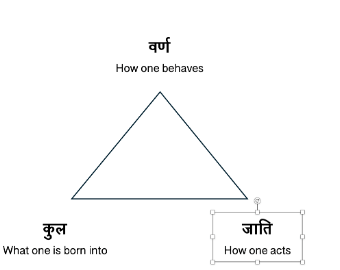
For each of these three, मनुस्मृति has a bunch of श्लोक that indicate that an identity of an individual may be seen as a complex of all three aspects having a regular inter-play with each other. वर्ण based on parentage alone cannot be the sole basis to identify the वर्ण of the person since a person’s parentage may not be known and even if known, one’s expressed actions and innate conduct also should reflect the वर्ण of a person. And it is for this reason that unlike the “Caste System” which used to operate in countries outside भारत on the basis of birth alone, मनुस्मृति (and other शास्त्र aligned to धर्म) recognizes that the वर्ण can change and does not remain static eternally (this will be covered later in the blog).
4.1 As per कुल (birth)
The following verses seem to indicate मनुस्मृति clearly indicating birth as the basis to determine one’s वर्ण
शर्मवद् ब्राह्मणस्य स्याद् राज्ञो रक्षासमन्वितम् । वैश्यस्य पुष्टिसंयुक्तं शूद्रस्य प्रेष्यसंयुतम् ॥ ३२ ॥
The name of the ब्राह्मण should be expressive of ‘peace,’ that of the क्षत्रिय, of ‘protection’; that of the वैश्य, of ‘prosperity,’ and that of the शूद्र, of ‘submissiveness.’(2:32)
If naming is to be done within a month of a person being born, it means a (tentative) वर्ण assignment is done as soon as a child is born. मनुस्मृति clearly recognizes that if one is born to parents who belong to one of the वर्ण, and if both parents belong to the same वर्ण, then the child may also be aligned to the same वर्ण (by force of genetics). However, unless उपनयनम् (initiation) is undertaken, मनुस्मृति states clearly that the वर्ण status is not attained even if one is born in such a कुल
मातुरग्रेऽधिजननं द्वितीयं मौञ्जिबन्धने । तृतीयं यज्ञदीक्षायां द्विजस्य श्रुतिचोदनात् ॥ १६९ ॥
तत्र यद् ब्रह्मजन्मास्य मौञ्जीबन्धनचिह्नितम् । तत्रास्य माता सावित्री पिता त्वाचार्य उच्यते ॥ १७० ॥
वेदप्रदानादाचार्यं पितरं परिचक्षते । न ह्यस्मिन् युज्यते कर्म किञ्चिदा मौञ्जिबन्धनात् ॥ १७१ ॥
According to the directions of the श्रुति, the first birth of the द्विज is from the mother, the second, after the मौञ्जिबन्धन (girdle-tying ceremony), and the third, after यज्ञदीक्षा (sacrificial initiation) (2:169). Among these, at that Brahmic birth which is marked by the tying of the girdle, the सावित्री has been declared to be his “Mother,” and the आचार्य his “Father (2:170). They call the आचार्य “father,” on account of his imparting the वेद. Before the मौञ्जिबन्धन, the performance of no यज्ञ कर्म is proper for him (2:171)
It is taking this view further that the following श्लोक appears in the स्कन्द पुराण:
जन्मना जायते शूद्र: कर्मणा द्विज उच्यते | वेदपाठेन विप्रस्यात् ब्राह्मणो ब्रह्म वेदनात् ||
Everyone is born as a शूद्र and by कर्म (refers to disciplined action, a cultured action and a lifestyle governed by विधि and निषेध which one comes to live by after उपनयनम्), one attains the status of a द्विज. द्विज is referred to as a विप्र after study of the वेद (meaning one starts knowing the meaning of the मंत्रs in the वेद) and ब्राह्मण is one who knows ब्रह्म.
4.2 As per जाति
जाति may be understood as the vocation one undertakes. People take up occupations as aligned to their innate inclinations – that is the idea. मनुस्मृति makes an interesting statement that when one is unable to recognize which वर्ण a person belongs to when the parentage of the person is not known, one should observe from the actions the person does.
वर्णापेतमविज्ञातं नरं कलुषयोनिजम् । आर्यरूपमिवानार्यं कर्मभिः स्वैर्विभावयेत् ॥ ५७ ॥
The man of mixed origin, who is devoid of वर्ण, unknown parentage, an अनार्य, even though having the appearance of an आर्य, one shall discover by his acts (10:57).
This suggests that one can assess the वर्ण based on the external actions being undertaken by a person for living.
अव्रतानाममन्त्राणां जातिमात्रोपजीविनाम् । सहस्रशः समेतानां परिषत्त्वं न विद्यते ॥ ११४ ॥
Even if thousands of ब्राह्मणs come together,—who have not fulfilled their duties, who are ignorant of the sacred texts, who subsist merely by the name of their जाति —the character of the ‘Assembly’ cannot belong to them (12:114)
Here, “Assembly” refers to a group of people qualified to explain the meaning of धर्म. Once again, a person who is seen externally as part of ब्राह्मण जाति but does not undertake any actions that a ब्राह्मण must undertake is not seen as qualified to expound the meaning of धर्म – birth alone does not automatically give access to जाति unless one is actually performing कर्म aligned to that particular जाति. And since there are a number of different types of vocations undertaken within a society, there are multiple जातिs present both in ancient and current times. But can a जाति be linked directly to a वर्ण? Apart from birth (जन्म) and vocation (कर्म), there is a third driver too (आचार), namely, character and conduct of the person, which is a determiner of वर्ण (as we will see below)
4.3 As per वर्ण
आचाराद् विच्युतो विप्रो न वेदफलमश्नुते । आचारेण तु संयुक्तः सम्पूर्णफलभाग् भवेत् ॥ १०९ ॥
एवमाचारतो दृष्ट्वा धर्मस्य मुनयो गतिम् । सर्वस्य तपसो मूलमाचारं जगृहुः परम् ॥ ११० ॥
जप्येनैव तु संसिध्येद् ब्राह्मणो नात्र संशयः । कुर्यादन्यन्न वा कुर्यान् मैत्रो ब्राह्मण उच्यते ॥ ८७ ॥
सावित्रीमात्रसारोऽपि वरं विप्रः सुयन्त्रितः । नायन्त्रितस्त्रिवेदोऽपि सर्वाशी सर्वविक्रयी ॥ ११८ ॥
The ब्राह्मण who departs from आचार (right behaviour), does not obtain the fruit of the वेद; he however who is equipped with आचार obtains the full reward (1:109). Having thus seen that धर्म is secured from आचार, the sages regarded आचार as the very root of all तप (1:110). It is by means of repeating मंत्र that the ब्राह्मण succeeds — there is no doubt in this. He may, or may not, do anything else, one comes to be called a ब्राह्मण if he is of a friendly disposition (2:87). Better the ब्राह्मण knowing the सावित्री alone, if he is thoroughly self-controlled, and not he who knows all the three वेद, but is not self-controlled, and eats all things and sells all things
How to determine the वर्ण of a person is not a current-day question alone – at least a few thousand years back, युधिष्ठिर made the same point that one cannot determine the वर्ण of an individual easily. See the lines conveyed by युधिष्ठिर to राजा नहुषा who appeared as an अजगर (within वनपर्व of महाभारत):
जातिरत्र महासर्प मनुष्यत्वे महामते। संकरात् सर्ववर्णानाम् दुष्परीक्ष्येति मे मतिः।।
सर्वे सर्वास्वपत्यानि जनयन्ति सदा नराः। वाङ्मैथुनमथो जन्म मरणं च समं नृणाम्।।
इदमार्षं प्रमाणं च ये यजामह इत्यपि। तस्माच्छीलं प्रधानेष्टं विदुर्ये तत्वदर्शिनः।।
O महासर्प! I think here in this world, it is very difficult to ascertain one’s जाति on account of continuous intercourse between people of all वर्ण. Men of all वर्ण are without restriction constantly begetting children on women of all वर्ण. And speech, cohabitation, birth and death of all people are similar in all respects. The proof of this, i.e., the difficulty of ascertaining one’s वर्ण is found in such expressions made use of by the ऋषिs, as “whatever वर्ण one may belong to, we celebrate the यज्ञ”. It is on this account that the wise have asserted that the character is the chief and needful thing.
Then how does one determine वर्ण of a person?
सर्प उवाच
ब्राह्मणः को भवेद् राजन् वेद्य किं च युधिष्ठिर। ब्रवीह्यतिमतिं त्वां हि वाक्यैरनुमिमीमहे।।
युधिष्ठिर उवाच
सत्यं दानं क्षमा शीलमानृशंस्यं तपोघृणा। दृश्यन्ते यत्र नागेन्द्र स ब्राह्मण इति स्मृतः॥
O राजन्! Whom can we call a ब्राह्मण? O युधिष्ठिर! What is it that ought to be known? From what you have said, I deem you to be endowed with very high intelligence.
O नागेन्द्र! One is a ब्राह्मण in whom are found सत्य, दान, क्षमा, शील (good conduct), अनृशंस्यं (benevolence), तप & अघृणा (lack of hatred or merciful).
सर्प उवाच
चातुर्वर्ण्यं प्रमाणं च सत्यं च ब्रह्म चैव हि। शूद्रेष्वपि च सत्यं च दानमक्रोध एव च। आनृशंस्यमहिंसा च घृणा चैव युधिष्ठिर।।
O युधिष्ठिर! Even in the शूद्र are found सत्य, दान, अक्रोध (no anger), अनृशंस्यं, अहिंसा, अघृणा and knowledge of the वेद which promotes the welfare of all four वर्ण, which is true and guide in all matters of धर्म.
युधिष्ठिर उवाच
शूद्रे तु यद् भवेल्लक्ष्म द्विजे तच्च न विद्यते। न वै शूद्रो भवेच्छूद्रो ब्राह्मणो न च ब्राह्मणः॥
The शूद्र in whom these लक्षण are present is not a शूद्र but something higher and a ब्राह्मण in whom these लक्षण are absent is not a ब्राह्मण
यत्रैतल्लक्ष्यते सर्प वृतं स ब्राह्मणः स्मृतः। यत्रैतन्न भवेत् सर्प तं शूद्रमिति निर्दिशेत् ॥
And O सर्प! It is asserted that the one who is distinguished by these लक्षण is a ब्राह्मण and who does not possess them is a शूद्र
तावच्छूद्रसमो ह्येष यावद् वेदे न जायते। तस्मिन्नेवं मतिर्द्वैधे मनुः स्वायम्भुवोsब्रवीत्।।
कृतकृत्याः पुनर्वर्णा यदि वृत्तं न विद्यते। संकरस्त्वत्र नागेन्द्र बलवान् प्रसमीक्षित:।।
Before initiation into the वेद, every man is regarded as a शूद्र. There being a difference of opinion on the point, स्वायम्भु मनु laid down that if, having gone through purificatory rites (as laid down in the वेद), the first three वर्ण do not regulate their conduct, in that case, the mixed castes should be considered as superior to them.
यत्रेदानीं महासर्प संस्कृतं वृत्तमिष्यते। तं ब्राह्मणमहं पूर्वमुक्तवान् भुजगोत्तम।।
O महासर्प! I have therefore designated him as a ब्राह्मण who observes the principles of good behaviour.
Principle is very clear – वर्ण is determined based on conduct and conduct alone. And conduct is nothing else but working of त्रिगुण within oneself. What we witness today is that the family lineage has been assigned a certain linkage with a वर्ण but no one does an attitudinal study (no one even knows how to do this) to classify people into any of the वर्णs – in fact, by assigning the tag of “upper caste” and ‘lower caste” goes against multitude of श्लोकs within मनुस्मृति itself which understands the operation of the dynamic trio within individuals – कुल, जाति and वर्ण – the स्मृति in facts add that those whose conduct is mis-aligned to the वर्ण assigned to them when they were born will need to be derecognized from such a वर्ण. This is reinforced by मनुस्मृति by means of the following श्लोक:
आचारः परमो धर्मः श्रुत्योक्तः स्मार्त एव च । तस्मादस्मिन् सदा युक्तो नित्यं स्यादात्मवान् द्विजः ॥ १०८ ॥
आचार [Right Behaviour] is highest धर्म; that which is prescribed in the श्रुति and laid down in the स्मृति. Hence, the द्विज, desiring the welfare of one’s आत्मा, should be always intent upon आचार (1:108)
Another श्लोक in मनुस्मृति reinforces that knowledge and external observances of required practices are not adequate but in fact useless – what is necessary is practicing of actual restraints or यम (not stealing, telling truth, not coveting what others have, cleanliness, etc) – see श्लोक below:
यमान् सेवेत सततं न नित्यं नियमान् बुधः । यमान् पतत्यकुर्वाणो नियमान् केवलान् भजन् ॥ २०४ ॥
The wise man shall always observe the यम (restraints), but not necessarily the नित्यकर्म (observances). Not observing the यम, and keeping the नित्यकर्म alone, he falls (4:204)
- 5. Vocation/ कर्म to be undertaken by each वर्ण
As a principle, this is easy – whatever occupation one has an innate aptitude to, one must perform such an activity. Do not engage in an activity that one is not tuned to – since performing such an activity may have dangerous consequences. In the 18th chapter of the श्रीमद्भगवद्गीता, श्रीकृष्ण states as below in terms of recommended actions that each वर्ण takes to:
ब्राह्मणक्षत्रियविशां शूद्राणां च परंतप। कर्माणि प्रविभक्तानि स्वभावप्रभवैर्गुणैः।।18.41।।
18.41 O परंतप! The कर्म of (कर्माणि) ब्राह्मण, क्षत्रिय, वैश्य & शूद्र (ब्राह्मणक्षत्रियविशां शूद्राणां च) are divided (प्रविभक्तानि) by (the predominance of) गुण’s (र्गुणैः) arising from (प्रभवै:) their nature (स्वभाव).
| कर्म of a ब्राह्मण शमो दमस्तपः शौचं क्षान्तिरार्जवमेव च। ज्ञानं विज्ञानमास्तिक्यं ब्रह्मकर्म स्वभावजम्।।18.42।। 18.42 The कर्म of ब्राह्मण (ब्रह्मकर्म), that is born of their nature (स्वभावजम्), is composure (शम:), self-restraint (दम:), तप:, cleanliness (शौचं), accommodation (क्षान्ति:) and also straight-forwarded-ness (आर्जवम्), knowledge (and its) assimilation (विज्ञानम्) and acceptance in the veracity of the वेद (आस्तिक्यं). | कर्म of a क्षत्रिय The कर्म of क्षत्रिय’s (क्षात्रं कर्म), that is born of their nature (स्वभावजम्), valour (शौर्यं), self-confidence (तेज:), धृति, dexterity viz ability to act with confidence (in sudden situations) (दाक्ष्यं) and also not fleeing from battle (युद्धे च अपि अपलायनम), generosity (दानम्) and leadership (ईश्वर-भाव-च). |
| कर्म of a वैश्य & a शूद्र कृषिगौरक्ष्यवाणिज्यं वैश्यकर्म स्वभावजम्। परिचर्यात्मकं कर्म शूद्रस्यापि स्वभावजम्।।18.44।। 18.44 The कर्म of वैश्य (वैश्यकर्म), that is born of their nature (स्वभावजम्), is agriculture (कृषि), maintaining animals (गौरक्ष्य) and commerce (वाणिज्यं). The कर्म of शूद्र (शूद्रस्य कर्म), that is born of their nature (स्वभावजम्), is in the form of service (परिचर्या आत्मकं). | |
The fact that people choose modes of action that are aligned to their disposition is the most logical expression of all beings. As we think, so we do. The above may be summarized as below for ease of reference:
| वर्ण | Suitable कर्म | Purpose of कर्म (for धर्म) |
| ब्राह्मण | ऋत्विक् in a यज्ञ, teach वेद & taking दान from aधार्मिक | Study वेद to teach धर्म to all |
| क्षत्रिय | Governance & taking to arms for fighting wars | Provide leadership to protect all |
| वैश्य | Agriculture, commerce & animal care | Provide right economic valuation |
| शूद्र | Hard skills (construction, craftsman, music & dance, etc), retailing | Provide material products/ labour to all |
It is quite evident that every वर्ण needs to undertake their respective कर्म to benefit others in the society (while earning income from their chosen vocation). And when a कर्म that is aligned to one’s own disposition is undertaken to benefit others, it becomes धर्म or more particularly, it is स्वधर्म. And when people are allowed to choose activities as per their own disposition, they are the happiest since they are undertaking activities that is fully tuned to their own individual persona. Put another way, वर्ण is determined by one’s own कर्म as below:

Question now arises is – why were these “occupations” assigned to each of these four वर्णs? It is important to understand this properly before we dive into other aspects. And there are two principles that may have been considered before assigning these occupations –
- All people need to sustain their own life, and such sustenance can happen only if they are engaged in some form of activity
- The vocation must be as closely aligned to their own individual inclination/ aptitude – this will facilitate ease of work since the person is already tuned to the mindset required for such a vocation
Once the above principles are understood, it becomes easy to appreciate why ब्राह्मण, for example, has been asked to devote to study and teaching. सत्व is highest among the ब्राह्मण and such people can devote the whole day to reading and writing without getting frustrated/ distracted. Similarly, क्षत्रिय is naturally inclined to leadership or fighting wars and क्षत्रिय has been assigned to offer leadership and protect all for धर्म. Activity orientation of a वैश्य is primarily रजस् but this activity orientation is tuned towards material pursuits – hence, push towards business and agriculture. And lastly, a शूद्र is one who does not naturally take to study of the वेद or has leadership skills but has the necessary hard skills and stamina to perform hard labour – मनुस्मृति thus directs a शूद्र to dedicate this orientation of hard physical skills to help others in the society.
Was education restricted to the शूद्र? Here, one must note that education today is about acquiring skills to undertake a job or pursue research in material sciences or use some aspect of प्रकृति to sustain income. There is no mention in मनुस्मृति about restrictions imposed in acquiring skills in material sciences – of course, that era had lesser number of vocations compared with today. However, it is quite possible that people who built roads, buildings, wells, temples, etc., were needed in a large measure event in ancient times and just like today and hard labour is needed to undertake all such building activity – meaning शूद्रs were engaged in such vocations. Even in the धर्म sphere, there may not have been any restriction for शूद्रs to read (or listen) to the पुराणs, chant स्तोत्रs, learn wisdom from गुरुs, do पूजाs, etc since all these were available in local languages which were accessible to all – the restriction applied only to study of the वेद.
Are people higher up in the hierarchy (namely ब्राह्मण) allowed a greater measure of freedom in choosing their vocations? The answer is an unequivocal “NO” – Restrictions were in place for each of the वर्ण – meaning that a ब्राह्मण cannot become a king, do agriculture, etc., a क्षत्रिय cannot teach वेद or undertake hard labour, etc. And why is this so? Since no clear arguments are given in the स्मृति (except state that this should not be done), one may think that this may have been to avoid “conflict of interest” – for example, if a ब्राह्मण starts doing leadership, it will go against their innate inclination to focus on abstract ideas of ब्रह्म and devote their lives to it. Should one who has a ब्राह्मण orientation get into business (वैश्य वर्ण)? There is an interesting set of श्लोक within मनुस्मृति:
ऋतामृताभ्यां जीवेत् तु मृतेन प्रमृतेन वा । सत्यानृताभ्यामपि वा न श्ववृत्त्या कदा चन ॥ ४ ॥
ऋतमुञ्छशिलं ज्ञेयममृतं स्यादयाचितम् । मृतं तु याचितं भैक्षं प्रमृतं कर्षणं स्मृतम् ॥ ५ ॥
सत्यानृतं तु वाणिज्यं तेन चैवापि जीव्यते । सेवा श्ववृत्तिराख्याता तस्मात् तां परिवर्जयेत् ॥ ६ ॥
He (ब्राह्मण) shall live in ऋत (Truth) and अमृत (nectar) or by मृत (Death) and प्रमृत (super-death) or, even by सत्यानृता (truth and falsehood) but never by the श्ववृत्त्या (living of the dog) (4:4). Gleaning and picking is to be known as ऋत and what is obtained unasked, अमृत alms obtained by begging is मृत and cultivation is declared to be प्रमृत (4:5). Trade is “Truth and Falsehood;” even by that one may live. Service has been declared, to be the “living of dogs;” hence one should avoid it (4:6).
Cultivation which the वृत्ति for a वैश्य is referred to as प्रमृत (super-death) for a ब्राह्मण and not recommended at all – why so? This is because cultivation involves हिंसा (many small and micro-organisms which live on the soil end up being killed) – even in abnormal conditions, agriculture is to be avoided; see the relevant श्लोक from मनुस्मृति below:
वैश्यवृत्त्याऽपि जीवंस्तु ब्राह्मणः क्षत्रियोऽपि वा । हिंसाप्रायां पराधीनां कृषिं यत्नेन वर्जयेत् ॥ ८३ ॥
कृषिं साधुइति मन्यन्ते सा वृत्तिः सद्विगर्हिताः । भूमिं भूमिशयांश्चैव हन्ति काष्ठमयोमुखम् ॥ ८४ ॥
But even when subsisting by the occupation of the वैश्य, the ब्राह्मण or the क्षत्रिय shall carefully avoid agriculture, which involves injury to living creatures and is dependent upon others (10:83). People think agriculture to be good; but that occupation is despised by the righteous; the iron-tipped wood injures the earth and the earthly creatures (10:84).
The possibility of earning income and having an easy life cannot be conceived of for a ब्राह्मण. ब्राह्मण having a सत्व orientation ends up possessing a certain way of thinking and anyone having such an orientation will struggle to take up the role of other three वर्ण – some of the expectations on the conduct of a ब्राह्मण are given below:
वैरिणं नोपसेवेत सहायं चैव वैरिणः । अधार्मिकं तस्करं च परस्यैव च योषितम् ॥ १३३ ॥
सत्यं ब्रूयात् प्रियं ब्रूयान्न ब्रूयात् सत्यमप्रियम् । प्रियं च नानृतं ब्रूयादेष धर्मः सनातनः ॥ १३८ ॥
भद्रं भद्रमिति ब्रूयाद् भद्रमित्येव वा वदेत् । शुष्कवैरं विवादं च न कुर्यात् केन चित् सह ॥ १३९ ॥
He shall not engage with his enemy, or with his enemy’s friend, or with a person who follows अधर्म , or with a thief, or with the lady of another person (4:133). He shall say what is true; and he shall say what is agreeable; he shall not say what is true, but disagreeable; nor shall he say what is agreeable, but untrue; this is the eternal law (4:138). What is (not) well, he shall call “भद्रं”; or, he shall simply say “भद्रं;” he shall not create needless enmity or dispute with anyone (4:139).
वेदमेवाभ्यसेन्नित्यं यथाकालमतन्द्रितः । तं ह्यस्याहुः परं धर्ममुपधर्मोऽन्य उच्यते ॥ १४७ ॥
He shall diligently recite the Veda, whenever he finds time. They declare this to be his primary duty; everything else is declared to be his secondary duty (4:147)
यद् यत् परवशं कर्म तत् तद् यत्नेन वर्जयेत् । यद् यदात्मवशं तु स्यात् तत् तत् सेवेत यत्नतः ॥ १५९ ॥
सर्वं परवशं दुःखं सर्वमात्मवशं सुखम् । एतद् विद्यात् समासेन लक्षणं सुखदुःखयोः ॥ १६० ॥
He shall carefully avoid every such act as is dependent upon others; such acts as are dependent upon himself, every one of these he shall eagerly pursue (4:159). All that is dependent on others is painful; all that is dependent on oneself is pleasing; he shall know this to be, in short, the definition of pleasure and pain (4:160).
परस्य दण्डं नोद्यच्छेत् क्रुद्धो नैनं निपातयेत् । अन्यत्र पुत्रात्शिष्याद् वा शिष्ट्यर्थं ताडयेत् तु तौ ॥ १६४ ॥
He shall not, when angry, raise the rod against another person, nor shall he let it fall; except in the case of the son or the pupil; these two he may beat with a view to correction (4:164).
ऋत्विक्पुरोहिताचार्यैर्मातुलातिथिसंश्रितैः । बालवृद्धातुरैर्वैद्यैर्ज्ञातिसम्बन्धिबान्धवैः ॥ १७९ ॥
मातापितृभ्यां जामीभिर्भ्रात्रा पुत्रेण भार्यया । दुहित्रा दासवर्गेण विवादं न समाचरेत् ॥ १८० ॥
एतैर्विवादान् सन्त्यज्य सर्वपापैः प्रमुच्यते । एतैर्जितैश्च जयति सर्वान्लोकानिमान् गृही ॥ १८१ ॥
He shall not have a quarrel with the ऋत्विक् (officiating priest), the पुरोहित (priest), or his आचार्य (teacher), or with his मातुल (maternal uncle), or his अतिथि (guests) or संश्रित (dependants), with बालवृद्धातुरै: (children, or with old or sick persons), or with वैद्य (doctors), with his ज्ञातिसम्बन्धिबान्धवैः (paternal relations or marriage relations), with his मातापितृभ्यां (parents), or जामीभि: (female relations), or भ्राता (brother) or पुत्र (son), or भार्या (wife), or दुहित्रा (daughter), or with his दासवर्ग (servants) (4:179-180). Having renounced quarrel with these, the householder becomes freed from all पाप; and, by ignoring them, he wins all these worlds (4:181).
आचार्यो ब्रह्मलोकैशः प्राजापत्ये पिता प्रभुः । अतिथिस्त्विन्द्रलोकेशो देवलोकस्य चर्त्विजः ॥ १८२ ॥
जामयोऽप्सरसां लोके वैश्वदेवस्य बान्धवाः । सम्बन्धिनो ह्यपां लोके पृथिव्यां मातृमातुलौ ॥ १८३ ॥
आकाशेशास्तु विज्ञेया बालवृद्धकृशातुराः । भ्राता ज्येष्ठः समः पित्रा भार्या पुत्रः स्वका तनुः ॥ १८४ ॥
छाया स्वो दासवर्गश्च दुहिता कृपणं परम् । तस्मादेतैरधिक्षिप्तः सहेतासञ्ज्वरः सदा ॥ १८५ ॥
The आचार्य is the ईश of the ब्रह्मलोक; the पिता is प्रभु of the प्रजापति लोक; the अतिथि is the ईश of the इंद्रलोक ; and the पुरोहित are the ईश of the देवलोक (4:182). जामीभि (female relatives) (have power) over the अप्सरालोक ; बान्धवाः (maternal relations), over that of the वैश्वदेव; सम्बन्धिन (marriage-relations), over the आपलोक ; मातृमातुलौ (the mother and maternal uncle), over the पृथ्वी; बालवृद्धकृशातुराः (the children, the aged, the emaciated and the sick) should be regarded as the ईश of आकाशलोक; the ज्येष्ठ भ्राता (elder brother) is equal to the पिता; the भार्या (wife) and the पुत्रः (son) are one’s own body (4:183-184). दासवर्ग (servants) are one’s own shadow; the दुहिता (daughter) is the highest object of tenderness. For these reasons, when offended by these, he shall always bear it without heat (4:185).
दासवर्ग described above is essentially a शूद्र and they are expressed as one’s own shadow – and a ब्राह्मण is being told that any offence by them too must be tolerated!!!!! Clearly, it is evident on the high standards of living expected of a ब्राह्मण making it very difficult to choose the occupation of other वर्ण while retaining a सत्व orientation. Similarly, if a क्षत्रिय takes up the role of a शूद्र or a ब्राह्मण, the work being done goes against the innate orientation of leadership, aggression, etc and such a person will struggle to continue doing an activity against one’s innate inclination. But if for whatever reason, when one pursues a vocation that is misaligned to our innate orientation, this will enhance mental stress and eventually lead to an unstable mind and thus an experience of an unhappy life. It is for this reason that while the स्मृति proposes domains that are aligned to the गुण orientation of each वर्ण with clear prohibition not to take up the role belonging to another वर्ण since it is harmful for the person himself.
5.3 How to understand working of innate गुण within all?
To understand vocation prescription of मनुस्मृति better, the dynamic of how the inner world of each वर्ण operates is essential to appreciate. To illustrate this better, I am borrowing the idea of पञ्चकोश from तैत्रीय उपनिषद् and using this to explain how each वर्ण is centered into each कोश in varying proportions and vocation prescriptions vary precisely because the quantum of centering in each कोश vary across the four वर्ण – I must add that this linking of वर्ण with कोश does not have any sanction formally in any शास्त्र but it is my personal idea that I think will be useful to understand why vocation prescriptions vary across वर्ण.

| आनंदमय कोश (आ-को) | Most सूक्ष्म layer – experienced in सुशुप्ति as आनन्द, zone, संस्कार present in causal mode |
| विज्ञानमय कोश (वि-को) | Layer of बुद्धि/ intellect, the discriminating faculty |
| मनोमय कोश (म-को) | Layer of मन, seat of sensory processing, likes, dislikes, emotional reactivity (ज्ञानेन्द्रिय) |
| प्राणमय कोश (प्रा-को) | Layer of प्राण that animates the body (कर्मेन्द्रिय) |
| अन्नमय कोश (अ-को) | Most स्थूल layer – refers to the शरीर, the physical body, the outermost layer in all |
What will be the mindset that will be needed to discharge a vocation relating to each वर्ण? I am using the पञ्चकोश contained in the to make this clearer.
- ब्राह्मण vocation innately remains in the आनंदमय कोश zone, attracted to ब्रह्म or abstract aspects of the life. A ब्राह्मण prefers spending time contemplating on presence of संस्कारs within and how these too can be eliminated through धर्म कार्य. Much of other qualities like बुद्धि, emotion within मन, engagement with society, etc., are geared towards doing नित्य & नैमित्तिक कर्म at the साकार level but geared towards attaining one’s निराकार state of being. ब्राह्मण innately is less inclined towards physical and social aspects of the world – in fact, they tend to be distant and prefer being enjoying the bliss of solitude. And one who dwells more on the आनंदमय कोश can easily adopt the समदृष्टि lens towards all as well as live peacefully even when the more स्थूल aspects of प्रकृति (wealth, luxury, etc.,) are not accessible. A ब्राह्मण is innately aligned to सत्वगुण and therefore happy living a life as per demands of the शास्त्र. But given that access to ज्ञान can enhance one’s अहंकार, मनुस्मृति prescribes a ब्राह्मण to live on दान or दक्षिणा earned from doing यज्ञ and teaching शास्त्र and prohibits other modes of living. मनुस्मृति also prescribes that a highest ब्राह्मण is one who has no clue where wealth for sustaining their next day will come from but still remains calm knowing that one will get that नियति has ordained.
- क्षत्रिय vocation primarily dwells in the zone of leadership and activity to protect others. The strength of the क्षत्रिय is derived from using one’s बुद्धि to be aware of how the minds of people work (which requires an active मन or mind). While a क्षत्रिय may need a strong शरीर, but more critical than one’s own शरीर is the ability to manage and maintain a strong army to protect all. It is for this reason that use of विज्ञानमय कोश and मनोमय कोश is higher than that of a ब्राह्मण. While रजस् is more dominant, this रजस् is driven for protection of all (सत्व) and this is why मनुस्मृति prescribes roles of leading people, having a generous disposition and fighting wars for upholding धर्म. And to ensure that leadership does not lead to अहंकार, क्षत्रिय is told not to work independently but under direction of a ब्राह्मण (like राम taking guidance from ऋषि वसिष्ठ on all matters of governance)
- वैश्य vocations are also activity oriented (रजस् component is high) but such a रजस् is driven to enhance material prosperity (viz तमस्). Since the key goal for which रजस् is used to to enhance material prosperity, agriculture and trade become the natural go-to professions. In current-day, entrepreneurs who create manufacturing companies or trading companies and thereby add value to materials (by turning them into finished products) will be seen as a zone of a वैश्य naturally. “Value” for people invariably means a good understanding of people and innate understanding of how goods need to be moved (just as प्राण moves energy across the body) in an effective and efficient manner. वैश्य dedicated to धर्म makes lives of all society secure and prosperous. पुराण are littered with advice to वैश्य to use wealth to build wells, tanks, roads, etc., – this is again because too much wealth can lead to अहंकार but if the wealth is used for public good, the वैश्य attains पुण्य and thus remains on the path to धर्म.
- शूद्र by nature is fully immersed into the outer स्थूल aspects of प्रकृति (since तमस् is dominant). All the skilled carpenters, plumbers, craftsmen, etc., have an innate ability to mould the physical aspects of प्रकृति to generate a high level of quality. This requires strength and dexterity, and this is why तमस् present within the शूद्र aids in making this possible. However, capable and skilled hands need direction and since सत्व and रजस् गुण are relatively utilized in a lower scale then other वर्ण, serving other वर्णs therefore gives them the necessary direction and purpose. It is for this reason that a शूद्र predominantly operates at the layer of अन्नमय कोश but aided by मन and प्राण, they too become a valuable member of the society. In current day, if a person is not capable of undertaking high-end scientific research, does not have political or social capital, does not have entrepreneurial skills but has physical skills, they join as a salaried person and assign themselves in service of a larger company or a politician to survive (and even thrive) – and thus, they too become a valuable member of the society at large.
If the above table feels complex, there is a simpler table that brings out the गुण distribution among members of each वर्ण (given as an illustration to understand the working):

Given this गुण distribution, the choice of vocations needs to be aligned in a way that the गुण of the person and the गुण of the vocation (viz कर्म) mirror each other – when they mirror each other, the person is stressed to the minimum but if the गुण required for a role does not mirror one’s own innate गुण, there is a clash, a stress that is not helpful for the individual himself or herself – it is for this reason that prescription of vocation has been given within मनुस्मृति for each वर्ण. For the sake of discussion, let me put together some current day examples of कर्म that can be linked to गुण (not to be taken literally but to understand the idea of linkage):
| SN | कर्म | Dominant गुण | Ideal for which वर्ण |
| 1 | Station clerk at the counter | तमस् | शूद्र |
| 2 | Politician | रजस् | क्षत्रिय |
| 3 | Steel manufacturing | रजस् with तमस् | वैश्य |
| 4 | Typical lower rank salaried employee | तमस् with रजस् | शूद्र |
| 5 | Cooking food/ waiter | तमस् with रजस् | शूद्र |
| 6 | Owner of a restaurant | रजस् with तमस् | वैश्य |
| 7 | Theoretical Physics research scientist | सत्व | ब्राह्मण |
| 8 | Army general | रजस् with सत्व | क्षत्रिय |
| 9 | Wine tasting | Tamas | शूद्र |
| 10 | Car racer | तमस् with रजस् | शूद्र |
| 11 | Song/ dance/ movie making | तमस् with रजस् | शूद्र |
| 12 | Song/ dance, etc that inspires one for परमार्थ | सत्व | ब्राह्मण |
Some can be tough and may require more thinking – but the principle must be clear that each कर्म has a certain dominant गुण driving it – and one who is able to determine one’s own innate dominant गुण will be comfortable in doing a related कर्म without unrest or discomfort – this is not a restriction of freedom, but this is good for the individual himself or herself.
But one may still argue that such a fixation restricts freedom for individuals – isn’t such a binding akin to suppression of personal choice? Question which the ऋषिs therefore grappled with is – does binding restrict freedom or does it facilitate true freedom? Do read on.
6. Binding is the way to freedom
This is a very important aspect that is seldom discussed (except possibly in अध्यात्म circles). Discipline is essential for success in any endeavour. An athlete binds his or her life to training which facilitates later success in the sport; a student binds his or her life to years of study and such binding to continuous study enables success in life. Put another way, to gain something, one has to necessarily give up something else. And this discipline that one binds oneself to is understood as तपस्या. मनुस्मृति gives a few lines that may be seen as one of the most important lines in the धर्मशास्त्र:
तपोमूलमिदं सर्वं दैवमानुषकं सुखम् । तपोमध्यं बुधैः प्रोक्तं तपोऽन्तं वेददर्शिभिः ॥ २३४ ॥
ब्राह्मणस्य तपो ज्ञानं तपः क्षत्रस्य रक्षणम् । वैश्यस्य तु तपो वार्ता तपः शूद्रस्य सेवनम् ॥ २३५ ॥
यद् दुस्तरं यद् दुरापं यद् दुर्गं यच्च दुष्करम् । सर्वं तु तपसा साध्यं तपो हि दुरतिक्रमम् ॥ २३८ ॥
महापातकिनश्चैव शेषाश्चाकार्यकारिणः । तपसैव सुतप्तेन मुच्यन्ते किल्बिषात् ततः ॥ २३९ ॥
यत् किं चिदेनः कुर्वन्ति मनोवाङ्मूर्तिभिर्जनाः । तत् सर्वं निर्दहन्त्याशु तपसैव तपोधनाः ॥ २४१ ॥
All happiness among देवता and मनुष्य has been declared by the wise ones, to whom the वेद was revealed, to have तप for its source, तप for its middle and तप for its end (234). The तप for the ब्राह्मण is ज्ञानं; the ‘तप for the क्षत्रिय is रक्षणम् (protecting); the ‘तप for the वैश्य is वार्ता (agriculture); and the ‘तप for the शूद्र is सेवनम् (service) (11:235). What is hard to traverse, what is hard to attain, what is hard to reach, and what is hard to do, all this is accomplished by तप; as तप is difficult to transgress (11:238). Those who have committed heinous offences, as also those who have committed other misdeeds, become freed from their पाप by means of तप well-performed (11:239). Whatever पाप people commit by thought, word or deed,—all that they speedily burn away, having तप as their sole wealth (11:241).
And what is success as per मनुस्मृति? We have already discussed this earlier that the highest goal as per मनुस्मृति is आत्मज्ञान and तपस्या is seen as the most essential कर्म one has to engage in to achieve the highest goal of life. Question which now arises is – why does मनुस्मृति insist that sticking to one’s own वर्ण is akin to तपस्या itself? And this is possibly the most important and central question of this blog. And this is where texts on धर्म differ from normal inspiration text material that we see in the current-day. For this, I will repeat the श्लोक conveyed earlier –
अर्थकामेष्वसक्तानां धर्मज्ञानं विधीयते । धर्मं जिज्ञासमानानां प्रमाणं परमं श्रुतिः ॥ १३ ॥
The knowledge of धर्म is ordained for those who are not addicted to the pursuit of अर्थ (wealth) and काम (pleasures); and for those seeking for the knowledge of धर्म, the श्रुति (वेद) is the highest authority (2:13)
In the current day, to gain access to the high-income domains require higher education – this means irrespective of whether one is oriented as per their own aptitude towards education or not, if one desires to get into a high-income domain or some position of power, one needs to necessarily undertake higher education. Similarly, from an entertainment perspective, if one wants to attend a musical by a popular musician, one may need to pay a cost of money to get tickets – and one having no money may not be able to afford the tickets and fulfil one’s desires. Key point to make here is that in the zone of अर्थ and काम (wealth and desires/ entertainment/ pleasures), irrespective of what one’s inner orientation is, one has to acquire access to some domain (higher education, qualifying experience, etc) to meet one’s goals. If I am an artist but there is no income from being an artist, I will necessarily have to choose another domain to earn income. “Freedom of choice” thus becomes an essential feature that a society must offer to enable its people to gain access to lead a successful material life (to meet the अर्थ and काम needs).
But when in addition to अर्थ and काम, धर्म is the priority of a human society, how must one approach vocations misaligned to one’s individuality? Among other things, with respect to personal engagement, धर्म states that sticking to whatever one’s innate orientation is frees one from पाप and deepens one’s insight into the truth. श्रीकृष्ण, in fact, goes one step further and states the below in the श्रीमद्भगवद्गीता:
श्रेयान्स्वधर्मो विगुणःपरधर्मात्स्वनुष्ठितात् । स्वधर्मे निधनं श्रेयः परधर्मो भयावहः॥३.३५॥
Better (श्रेयान्) is one’s own धर्म (स्वधर्मः) which is imperfectly performed (विगुणः) than the well-performed (स्वनुष्ठितात्) धर्म of another (परधर्मात्). Death (निधनम्) in one’s own धर्म (स्वधर्मे) is better (श्रेयः). The धर्म of another (परधर्मः) is fraught with fear (भयावहः)
कर्म needs to be undertaken for धर्म and one’s कर्म becomes स्वधर्म if the work is aligned to one’s own गुण disposition – if the work undertaken is not aligned to one’s own disposition, even if it is performed very well, it is not good at all. When one performs कर्म that is not aligned to one’s own गुण orientation, one experiences stress, discomfort, etc., inside. The cause of stress in an individual in today’s world is precisely because when wealth or power becomes the sole motivator of action, one may attain wealth or power but internally, one remains disturbed/ distracted since one is performing actions that are misaligned to one’s own innate mental aptitude – and the resultant stress breaks one down fully. Hence, श्रीकृष्ण says that such an action is fraught with fear.
What is binding? Telling an artist to remain an artist despite no scope for income and recognition is a form of binding. And unfortunately, one may struggle to stick to one’s innate orientation when the wider society does not find value in it – equally, one may become attracted to seek another domain (e.g., an introvert artist wanting to become a musician because he/ she may be attracted to the potential to earn fame via such a vocation). But when one sticks to one’s innate गुण (not being lured by fame, wealth, etc), such a binding that resists pressure of lures/ attractions of other domains is nothing else but तपस्या – and such a तपस्या is a path to आत्मज्ञान – this is why binding is recommended for people of all वर्ण – binding to their innate वर्ण. One example of binding for a ब्राह्मण is given below:
न लोकवृत्तं वर्तेत वृत्तिहेतोः कथं चन । अजिह्मामशथां शुद्धां जीवेद् ब्राह्मणजीविकाम् ॥ ११ ॥
नैहेतार्थान् प्रसङ्गेन न विरुद्धेन कर्मणा । न विद्यमानेष्वर्थेषु नार्त्यामपि यतस्ततः ॥ १५ ॥
He (a ब्राह्मण) shall never follow the worldly way, for the sake of subsistence; he shall live the straightforward, sincere and pure life of the ब्राह्मण (4:11). He shall not seek wealth by clinging pursuits, or by contrary acts; nor when wealth is already there; nor from here and there, even in times of distress.—(4:15)
A great example of binding as expression of तपस्या is captured in the image below:
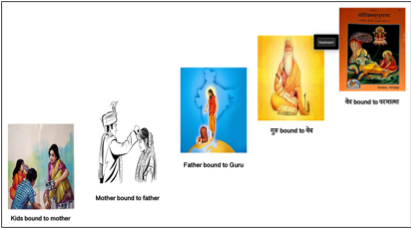
Many शास्त्र do refer to this hierarchy which state that kids are doing service of mother, mother doing service of father, father bowing down to a गुरु, etc. And seeing this without context, words like “bowing down” or “serve” appear like an expression of inequality. However, reading the शास्त्र end to end, it becomes clear that everyone operates with a binding – mother bound to father, father bound to गुरु, गुरु is bound to the शास्त्र while शास्त्र itself as धर्म is bound to परमात्मा. Texts like श्रीमद्भागवतम् (and many others) state that even परमात्मा is bound to both धर्म as well as भक्त (who are none else but humans bound to धर्म). And looking at the big picture, everyone respects the hierarchy given here since everyone knows that all of them are binding their life to the वेद to eventually attain ज्ञान of परमात्मा (also expressed as आत्मज्ञान). And this binding prescribed is not actually binding to individuals but binding to the code of धर्म – and it is this big picture that मनुस्मृति appears to be encouraging the society to adopt for the benefit of all. And when one is bound to one’s स्वधर्म, if one operates true to one’s own innate orientation, the following image reflects a positive, middling and negative outcome for people of all वर्ण:
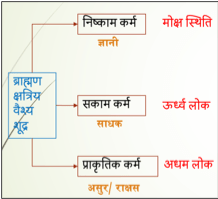
Key point to note is that if any of the वर्ण performs a निष्काम कर्म, they will attain to मोक्ष and if they perform a सकाम कर्म, they will attain an ऊर्ध्व गति (viz good life in this world as well as after-life expressed as स्वर्ग) while whosoever performs a कर्म that is aligned to their innate संस्कारs, they will attain an अधम लोक. Key point is – धर्म works in the same manner to all irrespective of what वर्ण they belong to. It is no wonder that the संत परम्परा within धर्म in भारत had always carried the presence of people from all वर्ण (including women) precisely because the route to मोक्ष is निष्काम कर्म and धर्म is the route to a happy/ satisfied life even in this world (referred to as ऊर्ध्वलोक above).
Note: We will not get into a discussion here on what is the meaning of a निष्काम कर्म or a सकाम कर्म since that will be a discussion on अध्यात्म and will be a diversion.
It is for this reason that श्रीकृष्ण in Chapter 9 of the श्रीमद्भगवद्गीता:
मां हि पार्थ व्यपाश्रित्य येऽपि स्युः पापयोनयः। स्त्रियो वैश्यास्तथा शूद्रास्तेऽपि यान्ति परांगतिम्।।9.32।।
किं पुनर्ब्राह्मणाः पुण्या भक्ता राजर्षयस्तथा। अनित्यमसुखं लोकमिमं प्राप्य भजस्वमाम्।।9.33।।
O पार्थ! even those who take जन्म as lower beings, also स्त्री, वैश्य: and शूद्र, they also, because (have) taken शरण in Me, they will attain the highest गति. What again (to speak) of ब्राह्मण who are pure and are My भक्त, similarly राजा who are ऋषि. Having obtained this impermanent and unpleasant लोक, may you seek Me.
7. Does such a form of binding operate in the 21st century or is this outdated?
वर्ण as a principle remains valid. Let me illustrate this by putting together the various roles performed within a Company.
| Board (Govern) | CEO (Lead/ Direct) | Marketing/ Design (Add value) | Support (Execute) | |
| Bound by | Nation’s interestLocal Law | ShareholdersMission/ vision | Company strategyCustomer interest | Policy/ ProceduresManager’s will |
| बुद्धि (सत्व) | 50% | 30% | 20% | 10% |
| मन (रजस्) | 30% | 50% | 30% | 20% |
| इंद्रिय (रजस्) | 20% | 20% | 50% | 30% |
| शरीर (तमस्) | 10% | 10% | 10% | 50% |
The role of the Board is like that of a ब्राह्मण since the सत्व component is the highest while support staff or executives who perform hard work by following orders or will of their superiors become the शूद्र in today’s world. CEO as the क्षत्रिय and Product and design roles are aligned to that of a वैश्य. All these roles operate as a hierarchy, and everyone respects this hierarchy since the goals of individuals and shareholders are best achieved if people respect this hierarchy and operate within their identified sphere of influence.
Note that अर्थ and काम are the goals of a company but they too need to operate within the regulatory framework together with laws of the country (viz akin to binding). This means that adherence to धर्म is necessary even when goals are अर्थ and काम. “Binding” is thus not an idea contrary to or a limitation of “freedom of choice” – in fact, it is an aid to a free life.
One may argue here that despite people being bound to a certain scope, there is scope for progress as a support executive can aspire to become a CEO while there is no such scope for improvement of वर्ण and one is forever born into it. But one must know that not all people choose progress – not all want to become part of top management, and many are comfortable to remain in the so-called “lower” positions. They have probably recognized that the demands of the top management role are misaligned to their individuality and therefore stay-put in the lower positions. And if someone argues that corporate system does not operate in the form of a rigid hierarchy with dress restrictions, inter-dining restrictions, etc., one must know that even in the Corporate world, without formally using the words like “hierarchy”, “benefits” availed by senior management often vary with others and people at the top have access to larger cabins, better conference rooms, more off-sites to participate in, higher quality training courses, greater ESOPs, etc. But this is not seen negatively nor does anyone at the lower end resent this but these in fact become an inspiration for others to work harder to reach the top (if interested).
System of वर्ण संस्कार operates in the same way – those who know their innate orientation stick to it throughout life but those having necessary qualities or attributes can improve their वर्ण too (since the शास्त्रs allow this).
8. Improvement of वर्ण
Within मनुस्मृति itself, we have verses which recognize the possibility of improvement of one’s वर्ण.
शूद्रो ब्राह्मणतामेति ब्राह्मणश्चैति शूद्रताम् । क्षत्रियाज् जातमेवं तु विद्याद् वैश्यात् तथैव च ॥ ६५ ॥
अनार्यमार्यकर्माणमार्यं चानार्यकर्मिणम् । सम्प्रधार्याब्रवीद् धाता न समौ नासमाविति ॥ ७३ ॥
The शूद्र attains the position of the ब्राह्मण and the ब्राह्मण sinks to the position of the शूद्र; the same should be understood to be the case with the offspring of the क्षत्रिय or of the वैश्य (10:65). Having examined the अनार्य behaving like an आर्य and the आर्य behaving like the अनार्य , the creator declared ‘that these are neither equal nor unequal’ (10:73).
As per Medhatithi, the famous commentator of मनुस्मृति, the words “these are neither equal nor unequal’ mean that no man can be respected simply on the strength of his वर्ण; what wins respect is quality; if one is devoid of good qualities, his वर्ण cannot come to his rescue; for if it did, then there would be no point in the prescribing of प्रायश्चित्त कर्म (expiatory rites). But how does upward or downward movement happens to people making them move across वर्ण?
तपोबीजप्रभावैस्तु ते गच्छन्ति युगे युगे । उत्कर्षं चापकर्षं च मनुष्येष्विह जन्मतः ॥ ४२ ॥
By the force of तपस्या and the seed, they attain higher or lower rank among people, through birth, cycle after cycle (10:42)
Clearly, मनुस्मृति states that तपस्या (discipline) as the force that elevates the वर्ण of a person/ family while those marrying into a different वर्ण descend into a lower वर्ण. And for those who are seen as अनार्य, मनुस्मृति states the below:
ब्राह्मणार्थे गवार्थे वा देहत्यागोऽनुपस्कृतः । स्त्रीबालाभ्युपपत्तौ च बाह्यानां सिद्धिकारणम् ॥ ६२ ॥
For those outsiders (who operate outside the pale of वर्ण), success (of upward movement of वर्ण) is secured by unrequitedly dedicating one’s body for the sake of ब्राह्मणs and cows, and in defence of women and children (10:62)
And to become आर्य, one has to have a deep need to imbibe the traits the distinguish an आर्य
अहिंसा सत्यमस्तेयं शौचमिन्द्रियनिग्रहः । एतं सामासिकं धर्मं चातुर्वर्ण्येऽब्रवीन् मनुः ॥ ६३ ॥
अहिंसा (abstention from injuring), सत्यम् (truthfulness), अस्तेयं (abstention from taking possession of objects that do not belong to the person), शौचम् (purity/ cleanliness) and इन्द्रियनिग्रहः (control of the sense-organs) —this मनु has declared to be the sum and substance of duty for the four वर्ण (10:63)
Having said that, it is not an immediate change that happens in case of upward movement of वर्ण. Says मनुस्मृति –
शूद्रायां ब्राह्मणाज् जातः श्रेयसा चेत् प्रजायते । अश्रेयान् श्रेयसीं जातिं गच्छत्या सप्तमाद् युगात् ॥ ६४ ॥
If the child born from a शूद्र woman to a ब्राह्मण goes on being wedded to a higher वर्ण, the child attains the higher वर्ण, within the seventh generation.
Medhatithi adds that for a वैश्य woman and a क्षत्रिय woman, the higher वर्ण is attained in the fifth and third generation. Here, the idea being conveyed is that multiple generations need to live a life of तपस्या, अहिंसा, etc and once this becomes part of family genetics, upward movement of वर्ण will happen. Unfortunately, one has no access to any form of research which conveys whether children inherit the गुण of the parents and to what extent, etc though at an uninformed level, one can say that children tend to inherit the traits of their parents. मनु however believes that while this is so, children can change their conduct and over time, the conduct of the subsequent generations can align to the conduct of higher वर्ण.
शुचिरुत्कृष्टशुश्रूषुर्मृदुवागनहङ्कृतः । ब्राह्मणाद्याश्रयो नित्यमुत्कृष्टां जातिमश्नुते ॥ ३३५ ॥
If he (viz a शूद्र) is pure, attendant upon his superiors, of gentle speech, free from pride, and always dependent upon the ब्राह्मण,—he attains a higher वर्ण (9:335).
To conclude this section on cross movement across वर्ण, a श्लोक within the व्याधगीता of the महाभारत is reproduced below –
शूद्रयोनौ हि जातस्य सद्गुणानुपतिष्ठतः | वैश्यत्वं भवति ब्रह्मन्क्षत्रियत्वं तथैव च || आर्जवे वर्तमानस्य ब्राह्मण्यमभिजायते |
A man may be born as a शूद्र but if he is endued with सद्गुण and established in it, he will attain the state of वैश्य or of a क्षत्रिय or a ब्राह्मण
9. Does an upper caste/ lower caste categorization in modern India make sense? Unenviable life of a ब्राह्मण
मनुस्मृति has created a hierarchy with a single differentiating factor – the study of the वेद. One is seen as “higher” because one is practicing the वेद lifestyle – and one who does not practice such a lifestyle cannot be part of the hierarchy but in fact either a शूद्र or even lower.
द्विजातयः सवर्णासु जनयन्त्यव्रतांस्तु यान् । तान् सावित्रीपरिभ्रष्टान् व्रात्यानिति विनिर्दिशेत् ॥ २० ॥
योऽनधीत्य द्विजो वेदमन्यत्र कुरुते श्रमम् । स जीवन्नेव शूद्रत्वमाशु गच्छति सान्वयः ॥ १६८ ॥
नाभिव्याहारयेद् ब्रह्म स्वधानिनयनाद् ऋते । शूद्रेण हि समस्तावद् यावद् वेदे न जायते ॥ १७२ ॥
The sons that the द्विज men beget on wives of equal वर्ण, but who, not fulfilling their sacred duties, become excluded from the सावित्री —should be designated as ‘व्रात्या: (apostates) (10:20). The द्विज, who, not having learnt the वेद, labours over other things, soon falls, along with his descendants, even while living, to the state of the शूद्र (2:168). One should hot pronounce Vedic texts, apart from the स्वधा-offering; because so long as he is not born in the वेद, he is equal to a शूद्र (2:172).
Two similar expressions are found even in पराशरस्मृति:
सावित्र्याश्चापि गायत्र्याः सन्ध्योपास्त्यग्निकार्ययोः । अज्ञानात् कृषिकर्तारो ब्राह्मणा नामधारकाः ।।
गायत्री रहितो विप्र: शूद्रादप्य शुचिर्भवेत् । गायत्री ब्रह्मतत्वज्ञा: संपूज्यन्ते द्विजोत्तमा: ।।
ब्राह्मणs, who are ignorant of the वेद, and गायत्री and संध्या, and those who do not undertake any अग्निकार्य (meaning doing यज्ञs, etc) and live by agriculture, are only ब्राह्मण by name (8:11). A ब्राह्मण without a गायत्री मंत्र is more degraded than a शूद्र. ब्राह्मणs, who know the परम्ब्रह्म and are devoted to गायत्री, are the foremost in honour and sanctity (8:31).
By this logic therefore, the idea of an “upper caste” or a “general caste” in modern भारत goes against the key principle for hierarchy as per मनुस्मृति – the knowledge of the वेद. If मनु observes भारत today and sees people being classified as “upper” and ‘lower” caste, He may wonder that when all people are शूद्रs only, why are they classifying each other as per a hierarchy which He did not allude to in His स्मृति!!!!!!
So a question comes – earlier, द्विज had included people aligned to three वर्ण – ब्राह्मण, क्षत्रिय and वैश्य, but study of वेद was first given up by those regarded as वैश्य and क्षत्रिय. And post advent of the British, even those born in ब्राह्मण houses gave up the study of the वेद. Barring a miniscule brave minority (those who are still practicing a वेद style), no one today is aligned to the वेद – why is this so? Lifestyle of a द्विज in general and ब्राह्मण in particular is extremely difficult. Apart from responsibility of maintain a high character, there are physical requirements (a few listed below) which make it very difficult to practice a lifestyle aligned to the वेद in the current-day – maybe it is difficult in remain an आर्य within an अनार्य ecosystem. There is an interesting श्लोक within the legal section (that deals with how a king must handle court proceedings) in the मनुस्मृति as below:
न साक्षी नृपतिः कार्यो न कारुककुशीलवौ । न श्रोत्रियो न लिङ्गस्थो न सङ्गेभ्यो विनिर्गतः ॥ ६५ ॥
The king should not be made a witness; nor craftsmen, nor actors, nor a श्रोत्रिय (Vedic scholar), nor one in holy orders, nor one who has renounced all attachments (8:65).
Since a Vedic scholar should be considered as most reliable, question may come as to why such a person is being excluded to act as a witness? Medhatithi in this commentary states that the act of a witness may be prejudicial to the various यज्ञ कर्म (ritualistic acts) done by such a one and hence a श्रोत्रिय must be excluded. So the question that arises is – is the life of a ब्राह्मण so busy? Some of the नित्यकर्म and नैमित्तिककर्म of a ब्राह्मण are listed below to convey the challenging lifestyle of a ब्राह्मण:
कुसूलधान्यको वा स्यात् कुम्भीधान्यक एव वा । त्र्यहेहिको वाऽपि भवेदश्वस्तनिक एव वा ॥ ७ ॥
चतुर्णामपि चैतेषां द्विजानां गृहमेधिनाम् । ज्यायान् परः परो ज्ञेयो धर्मतो लोकजित्तमः ॥ ८ ॥
He (ब्राह्मण) shall be either one possessing a granary full of grains, or one possessing a jar full of grains; he may be one possessing what is wanted for three days, or one who does not possess enough for the next day (4:7). Among these four ब्राह्मणs, each later should be regarded as superior, and a superior winner of worlds by virtue of his merit (4:8).
वेदोदितं स्वकं कर्म नित्यं कुर्यादतन्द्रितः । तद् हि कुर्वन् यथाशक्ति प्राप्नोति परमां गतिम् ॥ १४ ॥
नैहेतार्थान् प्रसङ्गेन न विरुद्धेन कर्मणा । न विद्यमानेष्वर्थेषु नार्त्यामपि यतस्ततः ॥ १५ ॥
इन्द्रियार्थेषु सर्वेषु न प्रसज्येत कामतः । अतिप्रसक्तिं चैतेषां मनसा संनिवर्तयेत् ॥ १६ ॥
सर्वान् परित्यजेदर्थान् स्वाध्यायस्य विरोधिनः । यथा तथाऽध्यापयंस्तु सा ह्यस्य कृतकृत्यता ॥ १७ ॥
He shall, without sloth, always perform his own duty as prescribed in the Veda. Performing that, to the best of his ability, he attains the highest state (4:14). He shall not seek wealth by clinging pursuits, or by contrary acts; nor when wealth is already there; nor from here and there, even in times of distress(4:15). He shall not, through desires, become addicted to any sensual objects; excessive addiction to these, he shall avoid by mental reflection (4:16). He shall relinquish all things impeding study, maintaining himself somehow. This is what constitutes the accomplishment of his aims (4:17).
ऋषियज्ञं देवयज्ञं भूतयज्ञं च सर्वदा । नृयज्ञं पितृयज्ञं च यथाशक्ति न हापयेत् ॥ २१ ॥
अग्निहोत्रं च जुहुयादाद्यन्ते द्युनिशोः सदा । दर्शेन चार्धमासान्ते पौर्णमासेन चैव हि ॥ २५ ॥
सस्यान्ते नवसस्येष्ट्या तथार्तुअन्ते (तथार्त्वन्ते?) द्विजोऽध्वरैः । पशुना त्वयनस्यादौ समान्ते सौमिकैर्मखैः ॥ २६ ॥
नानिष्ट्वा नवसस्येष्ट्या पशुना चाग्निमान् द्विजः । नवान्नमद्यात्मांसं वा दीर्घमायुर्जिजीविषुः ॥ २७ ॥
To the rest of his power, he shall never omit the ऋषियज्ञं, देवयज्ञं, भूतयज्ञं, नृयज्ञं and पितृयज्ञं (4:21). He shall always offer the अग्निहोत्रं, either at the beginning, or, at the end, of day and night, as also the “दर्श” and the “पौर्णमास” at the end of each half-month (4:25). At the end of the grains, the ब्राह्मण shall perform the नवसस्येष्ट्या, at the end of the seasons, the द्विजोऽध्वरैः, at the end of the solstices the पशुयज्ञ and at the end of the year the सौमिकैर्मखैः (4:26). Without having performed the नवसस्येष्ट्या, and the पशुयज्ञ, the ब्राह्मण, who has set up the अग्नि, shall not eat new grain or meat,—if he desires to live a long life (4:27).
न नृत्येदथ वा गायेन्न वादित्राणि वादयेत् । नास्फोटयेन्न च क्ष्वेडेन्न च रक्तो विरावयेत् ॥ ६४ ॥
He shall not dance, nor sing, nor play upon musical instruments, nor clap, nor grind his teeth, nor, when satisfied (with another person), shall he create enmity (with such a person) (4:64)
पञ्च सूना गृहस्थस्य चुल्ली पेषण्युपस्करः । कण्डनी चौदकुम्भश्च बध्यते यास्तु वाहयन् ॥ ६८ ॥
तासां क्रमेण सर्वासां निष्कृत्यर्थं महर्षिभिः । पञ्च कॢप्ता महायज्ञाः प्रत्यहं गृहमेधिनाम् ॥ ६९ ॥
अध्यापनं ब्रह्मयज्ञः पितृयज्ञस्तु तर्पणम् । होमो दैवो बलिर्भौतो नृयज्ञोऽतिथिपूजनम् ॥ ७० ॥
देवताऽतिथिभृत्यानां पितॄणामात्मनश्च यः । न निर्वपति पञ्चानामुच्छ्वसन्न स जीवति ॥ ७२ ॥
For the householder there are five slaughter-houses: the hearth, the grinding-stone, household implements, mortar and pestle and water-jar;—by using which he becomes stricken (4:68). For the purpose of expiating all these in their course, the five great यज्ञ have been ordained by the great sages, for householders (to be performed) daily (4:69). Teaching is the offering to ब्रह्म, the तर्पण is the offering to पितृ, the होम is offering to देवताs, the बलि is offering to भूत and the honouring of अतिथि is offering to मनुष्य (4:70). He who does not make offerings to the five—viz., देवता, अतिथि, भृत्या (dependents), पितृ and himself — does not live, even though breathing (4:72)
अहुतं च हुतं चैव तथा प्रहुतमेव च । ब्राह्म्यं हुतं प्राशितं च पञ्चयज्ञान् प्रचक्षते ? ॥ ७३ ॥
जपोऽहुतो हुतो होमः प्रहुतो भौतिको बलिः । ब्राह्म्यं हुतं द्विजाग्र्यार्चा प्राशितं पितृतर्पणम् ? ॥ ७४ ॥
स्वाध्याये नित्ययुक्तः स्याद् दैवे चैवैह कर्मणि । दैवकर्मणि युक्तो हि बिभर्तीदं चराचरम् ॥ ७५ ॥
वैश्वदेवस्य सिद्धस्य गृह्येऽग्नौ विधिपूर्वकम् । आभ्यः कुर्याद् देवताभ्यो ब्राह्मणो होममन्वहम् ॥ ८४ ॥
अग्नेः सोमस्य चैवादौ तयोश्चैव समस्तयोः । विश्वेभ्यश्चैव देवेभ्यो धन्वन्तरय एव च ॥ ८५ ॥
‘They also call these five यज्ञ —(1) अहुतं, (2) हुतं, (3) प्रहुतम्, (4) ब्राह्म्यं हुतं and (5) प्राशितं (4:73). (1) जप is अहुतं, (2) Offering into अग्नि is हुतं, (3) Offering to भूत is प्रहुतम्, (4) The honouring of ब्राह्मण is ब्राह्म्यं हुतं and (5) doing पितृतर्पणम् is प्राशितं (4:74). One should be constantly engaged in Vedic Study, as also in acts in honour of the देवता; one who is engaged in acts in honour of the देवताs upholds the world, moveable as well as immoveable (4:75). Out of the food cooked in the गृह्य अग्नि , for the वैश्वदेव, the ब्राह्मण shall every day offer, according to rule, होम to these देवताs (4:84). First to अग्नि and to सोम, then to both these together, then to the विश्वेदेव and to धन्वन्तरि (4:85).
श्रावण्यां प्रौष्ठपद्यां वाऽप्युपाकृत्य यथाविधि । युक्तश्छन्दांस्यधीयीत मासान् विप्रोऽर्धपञ्चमान् ॥ ९५ ॥
पुष्ये तु छन्दसां कुर्याद् बहिरुत्सर्जनं द्विजः । माघशुक्लस्य वा प्राप्ते पूर्वाह्णे प्रथमेऽहनि ॥ ९६ ॥
अत ऊर्ध्वं तु छन्दांसि शुक्लेषु नियतः पठेत् । वेदाङ्गानि च सर्वाणि कृष्णपक्षेषु सम्पठेत् ॥ ९८ ॥
यथोदितेन विधिना नित्यं छन्दस्कृतं पठेत् । ब्रह्म छन्दस्कृतं चैव द्विजो युक्तो ह्यनापदि ॥ १०० ॥
Having performed the उपाकर्म (starting rite) on the full- moon day in the month of श्रावण or of भाद्रपद, the ब्राह्मण shall, with due diligence, study the वेद, according to rule, during four months and a half (4:95). The ब्राह्मण shall perform, outside, the “उत्सर्जनं (Suspension) of the वेद on the day of the पुष्य asterism, or on the forenoon of the first day of the bright fortnight of the month of माघ (4:96). After this, he shall diligently read the वेद during the bright fortnights, and all the subsidiary sciences during the dark fortnights (4:98). According to the prescribed rule, the ब्राह्मण shall, every day, during normal times, diligently recite the वेद in verse, as also the वेद in verse and prose (4:100).
The sheer difficulty in needing to engage with यज्ञ क्रिया on a daily basis throughout life with severe restrictions on earning wealth make the life of a ब्राह्मण extremely difficult. It may well be the reason why lesser people probably continued with study of the वेद and once the modern भारत ecosystem became discouraging to the continued study of वेद, even the people born in ब्राह्मण कुल have let go of the study of वेद (together with the attendant lifestyle that a वैदिक must engage in). And they have co-opted themselves into the अनार्य way of life where prominence is not to आत्मज्ञान and तपस्या, but the primary variable of “success” viz अर्थ and काम (of course, some have given up the वैदिक lifestyle as an आपद्धर्म since in difficult circumstances, regular धर्म cannot be practiced). Maybe it is in this context that when मनुस्मृति praises the ब्राह्मण in the liberal manner below, it is owing to recognition of difficulties in living such a lifestyle:
There are many statements which leave no room for doubt that ब्राह्मण is at the top of the hierarchy – a sample of glowing statements for a ब्राह्मण in the मनुस्मृति are reproduced below:
उत्तमाङ्गोद्भवाज् ज्येष्ठ्याद् ब्रह्मणश्चैव धारणात् । सर्वस्यैवास्य सर्गस्य धर्मतो ब्राह्मणः प्रभुः ॥ ९३ ॥
तं हि स्वयम्भूः स्वादास्यात् तपस्तप्त्वाऽदितोऽसृजत् । हव्यकव्याभिवाह्याय सर्वस्यास्य च गुप्तये ॥ ९४ ॥
भूतानां प्राणिनः श्रेष्ठाः प्राणिनां बुद्धिजीविनः । बुद्धिमत्सु नराः श्रेष्ठा नरेषु ब्राह्मणाः स्मृताः ॥ ९६ ॥
ब्राह्मणेषु च विद्वांसो विद्वत्सु कृतबुद्धयः । कृतबुद्धिषु कर्तारः कर्तृषु ब्रह्मवेदिनः ॥ ९७ ॥
In matters regarding धर्म , the ब्राह्मण is the प्रभु of this whole world;—because he sprang out of the best part of (प्रजापति’s) body, because he is the eldest of all, and because he upholds the वेद (1:98). Him the Self-existent one, after performing तप, created, in the beginning, out of his own mouth, for the conveying of offerings (to the देवताs) and of oblations (to the पितृs), and for the preservation of this entire creation (1:94). Among beings, aminated ones are regarded as foremost; among aminated ones, those that subsist by reason: among thinking beings, human beings are foremost; and among human beings, ब्राह्मण (1:96). Among ब्राह्मण, the विद्वान are the best, among the विद्वान, those with firm convictions (कृतबुद्धयः), among those with firm convictions, those that act up to them; and among the doers, those that know ब्रह्म (1:97).
ब्रह्मणः सम्भवेनैव देवानामपि दैवतम् । प्रमाणं चैव लोकस्य ब्रह्मात्रैव हि कारणम् ॥ ८४ ॥
By his very birth, the ब्राह्मण is a divinity even for the देवताs, and an authority for the people; and the वेद itself is the cause of this (2:84)
Simply put – higher the responsibility taken on and being discharged daily, higher one comes in a hierarchy!!!!!
10. Differentiation vs Discrimination (poor treatment of शूद्र in मनुस्मृति)
This topic generates the maximum debate when discussing मनुस्मृति.
10.1 What do we understand by “Differentiation”? When a society differentiates between people for the good of the people, one may term this as differentiation. Some examples –
- All governments globally treat people termed as citizens differently from non-citizens (in terms of benefits given, taxes levied, etc)
- Governments differentiate between rich and poor with the poor getting access to many freebies – good, medical benefits, housing, etc which are not made available to the rich
- Many architectural sites in भारत levy differential fees to local citizens as compared with foreigners
- The Goods & Services Tax (GST) differentiates between goods understood as mass consumption items and those identified as luxury items and the tax rates applied are different.
- Governments differentiate between identities (by race, colour, sex, geographical area, etc) and give special benefits to identified communities in the form of affirmative action or reservations in education and jobs, free transport passes, etc., for social equity reasons.
- In the financial world, we find categories like UHNI (Ultra High Net Worth Individual), HNI (High Net Worth Individual) and Regular investors and the entities clearly differentiate between each type of customers in terms of the products made available to them.
- People create professional associations who regulate new members and frame rules for existing members, if and when they decide to leave. Each such association (more found in clubs) end up having dress codes for members and thus create hierarchies in terms of the type of membership offered to each of them
Most of these are not seen as “discrimination” since the wider society agrees with the reasons for such a differentiation – maybe when the world’s current-day practices are read by a future society and they are not aware of the context, they may label some of the above as “discrimination”!!!!! . However, when one reads मनुस्मृति, we do see differentiation applied at a scale that is quite high (though in some measure, creation of hierarchies and deference to authority are universal and not unique to भारत)– see below
10.2 How people belonging to each वर्ण are even addressed:
ब्राह्मणं कुशलं पृच्छेत् क्षत्रबन्धुमनामयम् । वैश्यं क्षेमं समागम्य शूद्रमारोग्यमेव च ॥ १२७ ॥
Having met a ब्राह्मण, one should ask him his “welfare,” a क्षत्रिय his “freedom from his temper,” a वैश्य his “prosperity,” and a शूद्र his “freedom from disease” (2:127)
10.3 Hierarchy of what deserves respect:
वित्तं बन्धुर्वयः कर्म विद्या भवति पञ्चमी । एतानि मान्यस्थानानि गरीयो यद् यदुत्तरम् ॥ १३६ ॥
पञ्चानां त्रिषु वर्णेषु भूयांसि गुणवन्ति च । यत्र स्युः सोऽत्र मानार्हः शूद्रोऽपि दशमीं गतः ॥ १३७ ॥
Wealth, Relation, Age, Action and Learning, as the fifth, these are the grounds of respect; (among them) that which follows is weightier (than that which goes before it) (2:136). Among the three द्विज, he, in whom there are present most of these five, and of high degree, deserves (greater) respect; as also the शूद्र who has reached the tenth stage (of life) (2:137)
This states that even if शूद्र is good in learning, wealth, actions, etc., they deserve lesser respect than one who is a द्विज.
10.4 Whom a ब्राह्मण must keep friendly relations with
न संवसेच्च पतितैर्न चाण्डालैर्न पुल्कसैः । न मूर्खैर्नावलिप्तैश्च नान्त्यैर्नान्त्यावसायिभिः ॥ ७९ ॥
He shall not associate with (consisting of the setting up of friendly relations by accepting their gifts, living near their house, sitting with them under the shade of the same tree, and so forth) outcasts, nor with चाण्डाल (born of शूद्र father and ब्राह्मण mother), nor with पुल्कस (born of शूद्र father and निषाद* mother); nor with the मूर्ख (fools); nor with the अवलिप्त (haughty); nor with अन्त्य (usually the म्लेच्छ); nor with अन्त्यावसायि (born of a निषाद mother and चाण्डाल father) (2:79)
* निषाद is one who is born of a ब्राह्मण father and शूद्र mother
10.5 Where a ब्राह्मण can eat and not eat?
मत्तक्रुद्धातुराणां च न भुञ्जीत कदा चन । केशकीटावपन्नं च पदा स्पृष्टं च कामतः ॥ २०७ ॥
राजान्नं तेज आदत्ते शूद्रान्नं ब्रह्मवर्चसम् । आयुः सुवर्णकारान्नं यशश्चर्मावकर्तिनः ॥ २१८ ॥
आर्धिकः कुलमित्रं च गोपालो दासनापितौ । एते शूद्रेषु भोज्यान्ना याश्चात्मानं निवेदयेत् ॥ २५३ ॥
He shall never eat food offered by intoxicated or angry or sick persons; nor that which is contaminated by hair or insects, or that which has been intentionally touched with the foot (2:207). The king’s food takes off one’s vigour and the शूद्र’s food his ब्रह्मवर्चस; the goldsmith’s food his longevity, and the leather-cutter’s food his fame (2:218). His own ploughman, hereditary friend, cowherd, servant and barber,—among शूद्र; these are persons whose food may be eaten; as also one who offers himself (2:253).
This one may seem unusual where on one hand, it seems to state that a ब्राह्मण must avoid food by a शूद्र but if a ब्राह्मण happens to know the शूद्र and has friendship with such a person, he may eat their food. Across the text, we do find injunctions but later, one finds exceptions too – this is not to be seen as an inconsistency but an expression of how we tend to operate in life – no rule is fully cast in stone and there can be reasonable exceptions made that are sensible.
10.6 Where some will live? (this one is rough)
चण्डालश्वपचानां तु बहिर्ग्रामात् प्रतिश्रयः । अपपात्राश्च कर्तव्या धनमेषां श्वगर्दभम् ॥ ५१ ॥
वासांसि मृतचैलानि भिन्नभाण्डेषु भोजनम् । कार्ष्णायसमलङ्कारः परिव्रज्या च नित्यशः ॥ ५२ ॥
The dwelling of चण्डाल and श्वपच shall be outside the village; they shall be made अपपात्र and their wealth shall consist of dogs and donkeys. (8:51). The clothes of dead bodies shall be their dress; they shall eat in broken dishes; their ornaments shall be of iron, and they shall be constantly wandering (8:52).
अपपात्र means those who are kept aloof; the vessels in which they have eaten shall not be cleaned for further use; they shall be thrown away; with the exception of gold and silver vessels, in connection with which special methods of cleaning have been prescribed. Or, it may mean that when cooked rice, fried flour or some such food is given to them, they shall not be given in vessels that are in contact with their body; the food shall be given into the vessel lying on the ground, or held in the hand by someone else, and when the vessel thus filled has been placed on the ground, it shall be taken away by them.
10.7 How misfortunes are handled by each वर्ण
क्षत्रियो बाहुवीर्येण तरेदापदमात्मनः । धनेन वैश्यशूद्रौ तु जपहोमैर्द्विजोत्तमः ॥ ३४ ॥
The क्षत्रिय shall cut through his misfortunes by the strength of his arms; the वैश्य and the शूद्र by their wealth, and the chief of the twice-born (viz ब्राह्मण) by muttered prayers and oblations into the fire.
10.8 Entire geographies having people who were seen as व्रात्या
We have earlier seen the definition of a व्रात्या – the sons that the द्विज men beget on wives of equal वर्ण, but who, not fulfilling their sacred duties, become excluded from the सावित्री. The following geographies, even during the time of मनुस्मृति ended up being seen as inhabited by people who were labelled as व्रात्या:
| ब्राह्मण who is a व्रात्या | भूर्जकण्टकः, आवन्त्य, वाटधान, पुष्पधः & शैख |
| क्षत्रिय who is a व्रात्या | झल्ल, मल्ल, लिच्छिवि, नट, करण, खस, द्रविड |
| वैश्य who is a व्रात्या | आचार्य, कारुष, विजन्मा, मैत्रः, सात्वत |
The following lines suggest that those geographies outside the pale of what was regarded as the land of आर्य by मनुस्मृति were also aligned to the आर्य way of life before they degenerated – many of these come up in the महाभारत (and include Chinese, current day Afghanistan, people from Meghalaya, etc)
शनकैस्तु क्रियालोपादिमाः क्षत्रियजातयः । वृषलत्वं गता लोके ब्राह्मणादर्शनेन च ॥ ४३ ॥
पौण्ड्रकाश्चौड्रद्रविडाः काम्बोजा यवनाः शकाः । पारदापह्लवाश्चीनाः किराता दरदाः खशाः ॥ ४४ ॥
मुखबाहूरुपद्जानां या लोके जातयो बहिः । म्लेच्छवाचश्चार्यवाचः सर्वे ते दस्यवः स्मृताः ॥ ४५ ॥
But by the omission of the sacred rites, and also by their neglect of ब्राह्मण, the following क्षत्रिय वर्णs have gradually sunk to the position of the low-born (8:43). The पौण्ड्रक, the चौड्र, the द्रविड, the काम्बोज, the यवन, the शक, the पारद, the पह्लव, the चीन, the किरात, the दरदाः and the खश (8:44). All those races of the world which are outside the pale of the people ‘born of the mouth, the arms, the thighs and the feet,’—speaking the ‘barbaric’ or the ‘refined’ language—are called दस्य (8:45).
10.9 Differential treatment in the court of law
कौटसाक्ष्यं तु कुर्वाणांस्त्रीन् वर्णान् धार्मिको नृपः । प्रवासयेद् दण्डयित्वा ब्राह्मणं तु विवासयेत् ॥ १२३ ॥
शतं ब्राह्मणमाक्रुश्य क्षत्रियो दण्डमर्हति । वैश्योऽप्यर्धशतं द्वे वा शूद्रस्तु वधमर्हति ॥ २६७ ॥
पञ्चाशद् ब्राह्मणो दण्ड्यः क्षत्रियस्याभिशंसने । वैश्ये स्यादर्धपञ्चाशत्शूद्रे द्वादशको दमः ॥ २६८ ॥
The king shall however fine and then banish the three वर्ण giving false evidence; but the ब्राह्मण, he shall deprive of his clothes (and dwelling) (8:123). On abusing a ब्राह्मण, the क्षत्रिय should be fined one hundred; and the वैश्य one hundred and fifty; or two hundred; the शूद्र* however deserves immolation (8:267). For abusing a क्षत्रिय, the ब्राह्मण should be fined fifty; and in the case of a वैश्य, the fine shall be twenty-five; and in that of a शूद्र, twelve (8:268).
*Medhatithi states that punishment for शूद्र should be in the form of beating, cutting off the tongue, actual death, and so forth, to be adjusted in accordance, with the exact nature of the abuse
The below one appears sensible since it places greater burden on “educated” for acts of theft which are prohibited expressly in the वेद.
अष्टापाद्यं तु शूद्रस्य स्तेये भवति किल्बिषम् । षोडशैव तु वैश्यस्य द्वात्रिंशत् क्षत्रियस्य च ॥ ३३७ ॥
ब्राह्मणस्य चतुःषष्टिः पूर्णं वाऽपि शतं भवेत् । द्विगुणा वा चतुःषष्टिस्तद्दोषगुणविद्द् हि सः ॥ ३३८ ॥
In the case of theft, the guilt of a शूद्र is eightfold, that of the वैश्य sixteen-fold, and that of the क्षत्रिय thirty-two-fold; (8:337) that of the ब्राह्मण, sixty-four-fold, or fully hundred-fold, or twice sixty-four-fold; when he is cognisant of the good or bad quality of the act (8:338).
Whosoever attacks, even if he is a ब्राह्मण can be killed too
गुरुं वा बालवृद्धौ वा ब्राह्मणं वा बहुश्रुतम् । आततायिनमायान्तं हन्यादेवाविचारयन् ॥ ३५० ॥
Without hesitation one should strike an approaching आततायि (attacker)—be he a गुरु, a बाल, or an वृद्ध, or a highly learned ब्राह्मण (8:350).
10.10 चण्डाल and श्वपच – living outside the city (an assessment)
मनुस्मृति lays down multiple श्लोक describing what are referred to as mixed-वर्ण, names each such category and also has defined the parentage combination which have birthed these categories. For example, चण्डाल is a child of शूद्र father and ब्राह्मण mother (and maybe their progeny continue to inherit the category and continue to live outside the city). So, the first question that arises is – how do we assess the people who belong to each of these multiple mixed-वर्ण. The following verse should clarify this aspect – meaning that irrespective of the parentage who originally created these mixed-वर्ण, all of them, as per मनुस्मृति come under the category of शूद्र only. This should mean that all verses that apply to शूद्र in terms of improvement should apply to all people who belong to the mixed-वर्ण.
ब्राह्मणः क्षत्रियो वैश्यस्त्रयो वर्णा द्विजातयः । चतुर्थ एकजातिस्तु शूद्रो नास्ति तु पञ्चमः ॥ ४ ॥
The ब्राह्मण, the क्षत्रिय and the वैश्य are the three द्विज वर्ण; the fourth is the one वर्ण, शूद्र – there is no fifth (10:4)
Among all the mixed-वर्ण, we do see upward movement too since the specific geographies mentioned by मनुस्मृति as being outside the pale of the land of आर्य did subsequently witness presence of people from all four वर्ण. Having said that, we do see चण्डाल singled out a lot in various texts (not so the other mixed-वर्ण). Of course, one reads the story of Harishchandra who literally leads a life of चण्डाल for twelve years before he became a king again – though a very popular story, this may however be dismissed as mythology with no bearing on real life of a चण्डाल. Additionally, we also come across an event in the life of the great आदि शंकराचार्य who once encountered a चण्डाल and while his instinctive reaction was to shoo him away, it is said that शिव Himself was testing the गुरु and realizing his initial mistake, आदि शंकराचार्य fully bowed down to the चण्डाल seeing the presence of the same आत्मा within the चण्डाल as Himself.
But the question may still come about – why does मनुस्मृति want a चण्डाल to stay outside the village? The only explanation we may probably offer is that a dead body is seen as impure and we have multiple verses which specify the number of days a person is regarded as impure after a death in the family and since a चण्डाल is essentially burning bodies as a vocation throughout life, a person doing that vocation is asked to stay outside the village. We do not know any reasons as to why death is seen as impure in such a way that even if the person who dies stays far away, all his or her family members are seen as impure though their residence may be hundreds of miles away . We cannot use variables derived from Science to critique this since कर्म and connection between beings as a पराविद्या domain which a ऋषि has access to but not mortals like us. All we can do is to provide an explanation but no justification can be provided since the variables to assess such a situation remain unknown. The only comment I will make is that children of a चण्डाल need not remain a चण्डाल if they move away from the vocation and equally, using मनुस्मृति Itself, we can say that a चण्डाल will also attain आत्मज्ञान by continuing to engage in such an activity as a तपस्या. Therefore, whether historical evidence exists or not, using mythology, experience of आदि शंकराचार्य, श्रीमद्भगवद्गीता श्लोक by श्रीकृष्ण and words of मनुस्मृति Itself clarifying that “there is no fifth”, the prescription of शूद्र will apply to a चण्डाल too in terms of वर्ण movement and access to परमार्थ if the work is done with a निष्काम lens.
How do we assess this idea of differentiation vs discrimination?
- वर्ण संस्कार is a unique construct across the world – ancient and modern, where the whole society was organized as per the psychological orientation (गुण) of the people. No other society has attempted anything even close to this.
- With goal of आत्मज्ञान, the societal and individual behavioural construct was differentiated so that different activities, as aligned to the individual orientation, take all the people to the same goal. In a crude manner, we can say that in a race between a turtle and a Cheetah, we have to place a turtle on a moving vehicle so that both animals reach the goal at the same time – in the same way, if innate orientations of people are different, all of them need to be assigned to different कर्म so that, doing such a कर्म, they reach the same goal as all others.
- In some places, the style adopted by मनुस्मृति appears like a reasonable differentiation but at some places, it appears like a discrimination – it is however not clear what yardsticks do we establish to categorize the recommended actions into any of these two categories?
- Ritual purity standards for the ब्राह्मण seem extreme – but since the only goal of मनु is protection of वेद, and everything else is judged from this core urging, how do we praise or negate some of the injunctions within the स्मृति? For example, how can we evidence that eating the food prepared by someone who does पापकर्म passes on the पाप to the eater? How can we say it is excessive stipulation or the nature of the वेद requires this? Neither those who praise or those who criticize have an explanation aligned to धर्म as on date.
- Given that वेद is the only ancient text that continues to survive (while texts of other contemporary civilizations no longer exist), do we say that the prescriptions of स्मृति aided this survival or the fact that we have lost a large part of the वेद corpus should make us conclude that स्मृति failed to preserve the वेद?
- If we take four models – Model 1 was the वेद model where knowledge of the वेद is restricted to few people only who regulated the conduct of all, Model 2 may be the Christianity model where priests passed on knowledge of Holy Bible to all though they still held the key to interpretation and Model 3 being the Islam model where all people read and chant the Holy Quran and Model 4 being framing society on non-religious principles of equality and freedom. Which model has been successful – do we assign success based on # of adherents or based on civilizational achievements or based on quality of life in societies dominated by these models?
I have more questions than answers – having said that, as a principle, I can say that differentiation based on attributes of people has an appeal since this is technically already being done in every society in some form or manner. But beyond the principle, how to make this work in a sensible way after probably redefining the ideas of मनुस्मृति for today’s world is an interesting domain of work that needs further exploration.
11. Is शूद्र useless or to be despised?
Since शूद्र is associated with तमस् and तमस् in अध्यात्म is associated with laziness, selfishness, etc., there is often confusion as to whether शूद्र is one to be despised – also because शूद्र is seen as lowest in the hierarchy of four वर्ण. I can state with confidence that only one with half understanding can even make such a statement. तमस् denotes physicality (like sap of a tree) and this is essential for survival. When one reads the biography of Sri Ramakrishna Paramahamsa, it is said that He often used to get into long periods of समाधि (viz the zone beyond प्रकृति) and either his wife or his disciples used to keep garlic near his mouth and he used to return back from the state of समाधि into regular physical life (garlic, as the readers may know represents the गुण of तमस्). Similarly, निद्रा is a state when तमस् overtakes the body and mind and readers will know how critical निद्रा is for our day to day life. सांख्यकारिका gives the analogy of a lamp to state that all three गुण work together like wick, oil and flame that keeps a lamp alive – without तमस्, there is no physicality and thus, nothing physical in the universe can be sustained – it is the concretizing substance essential for shape and form. Therefore, while तमस् too is essential for life, excess of तमस् keeps one glued to संसार; just as excess of सत्व can lead to rise of अहंकार and similarly glued to संसार – and this distinction is critical before we do value judgement of any वर्ण, positive or negative.
गुरुs, while giving प्रवचन (discourses on धर्म), often link देवता कर्म, with सत्व, असुर कर्म with रजस् and राक्षस कर्म with तमस्. And while well intentioned, one may confuse शूद्र preposition to तमस् as aligned to राक्षस कर्म – and such an assessment will be way off mark. What we need to do here is to assign कर्म into धर्म and अधर्म and then assign गुण to such कर्म – resort to 16th chapter of the श्रीमद्भगवद्गीता will be helpful here where श्रीकृष्ण gives a binary for us to categorize the nature of कर्म as given below.
द्वौ भूतसर्गौ लोकेऽस्मिन् दैव आसुर एव च। दैवो विस्तरशः प्रोक्त आसुरं पार्थ मे श्रृणु।।16.6।।
प्रवृत्तिं च निवृत्तिं च जना न विदुरासुराः। न शौचं नापि चाचारो न सत्यं तेषु विद्यते।।16.7।।
16.6 In this world (लोकेऽस्मिन्) there are two manifestations of (human) beings (द्वौ भूतसर्गौ): the दैव and the आसुर (दैव आसुर एव च). The दैव has been spoken of (प्रोक्त) elaborately (विस्तरशः). Listen to Me (मे श्रृणु) about the आसुर (आसुरं), O पार्थ.
16.7 People (जना) who are आसुरी do not know (न विदु:) what activity to pursue (प्रवृत्तिं) and what activity to not pursue (निवृत्तिं). In them (तेषु), there is (विद्यते) no inner cleanliness (न शौचं) or even valid conduct (न अपि आचार:) or truthfulness (न च सत्यं).
Compare16.7 with definition of मनुस्मृति of an आर्य (given earlier) and one realizes that inculcation of qualities (अहिंसा, सत्य, शौचम्, etc) are fundamental to the idea of an आर्य, a Hindu a सनातनी across multiple शास्त्र and the below two श्लोक list the activities that are seen as अधर्म.
त्रिविधं नरकस्येदं द्वारं नाशनमात्मनः। कामः क्रोधस्तथा लोभस्तस्मादेतत्त्रयं त्यजेत्।।16.21।।
यः शास्त्रविधिमुत्सृज्य वर्तते कामकारतः। न स सिद्धिमवाप्नोति न सुखं न परां गतिम्।।16.23।।
16.21 Desire (ie wanting) (कामः), anger (क्रोध:) and greed (तथा लोभ)- This is the threefold (इदं त्रिविधं) gate of नरक (नरकस्य द्वारं) (i.e., painful experience) which is the loss of oneself (नाशनम् आत्मनः). Therefore (तस्मात् one should give up (त्यजेत्) these three (एतद् त्रयं).16.23 The one who (य:), casting away (उत्सृज्य) the scriptural injunctions (शास्त्र विधिम्) acts (वर्तते) out the impulsion of काम: (कामकारतः) – that one (स:) does not attain (अवाप्नोति) success (न सिद्धिम्), nor happiness (न सुखं), nor the supreme Goal (न परां गतिम्).
Therefore, when a क्षत्रिय resorts to धर्म, such a क्षत्रिय becomes a रक्षक but when such a one takes resort to अधर्म, he becomes a भक्षक. A ब्राह्मण can similarly either be akin to देवता if he sticks to धर्म but turn into a ब्रह्राक्षस if such a one takes resort to अधर्म. To make this simpler, the following table has been put together which may be used as a guide:
| Nature of कर्म | Outcome |
| धर्म | Enhances सत्व, takes one to ज्ञान |
| अधर्म | Depletes सत्व, deepens रजस् & तमस् |
| Mixed | Generates पुण्य or पाप, keeps one glued to संसार |
धर्म done by शूद्र thereby enhances the सत्व quotient within the person; however, अधर्म done by any of the four वर्ण is akin to a राक्षसकर्म and destroys the person. If शूद्र is indeed to be despised, why will दशरथ call शूद्रs too when he was performing the पुत्र कामेष्ठी यज्ञ for राम? In various पुराण and इतिहास texts, it is common to come across many stories where शूद्र is seen as a regular member of society and even ब्राह्मणs approach शूद्र (and even वैश्य) to get ज्ञान on धर्म (example – व्याधगीता in the महाभारत). As shown under Section 5.3. all three गुण are present in all the वर्ण but which one is dominant and expressed more regularly becomes an indicator of their वर्ण and a significant number of कर्म that one undertakes while living in पृथ्वी are कर्म imbued with रजस् and तमस् only. But what makes a कर्म to be expressed as अधर्म is not the innate गुण of the person nor the innate गुण of the कर्म being done but the भाव (or intent) with which the कर्म is undertaken. Let me clarify this by means of a few examples (once again, do not take this literally but these are being used to convey the principle):
| SN | Action | Dominant गुण | भाव with which कर्म is done | Outcome | |
| within कर्ता | Within कर्म | ||||
| 1 | Teaching | सत्व (ब्राह्मण) | सत्व | To make money, leak papers, etc | अधर्म |
| 2 | Charity | सत्व (ब्राह्मण) | सत्व | For fame, publicity, etc | अधर्म |
| 3 | Carpenter | तमस् (शूद्र) | शूद्र | Make good quality to benefit users and done as a duty | धर्म |
| 4 | Politician | रजस् (क्षत्रिय) | रजस् | To gain power to illtreat others | अधर्म, असुर वृत्ति |
| 5 | Politician | सत्व (ब्राह्मण) | रजस् | To help the society | Mental stress, keeps one glued to संसार |
| 6 | Singer/ music company | रजस् (वैश्य) | तमस् | Good लौकिक content that give joy to the listeners at good value | धर्म |
| 7 | Build computers | रजस् (क्षत्रिय) | रजस् | To offer highest value and lowest cost to benefit all | धर्म |
It is the भावना that ultimately keeps us glued to धर्म (and thus offering a way to ज्ञान) or takes us towards अधर्म. However, if there is a mismatch between one’s innate dominant गुण and the dominant कर्म one does throughout life, this mismatch causes mental stress and may even take us to depression owing to unrest generated by this mismatch – in such a state, it does not matter if the act is seen as good or bad, since it is harmful for the doer in the long run. It is with this backdrop that one must look at vocations assigned to each of the वर्ण so that ultimately, it takes all four वर्ण towards आत्मज्ञान.
12. Final conclusions on understanding of वर्ण संस्कार
- Key focus of मनु is आत्मज्ञान and the idea of वर्ण संस्कार has been postulated to ensure that the highest idea of तपस्या is practiced by the entire society throughout their lives.
- The idea of “Caste” or जाति व्यवस्था as a form of hierarchy does indeed lead to possibility of discrimination. Equally however, hierarchy is a natural inevitable construct every society takes anyway as long as societies assign “value” to anything (power, wealth, fame, मोक्ष, etc).
- The advantage of categorizing people into a “Caste” or जाति will mean that people within that caste community will have immediate access to a social capital which they can utilize to live an easy life.
- वर्ण is not equal to caste but represents working of गुण within all of us
- Whether in the past, in the current or in the future, having a right person for the role is essential. And who is the right person? One who is skilled, one who has the necessarily qualities required to undertake the job and one who will not misuse the position to benefit personally (or extended family). वर्ण is effectively making the same point that irrespective of what कुल one belongs to and irrespective of what जाति one is a part of, determining वर्ण is essential to assess suitability for any role.
- One must have the ability to assess on one’s own, what वर्ण the person is aligned to. And once this becomes known, one must undertake कर्म aligned to one’s own aptitude to lead a good life. Anyone pressured in doing an activity not aligned to one’s own disposition or doing an activity for material benefits or power may obtain such benefits but may lead a life of high stress causing trauma to the person and the people around the person.
- Differentiation between people is an informed approach to inculcate the idea of तपस्या in all – key aspect to guard against is that such a differentiation must not turn into discrimination. And whosoever is in the top of the hierarchy has to lead by example in living a more difficult lifestyle and this serves as an inspiration for all others too – that is precisely the ब्राह्मण model who is expected to live life as per the most ethical standards. And across many millennia, भारत has seen saint after saint from across all वर्ण attaining the lofty goal which मनुस्मृति Itself indicates towards the end of the शास्त्र.
सर्वमात्मनि सम्पश्येत् सत्चासत्च समाहितः । सर्वं ह्यात्मनि सम्पश्यन्नाधर्मे कुरुते मनः ॥ ११८ ॥
आत्मैव देवताः सर्वाः सर्वमात्मन्यवस्थितम् । आत्मा हि जनयत्येषां कर्मयोगं शरीरिणाम् ॥ ११९ ॥
एवं यः सर्वभूतेषु पश्यत्यात्मानमात्मना । स सर्वसमतामेत्य ब्रह्माभ्येति परं पदम् ॥ १२५ ॥
With a concentrated mind, one should perceive in the आत्मा all things, real as well as unreal. One who perceives all things in the आत्मा never turns one’s mind towards wrong(12:118). The आत्मा alone is all the देवताs; everything subsists in the आत्मा; it is the आत्मा that brings about the connection of these embodied beings with कर्मयोगं (12:119). He who thus perceives the आत्मा through the आत्मा, in all beings, becomes equal towards all and attains the highest state, ब्रह्म (12: 125).
ॐ तत् सत्
Sources:
- Manusmriti from Ganganatha Jha as available on Internet
- Parashara Smriti extracts from English translation by Pushpendra Kumar
- Extracts of Gita from translation by AK Aruna
- Extracts from Mahabharata from Internet
- Claude – Caste system as present outside India. Claude also was used to discuss the above paper thoroughly and the above output has been put together with generous inputs from Claude (which had to change position after my continuous challenge to its initial assertions 🙂

