
1 Background
In भारत, we have the idea of षण्मत (six paths) viz गणापत्यम्, वैष्णवम्, शैवम्, कौमरम्, शौरम् & शाक्तेयम्. आदि शंकराचार्य has expressed that all six संप्रदाय are paths aligned to the वेद and will take one to the परमार्थ स्थिति (ultimate state of being). In गणापत्यम्, गणपति is taken as परमात्मा, in वैष्णवम् – विष्णु or नारायण is expressed as the परमात्मा, शिव in शैवम्, कार्तिकेय or स्कन्द in कौमरम्, सूर्य in शौरम् and शक्ति in शाक्तेयम्. All these expressions of परमात्मा are found in the वेद and पुराण. For this blog, we will put together some ideas on the तत्व of गणपति – तत्व means Truth or principle. And when one undertakes the उपासना of गणपति as conceived off by the वेद, once the तत्व of गणपति is clear, उपासना will be successful and enable a साधक to attain ज्ञान of परमात्मा. All that is given below is a reproduction of a talk given by Shri Shanmukha Saamadeva Sharma in Telugu and available on Youtube under the header “Ganesh Tattvam”.
Just a few words on what उपासना means – in वेद, two steps or types of योग are defined to attain the highest – first referred to as कर्मयोग and second as ज्ञानयोग. कर्मयोग itself has two parts – first having five parts (नित्यकर्म, नैमित्तिककर्म, काम्य, निषिद्ध & प्रायश्चित्त कर्म) and second being उपासना. First part teaches us how to lead our daily lives – lives in pursuit of vocations, married life, etc., so that we are able to regulate our conduct as per धर्म. The second part, namely उपासना कर्म, is more targeted to become closer to the परमात्मा. Given that divinity is beyond नाम and रूप, परमात्मा has made Himself or Herself accessible via special names and forms to enable a साधक to gain concentration and focus. And what happens when one attains success in उपासना? One then becomes qualified (or attains योग्यता) to proceed towards ज्ञानयोग where on undertakes higher practices of ध्यान (meditation) to eventually take one towards मोक्ष.
2 गणपति तत्त्वम्
Who is गणपति? What is the truth behind the expression of गणपति? How can we conceive of the ultimate परमात्मा in the form of गणपति? Once we are able to know this, उपासना of गणपति becomes clearer. And this clarity will enable us to attain success in pursuit of गणपति उपासना. The below blog essentially captures the key ideas relating to गणपति and I hope this is useful to all who connect with गणपति but wish to know more than some rudimentary knowledge they may have gained from movies and a few texts. We have the very famous मंत्र that comes in the ऋग्वेद that is given below:
ओ-ङ्ग॒णाना᳚-न्त्वा ग॒णप॑तिग्ं हवामहे क॒वि-ङ्क॑वी॒नां उप॒मश्र॑वस्तवम्
ज्ये॒ष्ठ॒राज॒-म्ब्रह्म॑णा-म्ब्रह्मणस्पत॒ आ नः॑ शृ॒ण्वन्नू॒तिभि॑स्सीद॒ साद॑नम्
The above मंत्र may also be expressed without the Vedic signs in normal संस्कृत as given below:
गणानां त्वा गणपतिं हवामहे कविं कवीनामुपमश्रवस्तमम् ।
ज्येष्ठराजं ब्रह्मणां ब्रह्मणस्पत आ नः शृण्वन्नूतिभिः सीद सादनम् ॥
This मंत्र is ubiquitous – comes up in the ऋग्वेद or the रुद्रम् (and many other places). More particularly, every यज्ञ and even marriages begin with the chanting of this मंत्र. Even a basic Hindu connects with गणपति is one who removes विघ्न (or obstacles) – from that lens, it therefore becomes pertinent to begin all major वैदिक events with this मंत्र. But as we shall we below, there is a lot more to this मंत्र that simply removal of विघ्न.
Let us take an easier meaning first:
- Among the गण (Group of Prayers), to You Who are the गणपति (Lord of the Prayers), we Offer our हवि (offerings poured into यज्ञकुंड)
- You are the Wisdom of the Wise (कविं कवीनाम्) and Uppermost in Glory (ज्येष्ठराजं),
- You are the foremost King of the Prayers, presiding as the Lord of the Prayers (ब्रह्मणां ब्रह्मणस्पत),
- Please come to us by Listening to our Invocation (आ नः शृण्वन्नूतिभिः) and be Present in the Seat of this यज्ञ सदन (place where यज्ञ is being done) (to charge our Prayers with Your Power and Wisdom).
There are however multiple layers of richer meanings – we will take these up below:
3 गणपति from the lens of यज्ञ
3.1 First meaning
गणानां त्वा गणपतिं – Among all the गणs, you are the protector (पति) of all the गण. गण means a group and reference at the first level comes to the देवताs. And among the देवता, गणपति is the protector of the देवताs themselves – and thus, He comes on top of all देवताs.
हवामहे – we are inviting you; or we are doing your उपासना.
कविं कवीनाम् – You are a कवि among all the कविs. कवि means one who has दर्शन शक्ति (power to see) and here, दर्शन does not refer to normal vision (that can be seen in a प्रत्यक्ष or direct manner) but that which is beyond the access of our senses vis इंद्रिय. कवि is thus one who sees what others cannot see and वेद मंत्र is referred to as the कवि since it is वेद मंत्र via which one has access to the परमात्मा. However, गणपति is कविं कवीनाम् viz कवि of कवि – why so? This is because गणपति is परमात्मा Himself and sitting at that highest point, गणपति sees the entire प्रपञ्च (the physical universe) as a universal observer (साक्षी). Note here that while a normal living being only sees using the इंद्रिय and that too, only the aspects that are present around the person, गणपति sees the whole universe simultaneously – and that is why He is referred to as कविं कवीनाम्.
उप॒मश्र॑वस्तवम् – simple meaning is that while all other aspects of the universe can be explained via use of an उपमान (analogy, like beautiful as the moon, glorious as the sun, etc). गणपति cannot be compared as there is no analogy to describe Him. Hence, गणपति is incomparable, and that is the meaning here. उप॒मश्र॑वस्तवम् also means अन्नम् (or द्रव्य-पदार्थ or ingredients used within a यज्ञ)
ज्येष्ठराजं – गणपति is the eldest or the foremost among all the देवता – and ज्येष्ठ means “eldest”.
ब्रह्मणां ब्रह्मणस्पत– among the ब्रह्मणां where ब्रह्म means the वेद मंत्र and here we mean the मंत्रs that specifically deal with कर्म or more particularly, वैदिक कर्म performed in a यज्ञ. गणपति is the ब्रह्मणस्पत meaning it refers to the highest among all कर्म (as the अधिपति or the primal force or देवता that powers every वेद मंत्र).
आ नः शृण्वन्नूतिभिः सीद सादनम् – सदन expanded as सदनस्य भावम् सदानाम्, refers to a home and more particularly, a home where यज्ञ is being done continually. Thus, while गृह refers to a normal home, सदन refers to a place where यज्ञ is conducted. नः॑ means mine and शृ॒ण्वन् means after listening – these words mean “listening to all our needs or longings present within our mind”. And, उतिभि॑ means “come with all your शक्तिs”
So, to put this all together, the one chanting this मंत्र is calling out to गणपति as the परमात्मा who is the highest among all कवि, who is ज्येष्ठराजं – the eldest. Among all the देवताs, you are the highest देवता. You are also the द्रव्य-पदार्थ or ingredients used within a यज्ञ – meaning, it is because of that अन्नम् gets its शक्ति. Among all कर्म, you are the highest viz यज्ञ. Please come to my यज्ञ with all your शक्ति and grace us. Once you come, this सदन will become divine and the objective of यज्ञ will be achieved without any impediments.
This first meaning sees गणपति from a यज्ञ lens – since every यज्ञ has a देवता, द्रव्य-पदार्थ and कर्म (or मंत्र that are chanted during the यज्ञ).
3.2 Second meaning
गणानां त्वा गणपतिं – गण means समूह (group). There are various groupings that may be imagined – groupings of human beings, grouping of animals, grouping of plants and even within a grouping, we can have a sub-grouping – for example, within humans, we can have a group of males, group of females, group of athletes, group of singers, etc. And while गण or groups represent the idea of separation, the forces of अनेक (multiple or many), गणपति is the सूत्र that ties all which are अनेक into एक – this is why this is referred to as गणपति. The same expression comes in the fourth अनुवाक of रुद्रम् too as given below:
नमो॑ ग॒णेभ्यो॑ ग॒णप॑तिभ्यश्च वो॒ नमो॒ नमो॒
Even in the श्रीमद्भगवद्गीता, श्रीकृष्ण express the same idea in a different way:
मत्तः परतरं नान्यत्किञ्चिदस्तिधनञ्जय।मयि सर्वमिदं प्रोतं सूत्रेमणिगणा इव।।7.7।।
7.7. There (अस्ति) exists (अस्ति) nothing (न अन्यत् किञ्चिद्) beyond (परतरं) Me (मत्तः), O धनञ्जय; all this (इदं सर्वम्) is strung (प्रोतं) on Me (मयि) just as (इव) the groups of pearls (मणिगणा) on a string (सूत्रे)
The एक that is behind the अनेक is श्रीकृष्ण or the रुद्र or the गणपति. And what is this एक? It is the चैतन्य (consciousness) that is also referred to as the परब्रह्म – since without चैतन्य, nothing exists.
गण also means इंद्रिय (sense organs) and as चैतन्य, गणानां त्वा गणपतिं means गणपति is the driver of the इंद्रिय.
कविं कवीनाम् – गणपति is the highest among all कवि since it that चैतन्य whose presence in all beings enables दर्शन शक्ति (ability to see or experience) and this is the reason for this name applied to गणपति.
कवि also refers to our thoughts and once again, चैतन्य is the trigger behind all thoughts which explains the use of the words, कविं कवीनाम्.
ज्येष्ठराजं – गणपति is present from the very beginning before anything else – it is from चित् that is an expression of परमात्मा from which the Universe and all beings possess चैतन्य (consciousness). चित् is present before all and hence, गणपति as चित् is the eldest of all.
ब्रह्मणां ब्रह्मणस्पत – for all the कर्म undertaken by all, गणपति is the चैतन्य शक्ति whose presence is necessary for all कर्म of all beings to be done.
उप॒मश्र॑वस्तवम् – for undertaking all कर्म, we need द्रव्य-पदार्थ and all this is also arranged by Him only. And when we undertake कर्म, we engage in experiences – and experiences involve eating (not just physical food but even eyes consume seen objects, ears consume sound, etc). And गणपति is the one that provides us with ऐश्वर्य in the form of these द्रव्य-पदार्थ thereby making experiences most effective.
आ नः शृण्वन्नूतिभिः सीद सादनम् – सदन also refers to शरीर and once again, the मंत्र can be understood as चैतन्य शक्ति present within the शरीर that triggers thoughts, इंद्रिय and actions (कर्म) and the मंत्र calls for गणपति to divinize the शरीर so that all कर्म can be performed effectively.
This meaning can be given as below:Among all the various groups of अनेक present within the Universe (present outside as diverse groups and sub-groups of various aspects of the universe or present inside as इंद्रिय), You as चैतन्य (consciousness) act as the trigger behind all thoughts and actions; as चैतन्य, you are the eldest, kindly provide us with all द्रव्य-पदार्थ to enable us to undertake कर्म and also provide us with ऐश्वर्य (prosperity) that comes as an outcome of performance of कर्म. Kindly come into our homes as well as within our शरीर and grace us with your presence so that all our actions become successful.
4 गणपति during the पूजा
When we undertake the गणपति पूजा (during भाद्रपथ चतुर्थी every year), we first create a small shape using turmeric and undertake its पूजा. Why we use a shapeless object first is to offer our पूजा to the निराकार (or non-physical) aspect of गणपति – and once this is completed, we then undertake our पूजा to the साकार रूप (form). And why is a साकार रूप taken on by गणपति? It is for उपासना – उपासकानाम् कार्यार्थम् ब्रह्मणो रूप कल्पना (for the purpose of undertaking उपासना, गणपति is expressed in a form).
And what specific रूप is appropriate for expressing गणपति to a भक्त? It must be a रूप that assists in removing विघ्न (obstacles) for the भक्त; therefore, use of elephant signifies बल (strength) and also the पुष्टि-शक्ति (strength of full-ness) and therefore, a full stomach with sweets in his hands.
But there are other reasons for the use of elephant? When ब्रह्मा became manifest, His first act was to undertake सृष्टि (creation or projection of the universe); however, He experienced विघ्न (obstacles) and was unable to undertake सृष्टि. ब्रह्मा then did ध्यान on ॐकार which led to परमात्मा taking on a रूप that is aligned to the sound of ॐकार – it was red in colour and it took an elephant रूप. Then, the परमात्मा gave the वक्रतुण्ड मंत्र to ब्रह्मा chanting which ब्रह्मा was able to then undertake सृष्टि, as all the विघ्न (obstacles) which He was experiencing earlier were removed. This event happened on मघा कृष्ण चतुर्थी and therefore this date is referred to as संकष्टन हरि – in Maharashtra, people celebrate both the चतुर्थी happening within a month as संकष्टी (a day of fasting and visiting a temple of गणपति).
And what does वक्रतुण्ड signify? तुण्ड means trunk (of the elephant) while वक्र means twisted and in all the मूर्ति of गणपति, the trunk is twisted and touches the हृदय. But तुण्ड also means “to break” while वक्र means “twisted, with obstacles” and thus वक्रतुण्ड again signifies “remover of obstacles”. Therefore, chanting the वक्रतुण्ड मंत्र or श्लोक will bring stability to the minds which is getting distracted by diversionary thoughts.
5 Forms of गणपति
There are lot of expressions or forms of गणपति – there is a reference to 56 forms in काशीक्षेत्र. तंत्रविद्या has an expression of 32 गणपतिs while मंत्रशास्त्र has an idea of 12 गणपति. Put another way, it is one परमात्मा that has in turn manifest in multiple forms.
As per सांख्यशास्त्र, we have this idea of 24 तत्व that make up this प्रपञ्च – these are called as अव्यक्त (unmanifest), व्यक्त (manifest), महत् (the big one, which has व्यापक लक्षण or the trait of expansion), अहंकार (I-ness), पञ्चभूत (five are आकाश – space, वायु – atmosphere, अग्नि – heat, जल – liquidity and पृथ्वी – gross physicality), पञ्च-ज्ञानेन्द्रिय (चक्षु – power of seeing, श्रोत्र – power of listening, घ्राण – power of smelling, रसन – power of tasting & त्वक् – power of touch), पञ्च-कर्मेन्द्रिय (वाक् – speech, पाणि – power of grasping, पाद – power of locomotion, पायू – power of reproduction & उपस्थ – power of discharge of waste), पञ्च-तन्मात्र (शब्द – sound, स्पर्श – touch, रस – taste, रूप – form & गन्ध – smell). The first four viz अव्यक्त, व्यक्त, महत् and अहंकार are seen as the roots – the पुनादि while the balance twenty are the outcomes/ derivatives/ compound substances – they are expressed as भवन्ति) of this universe.
How is all this connected to गणपति? अव्यक्त, the unmanifest, is the starting point – the ultimate reality and व्यक्त is the manifestation of अव्यक्त as this physical universe. This manifestation then expands, becomes big, and this is expressed as महत् and last is अहंकार – the universe develops a perception of “I-ness”. Unless the perception of “I”, exists, there is no universe just as within us, if the sense of “I” does not exist.
Unless the perception of I exists, there is no universe. Even within us, it is the same that if the sense of I does not exist, even I will not exist. The स्पंदन (vibration) of “I” indicates presence of चैतन्य and it is this अहंकार that is not just present at an individual being level, it is also present at the universal level. And from a साधना lens, till the time we link the “I” within us to the individual body, family, nation (viz the प्रपञ्च), etc., we are bound (we are in बंधन) but once this “I” is directed towards the परमात्मा, one becomes eligible for or is moving towards मोक्ष.
And why is all this important? Whenever we see the image of शिव with His family, the four ones who are visible have their equivalents in the four aspects expressed as पुनादि above. Thus,
अव्यक्त is महेश्वर
व्यक्त is जगदम्बा
महत् is गणपति
अहंकार is कुमार/ कार्तिकेय स्कन्द
And it is the same महत् that operates within us as बुद्धि. It is for this reason that we while we undertake पूजा or look at images, if we connect with the तत्व (principles) behind the forms, we can connect with the truths behind these forms and this way of seeing helps us to remain a साधक (rather than getting distracted by peripherals).
6 Other expressions to connect with गणपति
6.1 Texts which cover the तत्व of गणपति
The texts of वेद which cover गणपति are गणेश पूर्वा तापिनी उपनिषद्, गणेश उत्तरा तापिनी उपनिषद्, गणेश अथर्व शीर्ष उपनिषद् and वल्लभेष उपनिषद्
Within the पुराण, we have मुद्गल पुराण and गणेश पुराण which deal exclusively with गणपति. These are useful texts since they provide multiple ways of doing उपासना on गणेश. In addition, पुराणs like स्कन्द पुराण and ब्रह्मवैवर्त पुराण have separate sections called as गणेशखंड that deal with गणपति.
6.2 गणपति in योग
As per the study of योग, कुण्डलिनी शक्ति is present within us and keeps moving up and down between seven चक्रs – मूलाधार at the base of the spine to सहस्रार at the top of the head. गणपति is the देवता (or अधिपति) linked to the मूलाधार चक्र and thus happens to be the first देवता where a साधक must focus one’s ध्यान (meditation) – this corresponds to the usual practice among वैदिक साधकs to begin any activity by bowing down to गणेश – once this is successful, the शक्ति moves up to eventually reach at the top of the skull viz सहस्रार.
The expression of an elephant has another angle – to drink water, an elephant brings its trunk down and then draws water upwards to drink. In योग too, by mastering प्राणायाम, once success is attained, the चैतन्य (consciousness) in the form of कुण्डलिनी moves upward from मूलाधार located at the bottom of the spine to सहस्रार (located at the top of the skull).
6.3 Famous composition of गणपति by the legendary Muthuswami Dikshitar (MD)
MD is one of the most famous music composer in Carnatic music and one in particular, viz Vatapi Ganapatim Bhaje is very popular and dedicated to गणपति. An extract is given here in terms of how the idea of गणपति comes up:
वातापि गणपतिं भजेऽहं वारणास्यं वरप्रदं श्री (Vatapi Ganapatim Bhajeyam Varanaysam Varapradam)
वातापि – Vatapi is the name of a क्षेत्र (place) in Tamil Nadu and अगस्त्य ऋषि is the one who did आराधना of गणेश at this place. But there is another meaning of Vatapi – Vapati also means that which does पान of the वात or “that which facilities movement of वात” and here, वात means breath. Thus, the inner meaning of Vatapi is regulation of breath via practices like प्राणायाम in योग. To add further, breath is also referred to as हंस (inner movement as हं and outer movement as स) and when doing ध्यान, one focusses one’s attention on the inner and outer movement of the breath along with the inner sound that accompanies the breath. Sound is ध्वनि in संस्कृत – and MD composed this song also in हंसध्वनि राग.
Some of the other lines in the composition are:
पुरा कुम्भ सम्भव मुनिवर प्रपूजितं – अगस्त्य ऋषि is referred to as पुरा कुम्भ सम्भव मुनिवर here and the ऋषि is doing पूजा of गणपति (प्रपूजितं)
मुरारि प्रमुखाद्युपासितं – उपासना (of गणपति) is done by मुरारि (Murari viz नारायण) and others
मूलाधार क्षेत्रस्थितम् – गणपति is established in the मूलाधार क्षेत्र (we discussed this above already)
परादि चत्वारि वागात्मकं – गणपति is established in four types of वाक् viz परा, पश्यंति , मध्यमा and वैखरी (these are four types of speech – given that this is a detailed topic, I am not elaborating more here).
प्रणव स्वरूप – गणपति is प्रणव स्वरूप (meaning, गणपति is a representation of ॐ – this too is already covered earlier)
वक्रतुण्डम् – The trunk of गणपति is twisted – this too has been covered already)
6.4 Why not see the moon on गणेश चतुर्थी
गणेश चतुर्थी is celebrated every year annually in the शुक्लपक्ष चतुर्थी of the month of भाद्रपद. Among the various क्रिया undertaken as a part of पूजा of गणपति, one of the post-पूजा क्रिया is to study various कथा of गणपति. And one कथा in particular is very important – how even श्रीकृष्ण had to undergo a lot of miseries in terms of being blamed for stealing the शमन्तक मणि as well as murder of brother of the king, Satrajit. While the story ends well, the कथा states that श्रीकृष्ण suffered all the miseries owing to seeing चंद्र (moon) (albeit accidentally) on भाद्रपद शुक्लपक्ष चतुर्थी, which one is not meant to do. Eventually, श्रीकृष्ण had to perform गणपति पूजा and all troubles faced by Him vanished. Why should not sighting moon be singled out for this day? It is difficult to get an exact answer but from a तत्व lens, it is not difficult to appreciate the principle. As per वेद, चंद्र is the देवता of मन (the mind) (just as सूर्य is the देवता for vision, ब्रह्मा for बुद्धि, विष्णु for locomotion, etc). Seeing चंद्र before performing the पूजा essentially means using one’s mind before aligning with परमात्मा – and a mind that loses control is dangerous for all of us. Further, as per ज्योतिष विद्या, the moon on that day has a higher influence on the mind as compared to other days – so do all actions that are driven by our mind are commenced after seeking blessings of गणपति. And whether the physical moon has an effect on the mind or not, a साधक can at least be mindful of the fact that one’s mind must be in control and must be aligned with परमात्मा at all times while engaging in worldly actions – and not just on भाद्रपद शुक्लपक्ष चतुर्थी, but on all days of the year.
7 Types of गणपति
7.1 गणपति लक्ष्मी
लक्ष्मी is लक्षण शक्ति or ऐश्वर्यशक्ति of गणपति. गणपति लक्ष्मी is to be understood as an expression where गणपति is the expression of परब्रह्म (परमात्मा) and लक्ष्मी is the शक्ति of गणपति signifying prosperity (ऐश्वर्य).
7.2 वल्लभ गणपति
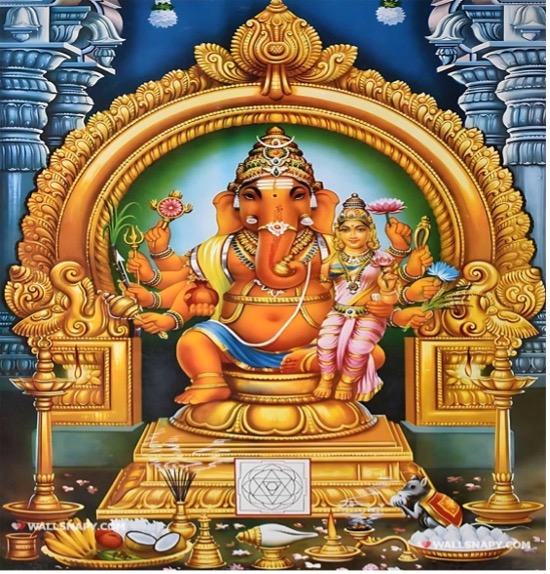
In representation of गणपति as वल्लभ गणपति, गणेश is shown with ten hands apart from a trunk (which is often seen as the eleventh hand). Each of the hands is to be seen as an expression of five मिथुन देवताs (or couples) – this is also referred to as श्रीविद्या गणपति. Each of these two hands needs to be seen as below:
| Right side hands | Left side hands |
| चक्र or wheel representing विष्णु | पद्म or Lotus representing लक्ष्मी |
| त्रिशूल representing शिव | पाश (coiled rope or open loop) representing पार्वती |
| Sugarcane representing मन्मथ (or कामदेव) | Black Lotus representing wife of कामदेव viz रति |
| गदा (mace) representing वल्लभ स्वामी | Bunch of Paddy representing भू-देवी (agriculture & fertility) |
| Pomegranate representing पुष्टि (nourishment and abundance) | Tusk (स्वदंत) representing पुष्टिपति (as remover of obstacles) |
Sometimes, the images also display a कलश (copper vessel with broad base and small top) – this कलश contains अमृत (nectar) and this is therefore signifying the outcome or final benefit of उपासना of गणपति viz मोक्ष प्राप्ति or ब्रह्मानन्द (highest bliss).
Put another way, the entire body of गणपति (together with hands) जगत् (or universe) while head of गणपति signifies परब्रह्म which is attainable once a साधक is in तुरीया अवस्था.
7.3 उच्छिष्ट गणपति
उच्छिष्ट is equivalent of झूटा in Hindi – whenever someone puts a food item into their mouth and then passes on the same food item to another, such a food item is उच्छिष्ट for the other – this is generally disallowed in Hindu traditions.
But why is गणेश referred to as उच्छिष्ट? गण also means अक्षर (alphabet) and thus गणपति means अक्षरपति. And why is गणेश अक्षरपति? This is because गणेश is a representation of ॐकार and as per Hinduism, the whole universe came out from ॐकार and even all अक्षर came from it only – therefore, गणेश is अक्षरपति. Now, we know that all the words come out from the mouth – once an expression of an idea comes from within one’s हृदय (or the mind), this then flows into the mouth where the tongue touches various parts of the mouth in rapid succession to generate various sounds which then uttered out. Therefore, since all words come out of the mouth, गणपति thus becomes उच्छिष्ट गणपति
7.4 Presence of a rat (मूषिक) below गणपति
If one imagines how the tongue is moving inside the mouth to utter a sound, the movement may be described as rat that is struck inside a hole and moving rapidly inside the mouth. This is one reason why a rat is shown as a वाहन (vehicle) of गणपति – this is because owing to the presence of गणपति, all words come together meaningfully and expressed out.
There is another idea – the word मूषकम् comes from मुश् धातु in संस्कृत – and this means thief. And we as individuals are expressed as a जीव is seen as a thief why so? Just as a rat steals objects from the house but no one knows where it goes or takes. जीव similar experiences based on the hidden desires and longings present within it. But once the जीव aligns with गणपति, गणपति subdues the longings of the जीव (rat is shown at the feet of गणपति) and one therefore lives a life of धर्म aligned to परमात्मा.
7.5 Other representations
गणपति is shown as नर्तन गणपति – in a dancing form. ध्यान of this गणपति gives आनन्द and ऐश्वर्य. गणपति is also expressed as हेरम्भ गणपति – हे represents those who are undergoing grief while रम्भ is protector and thus हेरम्भ गणपति is one who protects all the needy who are under grief.
There are many more – maybe sometime in future, गणपति gives an opportunity to talk about these too.
7.6 Various facets of गणपति विग्रह within our homes
When we enter the house and even go out of the house, गणपति must be visible. We therefore bow down to it before doing all our activities – this will ensure that all activities undertaken are met with success.
गणपति is often shown in red – why? As per वेद, the first colour is red (वर्णानाम् आद्यम् लोहितम्) just as सूर्य is deep red before rising, the red colour represents the first principle.
गणपति is expressed as one who grants क्षिप्र प्रसाद – meaning the प्रसाद (benefits) is granted very quickly to a भक्त. The ingredients used in the पूजा of गणपति are very easy – within भारत, the leaves offered to गणपति are present all around. And गणपति is most happy when offered दूर्व or grass (that literally grows anywhere and thus most easily accessible). As per the शास्त्रs, सूर्य energy is absorbed very well by grass and offering of दूर्व to गणपति enables protection of the भक्त from the forces/ influence that can take a भक्त away from परमात्मा.
A common sight among all गणपति विग्रहs is the presence of sweets (Laddu or Modaka). Given the near universal joy that people experience in consuming sweets, they are seen as symbol of पूर्णत्वम् (completeness) and आनंदम् (joy/ bliss). As परमात्मा, गणपति is आनन्द स्वरूप meaning the very स्वभाव of गणपति is आनन्द – पूजा to गणपति means we too can partake in the आनन्द that भगवान् will grant to us as भक्तs.
Another depiction of गणपति is to show Him having two wives – सिद्धि & बुद्धि. As will be evident to anyone with a basic knowledge of these words, सिद्धि means success and बुद्धि means wisdom/ intellect. Showing these as wives means that परमात्मा operates with two शक्तिs – success and wisdom. Further, they have two children – क्षेम and लाभ – and these mean welfare and gains. Simply put, doing पूजा and उपासना of गणपति will mean we गणेश will give us प्रसाद in the form of क्षेम and लाभ using the two शक्तिs aligned to Him viz सिद्धि & बुद्धि
8 Further meanings of the various words/ names associated with गणपति
For गणपति sound, गम् is the बीज (seed word) – it is said that all names beginning with गकार are liked by गणपति since that sound activates certain parts of the body as per योग. As per गुरुs, the word ग is indicative of ज्ञान while न is indicative of आनन्द (bliss).
Second, गण in संस्कृत signifies “counting” – and it is everything in प्रकृति (physical universe) that is amenable to the counted (or can be measured) and गणपति (as the पति or protector of प्रकृति) is the protector of all that which can be counted.
Third, some उपनिषद् refer to विघ्न as कालम् (time principle) since it is – since it is कालम् that sometimes gives us access to opportunities while at other times, it exposes us to difficulties. And गणपति is thus also understood as controller of the principle of time when the नाम of विघ्नेश्वर or विघ्ननायक is used.
Also विनायक is also understood as विशेष-नायक or विगत-नायक. नायक means leader or head. Thus, as विशेष-नायक, He is special and above all. विगत-नायक is understood as “without a head” which means that while all other aspects of the universe are headed by or protected by someone, गणपति has no one above Him – since He is the highest as परब्रह्म – and thus, the label of विगत-नायक.
Let us now take up the words – ग & ज. ग is a signifier of the direction people are going towards (यत्र गच्छन्ति -meaning where one is going to) – and we are moving in this प्रपञ्च which has a नाम and रूप. On the other hand, ज is the signifier of birth (जन्म or birth) or where one has come from. Thus, taken together गज signifies परमात्मा (or परब्रह्म) from where this universe has taken birth from together with प्रपञ्च. Interestingly, in संस्कृत, गज means elephant while जग means the physical universe.
One must note that there are other representations where the animal body is combined with a human body – the animal body shown as the head while rest of the human body as a human being itself. These are – हनुमान्, गरुड़, नरसिंह and हयग्रीव apart from गणपति. In all these cases, this is a representation of dualities present within the universe – heat & cold, light & darkness, water & fire, animals & man, etc. And each such representation is suggesting the coming together of these dualities (द्वन्द्व) or fusing these into one with the head signifying परब्रह्म or परमात्मा or पुरुष and the नर आकर signifying प्रपञ्च (or the physical universe). And just as head rules the body, परमात्मा runs the world but equally, परमात्मा is not part of the world but is very much a part of the world activity engaging in it.
Last, गणपति is also referred to as एकदन्त – which also means a single tooth. And there are many stories in the पुराण as to how this has come about. But this also signifies a तत्व (principle) of गणपति – एक means श्रेष्ठ (highest) and दन्त signifies बल (strength) and thus एकदन्त means one who is the strongest.
ॐ तत् सत्

